Internationalization of Zakah Management for Poverty Alleviation among Muslims in the 21st Century
- Kogi State College of Education
Journal of Business Management and Accounting 8(1) (2018) · https://doi.org/10.32890/jbma2018.8.1.8793
Abstract
Zakah has been a national affair among Muslim countries such that each country manages its own collection and distribution. However, there has been an effort to internationalize zakah management since 2009 when the idea of the World Zakat Fund was suggested by the Malaysian government. This is an important innovation as the Prophet (PBUH) emphasized that Muslims all over the world are one and brothers to one another. Since the idea started in 2009, the subject of internationalization of zakah management is yet to receive adequate scholarly research attention. The present study fills this gap by discussing internationalization of zakah management and its advantages in poverty alleviation among Muslims. The study also gave other suggestions for improving zakah management in view of the complexity and extensive nature of poverty among Muslims in the 21st century.
Keywords: Internationalization of zakah, zakah management, poverty alleviation
The Concept of Poverty in Islam
There is no one-size-fits-all definition of poverty. Different researchers have defined poverty in different ways. Hence, Poverty is a relative term (Korayem & Mashhour, 2014). How people perceive it varies from person to person (Akindola, 2009; Aisyah, 2014). Sirageldin (2000) classifies poverty into chronic and transitory poverty. Chronic poverty, he posits, refers to individuals who are in poverty and do not possess the means to get out of it for some reasons such as involuntary migration, environmental condition, health, social mobility or financial constraints (Iqbal, 2015). While transitory poverty could be as a result of a bad harvest, temporary loss of job, loss in business or intentional migration in search for greener pastures. In Islam, poverty is seen from the angle of needs, whether it is one who is in need of basic necessities, or the traveller who is stranded and needs assistance to continue the journey, or the debtor who is overwhelmed with debt and is in need of fund to clear these debts, or still, those whose property has been damaged by natural disasters (Korayem & Mashhour, 2014). Yusuf (1990) argued that contrary to conventional opinion, poverty in Islam is fixed. It is deprivation, a lack of being able to satisfy the basic necessities of life (Ahmed, 2004). Poverty in Islam is viewed from the inability to fulfil the five fundamental requirements of life (Aisyah, 2014). There are five foundations which according to Imam Al-Ghazali must be protected in Islam. They are: protection of life, religion, wealth, reason and progeny. Without these, the individual cannot exist. Protecting these foundations are considered to be the goals of shari’ah. For these to be ensured, it is paramount that the individual meets his basic needs of food, clothing and shelter among others, thus making it obligatory on the Muslim society to eradicate poverty by providing these needs (Ahmed, 2004). Man struggles to protect these foundations according to his needs. Imam Ghazali further indicated that human needs are in hierarchy, just as was demonstrated by Maslow (1943). Ghazali’s hierarchy of needs are divided into necessities, conveniences and refinements (Aisyah, 2014; Anas, 1980; Irfan, 1996). The necessities in Imam AlGhazali’s hierarchy, are the basic minimum things that every person should possess, and these ordinarily should be provided by the state (Yusuf, 1990). These make up the subsistence level. The next are the convenience needs which are not actually vital to preservation of the foundations but are needed to make life easier. These needs make up for the sufficiency level. Lastly are the refinement needs. They are those things that are just needed to adorn life. They make up for the luxuries of life (Anas, 1980; Irfan, 1996). From analogy of the hierarchy of needs of Imam Al-Ghazali, anyone living below the sufficiency level is said to be poor from the Islamic point of view (Korayem & Mashhour, 2014). For the purpose of this research, poverty was seen from the angle of not being able to provide for one’s basic needs, which is in tandem with the Islamic definition of poverty. Poverty and ways of reducing it has always been an integral part of the economic system of Islam right from the onset (Bonner, 2003; Chapra, 1985). History has it that the first generation of Muslims in Makkah were mostly the weak and down trodden (Bonner, 2005; Farooq, 2008; Watt 1961). This made it easy for the Makkans to persecute them until the command came for them to migrate to Madinah. In Madinah, the Muslims now referred to as the muhajirun (emigrants), were never in need of assistance as they were at that time. The prophet (PBUH) commanded the host community, the ansars (helpers), to assist their brothers in faith with whatever they possess, so much so that it was reported that some ansars divorced their wives and after the iddah period, gave them to their muhajirrun friends in marriage (Haykal, 1933; Washington, 1894; Watt 1956). Their acts of kindness and generosity was applauded in history and was worthy of being mentioned in the Qur’an: And those who, before them, had homes (in Al-Madinah) and had adopted faith, love those who emigrate to them, and have no jealousy in their breasts for that which they have been given (from the booty of Banu An-Nadir), and give them (emigrants) preference over themselves even though they were in need of that. And whosoever is saved from his own covetousness, such are the successful. (Qur’an 59:9). It was in this scenario that the institution of zakah was commanded in the second year of hijrah (Bonner, 2005; Mohammed, 2011). The prophet (PBUH) was commanded to “take from the rich and return to the poor”. In this way, the prophet (PBUH) ordered some of his sahabas to function as sa’i (zakah collectors), to collect zakah from the rich muslims and return same to the less privilged in the society. It was reported that sometimes, these zakah collectors would go to collect zakah and would return empty-handed, for they would have finished distributing all that was collected, before returning home. Such was the stand of Islam on poverty during the time of the prophet. In Islam, man is Allah’s vicegerent on earth and Allah has provided him everything in trust (Sahadat, 1997). In carrying out his day to day activities, he must not forget the trust placed on him (Khan & Sheikh, 2012). Islam as a religion encourages its adherents to work for their survival. It discourages laziness and dependence, while extolling hard work and diligence. On several occasion, the prophet (PBUH) has advised that the ummah pray against poverty and despondence, as poverty according to the prophet (PBUH) leads to kufr. This statement of his could stem from the fact that the poor are vulnerable to proselytization from missionaries of other faiths. It is also a fact that the first set of Muslims were mainly the poor people of Makkah (Farooq, 2008). Poverty is believed to lead to crime and sins (Al-Tayib, 2003). This side effects of poverty makes it compulsory for the society to fight poverty with all its might by creating an enabling environment for able citizens to earn their livelihood, through engaging in various jobs, and also making provisions for the disabled, minors, poor and needy, by distributing returns from economic activities equitably, in order that the wealth of the nation should not rotate among the wealthy only (Al-Tayib. 2003; Iqbal, 2015). These are the aims of zakah. 3.0
Overview of the Literature on Zakah and Poverty Reduction
It is generally agreed that one of the intent of zakah, in addition to purifying wealth, is the eradication of poverty, and it also helps the economy by increasing consumption level (Abu Bakar & Abd.Ghani, 2011; Akram & Afzal, 2014; Hashem & El-Sha’er, 2015; Lim, 2015; Shahatah, 1985). As its primary aim is the redistribution of wealth, zakah, when managed properly, can lead to poverty alleviation, as the rich will be encouraged to invest, thereby increasing productivity and employment (Abd.Wahab & Abdul Rahman, 2011). Zakah is perceived as a vital tool for the reduction of economic inequality, poverty elimination and provision of social security (Chapra, 1979; Khan, 2005). This can be deduced from the fact that five of the beneficiaries are linked to poverty situations (the poor, needy, debtors, slaves and travellers are all in one state of deprivation or the other). Zakah can serve as a source of revenue (Daud & Audu, 2011), it reduces poverty, increases investment and employment opportunities (Aliyu, 2002; Dogorawa, 2008; Khan, 1994). Hassan and Khan (2007) went as far as implying that zakah has the potential to increase government’s taxation potential. This is because, zakah has the ability of increasing employment, productivity and output. Redistribution of wealth as an economic function was stressed by Usher (1992). He asserted that altruism, insurance, deterrence of crime and preservation of the liberal societies are among the motives of redistribution. Altruism he argued, enables the wealthy individual have a genuine concern for the less privileged in the society. The altruist may either decide to give charity privately, in this case, it will be said that he derives utility function from his immediate surroundings, or give charity through the state, if he derives utility function from improving the welfare of the community. According to Usher, this will be a better choice as the funds donated to the state will be channelled to poverty alleviation schemes. The fear of uncertainties such as natural disasters, fire outbreaks or accidents makes people to insure their lives and property but there are some categories of risks that cannot be insured in a liberal state as asserted by Usher (1992). These risks fall under the chances of having poor parents, being retarded from birth. These conditions cannot be insured by private markets, and sufferers therefore look up to the public sector for help in such circumstances. Continuing with his arguments on the motives for redistribution, Usher (1992) contended that it is assumed that poverty has the potential of leading people to crime, while having average means of survival can eliminate such tendencies. He therefore argued that where wealth is not redistributed, the rich out of fear of crimes perpetuated by the poor, will invest a lot in taking measures to protect themselves and also spend fortunes in bringing criminals to justice. He therefore suggested that it will be of more benefit to the society if the wealthy channel these resources into redistribution and thereby reducing crime in the process. The above arguments are functional in the preservation of the society. These arguments of Usher (1992) are completely put into consideration in the zakah system. First, the Muslim’s utility function is most likely the concern for the poor and their welfare as a group and as such, going by Usher’s argument, he/she may prefer giving zakah to the state for the common good of man (Siddiqi, 1996). And on the issue of the category of risks that cannot be insured, the laws of zakah has already stated that individuals affected by such problems must be taken care of by the state. When this is done, the fear of crime will be eliminated and resources will be redirected to more productive avenues. All these are achievable in a functional zakah paying state because zakah is a social security for the poor. The institution of zakah eradicated poverty in earlier generation (Ahmed, 2004). It has been reported that zakah payers would go out with their zakah during the time of Umar ibn Khattab and Umar ibn Abdul Aziz, seeking who to give, but will return home with same, as nobody would collect due to adequacy (Farooq, 2008). There is a report of Umar ibn Khattab admonishing his governor, when the latter sent a third of the zakah from Yemen to him: “I have not sent you as a tax collector but rather to take from their rich and return to their poor” the governor was reported to have replied thus; “I would not have sent you anything, had I found somebody to take it from me”. A year later, the governor sent half of the zakah funds and then sent all of it in the third year (AlTayib, 2003). Also during the time of Umar ibn Abdul Aziz, one of his representatives to Africa reported that at a point, there was no one willing to receive the zakah. He therefore used the funds to buy slaves and thereafter freed them on the grounds that they become Muslims (Muhammad, 1988). Ahmed (2008) argued that poverty cannot be eradicated effectively without recourse to zakah. He posited that zakah should be accompanied by other robust macroeconomic policies. Such policies should be such that are capable of enhancing growth and redistributing income in a way to eradicate poverty. This view of seeking other means in addition to zakah has also been stated by Faridi (1983). In a similar vein, Shirazi (2014) puts the blame of mass poverty in some Muslim countries on their neglect of zakah, which as stated by him, was helpful to the earlier generations in the fight against poverty. His study concluded that while poverty can be totally eliminated in a good number of IDB member countries, through potential zakah collection, other countries with a very high percentage of resource shortfall may in addition to zakah, seek other means of eradicating poverty. Though the contemporary zakah system is fraught with some irregularities, significant impact has been recorded in places like Sudan, Egypt, Malaysia and Pakistan (AlTayib, 2003; Shirazi, 1995). Afif et al., (2013) revealed that entrepreneurial asnaf of the Lembaga Zakat Selangor have been able to liberate themselves from poverty, through engaging in small scale enterprises, with funds received as zakah. Similarly, as asserted by Benthall (1999), zakah funded programs in Nablus, West Bank have been able to redirect their funds, and reinvested in real estate and agriculture, and has in turn achieved the status of an employer of labour. Aside employing about 3,500 people, the committee of the program has also given grants to seven hundred and fifty people to pursue secondary and tertiary education. More acts of the philanthropy were also reported to be carried out by the committee without necessarily giving preference to people who they think or feel are more devout. There are various accounts of individuals who received zakah, to either start up or boost their business and after some years, they became zakah payers. A particularly interesting case is that of a former asnaf, as revealed by Nurul Husna, (2010), who now has over twenty employees and earns over RM10,000.00 as his monthly income. Several suggestions have been made on the need to use zakah funds for empowerment, such that artisans will be provided with money to purchase equipment or such equipment be bought by the zakah institutions directly and given to these artisans. By so doing, there will be an increase in employment opportunity and this in turn reduces poverty (Akram & Afzal, 2014). Another way poverty alleviation is possible through the zakah system is that it prevents hoarding of property (Maududi 1984; Sadeq, 1996). In a functional Islamic society, the individual who hoards wealth faces the risk of the wealth diminishing over time, without any financial benefit to him. This is because, year in, year out, he will be required to pay zakah from such wealth until such a time when the wealth will no longer be qualified for zakah, as it has gone below the nisab. On the contrary, when such money or wealth is put into proper usage by venturing into profitable businesses, it not only increases the individual’s wealth but also boost the nation’s economy and opens avenues for job creation (Akram & Afzal, 2014). Magda (2015) argued that zakah also has the potential of stopping riba. This is because the poor will not be forced to borrow from exploitative money vendors and at the macro level, there would be no need for the state to borrow money from wealthier countries to finance poverty alleviation scheme. Another area zakah will be of benefits is in the area of pension. That old pensioners who were former civil servants are suffering, is no longer news in countries like Nigeria. Getting pension has become difficult and sometimes the stress of getting it puts more strain on these pensioners that they end up having health issues. (Oyeranti & Olayiwola, 2005) seem to have captured the situation perfectly when they stated that the salaries of these people were even below the poverty line while in service, how much more their pension, which is usually seventy percent of their actual salary. They also stated that workers in the private sector, the disabled and other disadvantaged citizens are not included in pension schemes. Under zakah system, such person would ordinarily have nothing to worry about as they are adequately covered under the classification of the poor and needy. In a study conducted in Kano, one of the zakah paying states in Nigeria, it was concluded that zakah plays an important role in poverty alleviation, and income redistribution. It stated that zakah in Kano has done a lot through economic empowerment, Ramadan feeding and medical assistance to beneficiaries and the likes. The article claimed that millions of people have benefited from the scheme. However, it stated that zakah administration in the state is facing some challenges which, are as a result of the population of the state and large numbers of destitute (Wali, 2013). It should not be mistaken that Islam encourages laziness by specifying that the poor has a right in the wealth of the rich, rather it is to be seen from the light of brotherhood that is so much encouraged in Islam. Dependency on people is frowned at and everyone is encouraged to strive for his livelihood. The prophet (PBUH) has said that it is better for a man to go to the bush, cut wood and sell than for him to beg from others. Zakah only comes to assist when, even after one’s struggle, one is not able to meet up with the demands of daily living. Like all other situations the believer finds himself, poverty is also considered a test (Qur’an 2:155). So the zakah is supposed to be a kind of addition, a supplement to the poor to enable them have the basic requirements of life (Nik Mustapha, 1989). Whenever zakah was carried out in true spirit, it had always fulfilled its intent of making a better society through improving the living conditions of members of that society (Hossain, 2012; Nur Barizah & Abdul Rahim, 2007). Zakah has not been effective in combating poverty in some places due to the fact that its implementation has not been proper (Nur Barizah & Abdul Rahim, 2007), and no country has been able to enforce it in letter and in spirit (Maududi, 1984). It has been argued that when administered in true spirit, it will bring about comfort and satisfaction in the society within a short period of time (Maududi, 1984). 4.0
Findings and Discussion
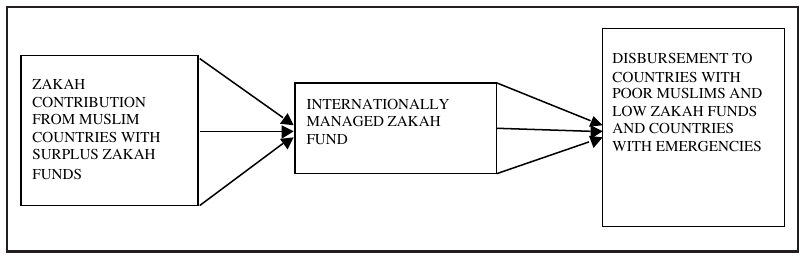
Poverty among Muslims is a global phenomenon. It is not restricted to a particular country or region. Hence any attempt to alleviate poverty should be approached from an international perspective. A key tool for poverty alleviation in Islam is zakah (Khan, 2005) hence there should be effort to make zakah management an international affair among Muslims. Internationalization of zakah management means there should be a body that manages zakah affairs globally. Such body should consist of members drawn from zakah management institutions from Muslim countries or other nominees as deemed appropriate. Zakah funds should be collected from countries with surplus in a particular year. The funds should be accumulated centrally and distributed to countries that have poor people in need of assistance and countries with emergency problems. The framework in Figure 1 describes internationalization of zakah management.
ZAKAH CONTRIBUTION FROM MUSLIM COUNTRIES WITH SURPLUS ZAKAH FUNDS
INTERNATIONALLY MANAGED ZAKAH FUND
DISBURSEMENT TO COUNTRIES WITH POOR MUSLIMS AND LOW ZAKAH FUNDS AND COUNTRIES WITH EMERGENCIES
Why is the suggestion for internationalization of zakah necessary and what difference can it make to current efforts aimed at poverty alleviation among Muslims globally? This is a crucial question this section of the current paper seeks to answer. Zakah management is currently being carried out by zakah institutions in individual countries, for example, BAZNAS in Indonesia, Islamic Religious Council in Brunei, the State Islamic Religious Councils (SIRC) in Malaysia and the Majlis Agama Islam Singapura (MUIS) in Singapore. What these bodies do is to mobilize zakah funds among Muslims within their national jurisdictions and distribute to the poor and needy Muslims. While the current model of zakah management may be adequate for the needs of individual
Muslim countries, it does not optimally serve the interest of the global Islamic community. For instance, some national zakah institutions have surplus fund in some years, for example, in Malaysia (Ram Al Jaffri, Norfaiezah & Rahayu, 2016). It should be noted that during such years, there are millions of Muslims experiencing serious hardships worldwide. Additionally, Muslim countries are not equally endowed in terms of natural resources and wealth. For instance, the Middle East countries such as UAE, Kuwait, Saudi Arabia, Qatar and others are wealthier than other Muslim countries like Chad, Mali etc. South East Asian countries such as Malaysia and Indonesia are richer than other Asian Muslim countries such as Bangladesh and Pakistan. The inequality of wealth and resourceendowment among Muslims countries is not a random or accidental occurrence. In the same manner, individuals are endowed with different level of material wealth, nations too have different levels of endowments. These are part of Allah’s (SWT) plan as shown in the Qur’an: It is We Who portion out between them their livelihood in this world, and We raised some of them above others in ranks, so that some may employ others in their work… (Qur’an 43: 32) From the above verse, it can be inferred that different levels of wealth among Muslim countries is part of Allah’s (SWT) plan to test mankind, whether they would be their brothers’ helpers, by way of the richer people or countries helping the poorer. Moreover, the need for internationalization of zakah management stems from the fact that there are numerous countries worldwide that are not classified as Muslim countries nor do they have Islamic governments. However, such countries consist of a substantial amount of Muslim population, for example, Ghana, Nigeria, India, Myanmar (currently facing the Rohingya crises) and others. The current focus of zakah on national collection and distribution puts the countries mentioned above at a disadvantage. Firstly, since Muslims in these countries do not live under Islamic governments, there are no government-backed institutions for collection and distribution of zakah (Adamu, Musa, & Rafidah, 2017). In these areas, individuals give zakah according to their own preferences and initiatives. This has been found to be ineffective by the study of Adamu et al., (2017). channeled to Muslim communities in countries that do not operate Islamic governments and where zakah is not a government priority. Unfortunately, most of the poor Muslims in the world live in such communities. From the discussion in this section, it is clear that internationalization of zakah could make the global fight against poverty more effective. There are some reasons to believe this argument. Firstly, poverty among Muslims is an international issue as it does not affect any countries in isolation. Hence, there is need to make the solution international as well. Additionally, Allah (SWT) and the blessed Prophet (PBUH) emphasized the oneness of the entire Muslim population in the world. The implication is that zakah management structures that emphasize only national poverty alleviation do not ideally represent the philosophy of Islam. Islam emphasizes collectivism and as such, the solution to global poverty among the Muslim population can be more effective if Muslims worldwide join efforts and work together. Secondly, combined zakah effort by Muslim countries would lead to economies of scale. This means combined zakah resources from numerous Islamic countries can have greater impact when applied to tackling the problem of poverty. Even during the time of the Prophet (PBUH), he always emphasized collectivism among Muslims in solving problems. Though Islamic countries and Muslim communities are numerous and scattered around the world, coordination of zakah effort would not constitute a major challenge. Ease of communication and 21st century information technology revolution has turned the world into a global village which will make it easy to coordinate zakah activities among Muslim countries worldwide. Thirdly, managing poverty through zakah with an international perspective could ensure that funds are channeled to areas of very urgent needs. For example, some Muslim communities affected by natural disasters like flood and drought could get priority attention. A crucial question that could arise on the issue of international zakah management is how it would affect existing national zakah authorities. The internationalization of zakah does not mean existing national zakah authorities should merge to form an international body. They should continue to operate within their own countries and at the same time contribute to the international zakah fund and international poverty alleviation initiatives. 5.0
Other Suggestions for Improving Zakah Management
Apart from internationalization of zakah collection and distribution, there is need for other innovations in zakah management to meet the challenges of poverty in Muslim communities across the world. As stated in the introductory section, poverty among contemporary Muslim communities is widespread and occurs in a complex form. This cannot be compared to the time of the Prophet (PBUH). The Modern Islamic world covers a very extensive area and cannot be compared to the time of the Prophet (PBUH) when Islam was at its founding stage. In view of the current realities, there is need for more innovations in zakah and poverty management. An issue that should be emphasized is sustainability of poverty alleviation with zakah funds. This means poverty alleviation with zakah funds should be made in such a way that recipients are able exit poverty and not to continue to depend on zakah forever.
There is wisdom in adopting poverty exiting strategy to manage zakah funds. A situation where poor Muslims depend on zakah fund to survive is not in line with the Prophet’s (PBUH) philosophy of poverty management. The following Hadith of the Prophet (PBUH) clearly discourage Muslims from being dependent on charity and encourage self-reliance: Abu Hurayra is reported to have heard the messenger of Allah (may peace be upon him) as saying: it is better for one among you to bring a load of firewood on his back and give charity out of it (and satisfy his own need) and be independent of people, than that he should beg from people whether they give him anything or refuse him (Sahih Muslim, no 2267). Lessons from the above hadith means managers of zakah funds must also do their best to discourage poor Muslims from continuously depending on zakah for survival. They can do this by implementing zakah policies that can take recipients out of poverty. Such policies could come in a variety of ways and researchers have suggested skills acquisition and education of the children of poor Muslims (Al-Omar, 1985; Rose, 2010; Wan Marhaini & Shamsiah, 2012). These have the potential of taking poor Muslims out of the poverty level after some time. Another way of improving zakah management to alleviate poverty is to ensure adequate collection. Currently, there are a lot of problems with zakah compliance across Muslim countries (Tajuddin, Azman & Shamsuddin, 2015). The implication is that adequate zakah funds are not mobilized to effectively address the problem of poverty. To improve zakah compliance by wealthy Muslims across the world, this paper suggests zakah payer engagement. This means a continuous follow up and dialogue with wealthy Muslims and continuous reminder about their zakah obligations. As stated in the Qur’an, human beings are forgetful (Qur’an 20:115), and should be constantly reminded of their religious obligations (Qur’an 51:55). In addition to raising more zakah funds through continuous engagement with wealthy Muslims, zakah authorities need to look beyond the statutory zakah payment from wealthy Muslims. While zakah is a compulsory religious obligation, wealthy Muslims should also be persuaded to spend more than the statutory threshold in order to effectively alleviate poverty. An international zakah organization as advocated in this study can also partner with charity organizations worldwide to source for additional funds that could complement whatever is available from zakah contribution.
6.0Conclusion
The paper advocates for internationalization of zakah management and poverty alleviation among Muslim communities around the world. The idea of internationalization of zakah was put forward by the Malaysian government in 2009 (Abdul Ghafour, 2009) but it is yet to receive academic research attention. This paper attempts to fill the gap by discussing poverty reduction programs among Muslims. The paper argues that internationalization of zakah management could lead to more effective poverty alleviation by ensuring that zakah funds are mobilized from multiple countries. International management of zakah funds will lead to interventions in Muslim communities in countries that are not under Islamic governments. As pointed out in the study, internationalization should not affect existing national collection and distribution of zakah. Rather, existing national authorities can support the international body while they still focus on their own countries. The policy of internationalization is in line with collectivism and consultation among Muslims as advocated by the Prophet (PBUH). The population of the Muslim ummah in the world continue to increase and they are scattered in many Muslim countries across the world. Additionally, there are millions of Muslims living in countries that are not governed by Islamic laws and do not have official zakah management institutions. Such Muslim communities can be reached by the international zakah fund. As discussed and argued in this paper, internationalization of zakah management and innovative policies are means through which poverty can be drastically reduced among Muslims in the 21st century.
References
- Abu Bakar, M. H., & Abd. Ghani, A. H. (2011). Towards achieving the quality of life in the management of zakat distribution to the rightful recipients (the poor and needy). International Journal of Business and Social Sciences, 2(4), 237-245.
- Abd.Wahab, N., & Abdul Rahman, A. (2011). A framework to analyse the efficiency and governance of zakat institutions. Journal of Islamic Accounting and Business Research, 2(1), 43-62.
- Abdul Ghafour, P. K. (2009). Global zakah fund. Arab News, retrieved from www. arannews.com/node/327093
- Adamu, U., Musa, Y. O., & Rafidah, M. C. (2017). Determinants of zakat compliance behavior among Muslims living under non-Islamic governments. International Journal of Zakat, 2(1), 95-108.
- Ahmed, H. (2004). Roles of zakah and waqf in poverty alleviation. Jeddah: Islamic Research and Training Institute, Islamic Development Bank.
- Ahmed, H. (2008). Zakah, macroeconomic policies and poverty alleviation: Lessons from simulation on Bangladesh. Journal of Islamic Economics, Banking and Finance, 4(2), 81-103.
- Aisyah, M. (2014). The role of zakah and binary economics in poverty reduction. Jurnal Bisnis dan Manajemen, 4(2), 178-197.
- Akindola, R. B. (2009). Towards a definition of poverty: Poor people’s perspectives and implications for poverty reduction. Journal of Developing Societies, 25(2), 121-150.
- Akram, M. M. & Afzal, M. (2014). Dynamic role of zakat in alleviating poverty: A case study of Pakistan. Munich Personal RePEc Archive. Paper no 56211.
- Al-Hilali, M. T., & Khan, M. M. (n.d.). The noble Qur’an. English translation of the meanings and commentary. Madinah: King Fahd Complex for the Printing of the Holy Qur’an.
- Al-Tayib, Z. A. (2003). The disbursement of zakah. In Alvi, S., & Al-Roubaie, A. (Eds.). (2014). Islamic Economics, IV. New York: Routledge.
- Al-Omar, F. A. (1985). Management of zakah through semi-government institutions. In I.A. Imtiazi, M.A. Mannan, M.A. Niaz & A.H. Deira (Eds.). (2000). Management of zakah in modern Muslim society (2nd Ed). Jeddah: Islamic Development Bank. 131-156.
- Anas, Z. (1980). Islamic economies: An approach to human welfare. In A. Khurshid (Ed.) Studies in Islamic Economics. Jeddah: International Centre for Research in Islamic Economics. UK: The Islamic Foundation.
- Benthall (1999). Financial worship: The Qur’anic injunction to almsgiving. The Journal of the Royal Anthropological Institute, 5(1) 27-42.
- Bonner, M. (2003). Poverty and Charity in the rise of Islam. In Poverty and Charity in Middle Eastern Contexts. (pp. 13-30). State University of New York Press.
- Bonner, M. (2005). Poverty and economics in the Qur’an. The Journal of Interdisciplinary History, 35(3), 391-406.
- Chapra, M. U. (1979). The Islamic welfare state and its role in the economy. Leicester, UK; The Islamic Foundation.
- Chapra, M. U. (1985). Towards a just monetary system. Leicester: The Islamic Foundation.
- Daud, M., & Audu, M. A. (2011). The economic significance of the zakah system: An exploratory analysis of its fiscal characteristics. Elixir Finance Management, 36, 3085-3090.
- Dogorawa, A. B. (2008). Achieving equitable wealth distribution: Exposing the role of zakah as a redistributive agent. Al-Ijtihad: The Journal of Islamization of Knowledge and Contemporary Issues, 7(1), 1-29.
- Faridi, F. R. (1983). Theory of fiscal policy in an Islamic State. Journal of Research in Islamic Economics, 1(1), 15-30.
- Farooq, M. O. (2008). The challenge of poverty and the poverty of Islamic economies. Journal of Islamic Economics, Banking and Finance, 4(2), 35-58.
- Hashem, E. A., & El-Sha ‟er, S. (2015). Can zakat help to enhance financial inclusion? Case study Egypt. International Journal of Education and Research, 3(3), 413-432.
- Haykal, M. H. (1933). The life of Muhammad. (I.R. Al-Faruqi, Trans.). Philadelphia: Temple University.
- Hassan, M. K., & Khan, M. (2007). Zakat, external debt and poverty eradication strategy in Bangladesh. Journal of Economic Cooperation, 28(4), 1-38.
- Hossain, M. Z. (2012). Zakat in Islam: A powerful poverty alleviating instrument for Islamic countries. International Journal of Economic Development Research and Investment, 3(1), 1-11.
- Irfan, U. (1996). Economic doctrines of Islam. U.S.A: International Institute of Islamic Thought.
- Iqbal, M. M. (2015). Inclusive growth with zakat. Paper submitted to the 30th Annual General Meeting and Conference of the Pakistan Society for Development Economics.
- Khan, M. A. (1994). An introduction to Islamic economics. Washington D.C: International Institute of Islamic Thought.
- Khan, F. (2005). Integrating faith-based institutions (zakah and awqaf) in poverty reduction strategies.
- Khan, M. B., & Sheikh, N. N. (2012). Human resource development, motivation and Islam. Journal of Management Development, 31(10), 1021-1034.
- Korayem, K., & Mashhour, N. (2014). Poverty in secular and Islamic economics: conceptualization and poverty alleviation policy, with reference to Egypt. Topics in Middle Eastern and African Economies, 16(1), 1-16.
- Lim, H. (2015). Zakat and social protection: The relationship between socio-religious CSOs and the government in Indonesia. Journal of Civil Society, 11(1), 79-99.
- Maslow, A. H. (1943). A Theory of Human Motivation. Psychological Review, 50(4), 370-96.
- Magda, I. A. M. (2015). Potential of zakat in eliminating riba and eradicating poverty in Muslim countries (case study: Salary deduction scheme of Malaysia. International Journal of Islamic Management and Business, 1(1), 40-63.
- Maududi, S. A. (1984). Economic system of Islam. (K.Ahmad ed.). Lahore, Pakistan: Islamic Publications Ltd.
- Mohammed, B. Y. (2011). Zakat expenditure, school enrolment, and economic growth in Malaysia. International Journal of Business and Social Science, 2(6), 175-181.
- Muhammad, Q. I. (1988). Al siyaasah al-maaliyyah li Umar ibn Abdal Aziz. Cairo: Al-Hay’ah al-Misriyyah al-Aammah lilkitab.
- Nik Mustapha, N. H. (1989). Zakat in Malaysia-present and future status. Journal of Islamic Economics, 1(1), 47-75.
- Nur Barizah, A., & Abdul Rahim, A. (2007). A comparative study of zakah and modern taxation. In Alvi, S., & Al-Roubaie, A. (Eds.). (2014). Islamic Economics III. New York: Routledge.
- Nurul Husna, H., Hazlina, H., Nur Syuhada, J., & Rashidah A. (2010). Zakat for asnafs’ business by Lembaga Zakat Selangor. Malaysian Accounting Review, Special Issue, 9(2), 123-138.
- Oyeranti, O., & Olayiwola, K. (2005). Policies and programs for poverty reduction in rural Nigeria. An interim report submitted to the African Economic Research Consortium (AERC), Nairobi.
- Raimi, L., Patel, A., & Adelopo, I. (2014). Corporate social responsibility, waqf system and zakat system as faith-based model for poverty reduction. World Journal of Entrepreneurship, Management and Sustainable Development, 10(3), 228-242.
- Ram Al Jaffri, S, Norfaiezah, S. & Rahayu, M. (2016). Zakat durplus funds management. International Journal of Economics and Financial Issues, 6(S7), 171–176.
- Rose, A. (2010). Zakat management in Brunei Darussalam: A case study. In the proceedings of the seventh international conference. The Tawhidi epistemology: Zakat and waqf economy, Bangi. 375-407.
- Sadeq, A. H. M. (1996). Ethico-economic institution of zakah: An instrument of self-reliance and sustainable grass root development. Humanomics, 12(2), 47-69.
- Sahadat, J. (1997). Islamic education: A challenge to conscience. The American Journal of Islamic Sciences, 14(4), 19-34.
- Shahatah, S. I. (1985). Limitations on the use of zakah funds in financing the socio-economic infrastructure of society. In (I. A. Imtiazi, M. A. Mannan, M. A. Niaz and A. H Deria (Eds.) (2000). Management of zakah in modern Muslim society. Jeddah: Islamic Development Bank, 57-73.
- Shirazi, N. S. (1995). The impact of zakat and ushr: Some empirical findings for Pakistan. In M. H. Sahibzadah (ed.). Poverty Alleviation in Pakistan.
- Shirazi, N. S. (2014). Integrating zakat and waqf into the poverty reduction strategy of the IDB member countries. Islamic Economic Studies, 22(1), 79-108.
- Siddiqi, N. (1996). Role of the state in the economy: An Islamic perspective. Leicester, UK: The Islamic Foundation.
- Sirageldin, I. (2000). Elimination of poverty: Challenges and Islamic strategies. Islamic Economic Studies, 8(1), 1-16.
- Tajuddin, S. T., Azman, S. A., & Shamsuddin. (2015). Compliance behavior of zakat on income among Muslim youth in Klang Valley. In proceeding of the international conference on social research. Kuala Lumpur, Malaysia.
- Usher, D. (1992). The welfare economics of markets, voting and predation. Manchester, UK: Manchester University Press.
- Wali, H. N. (2013). Utilization of zakat and Islamic endowment funds for poverty reduction: A case study of Zakat and Hubshi commission, Kano State-Nigeria. Journal of Economics and Sustainable Development, 4(18), 141-148.
- Wan Marhaini, W. A., & Shamsiah, M. (2012). Classical jurists’ view on the allocation of zakat: Is zakat investment allowed? Middle-East Journal of Scientific Research, 12(2), 195-203.
- Washington, I. (1849). Mahomet and his successors. London: The Co-operative Publication Society.
- Watt, W. M. (1956). Muhammad at Medina. London: Oxford University Press.
- Watt, W. M. (1961). Muhammad: Prophet and statesman. London: Oxford University Press.
- World Bank. (2013). The world bank group goals: End extreme poverty and promote shared prosperity. Washington DC: World Bank.
- Yusuf S. M. (1990). The consumption and distribution of wealth. Economic justice in Islam. Islamabad: Dawah Academy 55-70.