Total Quality Management: Perspective of Saudi Healthcare Organizations
- School of Business Management, College of Business, Universiti Utara Malaysia, Sintok, Kedah
Journal of Business Management and Accounting 9(1) (2019) · https://doi.org/10.32890/jbma2019.9.1.8769
Abstract
Total Quality Management is essential in the healthcare sector. Delivering good healthcare services is one of the main issues among healthcare organizations. Healthcare customers are satisfied with healthcare providers when their services meet the level of their expectations. Satisfying healthcare customers (both public and private) can be attained through Total Quality Management. This paper highlights the importance of using Total Quality Management in healthcare organizations in the Kingdom of Saudi Arabia (KSA). A review of the implementation of TQM among Saudi healthcare organizations highlighted the challenges faced in the sector. The sustained efforts in improving the service quality in Saudi healthcare have led to remarkable results. However, there are more challenges regarding the quality of services. This paper is helpful for strategic planners, policy makers, and management in the KSA healthcare sector and in other jurisdictions.
Keywords: Healthcare, TQM, Saudi Arabia, review
1.0Introduction
The healthcare sector is constantly striving all over the world to provide high quality and innovative services to customers (Jacobs, et al., 2013). In healthcare services, the level of satisfaction is measured through quality that meets the customers’ expectations. There are many elements considered as significant for healthcare service in order to be successful in terms of quality level, for instance, organizational structure (Bass & Avolio, 1999). The healthcare sector is challenged by the fast increasing cost of technology and equipment. In addition, customers have become demanding when it comes to receiving high quality services (Jacobs, et al., 2013). Therefore, healthcare * E-mail: alotaibi_ghanem@oyagsb.uum.edu.my providers can no longer make do with providing free or low cost services. This challenge is typically faced by healthcare organizations in KSA.
The healthcare sector in KSA consist of three units: first, Ministry of Health (MOH) hospitals, second, military hospitals and lastly, private hospitals (MOH, 2016). MOH hospitals constitute about 58% of the total hospitals in KSA. The hospitals deliver healthcare services for KSA residents and their dependents.
The healthcare sector in KSA is significantly growing and increasing. The government stated that the investment in infrastructure for healthcare service is heavily supported by all KSA cites (Almalki, Fitzgerald, & Clark, 2011). The portion of budget allocated to the healthcare sector has increased up to 7% in 2013. The percentage of Saudi professionals who are employed in the healthcare organizations has also increased to almost 61% of all manpower that are employed in healthcare sector in 2013. In addition, the total number of Saudi professionals increased to 106,387 in 2013 – a significant increase when compared to the total number of non-Saudi professionals who are employed in healthcare organizations in the year 2013 (i.e., 68,494) (MOH , 2013).
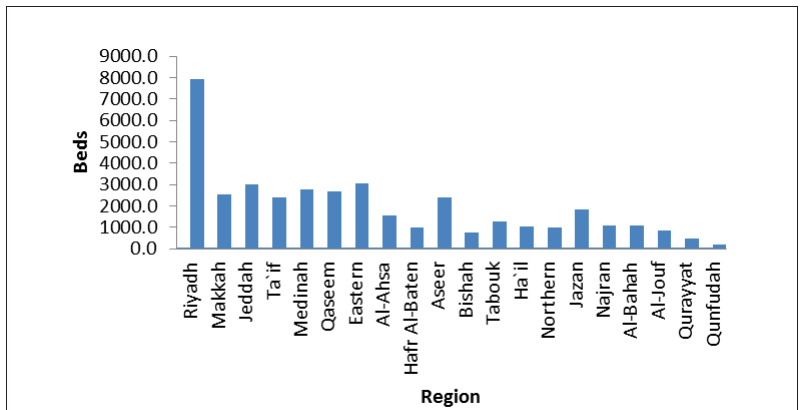
The total number of KSA population is almost thirty million (30,000,000). Riyadh city and its region present the highest number at 7,516,959 and the highest hospitals allocated number of beds of around 7,937 beds. Riyadh is followed by Jeddah city and its region, then Mekkah city and its region. These three areas together present about 45.6% of the total number of population (13,679,738). The three areas consume 13,452 of the hospitals allocated beds, which is 34.5% of the total number of the beds (Ministry of Health’s Statistics Annual Book, 2013). Figure 1 shows the distribution.
2.0TQM in Healthcare
Successful healthcare system often includes holistic services, such as curative, preventive and rehabilitative services. This is mentioned in MOH’s Mission Statement which states: “it is for the benefit of patients and their families, as well as the community”. In order to achieve the proper implementation, healthcare sector can develop and improve awareness of health, and ensure uprightness of the distribution of services in the different areas. In addition, the work can be made by increasing skills of the employees, training them and increasing their efficacy. Enhancing employees’ skills will improve their commitment and will elicit the required behavior and atmosphere in the healthcare organization workplaces (Mosadeghrad, 2013).
2.1Quality definition in healthcare services
There has been an increasing focus on the issues of quality service in healthcare organizations over the years (Alotaibi, Mokhtar, Taib & Yusoff, 2015) despite the fact that defining quality in services is ambiguous, especially when applied to healthcare. Defining quality in service is difficult because of the participation of people in creating and delivering healthcare services (Rocha et al., 2013; Mustafa & Bon, 2015). Individual’s awareness varies and is sometimes contradictory. For example, patients place more importance on health improvement with less cost.
There are many reasons behind the need to provide a complete definition of quality service in healthcare. Lack of clarity was explained as the essential issue that would characterize quality in the healthcare organizations (Sewell, 1997). Individuals’ expectations determine the specific perspective of quality in healthcare, and therefore a clear and complete definition of quality service in healthcare is still elusive. In addition, what complicates defining quality in healthcare services is that healthcare organizations operate at different levels of communities, as values and expectations could significantly vary. Communities that desire to connect with healthcare organizations are the nurses and doctors, patients, pharmacists, as well as the administrators. Therefore, in order to define quality service in healthcare, focus should be placed on individuals’ preferences, so that their expectations and needs can be surveyed and satisfied thoroughly.
According to Zabada, Rivers, and Munchus (1998), when individual’s expectations are satisfied in terms of the results of healthcare services, quality service would be achieved. However, this conclusion appears to consider that individuals have an overall awareness of the results at the early stages of their cure, which justifies the use of individuals’ expectation in measuring quality in healthcare.
The difficulty in defining quality has an impact on measuring quality in healthcare service. Measuring quality of services in healthcare is defined by Deming (2000) based on the view of how quality could relate to explicit and specific types of problems. Examples of the critical issues are; providing comfort medical care to the customer, age and gender of customers, and laboratories and facilities to be used.
3.0Perspectives of Using TQM in Healthcare in KSA
There has been a need for doing more research regarding the evaluation of TQM implementation in the healthcare organizations in KSA. According to Al-Qahtani and Ibn-Methheb (1999), TQM has been implemented in the Saudi public sector, including healthcare organizations such as hospitals. They tried to evaluate the understanding of TQM system in public sector in KSA. They showed how TQM is observed and implemented as a managerial model and applied factors of TQM to the public sector. These earlier findings claimed that solutions to some difficulties could prevent the successful application of TQM.
Al-Qahtani and Al-Methheb (1999) explained that the MOH promotes TQM in the healthcare. However, they reached the conclusion that although TQM was used and adopted since 1990 by the MOH, the outcomes and results are still below expectation. The MOH had initiated TQM system and standards to be suitable with the culture and the structure of the organizations in the public sector, including healthcare.
The MOH has organized various TQM training for both Saudi and non-Saudi employees in healthcare organizations with specific focus on middle management. Although it was claimed that top management was committed to the TQM training programs, their awareness of the TQM practices and concept was relatively less. The implementation of TQM in healthcare had some deficiency and weaknesses. Therefore, TQM implementation needs to be more effective to bring about expected outcomes. TQM should influence performance, organizational outcomes, innovation performance in the KSA healthcare (Alotaibi et al., 2015; Mustafa & Bon, 2013).
4.0Conclusion
This paper reviewed the importance of TQM in healthcare organizations. The review involved KSA healthcare sector. The KSA government has initiated plans to increase the quality of services of healthcare organizations. Healthcare services providers in KSA are of three types: MOH hospitals, military hospitals, and private hospitals. The plans have been implemented starting from earlier 1990s and have continued up to date. Through the decades, the outcomes of implementing TQM were remarkable and produced many developments. However, findings in the literature showed there is a need for more effective TQM as emerging growth of technology, extensive competition, and increased customers’ expectations have created more challenges and highlight the need for more effective TQM outcomes.
References
- Al-Qahtani, S., & IBN-Methheb, M. (1999). Implementation of total quality management in some Saudi public sector organizations. Economics and Administration, 13(2). -93 Total Quality Management: Perspective of Saudi Healthcare Organizations: 89-93 93 Almalki, M., Fitzgerald, G., & Clark, M. (2011). Health care system in KSA: An overview. Eastern Mediterranean Health Journal, 17(10).
- Alotaibi, G., Mokhtar, S., Taib, C., & Yusoff, R. (2015). The influence of organizational culture and leadership behavior on innovation performance. International Journal of Business Research, 15(5), 47–56.
- Bass, B., & Avolio, B. (1999). Training full range leadership: A resource guide for training with the MLQ. Mind Garden: Palo Alto, CA.
- Jacobs, R., Mannion, R., Davies, H. T. O., Harrison, S., Konteh, F., & Walshe, K. (2013). The relationship between organizational culture and performance in acute hospitals. Social Science & Medicine (1982), 76(1), 115–25. http://doi.org/10.1016/j.socscimed.2012.10.014
- MOH, M. of H. S. A. (2016). Health Statistic Anual Book.
- Mosadeghrad, A. M. (2013). Obstacles to TQM success in health care systems obstacles to TQM success in health care systems. International Journal of Health Care Quality Assurance, 26(2), 147–173. http://doi.org/10.1108/09526861311297352
- Mustafa, M. A., & Bon, A. T. (2015). Impact of total quality management practices on innovation in service organizations. Universiti Tun Hussein Onn Malaysia.
- Rocha, A., Martins, A., Freire, J. C., Kamel Boulos, M. N., Vicente, M. E., Feld, R., Rodríguez-Molinero, A. (2013). Innovations in health care services: The CAALYX system. International Journal of Medical Informatics, 82(11), 1–14. http://doi.org/10.1016/j.ijmedinf.2011.03.003
- Rocha, F., Marziale, M., Carvalho, M., Id, S., & Campos, M. (2014). The organizational culture of a Brazilian public hospital. Rev Esc Enferm USP, 48(2), 303–9. http://doi.org/10.1590/S0080-623420140000200016
- Sewell, N. (1997). Continuous quality improvement in acute health care: Creating a holistic and integrated approach. International Journal of Health Care Quality Assurance, 10(1), 20–26.
- Zabada, C., Rivers, P. A., & Munchus, G. (1998). Obstacles to the application of total quality management in health-care organizations. Total Quality Management, 9(1), 57–66.