Influence of Green Supply Chain Management Practices on Operational Performance: An Empirical Study amongst Pakistani Textile Manufacturers
- Othman Yeop Abdullah Graduate School of Business, Universiti Utara Malaysia
- Barani Institute of Sciences
Journal of Business Management and Accounting 9(1) (2019) · https://doi.org/10.32890/jbma2019.9.1.8767
Abstract
The purpose of the present research is to investigate the influence of green supply chain management practices on the operational performance of the textile manufacturing industry in Pakistan. The study analyzed three main determinants of green supply chain management practices, i.e., green purchasing, eco-design and environmental cooperation with customers. The study utilized a sample of 152 textile manufacturing organizations. The data was collected through survey method using a reliable and valid questionnaire. Statistical analysis was performed using the Partial Least Square Structural Equation Modelling technique with the aid of Smart PLS software version 3.0. Multiple regression analysis was employed for hypotheses testing. Empirical findings reveal a strong influence of green practices: eco-design and environmental cooperation with customers on increased operational performance of textile manufacturing organizations.
Keywords: Green supply chain management, green purchasing, eco-design, operational performance, textile manufacturing industry
1.0Introduction
Environmental challenges such as pollution, rapid depletion of natural resources, global warming disturb the ecological balance. The increase in ecological issues affect governments, societies, organizations and individuals making them to take preventive measures against environmental problems (Yildiz Çankaya & Sezen, 2019). Manufacturing organizations are considered as a primary source of environmental problems. Governments and communities are pressurizing them to review their production and supply chain processes. Strategic alignment of supply chain management * E-mail: atifgill@hotmail.com is necessary for manufacturing organizations to achieve environmental performance (S. A. R. Khan & Qianli, 2017). All business processes need to be synchronized and coordinated with each other such as purchasing, warehousing, manufacturing, marketing and sales to obtain better operational efficiency. Strategic imperatives that need to be aligned at the organizational level include efficient processes, quality improvement, customer orientation, green practices and environmental safety initiatives (Green Jr, Zelbst, Meacham, & Bhadauria, 2012a). From the recent decade, the integration of environmental concerns with supply chain management to enhance operational performance has received substantial attention. Yildiz, Çankayaand and Sezen (2019) explained the green supply chain as a combination of green procurement, environmental circulation, reverse logistic, marketing and environmental management. Customers are also demanding organizations to implement green supply chain management (GSCM) practices to save the environment from hazardous effects of pollution, reducing the depletion rate of natural resources and minimizing energy consumption. Other factors that compel organizations to implement GSCM practices include change in weather, increase in temperature, natural resources exhaustion and pollution (Younis, Sundarakani, & Vel, 2016).
Firms are considering green supply chain management as a useful source to enhance the performance of business operations (Zhu & Sarkis, 2004; Zhu, Sarkis, & Lai, 2012). Especially in manufacturing organizations, implementation of green supply chain practices has caused significant improvements in operations (Green Jr, Zelbst, Meacham, et al., 2012a; Zhu et al., 2012). Past studies reported the impact of green supply chain management practices on economic performance (Geng, Mansouri, & Aktas, 2017; Gotschol, De Giovanni, & Vinzi, 2014; Green Jr, Zelbst, Bhadauria, & Meacham, 2012; Laari, Töyli, Solakivi, & Ojala, 2016). However, there is limited literature discussing the influence of GSCM practices on the operational performance of manufacturing industry (Vanalle, Ganga, Godinho Filho, & Lucato, 2017a; Wu, Ding, & Chen, 2012).
The manufacturing industry plays a significant role in the economy of a country. Developed countries are transforming their manufacturing industries with green technology to handle environmental issues. United States, China, Japan, Germany are some of the most industrialized countries and they are coping the environmental challenges by converting their polluting production methods into sustainable green procedures (Zhu, Geng, Fujita, & Hashimoto, 2010). While developing countries such as Pakistan struggle to implement green initiatives in their manufacturing industry to resolve the environmental degradation problems (S. A. R. Khan & Qianli, 2017).
Many manufacturing organizations prioritize environmental objectives in their key agenda due to socio-political pressure and to get a competitive advantage (Teixeira, Jabbour, de Sousa Jabbour, Latan, & De Oliveira, 2016). They took initiatives to implement GSCM practices such as sustainable sourcing, eco-design and re- -72 Influence of Green Supply Chain Management Practices on Operational Performance: An Empirical Study amongst Pakistani 57 manufacturing (Vanalle, Ganga, Godinho Filho, & Lucato, 2017b). There are various external and internal GSCM practices, as reported in the literature (see Table 1). More and more organizations are considering the integrated set of GSCM including both external and internal practices. The theoretical foundation of the present study is based on the complementary theory presented by Milgrom and Roberts (1995). The collective GSCM practices include external and internal practices such as green purchasing, eco- design and environmental cooperation with customers. When different GSCM practices are integrated, it shows greater impact on the operational efficiency of the organization (Al-Sheyadi, Muyldermans, & Kauppi, 2019). Previous GSCM studies have focused on the U.S. (Green Jr, Zelbst, Bhadauria, et al., 2012; Green Jr, Zelbst, Meacham, et al., 2012a), other Western contexts (e.g., Wales, U.K. in Sarkis and Dijkshoorn, 2007; Europe, in Aigbedo, 2019) and China (Li, 2014; Zhu, Sarkis, & Lai, 2008). Developing countries have not received much attention in the operations and environmental management literature (Al-Sheyadi et al., 2019).
Pakistan is a developing economy and the manufacturing industry plays a vital role in the economy of the country. Textile is the leading manufacturing industry in Pakistan (A. A. Khan & Khan, 2010a). However, from the last few years, Pakistani textile manufacturing industry has not performed well as compared to neighbouring countries like China, India and Bangladesh (Ortolano, Sanchez-Triana, Afzal, Ali, & Rebellón, 2014). The major issues include the obsolete production methods which consume excessive energy, increase the amount of waste, emission of hazardous elements in the environment, not cooperating with clients for cleaner-production and not synchronizing with suppliers to promote green purchasing (Ortolano et al., 2014). This all leads to the inability to deliver products on time, making inventory keeping cost high due to the inefficient supply chain. Hence, the primary objective of the present study is to examine the influence of GSCM practices on the operational performance of the Pakistani textile manufacturing industry. The current study is guided by the research question stated below:
Do GSCM practices (green purchasing, eco-design, environmental cooperation) influence the operational performance of Pakistani textile manufacturing organizations?
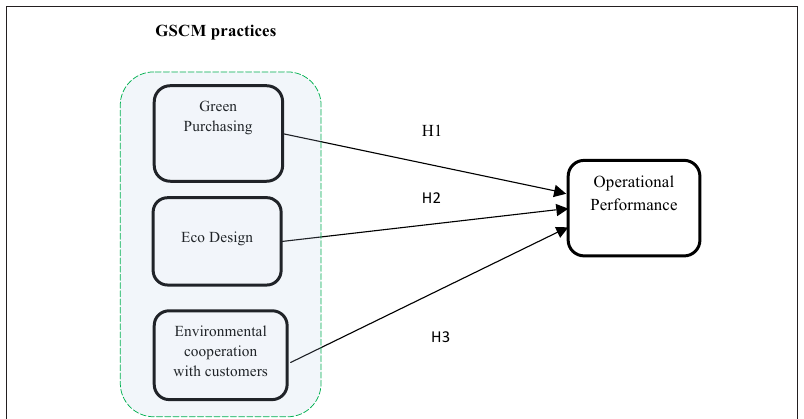
The motivation behind the present study is that routine based GSCM practices are not sufficient to achieve environmental and operational impact. The integration of external and internal environmental practices based on complimentary theory may lead to optimum operational performance (Al-Sheyadi et al., 2019). The present study’s findings can enable Pakistani textile manufacturing industry to improve the operational performance. Our paper is organized as follows. In Section 2, we present the literature in support of the research hypotheses, which we use to conceptualize the constructs and model (Fig. 2). Section 3 discusses the methodology containing survey and data analysis approach. The results of hypotheses tests are presented in Section 4 and discussed in Section 5, along with implications. Limitations and suggestions for future research follow in Section 6.
2.0Literature Review and Hypotheses
2.1Textile Manufacturing Industry
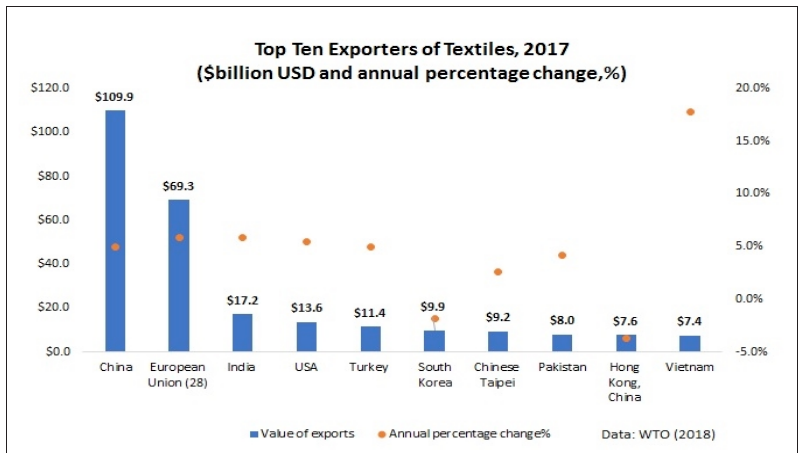
Report by the World Trade Organization (2018) state that textile manufacturing industry had shown growth with the rise of exports by 4.2% from 2.8% in the earlier year. China, the European Union and India emerged as the top three in the textile industry. While Pakistan stood at eight position (see Figure 1). In Pakistan, The textile industry is considered as the backbone of the economy and contribute more than 8% of the GDP (S. A. R. Khan & Qianli, 2017). Pakistan is the 4th largest producer of cotton with third largest spinning capacity in Asia. Spinning is one of the largest textile production units in Pakistan. The major reason for the declining growth in the textile industry in Pakistan is lack of research and development for cleaner production and inefficient supply ! chain management (A. A. Khan & Khan, 2010). ! !
2.2Green
GSCMSupply Chain Management practices
GSCM can generally be defined as the “practice of improving environmental performance along the supply chain, including product design, operations management, Green and customerPurchasing relationships”(Jia & Wang, 2019). GSCM is a management model that integrates the resources of the efficient supplyH1chain with environmental concerns to obtain operational and environmental benefits. GSCM enable sustainable practices Operational #$! Performance Eco Design
              Environmental                              #%!
-72   Influence of Green Supply Chain Management Practices on Operational Performance: An Empirical Study amongst Pakistani   59
in supply chain firms to promote environmental awareness and optimize operational efficiency (Sarkis, 2012).
2.3GSCM Practices
Due to an increase in global awareness of environmental protection, organizations have implemented GSCM to obtain a competitive advantage. Supply chain members are taking certain environmental initiatives by sharing information through network-based relationships. These GSCM initiatives involve source management, reverse logistics and integration of supply chain, which are also known as GSCM practices (Zhu & Sarkis, 2007). GSCM practices allow supply chain members to protect the environment and efficient integration through the closed loop and cross-organizational activities (Zhu et al., 2012). Several GSCM practices have been reported in the literature (see
| Study | GSCM practices |
|---|---|
| (Wu et al., 2012) | Green purchasing, cooperation with customers, eco-design and investment recovery |
| (Green Jr, Zelbst, Meacham, et al., 2012a) | Internal environmental management, green information systems, green purchasing, cooperation with customers, eco-design, and investment recovery |
| (Green Jr, Zelbst, Meacham, & Bhadauria, Internal | environmental management; |
| 2012b) | green information systems; environmental cooperation with suppliers; environmental cooperation with customers; environmental monitoring of suppliers; environmental monitoring of customer |
| (Sarkis, 2012) | Eco-Design, source reduction, EMSs |
| (Shang, Lu, & Li, 2010) | Green manufacturing and packaging, environmental participation, green marketing, green suppliers, green stock, and green eco- design |
| (Zhu & Sarkis, 2007) | Eco-Design, investment recovery, EMSs, collaboration with customers and suppliers |
2.4GSCM Practices and Operational Performance
Manufacturers have been giving special consideration to GSCM practices to improve operational performance (Zhu et al., 2012). Operational performance is vital for organizations to get a competitive advantage and GSCM practices facilitate operational performance by reducing lead time and unnecessary delays in operations (Geng et al., 2017). In addition to environmental concerns, researchers focus on evaluating the impact of GSCM practices on operational performance to evaluate competing priorities regarding ! firm operations. Golicic and Smith (2013) reported the inconsistency in the literature ! ! regarding the relationship between GSCM practices and operational performance. Therefore, it requires further investigation to evaluate the influence of GSCM practices on operational performance at the organization level (Vanalle, Ganga, Godinho Filho, & Lucato, 2017). Mitra and Datta (2014) stated there is insufficient research concerning GSCM practices in developing countries. Hence, it would be beneficial to explore in Pakistan the implementation of GSCM practices and their influence on operational performance.
2.5Proposed Research Framework
The above literature leads to the development of the research framework shown in Figure. 2 The framework shows that GSCM practices (Green purchasing, eco-design and environmental cooperation with customers) contribute to better operational performance in manufacturing organizations. The present study examines the direct effects of green purchasing (arc H1), eco-design (arc H2) and environmental cooperation
2.6Hypotheses Development
2.6.1Green Purchasing and Operational Performance
Green purchasing is the first step in a supply chain that involves the integration of environmental management with the supplier’s procurement process(Rao & Holt, 2005). Selection of a suitable supplier is not sufficient to fulfil the environmental goals of the organization. There must be proper collaboration with the suppliers regarding the environmental agenda of the firm and it also require strategic alignment with the suppliers to improve operational performance of the organization. The facts stated above leads to the development of the following hypothesis:
H1: Green purchasing has a significant positive influence on the operational performance of a manufacturing organization.
2.6.2Eco-design and Operational Performance
Eco-design also called ‘design for the environment’, refers to “the extent to which firms generate products and/or production processes that have minimal impact on the natural environment” (Zhu et al., 2008). It is considered an important GSCM practice for long- term prevention of environmental issues by designing the product to make it easy for recycling and friendly disposal. It provides manufacturing organizations edge over competitors by increasing the operational efficiency and by designing durable products. It also leads to utilizing less energy and improvement in the whole life cycle of the product to make it safer for the environment. This leads to the following hypothesis:
H2: Eco-design has a significant positive influence on the operational performance of a manufacturing organization.
2.6.3Environmental Cooperation with Customers and Operational Performance
Environmental education to suppliers, customers and distribution channel partners is very effective to improve the operation efficiency of a manufacturing organization. Primarily, customer satisfaction plays a very significant role in operational performance and cooperation with customers regarding cleaner production, eco-design and environmental impacts yield fruitful results and better performance (Teixeira et al., 2016). The above-stated arguments lead to the following hypothesis:
H3: Environmental cooperation with customers has a significant positive influence on the operational performance of a manufacturing organization.
3.0Methodology
3.1Constructs Measurement
Survey method was adopted in the present study to collect data from managers working in the textile industry consisting of spinning units of textile manufacturing industry located in Pakistan. The structured questionnaire based on items adopted from past literature are anchored on a 5-point Likert scale used to gather data. Eco-design variable measured through four items adopted from (Al-Sheyadi et al., 2019). Green purchasing variable measured through four items adopted from (Yildiz Çankaya & Sezen, 2019), Environmental cooperation with customers variable measured through three item adopted from (Vanille, Ganga, Godinho Filho, & Lucato, 2017b) and operational performance variable was measured using four items adopted from (Lee, Tae Kim, & Choi, 2012). Studies used for instrument development are shown in Table 2.
| Construct | Items | Cronbach’s α | Source |
|---|---|---|---|
| Green Purchasing | Suppliers selection Cooperation with supplier from environmental objective Suppliers assessment Design specification | 0.792 | (Yildiz Çankaya & Sezen, 2019) |
| Eco-Design | Design of products Products for reuse Avoid hazardous products Minimization of wastage | 0.730 | (Al-Sheyadi et al., 2019) |
| Environmental | Cooperation for eco-design | 0.830 | (Vanalle et al., 2017a) |
| Cooperation with | |||
| customers | Cooperation for cleaner production Cooperation for using less energy during transportation | ||
| Operational | Reduce lead time | 0.937 | (Lee et al., 2012) |
| Performance (OP) | Enhanced product quality Better product line After Sale service efficiency | ||
| -72 | Influence of Green Supply Chain Management Practices on Operational Performance: An Empirical Study amongst Pakistani | 63 |
3.2Procedure and Data Collection
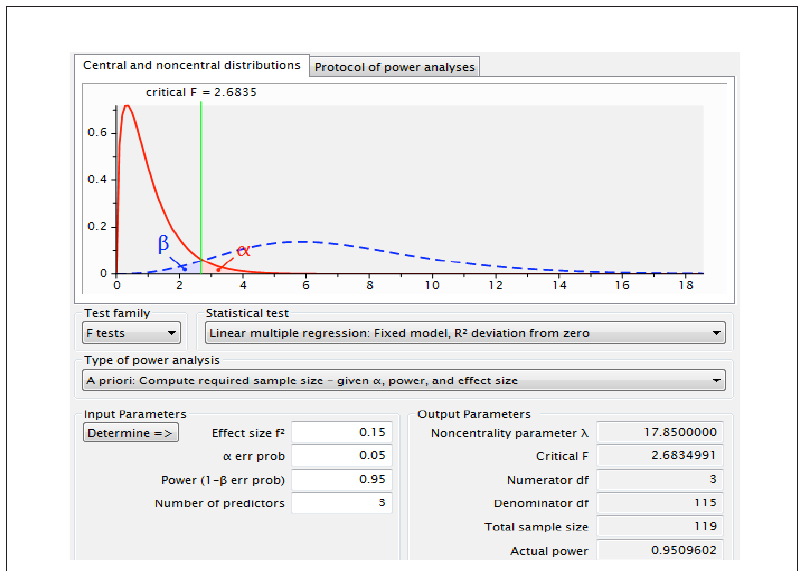
The sample size consists of textile manufacturing firms operating in Pakistan. Presently 315 textile manufacturing spinning mills are operational in Pakistan according to report of APTMA (2018). Gpower software was used to calculate the optimum sample size required (Faul, Erdfelder, Lang, & Buchner, 2007). Three predictors were used in this study to predict the outcome. The effect size medium and power set was 0.95. The optimum sample size of 119 was obtained through Gpower, as shown in Figure 3. However, due to the low response rate in Pakistan when the unit of analysis is an organization (S. A. R. Khan & Qianli, 2017), the sample size was increased, and the census method was used. Mid and top-level management were the respondents of the present study who are supervising operational matters and supply chain processes in the textile manufacturing industry. The unit of analysis in the current study is the organization. Questionnaires were posted to all 315 manufacturing organizations. The duration of data collection was six months starting from January to June 2017. We obtained late replies from 170 firms. From received responses, only 152 were usable, the remainder were partially filled and were discarded. Hence, the effective response rate is 48.25% which is consistent with previous studies conducted at organization level in Pakistan ! (Gill, Shahzad, & Ramalu, 2018; S. A. R. Khan & Qianli, 2017). ! !
3.3Statistical Method
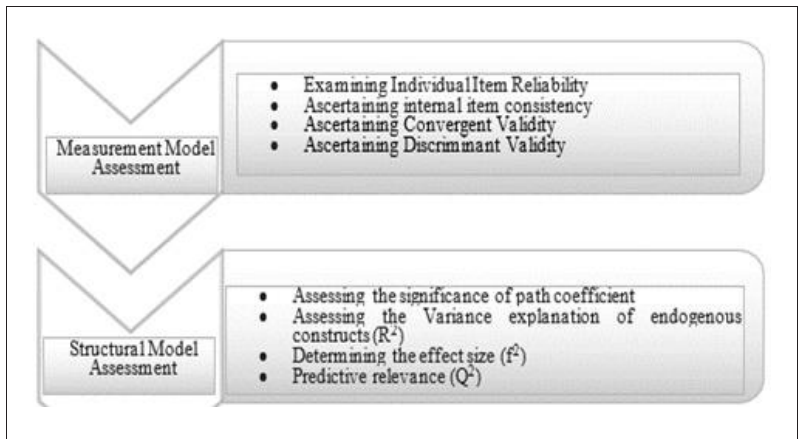
Partial least squares structural equation modelling (PLS-SEM) technique was deployed in the present study by using SmartPLS ver3.0 statistical software using the two-step approach, as shown in Figure 4. PLS-SEM was used due to the objective of the current study which is to analyze the prediction level of GSCM practices (green purchasing, eco- design and environmental cooperation with customers) on the operational performance of textile manufacturing industry and another reason is the small sample size (Hair, Hollingsworth, Randolph, & Chong, 2017).
4.0Results
4.1Respondents’ Profile
The demographics of respondents show that only 9.93% were female while 90.06% were male managers supervising supply chain management in textile industry while 2.64 % have less than one-year experience, 5.29% have more than one but less than two-year experience, 92.05% have more than three years’ experience supervising operational matters and supply chain activities in the Pakistani textile manufacturing organizations. -72 Influence of Green Supply Chain Management Practices on Operational Performance: An Empirical Study amongst Pakistani 65
4.2Measurement Model
Assessment of measurement model, also known as the outer model is the first step in PLS-SEM analysis. Reliability and validity are the criteria to evaluate the outer model. After running the PLS algorithm, one item of environmental Cooperation variable named as EC3 was dropped due to lower value of loading (see Figure 5). Internal consistency is measured through composite reliability (CR) which threshold should not be lower than 0.60 (Hair et al., 2011). The results in Table 3 show that CR values range from 0.769 to 0.838, indicating the reliability of the measurement model. In order to measure convergent validity: Average variance extraction (AVE) values were used with a threshold value of .50 and above (Henseler, Ringle, & Sarstedt, 2015). Table 3 shows the AVE values of all the variables that are above the cutoff value of 0.50. AVE values range from 0.538 to 0.626 which indicate that the convergent validity of the measurement model has been ascertained. Fornell-Larcker criterion (Fornell & Larcker, 1981) was used to measure the discriminant validity of the measurement model. The value of the square root of AVE of each construct should be higher than ! the maximum correlation value of the construct with any other variable (Hair, Hult, ! ! Ringle, & Sarstedt, 2014). Table 4 shows that the result of Fornell-Larcker criterion and AVE square root values Figure(diagonal 4. Two-Step values) PLS-SEM of all constructs are greater than the highest correlation withSource: any (Hair, otherRingle, construct. Thus, & Sarstedt, 2011) the discriminant validity of the present model has been established, and the above-mentioned results suggests that the measurement model is reliable and valid.
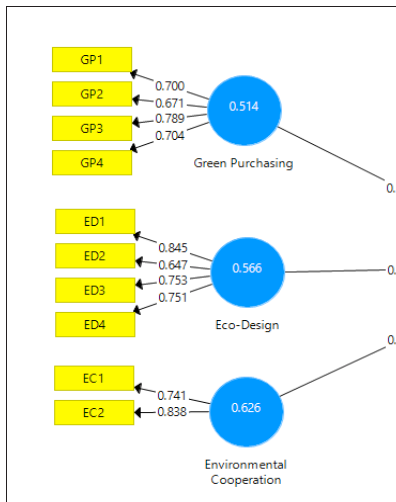
| Construct | Item | Loading | AVE | CR |
|---|---|---|---|---|
| Green Purchasing | GP1 GP2 GP3 GP4 | 0.700 0.671 0.789 0.704 | 0.538 | 0.822 |
| Eco-Design | ED1 ED2 ED3 ED4 | 0.845 0.647 0.753 0.751 | 0.566 | 0.838 |
| Environmental Cooperation | EC1 EC2 | 0.741 0.838 | 0.626 | 0.769 |
| Operational Performance | OP1 OP2 OP3 OP4 | 0.636 0.763 0.741 0.786 | 0.538 | 0.822 |
| Construct 1 2 3 4 |
1Eco-Design 0.752
 2. Environmental Cooperation               0.554              0.791
 3. Green Purchasing                        0.712              0.533            0.717
 4. Operational Performance                 0.656              0.511            0.575             0.733
Note: Diagonals represent the square root of AVE, while the off-diagonal represent the correlations. -72 Influence of Green Supply Chain Management Practices on Operational Performance: An Empirical Study amongst Pakistani 67
4.3Structural Model
After evaluating the outer model, the next step is to examine the structural model also known as the inner model. It involves measuring the predicting abilities and hypothetical relationships between exogenous and endogenous variables. Significance of the relationship has examined by running the bootstrapping procedure in smart pls 3.0. All three hypotheses (H1, H2 and H3) are direct relationships between exogenous and endogenous constructs. Table 5 shows the results of the structural model with respect to H1; the numbers show that green purchasing has no significant positive influence on operational performance (β=0.169; t=1.607); therefore, H1 is not supported. However, H2 results show that eco-design has a significant positive influence on operational performance (β=0.437; t=3.751), so H2 is supported. On H3, the results show that environment cooperation with customers has a significant positive influence on operational performance (β=0.180; t=2.304), therefore, H3 is supported. Hence, two hypotheses are supported (H2 and H3) out of three direct hypotheses. R2 value shows the predictive accuracy of the model and Table 5 shows that the R2 is 0.476 which indicates that the endogenous variable, operational performance, is close to moderate level of predictive accuracy as per the rule of thumb suggested by Hair et al. (2017). The effect size is represented by f2. Cohen (1988) provided the rule of thumb as follows: 0.15 f2 value show medium effect size, 0.35 value of f2 show substantial effect size, and 0.02value of f2 depicts small effect size. Table 5 shows the f2 value of green purchasing (0.025) having small effect size, eco-design (0.164) having medium effect size and environmental cooperation with customers (0.040) show a small effect size. Q2 reflects the predictive relevance of the model using Stone and Geisser’s method Q (Geisser, 1974). Q 2 value should be higher than 0 and Table 5 show that Q2 value is 0.235 which is higher than 0 and this indicate that all exogenous variables: green purchasing, eco- design and environmental cooperation with customers have predictive relevance for the endogenous variable, operational performance.
| Hypothesis | Relationship | β | Std | T-Value | Decision | |
|---|---|---|---|---|---|---|
| Error | ||||||
| H1 | GP ->OP | 0.169 | 0.105 | 1.607 | Not supported | 0.025 |
| H2 | ED ->OP | 0.437 | 0.116 | 3.751** | Supported | 0.476 0.164 0.235 |
| H3 | EC -> OP Purchasing, OP=Operational Performance | 0.180 **p<0.01 ED=Eco-Design, EC=Environmental Cooperation with the customer, GP=Green | 0.078 | 2.304** | Supported | 0.040 |
5.0Discussion and Implications
The results of multivariate regression analysis show that green supply chain management practices has a significant positive influence on operational performance. Findings show that eco-design and environmental cooperation with customers have a significant positive impact on operational performance, which is consistent with previous studies (Vanalle et al., 2017a; Wu et al., 2012). Eco-design has emerged as strong GSCM practice that plays a vital role in predicting the operational performance of manufacturing organizations. In a similar way, Zhu et al. (2010) investigated the GSCM practices among Japanese manufacturers and highlighted the role of eco-design for the highest operational performance. Eco-design helps organizations to build long term environmental sustainability through manufacturing recyclable products that can easily be disposed and remanufactured after the product life cycle. Eco-design not only improves the operational performance of the organization but also enhance competitive advantage through better environmental protection. Regulatory authorities at the local and international level are promoting eco-friendly products and discouraging hazardous goods which are not easy to dispose properly.
Stakeholders such as individual and groups who are directly affected by the actions of an organization play a significant role in the sustainability and performance of such organization (S. A. R. Khan & Qianli, 2017). Customers are the major stakeholders of manufacturing organizations and their preferences are very critical for smooth operations. The attainment of customer satisfaction is necessary to get a competitive advantage. To implement green practices, the involvement of buyers is essential. Findings of the present study show that environmental cooperation with customers brings substantial changes in the operational performance of a manufacturing organization. Further, in supply chain management, customers are considered a fundamental element that cannot be ignored. Customers provide valuable suggestions and feedback to improve the operational efficiency of the organizations. Customers also put pressure on the firms to use green practices and green their manufacturing procedures. Organizations usually conduct surveys to get feedback from buyers to know their requirements. A strong relationship with buyers leads to better performance in manufacturing organizations (Harms, Hansen, & Schaltegger, 2013).
Moreover, findings reveal that green purchasing itself cannot improve the operational performance of manufacturing organizations. In the line with the above argument, (. A. R. Khan & Qianli (2017) also found that green purchasing increase the cost in manufacturing organizations, and due to the the high cost of green purchasing, organizations of developing countries may be compelled to buy cheap non-green material from suppliers which in turn create no substantial impact on operational efficiency and performance. In developing countries, the awareness of buyers regarding environmental concern and pressure from regulatory authorities to adopt green practices has been mounting. But still, there is a lack of substantial financial compensation and exemption of levies that can motivate manufacturing organizations to buy green supplies. -72 Influence of Green Supply Chain Management Practices on Operational Performance: An Empirical Study amongst Pakistani 69
We argue that environmental sustainability and performance in manufacturing organizations can be achieved through efficient green supply chain practices. Managers and experts in the textile industry perform green supply chain management practices in collaboration with customers. Green practices skills have to be upgraded for manufacturing eco-design products and meeting the needs of buyers. The implementation of green practices through supply chain enhances the operational efficiency of manufacturing organizations by keeping the inventory level low and saving cost by recycling the waste into new products (Vachon & Klassen, 2008).
6.0Limitations and Further Research
The present research has several limitations. Pakistani textile manufacturing industry was only included as a sample of the current research. However, future studies may consider other industries in order to validate the impact of this model on operational performance. In the present study, three GSCM practices were taken as predictors: green purchasing, eco-design and environmental cooperation with customers. But future researchers may include more GSCM practices as independent variables such as green distribution and investment recovery to analyze their impact on the operational performance of the manufacturing organizations.
References
- Aigbedo, H. (2019). Assessment of the effect of location and financial variables on environmental management performance for industrial goods supply chains. Journal of Environmental Management, 236, 254–268.
- Al-Sheyadi, A., Muyldermans, L., & Kauppi, K. (2019). The complementarity of green supply chain management practices and the impact on environmental performance. Journal of Environmental Management, 242, 186–198.
- Cohen, J. (1988). Statistical Power Analysis for the Behavioral Sciences, (L. Erlbaum Associates, Hillsdale, NJ).
- Faul, F., Erdfelder, E., Lang, A.-G., & Buchner, A. (2007). G*Power 3: A flexible statistical power analysis program for the social, behavioral, and biomedical sciences. Behavior Research Methods, 39(2), 175–191. https://doi.org/10.3758/ BF03193146
- Fornell, C., & Larcker, D. F. (1981). Evaluating structural equation models with unobservable variables and measurement error. Journal of Marketing Research, 39–50.
- Geisser, S. (1974). A predictive approach to the random effect model. Biometrika, 61(1), 101–107. https://doi.org/10.1093/biomet/61.1.101
- Geng, R., Mansouri, S. A., & Aktas, E. (2017). The relationship between green supply chain management and performance: A meta-analysis of empirical evidences in Asian emerging economies. International Journal of Production Economics, 183, 245–258.
- Gill, A. A., Shahzad, A., & Ramalu, S. S. (2018). Examine the influence of Enterprise Resource Planning Quality Dimensions on Organizational Performance Mediated through Business Process Change Capability. 10(2).
- Golicic, S. L., & Smith, C. D. (2013). A meta–analysis of environmentally sustainable supply chain management practices and firm performance. Journal of Supply Chain Management, 49(2), 78–95.
- Gotschol, A., De Giovanni, P., & Vinzi, V. E. (2014). Is environmental management an economically sustainable business? Journal of Environmental Management, 144, 73–82.
- Green Jr, K. W., Zelbst, P. J., Bhadauria, V. S., & Meacham, J. (2012). Do environmental collaboration and monitoring enhance organizational performance? Industrial Management & Data Systems, 112(2), 186–205.
- Green Jr, K. W., Zelbst, P. J., Meacham, J., & Bhadauria, V. S. (2012a). Green supply chain management practices: impact on performance. Supply Chain Management: An International Journal, 17(3), 290–305.
- Green Jr, K. W., Zelbst, P. J., Meacham, J., & Bhadauria, V. S. (2012b). Green supply chain management practices: impact on performance. Supply Chain Management: An International Journal, 17(3), 290–305.
- Hair, Hult, G. T. M., Ringle, C., & Sarstedt, M. (2014). A primer on partial least squares structural equation modeling (PLS-SEM).
- Hair, J., Hollingsworth, C. L., Randolph, A. B., & Chong, A. Y. L. (2017). An updated and expanded assessment of PLS-SEM in information systems research. Industrial Management & Data Systems, 117(3), 442–458. https://doi.org/10.1108/IMDS-04-2016-0130
- Hair, Ringle, C., & Sarstedt, M. (2011). PLS-sem: Indeed a silver bullet (Vol. 19). https://doi.org/10.2753/MTP1069-6679190202
- Harms, D., Hansen, E. G., & Schaltegger, S. (2013). Strategies in sustainable supply chain management: An empirical investigation of large German companies. Corporate Social Responsibility and Environmental Management, 20(4), 205–218.
- Henseler, J., Ringle, C. M., & Sarstedt, M. (2015). A new criterion for assessing discriminant validity in variance-based structural equation modeling. Journal of the Academy of Marketing Science, 43(1), 115–135. https://doi.org/10.1007/ s11747-014-0403-8
- Jia, X., & Wang, M. (2019). The Impact of Green Supply Chain Management Practices on Competitive Advantages and Firm Performance. In Environmental Sustainability in Asian Logistics and Supply Chains (pp. 121–134). Springer.
- Khan, A. A., & Khan, M. (2010a). Pakistan textile industry facing new challenges. Research Journal of International Studies, 14(14), 21–29.
- Khan, A. A., & Khan, M. (2010b). Pakistan textile industry facing new challenges. Research Journal of International Studies, 14(14), 21–29.
- Khan, S. A. R., & Qianli, D. (2017). Impact of green supply chain management practices on firms’ performance: An empirical study from the perspective of Pakistan. Environmental Science and Pollution Research, 24(20), 16829–16844. -72 Influence of Green Supply Chain Management Practices on Operational Performance: An Empirical Study amongst Pakistani 71 Textile Manufacturers: 55-Laari, S., Töyli, J., Solakivi, T., & Ojala, L. (2016). Firm performance and customer-driven green supply chain management. Journal of Cleaner Production, 112, 1960–1970.
- Lee, S. M., Tae Kim, S., & Choi, D. (2012). Green supply chain management and organizational performance. Industrial Management & Data Systems, 112(8), 1148–1180.
- Li, Y. (2014). Environmental innovation practices and performance: Moderating effect of resource commitment. Journal of Cleaner Production, 66, 450–458.
- Milgrom, P., & Roberts, J. (1995). Complementarities and fit strategy, structure, and organizational change in manufacturing. Journal of Accounting and Economics, 19(2–3), 179–208.
- Mitra, S., & Datta, P. P. (2014). Adoption of green supply chain management practices and their impact on performance: An exploratory study of Indian manufacturing firms. International Journal of Production Research, 52(7), 2085–2107.
- Ortolano, L., Sanchez-Triana, E., Afzal, J., Ali, C. L., & Rebellón, S. A. (2014). Cleaner production in Pakistan’s leather and textile sectors. Journal of Cleaner Production, 68, 121–129.
- Rao, P., & Holt, D. (2005). Do green supply chains lead to competitiveness and economic performance? International Journal of Operations & Production Management, 25(9), 898–916.
- Sarkis, J. (2012). A boundaries and flows perspective of green supply chain management. Supply Chain Management: An International Journal, 17(2), 202–216.
- Sarkis, J., & Dijkshoorn, J. (2007). Relationships between solid waste management performance and environmental practice adoption in Welsh small and medium-sized enterprises (SMEs). International Journal of Production Research, 45(21), 4989–5015.
- Shang, K.-C., Lu, C.-S., & Li, S. (2010). A taxonomy of green supply chain management capability among electronics-related manufacturing firms in Taiwan. Journal of Environmental Management, 91(5), 1218–1226.
- Teixeira, A. A., Jabbour, C. J. C., de Sousa Jabbour, A. B. L., Latan, H., & De Oliveira, J. H. C. (2016). Green training and green supply chain management: Evidence from Brazilian firms. Journal of Cleaner Production, 116, 170–176.
- Vachon, S., & Klassen, R. D. (2008). Environmental management and manufacturing performance: The role of collaboration in the supply chain. International Journal of Production Economics, 111(2), 299–315.
- Vanalle, R. M., Ganga, G. M. D., Godinho Filho, M., & Lucato, W. C. (2017a). Green supply chain management: An investigation of pressures, practices, and performance within the Brazilian automotive supply chain. Journal of Cleaner Production, 151, 250–259.
- Vanalle, R. M., Ganga, G. M. D., Godinho Filho, M., & Lucato, W. C. (2017b). Green supply chain management: An investigation of pressures, practices, and performance within the Brazilian automotive supply chain. Journal of Cleaner Production, 151, 250–259.
- Vanalle, R. M., Ganga, G. M. D., Godinho Filho, M., & Lucato, W. C. (2017c). Green supply chain management: An investigation of pressures, practices, and performance within the Brazilian automotive supply chain. Journal of Cleaner Production, 151, 250–259.
- World Trade Organization. (2018). WORLD TRADE STATISTICAL REVIEW 2018. USA.
- Wu, G.-C., Ding, J.-H., & Chen, P.-S. (2012). The effects of GSCM drivers and institutional pressures on GSCM practices in Taiwan’s textile and apparel industry. International Journal of Production Economics, 135(2), 618–636.
- Yildiz Çankaya, S., & Sezen, B. (2019). Effects of green supply chain management practices on sustainability performance. Journal of Manufacturing Technology Management, 30(1), 98–121.
- Younis, H., Sundarakani, B., & Vel, P. (2016). The impact of implementing green supply chain management practices on corporate performance. Competitiveness Review, 26(3), 216–245.
- Zhu, Q., Geng, Y., Fujita, T., & Hashimoto, S. (2010). Green supply chain management in leading manufacturers: Case studies in Japanese large companies. Management Research Review, 33(4), 380–392.
- Zhu, Q., & Sarkis, J. (2004). Relationships between operational practices and performance among early adopters of green supply chain management practices in Chinese manufacturing enterprises. Journal of Operations Management, 22(3), 265–289.
- Zhu, Q., & Sarkis, J. (2007). The moderating effects of institutional pressures on emergent green supply chain practices and performance. International Journal of Production Research, 45(18–19), 4333–4355.
- Zhu, Q., Sarkis, J., & Lai, K. (2008). Green supply chain management implications for “closing the loop”. Transportation Research Part E: Logistics and Transportation Review, 44(1), 1–18.
- Zhu, Q., Sarkis, J., & Lai, K. (2012). Examining the effects of green supply chain management practices and their mediations on performance improvements. International Journal of Production Research, 50(5), 1377–1394.