Unveiling the Determinants of Work-Related Stress in the Policing Occupation
- School of Business Management, College of Business, Universiti Utara Malaysia, Sintok, Kedah
- Cawangan Pematuhan, Jabatan Integriti dan Pematuhan Standard, Ibu Pejabat Polis Diraja Malaysia
- Business Studies Department, Arab Open University, Aa`li
Journal of Business Management and Accounting 9(2) (2019) · https://doi.org/10.32890/jbma2019.9.2.8721
Abstract
The present study attempts to provide empirical evidence on the relationship between workload, working conditions, role conflict and job stress among the Royal Malaysian Police (RMP) Personnel. A survey among 178 RMP from six departments at one XYZ Police District in Selangor was conducted. Self-reported measures for all variables were used to obtain data pertaining to determinants of job stress. Multiple regression was employed to investigate three hypotheses that postulated significant positive relationships between workload, working conditions, role conflicts and job stress. The regression results found that workload and working conditions have positive relationships with job stress. However, role conflict did not significantly influence job stress. Plausible justifications for the relationships between workload and working conditions and job stress were discussed. The study provides a foundation for discussing both theoretical and managerial aspects of policing occupation.
Keywords: Job stress, workload, working conditions, role conflict, Royal Malaysian Police
1.0Introduction
Policing is widely acknowledged as a demanding and challenging occupation. Police officers are exposed to various stressful life situations since it is associated with protecting people’s lives, preventing crime in society which exposes them to unpleasant and dangerous physical working conditions (Irniza & Saliluddin, 2015; Manshor et al, 2003; Noblet, Rodwell, & Allisey, 2009). Apart from the critical conditions,
* Email: lazim@uum.edu.my, hadziroh@uum.edu.my, kenari9383@gmail.com, umairahm@gmail.com unpleasant working conditions such as resources deficiency, noise, overcrowded space, small offices, and inadequacy of staff are also major contributors to stress. Police organizations these days are saddled with inadequate resources which come in the form of insufficient staff, overcrowded offices, unavailability of office space and equipment shortages which influence and affect police working conditions thereby inflicting job stress related symptoms. Employee role in the organization is also identified as a job stressor and this may come in the form of role ambiguity and role conflict (Nikam & Shaikh, 2016). For instance, role conflict happens when an individual does not have a clear information regarding the necessary tasks or responsibilities to be performed, or do not have a clear information’s in relation to their positions within the organization (Kamarudin, Zulkafaly & Hassan, 2018). While many people may regard dangerous encounters with violent criminals as most stressful to police officers, research reveals that officers perceive stressors intrinsic to the police organization as more stressful. These include interpersonal relationships (Brown & Campbell, 1990; Noblet et al., 2009).
In Malaysia, stressful situations such as excessive workload, a high level of crimes and violence, traumatic accidents and role conflicts have been seen as the potential stressors among the Malaysian police. For instance, there are many cases in which traffic police were injured or killed while controlling and chasing offenders (Irniza & Saliluddin, 2015). This situation indicates that the Royal Malaysia Police (RMP) need to perform their tasks and responsibilities effectively in order to reduce crime cases. Subsequently, this effort is meant to contribute to reducing job stress among RMP. Previous studies on job stress among RMP are limited. Only a few studies are available on the determinants of job stress in the policing occupation (Irniza & Saliluddin, 2015; Lazim, Hadziroh & Hafiz, 2018; Mastor; 2009). For instance, a study by Irniza and Saliluddin (2015) used archival documents to provide a foundation for further studies on stress factors among RMP. Taken into consideration the observed issue on job stress among police personnel, this study was conducted to investigate the determinants of job stress among RMP by testing the influence of workload, working conditions and role conflict on job stress among them.
2.0Literature Review and Hypotheses Development
2.1Job Stress Concept
Job stress is defined as nonspecific response of the body to any demand made upon it to adapt, whether that demand produces pleasure or pain (Nikam & Shaikh, 2016). It involves particular relationship between the person and the environment that is appraised by the person as taxing or exceeding individual resources and endangering individual well-being. There are, however, no consensus regarding stress definition because most researchers have their own interpretation of stress. For example, some researchers use external stimuli such as a shocking accident or death as oppose to others that used internal stimuli like anger, grief, and nervousness to define stress (Lazarus, 1991). Generally, stress occurs when individuals’ bodies and minds are trying to adapt to the constantly changing surroundings (Lazarus, 1991; Oweke, Muola & Ngumi, 2014). In addition, stress is also the outcome of an interaction between a mixture of sources of strain and individual characteristics (Kamarudin, Zulkafaly & Hassan, 2018, Nikam & Shaikh, 2016)). The stress level within individuals are different and those differences depend on the individual self-perception and individual reception. Generally, individuals’ responses to stressful situations are often determined by their subjective perceptions and their capabilities in conveying, coping or dealing with a mixture of situations, and it’s not exclusively determined by the situations’ seriousness. Thus, in general, it could be understood that stress is determined by the individual’s self-perception and response towards a certain stressful conditions or situation. It can be said that stress is not determined by seriousness of the situation instead it is determined by the self-perception and response of an individual in relating to stressful situations.
Conceptually, stress is categorized into three types which are physical, emotional and behavioral/organizational stress. Physical stress surface when a person’s body starts to suffer from stressful conditions. The most common symptom of physical stress is headache as stress causes people to unconsciously tense their neck, foreheads and shoulder muscles (Dua, 1994). According to Dua et al. (1994), stress if persists for a long period of time, may lead to many physical symptoms such as digestive problems which includes ulcers, insomnia, fatigue, high blood pressure, nervousness and excessive sweating, heart disease, stroke and even hair loss. Furthermore, emotional stress occurs in the form of anxiety, anger, depression, irritability, frustration, over reaction to everyday problems, memory loss and a lack of concentration for any given task. Stress may influence behavioral changes in an individual. An individual who is suffering from stress effect may display behavioral changes that include lack of job involvement, absenteeism, early retirement, and poor interpersonal working relationships, reduced job performance, act of deviance and low level of job satisfaction (Dua et al., 1994).
According to Oweke, Muola and Ngumi (2014), policing is regarded as one of the most stressful occupations. This is due to the nature of police work itself which expose police officers to stressful and traumatic situations such as having to use weapons during violent encounters with criminals, extreme workload, work shifts, and poor working conditions. In this regard, general knowledge of stress adaptability is crucial as a foundation for understanding police adaptation to stressful situations. For instance, the Theory of Cognitive Appraisal states that stress adaptation depends on the ways employees evaluate a situation and their personal coping resources (Lazarus, 1991).
Moreover, according to Lazarus (1991), three phases of cognitive appraisal, primary appraisal, secondary appraisal and reappraisal that arise when a stressful situation occurs impact individuals’ wellbeing. Primary appraisal refers to the cognitive perceptual process whereby an individual perceives something as stressful, neutral or positive. Secondary appraisal involves evaluating what might be done about a stressful situation and the individual deciding whether they have the coping resources to deal with the stressor. Reappraisal involves an altered perception about how stressful the situation is based on new information from the environment. High stress level will lead to harm especially when an individual or employee lacks coping resources, coping strategies or ineffective strategies.
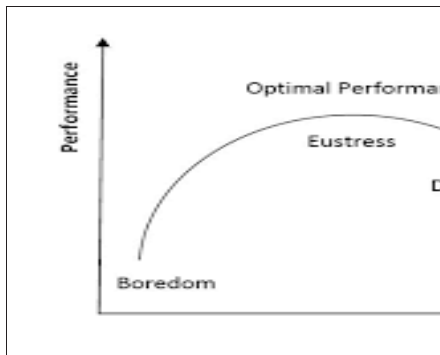
On the other hand, Dua (1994) highlighted two important elements that are associated with stress which is the actual interchange between the person and the environment; and the person’s responses over time to the stress experienced. Long-term stressors cause more severe health problems than short-term stressors. Long-term stress can suppress Noblet etimmune system, al., 2009). Forwhereas short-term instance, stresstocan according enhance Noblet et immunity. Biological al., (2009), when anstudies individual is demonstrate that stress is clearly a complex phenomenon whose health confronted by any stressor, it would cause different biological changes, and indirectly outcomes are would dependent upon each individual and how they deal with the stressors reflect on various levels of the body's defense mechanisms for coping with the assault. and over what time frame. Health consequences have been argued to occur in both the psychological and physiological (Watson & Spence, 2007). In the same vein, Kupriyanov and Zhdanov (2014) categorized stress into two which are eustress and distress. Eustress is defined as a good stress, while distress as bad stress. Eustress is stress Another theory that relates to stress adaptation is Stress Psychological U-Model (Lazarus level that is beneficial and motivates individual to generate creativity, performance and & Folkman, 1984). Figure 1 illustrates the stress psychological U-Model which productivity. Therefore, eustress may lead to enhancement of individual job performance which indicates how eustress and distress affects individual job performance. Researchers ultimatelyhave leads an individual found to work that stress can be usedharder. On the to influence flipside,attitude, individual distressbehavior is a category of stress that and human demoralizes survivals in general (Dua, 1994; Noblet et al., 2009). For instance, according to Nobletwellbeing employee and depletes motivational levels which may affect individuals’ and performance in a when et al., (2009), negative manner.isDistress an individual confrontedis drawn out on individual’s by any stressor, it would causeweaknesses different which makes thebiological person exposed to exhaustion and illness. If not controlled properly, distress is most changes, and indirectly would reflect on various levels of the body’s defense likely to result in stress mechanisms for(Lazarus & Folkman, coping with the assault.1984).
3.0Job Stress Sources
Sources of job stress in policing occupations is classified into two (Brown & Campbell, 1990). The first category is operational stressors. Operational stressor can be defined as a work related stressor which in the case of police career could be threat, violent encounter, and/or exposure to
In the same vein, Kupriyanov and Zhdanov (2014) categorized stress into two which are eustress and distress. Eustress is defined as a good stress, while distress as bad stress. Eustress is stress level that is beneficial and motivates individual to generate creativity, performance and productivity. Therefore, eustress may lead to enhancement of individual job performance which ultimately leads an individual to work harder. On the flipside, distress is a category of stress that demoralizes employee and depletes motivational levels which may affect individuals’ wellbeing and performance in a negative manner. Distress is drawn out on individual’s weaknesses which makes the person exposed to exhaustion and illness. If not controlled properly, distress is most likely to result in stress (Lazarus & Folkman, 1984).
3.0Job Stress Sources
Sources of job stress in policing occupations is classified into two (Brown & Campbell, 1990). The first category is operational stressors. Operational stressor can be defined as a work related stressor which in the case of police career could be threat, violent encounter, and/or exposure to danger, time pressure, or even demanding shifts duties (Brown & Campbell, 1990). All these traumatic and stressful conditions are psychologically and physically harmful to police personnel’s wellbeing (Violanti et. al., 1999). Meanwhile, the second category of police work stressors are organizational. Organizational stressors can be referred to as organizational characteristics that lead to stress in the workplace (Burke & Mikkelsen, 2006). Several factors have been identified as job stressors among RMP such as exposure to traumatic incidents, cross- boundaries violence, administrative problems, ineffective management system in RMP and non-compliance with rules and regulations (Irniza & Saliluddin, 2015). For instance, ineffectiveness in providing and developing police personnel with skills, knowledge and abilities for performing their tasks are believed to be associated with job stress among them. Although job related stress in policing occupation may be caused by multiple stressors, this study aimed to make specific investigation on the influence of workload, working condition and role conflict on job stress among RMP.
3.1The Relationship between Workload and Job Stress
Workload is defined as the quantity of work needed to be performed by employees and the level of difficulties associated with the job (Jex, 1998; Oweke, Muola & Ngumi, 2014). It is related to employee self-perception regarding the extra amount of work that need to be done and the number of jobs they need to complete in a specific time period (Lazim, Hadziroh, Hafiz, 2018; Nikam & Shaikh, 2016). With regards to policing occupation, the relationship between workload and job stress can be justified in two ways. First, workload is associated with huge number of working hours. Studies have found that excessive working hours is associated with poor health outcomes such as hypertension, increased risk of cardiovascular disease, anxiety and anger (Liberman et al., 2002; Noblet et al., 2009). Accordingly, Noblet et al. (2009) found that overtime and long hours in policing occupation had significant influence on job related stress symptoms such as fatigue, drowsiness and increase the risk of workplace accidents. Second, police stations are always overloaded with different tasks and some of them are performed outside office hours which force personnel to live away from their families on daily basis (Humayon, Raza, Amir, Hussain & Ansari, 2018). This is a major contribution towards job stress among RMP and lead to a poor balance in daily life. Particularly, it prevents them from fulfilling their responsibilities to families and society (Irniza & Saliluddin, 2015). Therefore, the following hypothesis is proposed:
Hypothesis 1: Workload is positively related to job stress among Royal Malaysian Police
3.2The Relationship between Working Conditions and Job Stress
Working conditions is the physical geographical location as well as the surroundings of the workplace, such as a factory site or office building (Nikam & Shaikh, 2016). Working conditions is also associated with employee workplace which include facilities, physical environment, noise level, safety, and office politics (Oweke et al., 2014). Different physical and psychosocial exposures in the working conditions have been found to be associated with work stress. Heavy physical work load, ergonomic conditions and exposures to hazardous substances are associated with negative and harmful effect for employee well-being (Allebeck & Mastekaasa 2004). In policing occupation, stressful working conditions such as low lighting, air quality, cleanliness, pollution, acoustics, equipment, working hours-shift work, office politics, unfavorable or hostile environment, law and order environment, and torture environment are associated with job stress among police officers in Pakistan (Humayon et al., 2018).
Prior studies have provided the evidence that working conditions could influence job stress in the workplace (Brown & Campbell, 1994; Humayon et al., 2018). According to Brown and Campbell (1994) the police organizations these days are saddled with inadequate resources which comes in the form of overcrowded office and equipment shortages. These situations create unconducive police working conditions, which in turn, inflict job stress related syndrome among police officers. Moreover, unpleasant working conditions or dangerous physical working conditions also affect physical and mental health of police officers (Humayon et al., 2018; Oweke et al, 2014). In this context, perilous physical working conditions associated with policing occupations that comes in the form of the nature of police work itself such as death of a co-worker, killed or be killed in the line of duty, facing and arresting violent criminals, informing relatives of sudden death, handling suicidal cases, and fatal accidents. The hazardous physical working conditions can have a strong influence on physical and emotional health, which in turn, would increase level of stress (Humayon et al., 2018). Therefore, the present study proposed the following:
Hypothesis 2: Working conditions is positively related to job stress among Royal Malaysian Police
3.3The Relationship between Role Conflict and Job Stress
Role conflict is defined as an incongruence between jobs demands and expectations in the employee’s roles which includes demands and expectations from supervisors, colleagues, and organizations (Kamarudin, Zulkafaly & Hassan, 2018; Nikam & Shaikh, 2016). Role conflict principally arises when an employee is required to perform numerous roles associated with their jobs inside an organization (Koustelios, Theodorakis & Goulimaris, 2004). The relationship between role conflict and job stress in policing occupation can be understood on the grounds of two arguments. First, role conflict can influence job stress when police officers are forced to take an incompatible and incongruent role. Therefore, incompatible demands will create inconsistent behavior and attitude in the workplace, thus developing feelings of disbelief in relations to his or her capabilities compared to other colleagues (Kamarudin et al., 2018). This situation is also known as operational related conflict in the policing occupation (Jessica, Jacky & Ivan, 2019). Secondly, role conflict is also related to job stress because it directly influences police working relationhsips in the office (Irniza & Saliluddin, 2015). In policing work culture, one example of role conflict is when two supervisors ask an employee to carry out conflicting duties at the same time but the employees cannot match these requirements and these cause stress to occur. Role conflict may take place in police work settings due to the requirement of the organizations which require police officers to meet the incompatible demands of an individual’s inside and outside the organization (Kamarudin et al., 2018). Hence, the following hypothesis is formulated:
Hypothesis 3: Role conflict is positively related to job stress among the Royal Malaysian Police
3.4Research Framework
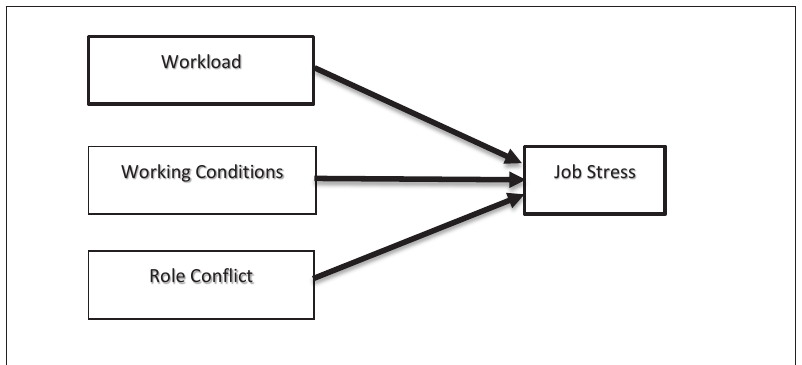
Taking into consideration discussions in the literature and prior empirical studies on the relationship between workload, working conditions and role conflict, the conceptual framework for the research is illustrated in Figure 2. The framework attempt to investigate the influence of workload, working conditions and role conflict as determinants of job stress among RMP. The fundamental premise is that workload, working conditions and role conflict have positive relation with job stress. For example, higher workload in the context of overtime and long hours in policing occupation may influence job stress among RMP. In the same way, unpleasant working conditions or dangerous physical working conditions may also influence job stress due to its potential effect on physical and mental health of RMP.
Workload
Working Conditions Job Stress
Role Conflict
4.0Method
4.1Population and sampling technique
The population of interest for this research consist of 425 police officers from five (5) different departments inside IPD in XYZ District in Selangor namely, (i) Criminal Investigation Department (JSJ), (ii) Narcotics Criminal Investigation Department, (JSJN), (iii) Commercial Crime Investigation Department (JSJK), (iv) Traffic Investigation and Enforcement Department (JSPT), and (v) Crime Prevention and Community Security Department (JPJKK). In order to collect the data, sampling was employed as it produces more reliable results (Sekaran, 2003). In determining the sample size, Krejcie and Morgan (1970) specified that a sample size of 201 is appropriate for a population on 425. This study used cross-sectional survey among 201 RMP in five departments in XYZ District in Selangor, and was guided by simple random sampling to select participants. As shown in Table 1, proportionate random sampling was used to determine number of participants in each department, before final number of participants in each department were randomly selected as sample in the study.
| Department | Population | Proportionate | Total Number of |
|---|---|---|---|
| (%) | Sample | ||
| Criminal Investigation | 86 | 86/425=20% | 20%x201=40 |
| Department | |||
| Narcotics Criminal | 47 | 47/425=11% | 11%x201=22 |
| Investigation Department | |||
| Commercial Criminal | 41 | 41/425=10% | 10%x201=20 |
| Investigation Department | |||
| Traffic Investigation and | 82 | 82/425=19% | 19%x201= 39 |
| Enforcement Department | |||
| Crime Prevention and | 169 | 169/425=40% | 40%x201=80 |
| Community Security | |||
| Department | |||
| Total | 425 | 100% | 201 |
4.2Measurement of Variables
Job stress - Job stress is operationalized as polices officers’ perception of psychological stress related to the policing occupation. The items used to measure job stress was adapted from Maslach and Jackson (1981) and it was measured using 5 items. All items employed a five-point scale ranging from ‘1’ “strongly disagree” to ‘5’ “strongly agree”. Examples of items include ‘I always experience a neck pain’, ‘I always have a headache’, ‘I have been feeling tense’, and ‘Lately, I have been tired’. The measures were slightly modified based on consultations with polices officers during a pilot study when it was tested for content validity.
Workload – Workload was operationalized as police officers’ perceptions of excessive jobs and responsibilities in policing occupation. This construct was measured using an instrument containing 9 items tapping the self-reported measures of workload. The workload items were adapted from Mansour, and Tremblay (2016). All items employed a five-point scale ranging from ‘1’ “strongly disagree” to ‘5’ “strongly agree”. Examples of items are ‘my job requires working very fast’, ‘my job requires working very hard’ and ‘I am not asked to do an excessive amount of work’.
Working conditions – Working conditions was operationalized as police officers’ perceptions of physical working conditions in their occupation. The items used for measuring physical working conditions were measured by 20 items which measuring various aspects of the physical working conditions in policing occupation such as workplace design (ventilation, air conditioning system,social relationships), illumination (brightness), noise (loud noise), temperature and humidity and shift work (time period). The working conditions items were adapted from Alonso and Oloke (2012). All items employed a five-point scale ranging from ‘1’ “strongly disagree” to ‘5’ “strongly agree”.
Role conflict – Role conflict is operationalized as police officers’ perception of incongruence or incompatibility between jobs demands and expectations in doing their jobs. This construct was measured using an instrument containing 9 items. The role conflict items were adapted from Randy, Janet and Jerome (1998). All items employed a five-point scale ranging from ‘1’ “strongly disagree” to ‘5’ “strongly agree”. Examples of items are ‘I work with group of people who expect many related things from me’, ‘I work with group of people who expect many unrelated things from me’, and ‘I often perform tasks that are too boring’.
Meanwhile, the final part of the questionnaire measured age, sex, tenure, marital status, department, current position, and education as demographic information which were determined by asking a single, objectively worded question.
5.0Findings
5.1Demographics of Respondents
The majority of respondents are (N=178) officers in XYZ District Police Station which consist of 80.3% of male and only 19.7% female. For the respondents age, 56.2% are police officers between 20-29 years old, 70.8% are married, and 79.8% of them are SPM holder. Based on the respondent’s work experience, the study found that 37.6% of the respondents have working experience of 1 to 5 years, 27% have been working for 6 to 10 years, 16.3% of the respondents have worked for 11 to 15 years, 4.5% have been working for 16 to 20 years, and 14.6% of the respondent have working experience of more than 20 years.
| Items | Category | Frequency | Percentage |
|---|---|---|---|
| Gender Male | 143 | 80.3 | |
| Female | 35 | 19.7 | |
| Total | 178 | 100.0 (continued) | |
| Items Category | Frequency | Percentage | |
| Age Below 20 | 1 .6 | ||
| 20-29 | 100 56.2 | ||
| 30-39 | 45 25.3 | ||
| 40-49 | 17 9.6 | ||
| 50 and above | 15 8.4 | ||
| Total | 178 100.0 | ||
| Race Malay | 120 67.4 | ||
| Indian | 20 11.2 | ||
| Chinese | 14 7.9 | ||
| Others | 24 13.5 | ||
| Total | 178 100.0 | ||
| Marital Single | 48 27.0 | ||
| Status Married | 126 70.8 | ||
| Divorce | 4 2.2 | ||
| Total | 178 100.0 | ||
| Academic STPM | 1 .6 | ||
| Level Bachelor Degree | 8 4.5 | ||
| SPM | 142 79.8 | ||
| Diploma | 7 3.9 | ||
| PMR | 20 11.2 | ||
| Total | 178 100.0 | ||
| Department Criminal Investigation | 36 20.2 | ||
| Narcotic Criminal Investigation | 26 14.6 | ||
| Commercial Crimes Investigation | 36 20.2 | ||
| Traffic Enforcement & Investigation | 28 15.7 | ||
| Crime Prevention & Community | 52 29.2 | ||
| Security | |||
| Total | 178 100.0 | ||
| Rank Constable | 52 29.2 | ||
| LanceCorporal | 47 26.4 | ||
| Corporal | 31 17.4 | ||
| Sergeant | 24 13.5 | ||
| Sergeant Major | 11 6.2 | ||
| Sub-Inspector | 2 1.1 | ||
| Inspector | 11 6.2 | ||
| Total | 178 100.0 (continued) | ||
| Items Category | Frequency Percentage | ||
| Total 1-5 years | 67 37.6 | ||
| Experience | |||
| 6-10 years | 48 27.0 | ||
| 11-15 years | 29 16.3 | ||
| 16-20 years | 8 4.5 | ||
| >20 years | 26 14.6 | ||
| Total | 178 100.0 | ||
| Total < RM 1000 | 1 | .6 | |
| Income | |||
| RM1001-RM2000 | 48 27.0 | ||
| RM2001-RM3000 | 46 25.8 | ||
| RM3001-RM4000 | 45 25.3 | ||
| >RM4000 | 38 21.3 | ||
| Total | 178 100.0 |
5.2Internal Reliability, Mean and Correlation
As shown in Table 3, the mean, standard deviation, scale reliabilities and correlation coefficient of the study were determined. The Cronbach alpha values obtained for the adapted scales were .717 for job stress, .820 for workload, .760 for working conditions and .850 for role conflict. The correlations show low to moderate correlations between variables thus eliminating the possibility of multicollinearity among them. In terms of correlations amongst variables, all three independent variables, namely workload (r = .269, p<.05), working conditions (r = .248, p<01), and role conflict (r = .268, p<.01), were found to be significantly and positively correlated with job stress.
| Variables | Mean | SD | JS | WK | WK | RC |
|---|---|---|---|---|---|---|
| Job stress (JS) | 4.32 | 2.23 | (.717) | |||
| Workload (WK) | 3.87 | 2.78 | .269*(.820) | |||
| Working | 3.63 | 2.32 | .248** .377** (.760) | |||
| conditions (WC) | ||||||
| Role Conflict (RC) | 4.16 | 2.98 | .268** .384** .159* (.850) | |||
| Note: * p<.05, **p<.01 |
5.3Multiple Regression Result
Multiple regression analysis indicate the proportion of the variance in dependent variable explained by the independent variables. As shown in Table 4, 71.5% of the variance in job stress is explained by workload, working conditions and role conflict. The results specifically found that two variables were positively significant to job stress, with workload recording a higher beta value (β=.427, p<.01), and followed by working conditions (β=.248, p<.01), thus supporting H1 and H2. However, role conflict did not appear to significantly influence job stress, hence fail to support H3.
| Model | Unstandardized | Standardized | t | Sig. | |
|---|---|---|---|---|---|
| Coefficients | Coefficients | ||||
| B | Std. | Beta | |||
| Error | |||||
| (Constant) | .229 | .495 | .464 | .644 | |
| Workload | .040 | .069 | .427 | .582 | .003 |
| Working Conditions | -.289 | .258 | .248 | .423 | . |
| Role Conflict | -.018 | .039 | .345 | -.455 | .650 |
| R Square = .617 | |||||
| R = .715 | |||||
| F= 44.744 | |||||
| *p < 0.05 | |||||
| a. Dependent Variable: JOBSTRESS | |||||
5.4Discussion, Implications and Conclusion
The present study found that workload and working condition were significantly related to job stress among RMP. However, it is surprising that the finding showed no relation between role conflict and job stress. With regards to the first hypothesis on the relationship between workload and job stress among Royal Malaysian Police, the research implies that when the Royal Malaysian Police needed to perform their duties and responsibilities beyond their standard workload, their stress levels increased. The finding is generally consistent with previous findings in relation to excessive workload and its relationships with job stress among police officers (Nikam & Shaikh, 2016; Oweke et al., 2014). A reasonable explanation for this finding could be that workload is more associated with job stress among the RMP. For example, excessive workload can cause fatigue, tiredness and stress, leading to a higher risk of errors and accidents in the workplace. In this regard, constant pressure to work every minute with limited opportunity to relax, working under tight deadlines, unrealistic deadlines and job demands interfere with personal time are all identified as workload factor that contributed to job stress among RMP.
Meanwhile, consistent with the second hypothesis, the current study also found that working conditions in the policing occupation is found to be a notable job stressor. The finding is consistent with previous findings in relation to unpleasant working conditions and its relationships with job stress (Humayon et al., 2018; Oweke et al, 2014). A reasonable explanation for this could be the potential impact of unpleasant work conditions on police officers’ physical, mental and social health. In fact, police jobs are considered as the most stressful because of the nature of their operations. For instance, the exposure to traumatic accidents can acumulate over time and subsequently increase job stress among RMP. Apart from traumatic accidents, a wide range of crimes, and violence that are experienced by RMP create insecurities in their life and increase their level of stress.
Finally, the third hypothesis in this study postulated that role conflict has a positive relationship with job stress among the Royal Malaysian Police. The findings indicate that role conflict does not have a significant relationship with job stress. This finding is not consistent with previous studies that role conflict was related to job stress (Kamarudin et al., 2018). One plausible explanation could be the certainty of roles in the RMP in which clear responsibilities occur in sharing tasks among personnel. This in a way implies that there should be an element of compatibiltiy between assigned tasks and work demands.
In terms of theoretical implications, the findings provide valuable input for researchers on the relationship between workload, working conditions and job stress in the policing occupation. A validated framework of its relationship is expected to provide good foundation for explaining and justifying the influence of workload and working conditions on job stress among RMP. Notably, the contribution of this study is its confirmation, in the Malaysian context, that excessive workload and unpleasant working conditions in policing occupation cause higher job stress among RMP.
Apart from theoretical contributions, the findings also provide some interesting input for managers. Based on the findings, the significant influence of workload and working conditions on job stress constitute an important message for practicing managers to explore new ways of managing works stress in policing occupation. As a starting point, the findings of the present study indicates the need for probably re-designing job contents to reduce job stress among police officers. Job analysis would be a great way to start in this regard. Based on the findings, it is also suggested that the nature of police work is an important contributor to stress at work as the job requires working in shifts, experiencing public apathy, and exposure to misery and death. Job analysis is a process of collecting information on jobs, responsibilities, duties and activities in organizations. Thus, a new list of jobs and responsibilities should be constructed to give fresh descriptions of professional policing roles.
In conclusion, the current study found that workload and working conditions are the two keys job stressors, particularly for Royal Malaysian Police. The current study has forwarded a model for examining direct influences of workload and working conditions on job stress in the policing occupation. As stated above, the findings indicate that workload and working conditions have a positive and significant influences on job stress in the policing occupation in Malaysia. However, role conflict has no significant influence on job stress. Thus, the management of job stress among the Royal Malaysian Police should include restructuring of current workload and redesigning more comfortable working conditions.
References
- Alonso, M. L., & Oloke, D. (2012). The impact of training on construction industry accidents: A review of the United Kingdom and Spain. Advanced Research in Scientific Areas, 3(7), 1837-1841.
- Anderson, G., Litzenberger, R. and Plecas, D. (2002). Physical evidence of police officer stress. An International Journal of Police Strategies & Management, 25, 99-420.
- Brown, J. A. & Campbell, E. A. (1990). Sources of occupational stressing police. Work and Stress, 4, 305-323.
- Burke, R. J., & Mikkelsen, A. (2005). Gender issues in policing: Do they matter? Women in Management Review, 20, 133–143.
- Conley, S., & Woosely, A. S. (2000). Teacher role stress, higher order needs and work outcomes. Journal of Education Administration, 38(2), 177-201.
- Dua, J. K. (1994). Job stressors and their effects on physical health, emotional health and job satisfaction in a University. Journal of Educational Administration, 32(1), 59-78.
- Humayon, A. A., Raza, S., Amir, H., Hussain, M. S., & Ansari, N. A. (2018). Assessment of work stress among Police in Pakistan. Journal of Applied Environmental and Biological Sciences, 8(2), 68-73.
- Hunnur & Sudarshan (2014). Cause and effect at workplace stress among police personnel: An empirical study. International Journal of Management Research and Business Strategy. 3(1), 12-23.
- Irniza, R., & Saliluddin, S. M. (2015). Are Malaysian police really stressed? Understanding their potential stress factors. International Journal of Public Health and Clinical Science. 2(5), 45-53.
- Jessica C.M.L., Jacky C.K.C., & Ivan, Y.S. (2019). The impact of job and family factors onwork stress and engagement among Hong Kong police officers. Policing: An International Journal, 42(2), 284-300.
- Jex, S. M. (1998). Stress and job performance: Theory, research, and implications for managerial practice. Thousand Oaks, CA: Sage.
- Kamarudin, K., Zulkafaly, F., & Hassan, N. M. (2018). Role conflict, role ambiguity and job stress among Police Officers. International Journal of Academic Research in Business and Social Sciences, 8(8), 861-873.
- Koustelios, T., Theodorakis, T., & Goulimaris, D. (2004). Role ambiguity, role conflict and job satisfaction among physical education teachers in Greece. International Journal of Educational Management, 18(2), 87-92.
- Krejcie, R. V., & Morgan, D. W. (1970). Determining sample size for research activities. Educational & Psychological Measurement, 30, 607-610.
- Kupriyanov, K., & Zhdanov, R. (2014). The eustress concept: Problems and outlooks. World Journal of Medical Sciences, 11(2), 179-185.
- Lazarus, R. S. (1991). Psychological stress in the workplace. Journal of Social Behavior and Personality, 6, 1-13.
- Lazim, M.M.Z., Hadziroh, I., & Hafiz, M.M.N (2017). Determinants of Job Stress among Royal Malaysian Police (RMP): A Conceptual Framework. Journal of Advanced Research in Business, Marketing and Supply Chain Management, 1(1), 49-53.
- Lazuras, L., Rodafinos, A., Matsiggos, G., & Stamatoulakis, A. (2009). Perceived occupational stress, affective, and physical well-being among telecommunication employees in Greece. Social Science & Medicine, 68(6), 1075-1081.
- Manshor. A. T, Fontaine.R., & Chong, S. C. (2003). Occupational stress among managers: A Malaysian survey. Journal of Managerial Psychology, 18(6), 622–628.
- Mansour, S., & Tremblay, D.G (2016). Workload, generic and work–family specific socialsupports and job stress: Mediating role of work–family and family–work conflict. International Journalof Contemporary Hospitality Management, 28(8), 1778-1804.
- Maslach, C., & Jackson, S. E. (1981). The measurement of experienced burnout. Journal of Occupational Behaviour, 2, 99-113.
- Nikam, P. K., & Shaikh, M. (2016). A comparative study of men and women Police job stress. American International Journal of Research in Humanities, Arts and Social Sciences. 16(1), 52-57.
- Noblet, A. J., Rodwell, J. J., & Allisey, A.F. (2009). Police stress: The role of the psychological contract andperceptions of fairness. Policing: An International Journal of Police Strategies & Management, 32(4),613-630.
- Oweke, J. A., Muola, J., & Ngumi, O. (2014). Causes of occupational stress in relation to level of occupational stress among Police Constable in Kenya. Journal of Humanities and Social Sciences, 3(19), 13-20.
- Randy, K. C., Janet S. W. M., & Jerome, T. (1998). Effects of role conflicts and role satisfactions on stress of three professions in Hong Kong: A path analysis approach. Journal of Managerial Psychology, 13(5/6), 318-333.
- Watson, L., & Spence, M.T. (2007). Causes and consequences of emotions on consumer behaviour: A review and integrative cognitive appraisal theory. European Journal of Marketing. 41(5/6), 487-511.S