Examining the corporate competitive capabilities of Malaysian manufacturing SMEs
- Faculty of Management and Economics, Universiti Malaysia Terengganu
- Sydney Business School, University of Wollongong
Journal of Business Management and Accounting 2(1) (2012) · https://doi.org/10.32890/jbma2012.2.1.7268
Abstract
The purpose of this paper is to examine the relationship between corporate competitive capabilities, which consists of cost leadership, differentiation, innovative marketing and customer service; and business performance. The paper is a quantitative-based approach using data obtained from the manufacturing sector of small to medium enterprises in Malaysia. Empirical results from structural equation modeling (SEM) demonstrate that corporate competitive capabilities had significant influence on its business performance. The paper has limitations due to a small response rate, would show short of a firmer conclusion from the analysis. This paper will contribute to the literature on strategic management, SMEs and resource-based view theory. This study is particularly new in the context of the Malaysian SMEs manufacturing industry. The findings provide useful guidance to Malaysian SMES’ practitioners and policy-makers, by understanding the unique capabilities of their firms.
Keywords: Corporate competitive capabilities, Business performance, Small and medium enterprises, Malaysia
Introduction
SMEs have long been recognized as the backbone of any economy, and have been an important generator of employment and growth in many countries, including Malaysia. However, there are many problems and obstructions for SMEs that lead to uncertainties in their growth. The development of SMEs in different countries will usually be threatened by the same pattern of infrastructure, institutional and economic problems (UNCTAD, 2001), as well as marketing and labour-productivity issues (Tambunan, 2007). As a backbone to their countries’ economic prosperity, SMEs need to take action to overcome the issues that inhibit their growth, focusing on rationalisation and reorganisation to be more productive and competitive in the global marketplace (MITI, 2006). *
To accomplish this, Malaysian SMEs must be equipped with the necessary skills, capability, technical expertise and best practices to remain relevant (NSDC, 2009; NSDC, 2010), and to adhere to globally accepted standards, adopt new technologies and discover new markets (NSDC, 2009). Moreover, it is important that SMEs recognise and know how to exploit the capabilities that exist in their organisation. Many studies have been carried out over the past few years to identify the significance of business capabilities to an organisation (Ogulin, 2003; Ting, 2004). The capability can be defined as a firm’s internal and external organisation skills, resources and functional competencies to meet the requirements of a changing economic environment (Teece, Pisano & Shuen, 1997). It has also been defined as “the exploitation of specific practices to attain performance gains” (Narasimhan, Swink & Kim, 2005, p. 1014). These definitions imply that some practical aspects may affect the exploitation of specific capabilities. Capabilities also are generated by sets of skills and resources to contribute to value-added tasks (Hart, 1995). Indeed, both capabilities and assets fundamentally demonstrate a mutual connection. In spite of this, capability shows a few different assets, particularly on the inability to provide a firm with monetary value, tangible plant and equipment, and cannot be traded or imitated (Dierickx, Cool & Barney, 1989; Day, 1994). To date, the major focus of empirical research on capability has been on firms in developed countries in the West (Stalk, Evans & Shulman, 1992; O’ Regan & Ghobadian, 2004). However, the existence and implications of the capability concept have not been closely examined in other contexts, particularly the context of developing countries. For example, while the progress of SME development in Malaysia has been examined in a number of studies (among others, Ndubisi & Salleh, 2006; Meena & Anil, 2007; Jusoh & Parnell, 2008), Malaysian business capabilities have been the subject of very limited empirical study, particularly as they relate to SCI and SMEs. Since SMEs serve as the primary growth engine in many countries (Baines, 2004; Hayashi, 2005; Hooi, 2006; Tambunan, 2007), the lack of study examining capabilities and SMEs is of some concern. Although studies of capability development are replete with references to resource- based view (RBV) theory, no definite evidence focuses on the importance of capability to SMEs’ success. An understanding of this issue could provide crucial insights to help develop countries’ SMEs – which are especially vulnerable to global financial conditions – to successfully compete at times of crisis, and to continue to grow. As such, the presence of corporate competitive capabilities is imperative to Malaysian SMEs. In this study, corporate competitive capabilities can be referred as distinctive competence as expressed in firms’ specific abilities. Firms must recognise their abilities to compete effectively in domestic and international markets. If SMEs in Malaysia do not seek to improve their competitive capabilities, their business may fail, particularly during an economic recession. This study measures the four factors of corporate competitive capabilities – cost leadership, differentiation, innovative marketing and customer service – and their relationship with business performance. Hence, the result can provide guidance to business wanting to develop an optimal mix of competencies to improve their competitiveness.
This study focuses on SMEs in the manufacturing sector in Malaysia, as this sector predominantly contributes to the growth of SMEs and is an important engine for the economy of many countries (Tambunan, 2007). The manufacturing sector also characteristically adopts clearer strategies with higher levels of fixed commitment compared to other sectors (Swartz & Iacobucci, 2000). In Malaysia, this sector has outperformed the economy as a whole since 2005, contributing overall added value ranging from 29.3 percent in 2005 to 30.4 percent in 2009 (NSDC, 2010). Therefore, this paper focuses on the context of SMEs’ performance in Malaysia. In addition, this paper seeks to fill the gap in a study of how corporate competitive capabilities relate to the success of SMEs in the business context of developing countries. It attempts to answer the research questions by empirically examining the existence of corporate competitive capabilities construct in the context of the business performance of Malaysian SMEs.
Theory development
2.1Corporate competitive capabilities
Competitiveness refers to the ability of a firm to grow and prosper among other firms in the marketplace (Han, Shaw & Maling, 2007), and involves a decision pattern and a range of business activities that a company intends to pursue. Competitiveness also contributes to economic and noneconomic factors affecting shareholders, employees, customers and the community (Andrews, 1980). It could also be referred to as the ability to sustain a market position, and requires the achievement of several simultaneous targets (Altenburg, Hillebrand & Meyer-Stamer, 1998). The firm must also focus on customers as their highest priority (Chopra & Meindl, 2007). Corporate competitive capabilities are necessary for a firm to develop core competence, and in turn to generate a good business strategy. It is common to have many substantial differences in capabilities and resource allocation across individual companies that pursue the same strategy. Such differences could significantly affect corporate performance (Narasimhan, Jayaram & Carter, 2001). Some pioneer scholars refer to corporate competitive capabilities as a competitive strategy or corporate strategy (Andrews, 1980; Watts, Kee Young & Hahn, 1992) and a manufacturing task (Miller & Roth, 1994). These concepts can be a middle point of direction for a company developing its goals (Andrews, 1980), and also as the outcomes of critical management decisions even though they are not controllable by the management (Tracey, Vonderembse & Lim, 1999). It is necessary to develop some taxons of competitive capabilities for the factors that contribute to an organisation’s capacity to meet customers’ needs, such as order-fill rate, product-line breadth, ordercycle time, order information, shipment and delivery, delivery speed and frequency, product quality, dependability and after-sale service, handling of returns and exceptions, design and volume flexibility, conformance, performance, price offered and advertising method (Miller et al., 1994;
Rao, Stenger & Haw-Jan, 1994; Tracey et al., 1999). However, other studies focus on different factors in considering better competitive capabilities, such as cost leadership (Watts et al., 1992; Kim, 2006a), innovative marketing, differentiation, customer service (Kim, 2006a), quality, dependability and flexibility (Watts et al., 1992), customer-service levels (Pratten, 1991; Innis & La Londe, 1994) and product development (Pratten, 1991). However, competitiveness in an European industry is measured in financial and economic terms (Voss, Blackmon, Hanson & Oak, 1995). Rao et al. (1994) recommend that an alternative competitive strategy must be developed at the corporate level to set a firm’s direction. They also recommend giving a command and criteria evaluation to the functional (lower) level. In this way, a firm’s mission and vision can be accomplished in a short time. However, according to Watts et al. (1992), it is important to develop consistent strategies and capabilities for other functional areas using corporate competitive strategy, to allow a firm to compete in global marketplace. According to Jusoh et al. (2008), most of Malaysian firms show that competitive advantage can be attained through lower production costs that are possible for developed countries, and also through stability in the economic and political environment. Therefore, Malaysia can provide many platforms for firms to grow and succeed. Over the past decade, Malaysia has transformed itself into a competitive manufacturing and export base. It has also focused on the development of a knowledgebased economy that emphasises information technology, and on developing an educated and trainable workforce. Similarly, McGinnis and Kohn (1993) contend that it is necessary for firms to be leaders in a competitive and unpredictable market environment by striving to compete strongly in the marketplace.
2.2Business performance
Business performance measurement is important to define many research areas of interest to both academics and practitioners, particularly management and psychology. In general, business performance can be described as “the operational ability to satisfy the desires of the company’s major shareholders” (Smith & Reece, 1999, p. 153), and it becomes a subset of the overall concept of organisational effectiveness (Venkatraman & Ramanujam, 1986). Business performance must be assessed to achieve organisational goals by measuring success or failure, and can be defined in several ways. Many studies examine the relationship of organisational practices and processes to affect the “bottom line”, and vice versa (Wall, Michie, Patterson, Wood, Sheehan, Clegg & West, 2004). Attempts to examine the relationship between strategy and performance have been made for more than 20 years. Scholars have examined the importance of performance evaluation and practices for an organisation (Dess & Robinson, 1984; Sapienza, Smith & Gannon, 1988; McGrath, MacMillan & Venkataraman, 1995; Song, Droge, Hanvanich & Calantone, 2005; Gruber, Heinemann, Brettel & Hungeling, 2010). Much research also focuses on the performance of small and medium firms (Pelham & Wilson, 1996; Jarvis, Curran, Kitching & Lightfoot, 2000; Alasadi & Abdelrahim, 2008; Thomas, Theresa &
Ed, 2008). Many empirical studies only rely on accounting measures of profitability such as return on investment (ROI), return on assets (ROA) and earnings per share, including turnover or number of customers (Wood, 2006). Scholars have often criticised the use of such accounting measures, as they primarily focus on economic dimension, ignoring other aspects of a firm’s performance (Quinn & Rohrbaugh, 1983; Venkatraman et al., 1986). However, the enlarged domain of business performance also covers marketing and financial aspects such as profitability, market share and sales growth (Feng, Terziovski & Samson, 2008). Some scholars emphasise that profit is not a good performance indicator for measuring SMEs, which will follow the remuneration policy that reduces profit and therefore tax obligation (Simpson, Padmore, Taylor & Frecknall-Hughes, 2006). However, measurements of business performance can be augmented by examining two quality variables: design quality and product improvement (Laura, Shawnee & Cornelia, 1996). The service sector uses different indicators to measure SMEs’ business performance, such as bedroom occupancy rate, break-even point and guest satisfaction (Morrison & Teixeira, 2004). However, Sousa, Aspinwall and Rodrigues (2006) and Wood (2006) have found no significant differences in the use of performance measures between industry and service enterprises, particularly in English SMEs. Many scholars have also discussed the use of subjective performance measures as a substitute for objective measures, which sometimes difficult to be obtained. There are many obstacles for small and medium firms in revealing their actual financial performance to the public. Scholars deliberate on the necessity of subjective measures (for example, using a seven-point Likert scale) for evaluating business performance. The use of subjective measurement is made more necessary by the relative difficulty, particularly for small firms, in gathering objective financial data. Either these are unavailable, or they are obscured or manipulated by managers eager to protect their firms’ reputations or avoid personal or corporate taxes (Dess et al., 1984; Sapienza et al., 1988). To conclude, the use of subjective measures to evaluate performance is acceptable, as it shows high positive correlations with objective measures (Song et al., 2005).
3Theoretical framework and instrument development
Figure 1 presents the broad-spectrum framework of the study. This framework embodies the hypothesis of this study, and represents relationship between corporate competitive capabilities and business performance as key variables. The corporate competitive capabilities is represented by four subconstructs (cost leadership, differentiation, innovative marketing and customer service) and five subconstructs representing the business performance (market, supplier, process, people and customer relationship).
Corporate Competitive Capabilities Cost Leadership Differentiation Innovative Marketing Customer Service
Business Performance Market Supplier Process People Customer Relationship
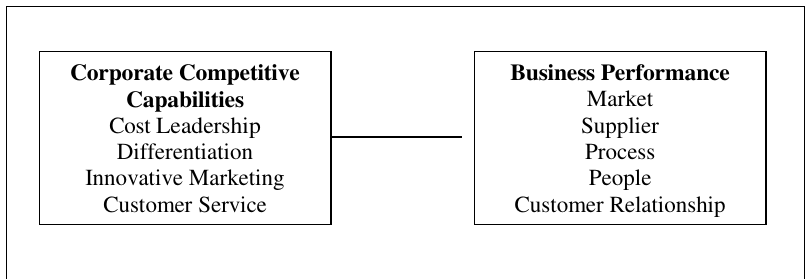
The hypothesis proposes that, corporate competitive capabilities – particularly those with a strong connection to customer satisfaction and market performance – contribute to the improvement of business performance (Stevens, 1989; Watts et al., 1992; Rosenzweig, Roth & Dean, 2003). However, conflict arises between external differentiation and internal cost leadership, which contributes to several types of competition selection schemes (Prajogo, 2007). While cost leadership and differentiation have a positive effect on retail grocery industry performance (Lynch, Keller & Ozment, 2000), there is no direct relationship between corporate competitive capabilities and performance for small firms (Kim, 2006b). The literature demonstrates that there is a significant performance implication for firms that apply innovative marketing techniques (Thomas, Litschert & Ramaswamy, 1991). Researchers have also emphasised that corporate competitive capabilities could enable firms to attain high customer satisfaction and improve future market performance (Innis et al., 1994; Tracey, 2004; Koufteros, Vonderembse & Jayaram, 2005). Indeed, managing capabilities effieciently could help firms enhance their performance and achieve competitive advantage (Fawcett, Calantone & Roath, 2000). From this perspective, the following hypothesis may be made: Hypothesis: The greater the corporate competitive capabilities of a firm, the better its business performance will be
4. Research methodology
4.1The sample and survey instrument
A survey was undertaken using a structured questionnaire, which was the principal means of data collection. The questionnaire survey was conducted throughout Malaysia. The questionnaire was distributed to 950 firms which are categorised as small and medium-sized by mail. One hundred thirtyfive usable questionnaires, which comprises of 14.2 percent response rate were returned. This response rate compares reasonably well with the majority of SMEs in Malaysia (Hooi, 2006; Hashim & Ahmad, 2008; Jusoh et al., 2008).
4.2Measurement
Most of the instruments in the questionnaire are adapted from the previous studies to suit the practice in the Malaysian manufacturing SMEs. The instruments have been tested for face-to-face validity on 12 respondents, randomly selected from the 2008 directory of the Federation of Malaysian Manufacturers (FMM, 2008). All the instruments for corporate competitive capabilities are measured using seven-point Likert scales ranging from 1 “extremely low” to 7 “extremely high”. Meanwhile, the instruments for business performance are measured from 1 “worst in the industry” to 7 “best in the industry”. Appendix A provides the survey instruments which were practiced during the collection of data survey.
5Confirmatory factor analysis
The focus of confirmatory factor analysis (CFA) is to test or confirm specific hypotheses or theories regarding the underlying structure for a set of variables (Netemeyer, Bearden & Sharma, 2003; Pallant, 2007). CFA requires the use of measurement theory in specifying the number of factors and the variable load on each factor (Hair, Black, Babin & Anderson, 2010), and it should be applied when the researcher has some prior knowledge of the underlying latent variable structure (Byrne, 2010).
The overall fit of the hypothesised model is tested using the maximum likelihood chi- square statistics provided in the AMOS programs, including other fit indexes, which are Goodness-Of-Fit Index (GFI), Adjusted Goodness-Of-Fit Index (AGFI), RootMean-Square Error Of Approximation (RMSEA), Standardised RMR, Tucker-Lewis Index (TLI), Comparative Fit Index (CFI) and Normed Chi-Square. If the data fits the models adequately, the regression coefficient and the CR value will be evaluated to test the research hypotheses. In this paper, CFA was measured through: (1) measurement models, (2) first-order measurement models and (3) second-order measurement models. Table 1 demonstrates the final results of CFA for each construct. 6.
Results
According to Figure 2, the model for 27 items of corporate competitive capabilities and 16 business performance constructs shows that the fit indices are good compared to the threshold standard value (X2/df = 1.63, GFI = .802, TLI = .889, CFI = .902, RMSEA = .069 and Standardised RMR = .068). The model then needed to be diagnosed to confirm the above model fit. The standardised residuals absolute value is less than 2.00, and none of MIs suggested the respecification of the model to improve the par value to 0.40. The results show that the model fits and can be tested for further analysis. Moreover, the results of fitting the structural model to the data indicate that the model has a good fit, as indicated by chi-square and degrees of freedom (1.63). Overall, the model also proved to be nomologically valid, as the results for goodnessof-fit were over the threshold values of (X2/df = 1.63, GFI = .802, TLI = .889, CFI = .902, RMSEA = .069 and Standardised RMR = .068. The output would answer the research hypothesis by considering the result of the causal model, that explains 69.1 percent (R2 = 69.1%) of the variance in business performance. Finally, the result accepts the hypothesis, as the specified relation between corporate competitive capabilities and business performance was supported by the data, given the regression coefficient of .831 ( = .83 1) and CR value of 5.983. The result reflects that the relationship is statistically significant, at p<. 001. ë
7Discussion
The multidimensionality of the corporate competitive capabilities co vers the independent and the differential relationship between the four dimensions of corporate competitive capabilities (cost leadership, differentiation, innovative marketing and customer service), and the five dimensions of business performance (market, supplier, process, people and customer relationship) within the context of Malaysian SMEs.
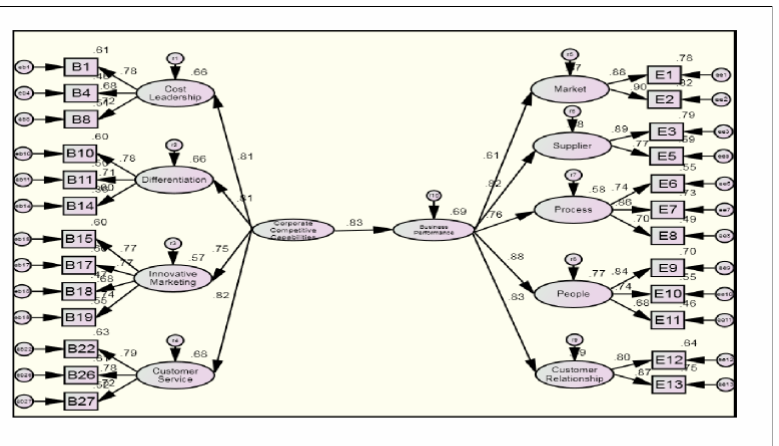
As reported, corporate competitive capabilities were significantly related to business performance ( = .831, p<. 001)). The finding suggests that the achievements of SMEs in Malaysia do absolutely depend on the ability to be more competitive in the market. ë
There is evidence to support the notion of the positive relationship between corporate competitive capabilities and business performance, as demonstrated by Rosenzweig et al. (2003). Cheng, Zhang, Ye and Xia (2006) also agreed with the findings and reported that competitive capabilities were the major contributor to the success of economic development in China. The finding, however, is not consistent with the work of Kim (2006b), which examined how competition capability related to business performance in small and large firms in Korea and Japan. According to the study, the influence of corporate competitive capabilities on business performance was different between small and large firms – as results for large firms in both countries indicated that the relationship was significant. Those findings indicate that firm size plays a significant role in the ability of competitive capability to improve performance. A similar study conducted by Man (2009) also demonstrated the insignificance between corporate competitive capabilities and business performance of 121 Malaysian manufacturing SMEs that examined the relationship between distinctive capabilities, innovativeness and strategy type, and business performance. Therefore, the significant result of the current study provides a new knowledge to be considered for sustaining the development of Malaysian SMEs as it was hypothesized from several different factors. This result indicated that Malaysian SMEs have to improve their competitive capabilities to be more aggressive in the local and global market. The findings also demonstrate that the objectives of many programmes to support the success of Malaysian SMEs have been achieved.
8Conclusions and recommendations
This paper presents a nomological network of constructs that relates a firm’s corporate competitive capability and business performance. This article provides a foundation for research in the area. It develops a theoretical framework for four factors of corporate competitive capabilities that relates these variables to consider their impacts on business performance. Given the important relationship between the variables, the analysis confirmed the higher-order constructs involved in the theoretical framework. These constructs were validated as multidimensional, consisting of four first-order constructs of corporate competitive capabilities (cost leadership, differentiation, innovative marketing and customer service) and five first-order constructs of business performance (market, supplier, process, people and customer relationships). This type of higherorder construct is infrequently analysed in many studies thus, this study makes a significant contribution by analysing the dimensionality and relationship between first-order and second-order constructs. The findings provide a new evidence to the resource-based view (RBV) theory as it showed that the relationship of corporate competitive capabilities with business performance was significant in the Malaysian industry. Therefore, to improve their capabilities, Malaysian SMEs should structure a more efficient plan that focuses on the capacities of developing product and market innovation; gaining access to market intelligence and government support, funding and working capital; and hiring qualified workforces. These capabilities will in turn help SMEs gain the ability to compete in the marketplace. Malaysia also must consider the use of outsourcing as a mechanism to grow and expand more extensively in the market and achieve higher levels of performance. Indeed, it would be more beneficial to the Malaysian SMEs if policy-makers could stress the development of such capabilities individually across the employees of the companies, even though many initiatives have been undertaken to improve entrepreneurship skills and to re-educate employees in new skills and abilities (NSDC, 2010). The findings also provided the basis for further study to carefully examine the existence and dimensionality of the construct of interest, including the re-assessment of suitability of each first-order constructs to the proposed second-order constructs. Further study is suggested to confirm whether the corporate competitive capabilities constructs are really beneficial and meaningful when firms apply them in various circumstances. The re-examination also needs to be particularly focused on SMEs in countries other than Malaysia. The findings will encourage policy-makers to incorporate all major components of firms’ corporate competitive capabilities into the RBV theory. The findings may also challenge policy-makers and practitioners to consider all firm elements before making decisions related to creating, making the most of and improving capabilities with limited resources to achieve superior business performance.
References
- Alasadi, R. & Abdelrahim, A. (2008). Analysis of small business performance in Syria. Education, Business and Society: Contemporary Middle Eastern Issues, 1, No. 1, pp. 50-62.
- Altenburg, T., Hillebrand, W. & Meyer-Stamer, J. (1998). Building Systemic Competitiveness: Concept and Case Studies from Mexico, Brazil, Paraguay, Korea and Thailand. Berlin: German Development Institute.
- Andrews, K. R. (1980). The concept of corporate strategy. Homewood, IL: Richard D Irwin.
- Baines, T. (2004). An integrated process for forming manufacturing technology acquisition decisions. International Journal of Operations & Production Management, 24, No. 5, pp. 447-467.
- Byrne, B. M. (2010). Structural equation modeling with AMOS: Basic concepts, applications, and programming. New York: Routledge Taylor & Francis Group.
- Cheng, H. Y., Zhang, D. M., Ye, M. & Xia, J. (2006). Competitive capability evaluation for middle and small enterprises in regional industries. The Business Review, Cambridge, 5, No. 2, pp. 104-108.
- Chopra, S. & Meindl, P. (2007). Supply chain management: strategy, planning, and operation. Upper Saddle River, NJ: Pearson/Prentice Hall.
- Dess, G. G. & Robinson, J. R. B. (1984). Measuring organizational performance in the absence of objective measures: The case of the privately-held firm and conglomerate business unit. Strategic Management Journal (pre-1986), 5, No. 3, pp. 265-273.
- Dierickx, I., Cool, K. & Barney, J. B. (1989). Asset stock accumulation and sustainability of competitive. Management Science, 35, No. 12, pp. 1504-1511.
- Fawcett, S. E., Calantone, R. J. & Roath, A. (2000). Meeting quality and cost imperatives in a global market. International Journal of Physical Distribution & Logistics Management, 30, No. 6, pp. 472-499.
- Feng, M., Terziovski, M. & Samson, D. (2008). Relationship of ISO 9001:2000 quality system certification with operational and business performance: A survey in Australia and New Zealand-based manufacturing and service companies. Journal of Manufacturing Technology Management, 19, No. 1, pp. 22-37.
- FMM (2008). FMM Directory 2008 Malaysian Industries – Supplying the world with competitive products and services. Kuala Lumpur: Federation of Malaysian Manufacturers.
- Gruber, M., Heinemann, F., Brettel, M. & Hungeling, S. (2010). Configurations of resources and capabilities and their performance implications: An exploratory study on technology ventures. Strategic Management Journal, 31, No. 12, pp. 1337-1356.
- Hair, J. J. F., Black, W. C., Babin, B. J. & Anderson, R. E. (2010). Multivariate data analysis: A global perspective. Upper Saddle River, NJ: Pearson Education.
- Han, S. B., Shaw, K. C. & Maling, E. (2007). The impact of ISO 9000 on TQM and business performance. The Journal of Business and Economic Studies, 13, No. 2, pp. 1-23.
- Hart, S. L. (1995), A natural-resource-based view of the firm. Academy of Management Review, 20, No. 4, pp. 986-1014.
- Hashim, M. K. & Ahmad, S. (2008). Internationalization of Malaysian SME’s influencing factors, sources of information and options. 2008 International Council for Small Business (ICSB) World Conference. Nova Scotia, ICSB.
- Hayashi, M. (2005). SMEs, Subcontracting and economic development in Indonesia: With reference to Japan’s experience. Tokyo: Japan International Cooperation Publishing.
- Hooi, L. W. (2006). Implementing e-HRM: The readiness of small and medium-sized manufacturing companies in Malaysia. Asia Pacific Business Review, 12, No. 4, pp. 465-485.
- Innis, D. E. & La Londe, B. J. (1994). Customer service: The key to customer satisfaction, customer loyalty and market share. Journal of Business Logistics, 15, No. 1, pp. 1-27.
- Jarvis, R., Curran, J., Kitching, J. & Lightfoot, G. (2000). The use of quantitative and qualitative criteria in the measurement of performance in small firms. Journal of Small Business and Enterprise Development, 7, No. 2, pp. 123-134.
- Jusoh, R. & Parnell, J. A. (2008). Competitive strategy and performance measurement in the Malaysian context: An exploratory study. Management Decision, 46, No. 1, pp. 5-31.
- Kim, S. W. (2006a). The effect of supply chain integration on the alignment between corporate competitive capability and supply chain operational capability. International Journal of Operations & Production Management, 26, No. 10, pp. 1084-1107.
- Kim, S. W. (2006b). Effects of supply chain management practices, integration and competition capability on performance. Supply Chain Management: An International Journal, 11, No. 3, pp. 241-248.
- Koufteros, X., Vonderembse, M. & Jayaram, J. (2005). Internal and external integration for product development: The contingency effect of uncertainty, equivocality and platform strategy. Decision Sciences, 36, No. 1, pp. 97-133.
- Laura, B. F., Shawnee, K. V. & Cornelia, L. M. D. (1996). The contribution of quality to business performance. International Journal of Operations & Production Management, 16, No. 8, pp. 44-62.
- Lynch, D. F., Keller, S. B. & Ozment, J. (2000). The effects of logistics capabilities and strategy on firm performance. Journal of Business Logistics, 21, No. 2, pp. 47-67.
- Man, M. M. K. (2009). The relationship between distinctive capabilities, innovativeness, strategy types and the performance of small and medium-size enterprises (SMEs) of Malaysian manufacturing sector. The International Business & Economics Research Journal, 8, No. 11, pp. 21-33.
- McGrath, R. G., MacMillan, I. C. & Venkataraman, S. (1995). Defining and developing a competence: A strategic process paradigm. Strategic Management Journal, 16, No. 4, pp. 251-275.
- Meena, C. & Anil, S. L. (2007). An international perspective on internal controls in small and medium enterprises. The Business Review, Cambridge, 8, No. 1, pp. 80-86.
- Miller, J. G. & Roth, A. V. (1994). A taxonomy of manufacturing strategies. Management Science, 40, No. 3, pp. 285-304.
- MITI (2006). IMP 3 Third Industrial Master Plan 2006-2020: Malaysia towards global competitiveness, Ministry of International Trade and Industry: 766.
- Morrison, A. & Teixeira, R. (2004). Small business performance: A tourism sector focus. Journal of Small Business and Enterprise Development, 11, No. 2, pp. 166-173.
- Narasimhan, R., Jayaram, J. & Carter, J. R. (2001). An empirical examination of the underlying dimensions of purchasing competence. Production and Operations Management, 10, No. 1, pp. 1-15.
- Narasimhan, R., Swink, M. & Kim, S. W. (2005). An exploratory study of manufacturing practice and performance interrelationships: Implications for capability progression. International Journal of Operations & Production Management, 25, No. 9/10, pp. 1013-1033.
- Ndubisi, N. O. & Salleh, A. S. (2006). SMEs in Malaysia: Development Issues. In N. A. Ndubisi and A. S. Salleh, Small and Medium Enterprises (SMEs): Malaysian and Global Perspectives. Selangor, Malaysia Pearson/Prentice Hall.
- Netemeyer, R. G., Bearden, W. O. & Sharma, S. (2003). Scaling procedures: Issues and applications. Thousand Oaks, CA: Sage Publications.
- NSDC (2009). SME Annual Report 2008 – Rising to meet global challenges. Kuala Lumpur: National SME Development Council.
- NSDC (2010). SME Annual Report 2009/10: Transformation to the New Economic Model. Kuala Lumpur: SME Corporation Malaysia.
- Ogulin, R. (2003). Globalization and Regionalization of Supply Chains. In J. Gattorna, Gower Handbook of Supply Chain Management. Hants: Gower.
- Pallant, J. F. (2007). SPSS Survival Manual: A step by step guide to data analysis using SPSS for Windows (Version 15). Crows Nest, NSW: Allen & Unwin.
- Pelham, A. M. & Wilson, D. T. (1996). A longitudinal study of the impact of market structure, firm structure, strategy and market orientation culture on dimensions of small-firm performance. Journal of the Academy of Marketing Science., 24, No. 1, pp. 27-43.
- Prajogo, D. I. (2007). The relationship between competitive strategies and product quality. Industrial Management + Data Systems, 107, No. 1, pp. 69-83.
- Pratten, C. (1991). The Competitiveness of Small Firms. Cambridge: Cambridge University Press.
- Quinn, R. E. & Rohrbaugh, J. (1983). A spatial model of effectiveness criteria: Towards a competing values approach to organisational analysis. Management Science, 29, No. 3, pp. 363-377.
- Rao, K., Stenger, A. J. & Haw-Jan, W. (1994). Training future logistics managers: Logistics strategies within the corporate planning framework. Journal of Business Logistics, 15, No. 2, pp. 249-272.
- Rosenzweig, E. D., Roth, A. V. & Dean, J. W. (2003). The influence of an integration strategy on competitive capabilities and business performance: An exploratory study of consumer products manufacturers. Journal of Operations Management, 21, No. 4, pp. 437-456.
- Sapienza, H. J., Smith, K. G. & Gannon, M. J. (1988). Using subjective evaluations of organizational performance in small business research. American Journal of Small Business, 12, No. 3, pp. 45-53.
- Simpson, M., Padmore, J., Taylor, N. & Frecknall-Hughes, J. (2006). Marketing in small and medium sized enterprises. International Journal of Entrepreneurial Behaviour & Research, 12, No. 6, pp. 361-387.
- Smith, T. M. & Reece, J. S. (1999). The relationship of strategy, fit, productivity and business performance in a services setting. Journal of Operations Management, 17, No. 2, pp. 145-16 1.
- Song, M., Droge, C., Hanvanich, S. & Calantone, R. (2005). Marketing and technology resource complementarity: An analysis of their interaction effect in two environmental contexts. Strategic Management Journal, 26, No. 3, pp. 259-276.
- Sousa, S. D., Aspinwall, E. M. & Rodrigues, A. G. (2006). Performance measures in English small and medium enterprises: Survey results. Benchmarking, 13, No. 1/2, pp. 120-134.
- Stalk, G., Evans, P. & Shulman, L. E. (1992). Competing on capabilities: The new rules of corporate strategy. Harvard Business Review, 70, No. 2, pp. 54-66.
- Stevens, G. C. (1989). Integrating the supply chain. International Journal of Physical Distribution & Logistics Management, 19, No. 8, pp. 3-8.
- Swartz, T. A. & Iacobucci, D. (2000). Handbook of Services Marketing & Management. Thousand Oaks, CA: Sage Publications.
- Tambunan, T. (2007). Entrepreneurship development: SMEs in Indonesia. Journal of Developmental Entrepreneurship, 12, No. 1, pp. 95-118.
- Teece, D. J., Pisano, G. & Shuen, A. (1997). Dynamic capabilities and strategic management. Strategic Management Journal, 18, No. 7, pp. 509-533.
- Thomas, A. S., Litschert, R. J. & Ramaswamy, K. (1991). The performance impact of strategy-manager coalignment: An empirical examination. Strategic Management Journal, 12, No. 7, pp. 509-522.
- Thomas, W. Y. M., Theresa, L. & Ed, S. (2008). Entrepreneurial competencies and the performance of small and medium enterprises: An investigation through a framework of competitiveness. Journal of Small Business and Entrepreneurship, 21, No. 3, pp. 257-276.
- Ting, O. K. (2004). SMEs in Malaysia: Pivotal Points for Change. Available from: http://74. 125.153. 1 32/search?q=cache:CVRk1kCCixcJ:aplikasi.kpkt.gov.my/ ucapan.nsf/6c7fcfbe486f405c48256e5a000bd038/6 10f5a532bc9245c48256fdc0 02eb0d2%3FOpenDocument+SMEs+In+Malaysia:+pivotal+points+for+change &cd=1&hl=en&ct=clnk [Accessed 20 October 2009].
- Tracey, M. (2004). A holistic approach to new product development: New insights. Journal of Supply Chain Management, 40, No. 4, pp. 37-55.
- Tracey, M., Vonderembse, M. A. & Lim, J.-S. (1999). Manufacturing technology and strategy formulation: Keys to enhancing competitiveness and improving performance. Journal of Operations Management, 17, No. 4, pp. 411-428.
- UNCTAD (2001). Growing Micro and Small Enterprises in LDCs - The “Missing Middle” in LDCs: Why Micro and Small Enterprises are not Growing. Geneva: United Nations.
- Venkatraman, N. & Ramanujam, V. (1986). Measurement of business performance in strategy research: A comparison of approaches. Academy of Management Review, 11, No. 4, pp. 801-814.
- Voss, C., Blackmon, K., Hanson, P. & Oak, B. (1995). The competitiveness of European manufacturing – A four-country study. Business Strategy Review, 6, No. 1, pp. 1-25.
- Wall, T. D., Michie, J., Patterson, M., Wood, S. J., Sheehan, M., Clegg, C. W. & West, M. (2004). On the validity of subjective measures of company performance. Personnel Psychology, 57, No. 1, pp. 95-118.
- Watts, C. A., Kee Young, K. & Hahn, C. K. (1992). Linking purchasing to corporate competitive strategy. International Journal of Purchasing and Materials Management, 28, No. 4, pp. 2-8.
- Wood, E. H. (2006). The internal predictors of business performance in small firms. Journal of Small Business and Enterprise Development, 13, No. 3, pp. 441-452.