Global Poverty Metrics and the Problem of Missing Context
- Entrepreneurship and Innovation Hub, School of Business and Entrepreneurship, American University of Nigeria
Journal of Business Management and Accounting 16(2) (2026) · https://doi.org/10.32890/jbma2026.16.2.3
Abstract
This study employs a mixed conceptual and secondary data analysis approach to investigate the poverty-environment nexus in Sub-Saharan Africa. Drawing on the Alkire-Foster Multidimensional Poverty Index (MPI) and World Bank data from 41 Sub-Saharan African countries, it challenges the over-reliance on standardized global indices for contextual understanding of poverty and environmental sustainability. Grounded in a tripartite theoretical framework integrating behavioral, structural, and political theories of poverty, the study demonstrates how aggregated MPI metrics conceal localized deprivation patterns and how variation in survey recency across countries introduces significant methodological bias. Critically, the six countries showing MPI improvement (Benin, Comoros, Kenya, Eswatini, Mozambique, and Tanzania) are also those with the most recent data (2021–2023), raising questions about whether observed gains reflect genuine progress. The analysis also reveals there is a disconnection between the numbers of national agro-environmental policies and their implementation effectiveness, underscoring the fact that policies alone do not result in poverty reduction or environmental sustainability. To address these gaps, the study recommends the adoption of disaggregated local data, community-based poverty indicators, and more frequent dataset updates. The findings advance understanding of context-specific poverty measurement and offer a framework for evaluating the applicability of global indices across diverse national settings.
Keywords: Multidimensional poverty index, poverty-environment nexus, Sub-Saharan Africa, sustainable development goals (SDGs), deprivations.
INTRODUCTION
Poverty and environmental degradation are complex, interconnected challenges that manifest in diverse forms worldwide. Economists, scholars, governments, and international organizations employ varied theories, policies, and programs to address poverty in different contexts. However, multidimensional poverty severely undermines sustainability and environmentally responsible behavior. Efforts in this area must therefore reflect the dynamic changes needed to inform the design and implementation of relevant Sustainable Development Goals (SDGs) (Hickmann et al., 2024).
The World Employment and Social Outlook Report by Ernst et al. (2024) projected a slight increase in the 2024 global unemployment rate, driven by a high concentration of working poverty and the negative impacts of climate change in developing countries. The 2023 Global Multidimensional Poverty Index (MPI) found that 50% of the 1.1 billion people living in poverty are below 18 years old. Most live in rural areas (84%), predominantly in Sub-Saharan Africa (534 million, 48%) and South Asia (389 million, 35%) (Poverty & Initiative, 2023). The 2024 MPI update shows these trends persist, with rural and child poverty rates unchanged. Poverty levels have risen slightly in Sub-Saharan Africa (19 million) and South Asia (13 million). However, six Sub-Saharan African countries (Benin, Comoros, Kenya, Eswatini, Mozambique, and Tanzania) have made notable progress, recording significant reductions in poverty incidence and MPI values (OPHI & UNDP, 2024).
These statistics depict the scale, dynamics, and distribution of poverty. Yet relying primarily on numerical data can be misleading, as the experience of poverty is relative and varies widely across countries. Understanding poverty also requires contextual insight that aggregate figures alone cannot provide. This conceptual research investigates the poverty-environment nexus, drawing on secondary data from the World Bank and the Oxford Multidimensional Poverty Index Reports. It argues that understanding this nexus requires looking beyond standardized datasets and recognizing the context- specific nature of these "wicked issues."
The relationship between poverty and environmental issues is complex, dynamic, and shaped by diverse policy interests, measurement frameworks, and temporal considerations. Poverty affects environmental behavior, sustainability, health, economic well-being, and individual lifestyles in wide-ranging ways. This research advances the field by demonstrating how applying universal indices without sufficient contextual grounding risks misrepresenting on-the-ground realities.
This study also contributes to ongoing discussions on the behavioral, structural, and political dimensions of poverty. These dimensions are often underrepresented in standardized global poverty frameworks. Behavioral perspectives show how socio-economic pressures, cultural perceptions, social norms, and coping mechanisms shape poverty-related decisions and environmental practices. Structural and political perspectives highlight the role of institutional gaps, inequalities, governance systems, and resource distribution in determining poverty outcomes. By integrating all three perspectives, this study underscores the value of context-sensitive, grounded approaches to poverty measurement and environmental sustainability interventions.
Existing literature reflects the wide range of meanings, dimensions, and scope attributed to poverty. For instance, poverty is described as a condition in which individuals or families lack sufficient resources to participate in the minimum way of life in their respective member states (Communities, 1975). This definition highlights poverty's relative and context-dependent nature, stressing the role of internal benchmarks. Some individuals may even self-identify as poor to access poverty alleviation programs (Deaton, 2006). Yet no universally accepted definition or measure of poverty exists (Roser, 2023). A multidimensional perspective using a systems model is therefore essential. It enables a broader understanding of deprivation indicators such as poor nutrition, child mortality, limited education, restricted access to essential services, and low asset ownership that characterize poverty (OPHI & UNDP, 2024).
This study adopts a tripartite theoretical framework, integrating behavioral (individual, cultural, and motivational), structural (demographic, labor market), and political (power, institutions, and policies) theories to analyze the behavior-poverty nexus (Brady, 2019). Bradshaw (2007) noted that poverty theories are rooted in "culture and belief models, traits, geographical differences, and the interplay of political and economic realities" (See Figure 1). By contrast, sustainability and environmental problems transcend geographical boundaries, generating global impacts derived from localized poverty- sustainability ecosystems. This paper is structured into five sections. Section 1 deconstructs the Multidimensional Poverty construct. Section 2 explores the Multidimensional Poverty-Environmental Behavior Nexus. Section 3 discusses Context and Evolution. Section 4 outlines the Methodology and presents the discussion. Finally, Section 5 addresses Limitations and concludes the study.
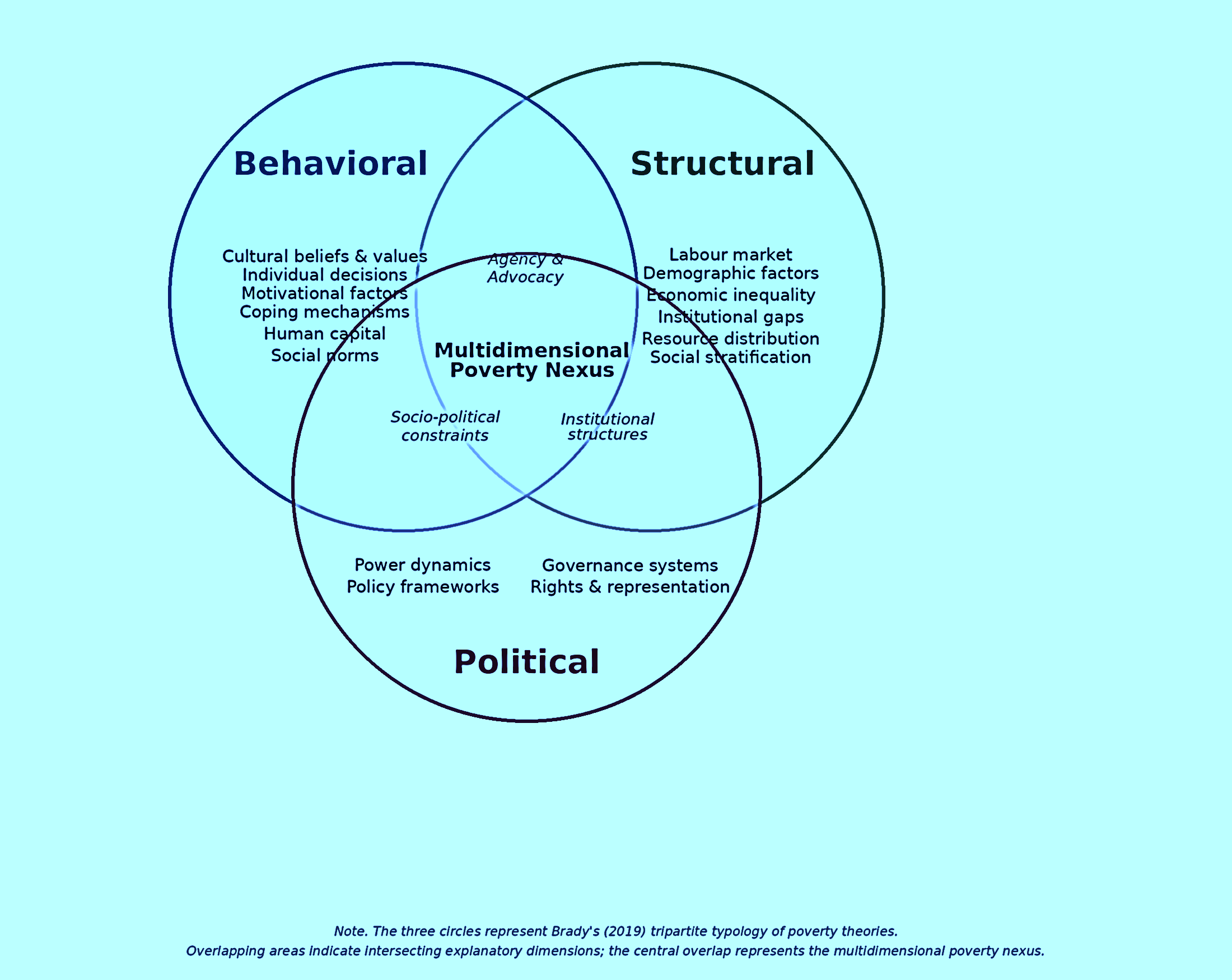
Note: The three circles represent Brady’s (2019) tripartite typology of poverty theories. Overlapping areas indicate intersecting explanatory proportions and the central overlap depicts the multidimensional poverty nexus. Source: Adapted from (Brady, 2019).
Unbundling Multidimensional Poverty
Multidimensional poverty is widely recognized as a comprehensive framework for measuring poverty (Khanam, Mohiuddin, Hoque, & Weber, 2018; Suppa, 2022). A systemic perspective is essential for understanding multidimensional poverty, particularly its endemic nature in specific contexts. It illuminates how multiple deprivations interact and affect individuals across social, economic, and contextual dimensions (Poverty & Initiative, 2023). Despite sustained efforts by economic actors at all levels, poverty continues to evolve and is now understood as a multidimensional construct reflecting deprivations and failures across multiple dimensions of life (Kakwani & Silber, 2008). This perspective reinforces the argument that poverty cannot be understood through economic indicators alone.
Behavioral, institutional, structural, and political realities all shape how deprivation is experienced across societies. The United Nations Sustainable Development Goals (SDGs) place "ending poverty" at the center of a global call to action, recognizing its link to all other SDGs by 2030. Progress has been made, but it is threatened by pandemics, armed conflicts, climate change, unintended consequences of welfare programs, economic tensions, the Fourth Industrial Revolution, rising inequality, artificial intelligence, and shifting labor markets. Growing global disparities have raised concerns that the SDGs may become unattainable (Grek, Tichenor, & Bandola-Gill, 2023; Nations, 2023). Persistent global trends, behavioral factors, inequality, and climate change’s socioeconomic impacts all suggest that eliminating global poverty will remain a formidable challenge. Factors such as survival-oriented behavior, imperfect market conditions, global economic fragmentation, and top-down development models impede progress. Evidence from developing and developed countries reveals the influence of financial scarcity on individual behaviors across various economic activities, leading to diverse manifestations of poverty (De Bruijn & Antonides, 2022). Understanding poverty is further complicated by the misconception that it is synonymous with being poor, a perception reinforced by stereotypical imagery from developing countries. Yet empirical evidence confirms that poverty also exists in developed contexts (Suppa, 2022). This global disparity drives migration toward perceived safe havens, as people seek better living standards and refuge from conflict.
Contextual realities, economic systems, institutional differences, and measurement approaches all contribute to inconsistencies in poverty classifications. Poverty is frequently assessed using benchmarks from developed countries that focus on currency values and living standards, despite the distinct realities of poverty across contexts (Banerjee, Benabou, & Mookherjee, 2006). Varying international poverty lines further complicate cross-national comparisons. This study uses the World Bank International Poverty Line ($2.15 per day) as a reference, consistent with the United Nations' approach to monitoring global extreme poverty (Hasell & Arriagada, 2022).
Multidimensional Poverty-Environmental Behavior Nexus
The poverty-environment nexus is complex and context-dependent, as reflected by the data from 46 Sub-Saharan African countries (Baloch, Khan, & Ulucak, 2020; Ssekibaala & Kasule, 2023). Rural residents are commonly assumed to experience greater deprivations than urban areas globally (Alkire, Kanagaratnam, & Suppa, 2023). Around five to six people living in poverty reside in Sub-Saharan Africa or South Asia: 534 million (47.8 percent) in Sub-Saharan Africa and 389 million (34.9 percent) in South Asia (Alkire, Kanagaratnam, & Suppa, 2023).
Poverty is not merely a matter of individual choice; it is often rooted in systemic and institutional factors, cultural norms, and deep-seated inequalities. This underscores the importance of behavioral, structural, and political perspectives in explaining how poverty shapes environmental practices, sustainability decisions, and resource access across societies. Individuals born into low-income families may face disadvantages shaped by immediate circumstances and broader societal structure. The 2024 MPI report "Poverty amid Conflict" shows that environmental behaviors are increasingly affected by conflicts, displacement, pollution, and uncertainty, which impede sustainability goals. At the macro level, disparities in resource distribution across geographical contexts, social classes, family sizes, and demographic groups significantly shape the poverty-environment dynamic. Human decisions and sustainability-related behaviors can contribute to the persistence of poverty. Moyer et al. (2023) found a direct relationship between climate-induced poverty and human behaviors, projecting that climate change could push 40 million additional people into extreme poverty by 2050, posing a significant threat to achieving the SDGs. While a significant proportion of individuals experiencing poverty reside in rural areas (84%), contextual understanding is crucial. Though rural areas tend to be poorer than urban ones, immersions in some rural contexts in Sub-Saharan Africa reveal that these communities may also experience benefits such as lower pollution levels, access to organic food crops, and stronger environmental stewardship. They are often more protective of their environment since their livelihoods depend on it.
However, external actors pursuing economic interests that disrupt the natural environmental balance often undermine their efforts. Policymakers and researchers must adopt contextual measurement frameworks that account for rural areas' unique cultural and environmental circumstances and actively involve these communities in designing poverty reduction initiatives. Addressing poverty in all its forms requires tackling the interconnected deprivations experienced by individuals and enhancing their ability to escape poverty dimensions (Poverty & Initiative, 2023). Each context shapes the multidimensional nature of poverty, the types of institutions, social norms, and individual cognitive perceptions. Understanding these influences requires exploring the impact of soft personality elements such as trait- personality, individual-group dynamics, economic-social environment, personal-family orientation, and attitude-mindsets. Lever (2013) identified context, causes-beliefs, self-classification, and exit possibilities as key perceptual dimensions of multidimensional poverty.
Poverty constrains individual choices and decision-making in ways that negatively affect the environment. Environmental degradation remains a central concern in this discourse, particularly in developing countries, where survival needs and long-term sustainability are often in tension (Uitto, 2016). This raises an important question: should the poverty-environment discourse focus only on developing countries and behaviors like firewood use, or should it extend to developed countries and larger-scale pollution from industry and transportation? Regardless of the perspective, it is critical to acknowledge that these behaviors negatively affect the environment. Bucknall, Kraus, and Pillai (2000) emphasized that while environmental resources are essential for economic development, efforts must be made to balance poverty reduction with ecological sustainability. Individuals experiencing poverty may be exposed to the physical and mental dimensions, while those living in urban areas or not classified as poor may also experience similar adverse effects on their health and well-being. Researchers emphasize the importance of understanding the poverty-environment nexus through cognitive and behavioral dimensions, particularly when investigating economic inequities (Hoyt, Billingsley, Burnette, Becker, & Babij, 2023).
Policymakers and researchers should adopt localized measurement frameworks that reflect rural areas' distinct cultural and environmental circumstances. This calls for greater community-based participation in designing and implementing poverty reduction initiatives. Such bottom-up approaches leverage traditional knowledge, customs, and practices in sustainability management. Participatory mapping, for example, can help communities identify perceived risks and strengthen community-based adaptation strategies.
The figure itself is in the PDF version.
Note:The diagram illustrates the interconnected dimensions of poverty, where each node reinforces the others, creating a “web” that traps individuals and communities. The Author added an additional dimension of Environmental Degradation, Culture & Context cuts across all nodes as a cross-cutting factor. Source: Adapted from Chambers (2013).
Chambers's (2013) Web of Poverty framework identifies twelve key components of multidimensional poverty: institutions and access, poverty of time, seasonal dimensions, and places of the poor, insecurities, physical ill-being, material poverty, social relations, ascribed and legal inferiority, lack of political clout, lack of information, and lack of education/capabilities. These components adapt to context and evolving poverty dimensions (See Figure 2). This study added three components to the framework: environmental degradation, culture, and context, grounded in the literature review and practical insights. This augmented framework enables a comprehensive investigation of the poverty- environment nexus and a deeper understanding of how these constructs interconnect.
Context and Evolution
Poverty’s persistent association with developing countries, its presence in affluent nations, and the limited success of poverty reduction efforts all raise fundamental questions. Answering them requires acknowledging the multidimensional nature of poverty and each region's unique behavioral, environmental, and institutional context. This underscores the importance of integrating behavioral, structural, and political perspectives when examining poverty and environmental sustainability.
The extensive literature on poverty highlights its fluidity and complexity across diverse perspectives. Examples include studies on the base of the pyramid (London, 2012), Europe and US poverty (Goedemé, Decerf, & Van den Bosch, 2022; Martí & Ródenas, 2024), Poverty in Asia (Wan & Sebastian, 2011), foreign aid (Anetor, Esho, & Verhoef, 2020; Mahembe & Odhiambo, 2019), youth poverty (Taiwo, Oluwole, & Ayooluwa, 2022), effects of forced displacements (Admasu et al., 2021), measurements (Deaton, Rausser, & Zilberman, 2020), poverty alleviation among Muslims (Ummulkhayr, 2018), rural poverty (Poverty & Initiative, 2022), subjective dimension (Nandori, 2024), strengths of people (Frankenhuis & Nettle, 2020). Although poverty is concentrated in Sub-Saharan Africa, it also exists in developed nations such as the United States, the United Kingdom, and European countries (Shrider & Creamer, 2023; Stojilovska et al., 2023). However, the experience of poverty in these contexts differs significantly from that in developing countries. Therefore, a context-based, two- pronged approach focused on poverty and the environment is essential.
The timeline of global efforts to frame the poverty construct demonstrates the evolutionary nature of the poverty discourse. Pro-environmental and sustainable behaviors are influenced by a complex interplay of internal and external factors operating at micro, macro, and institutional levels. Poverty- induced sustainability and environmental actions manifest differently across contexts, reflecting variations in poverty dimensions and environmental problems. For example, individuals residing in informal settlements or rural areas may be compelled to use firewood or charcoal for cooking due to economic constraints despite preferring cleaner energy sources. While this contributes to environmental issues and carbon emissions, the scale of this impact is smaller than that of industrial and transportation emissions in urban areas. Private and public sector initiatives in African cities have promoted energy- conserving stoves and briquettes. Immersion experiences in East Africa show that behavioral change strategies using low-cost innovative technologies can be effective without imposing significant lifestyle changes, by appealing instead to local values and cultural norms.
External forces, population dynamics, geography, economic conditions, and environmental degradation can nonetheless exacerbate and perpetuate poverty. Barbier (2010) illustrates this through the "poverty- environment trap": survival needs often necessitate exploiting environmental resources. Individuals experiencing poverty may live closer to nature, making this nexus central to understanding the global poverty discourse. Adopting a granular perspective on multidimensional poverty data yields more realistic insights and solutions than a region-based approach. Frankenhuis and Nettle (2020) urged researchers to move beyond cultural biases and adopt a contextual understanding of human behavior. People experiencing poverty often develop competencies that help them to survive difficult realities, which Ellis et al. (2022) term “hidden talents in harsh environments.” An analysis of the global agricultural value chain further shows how farm laborers and small-scale farmers typically earn minimal returns at the lowest points in the supply chain. Aggregated MPI metrics can conceal localized deprivation patterns. For instance, a region may show average improvements in clean water access while marginalized communities still rely on unsafe sources, which is a reality masked by the aggregated data.

Source: 2023 Multidimensional Poverty Index (Poverty, 2023). Values show number of people (millions) deprived in eachAfrica indicator. Regions: Arab States: East Asia & Pacific: Europe & Central Asia: Latin America & Caribbean: South Asia: Sub- Saharan Africa.
As illustrated in Figure 3, the mix of deprivations a household faces can create or perpetuate poverty traps. The specific combination of deprivations significantly influences whether a household remains chronically poor or escapes poverty (Thorbecke, 2013). For example, a household with many children is likely to face greater pressure and severe deprivations than one comprising mainly working-age adults.
The figure itself is in the PDF version.
Note : Key themes shown in italics in the original source are retained here for reference. Source: Adapted from (Paul, D. 2021)
Figure 4 depicts the evolution of poverty definitions and the global poverty-environment nexus as a dynamic, fluid process. Reviews of international summits reveal a consistent theme of change. This historical trend, combined with poverty’s multifaceted dimensions, suggests ongoing evolution in both the UN SDGs and the understanding of multidimensional poverty. New themes will likely emerge as global and local challenges shift. Existing research and multidisciplinary perspectives support links between multidimensional poverty deprivations and the UN SDGs. Disaggregation in developing and developed country contexts reveals diverse survival strategies. The literature highlights the resilience and adaptability of responses within these contexts. For instance, necessity entrepreneurship, local innovation, creativity, and inclusive cooperatives help establish micro-enterprises and create locally adapted pathways to empowerment for people experiencing poverty.
METHODOLOGY
This study employs a mixed conceptual and secondary data analysis approach. Conceptually, it synthesizes behavioral, structural, and political theories of poverty to develop an integrative framework for the poverty-environment nexus. The 2024 MPI data presented in Figure 5 were compiled from multiple nationally representative surveys; a full list is provided in Table 1 in the Appendix. Empirically, it draws on secondary data from the World Bank and the Oxford Poverty and Human Development Initiative (OPHI) covering 41 Sub-Saharan African countries (see Table 2 in the Appendix). The analysis applies the Alkire-Foster method to measure multidimensional poverty. The Sub-Saharan Africa focus was chosen to maximize contextual relevance, given that this region accounts for the largest share of countries in the global MPI dataset. A major limitation of this methodological approach is that the secondary datasets vary in survey recency and methodology across countries, constraining direct cross-country comparisons.

Source: Global Multidimensional Poverty Index (MPI) Databank 2024 developed by Ayush Patel using data by Alkire, Kanagaratnam and Suppa (2024a and 2024b).
DISCUSSION
The 2024 Multidimensional Poverty Index (MPI) data reveal that Sub-Saharan African countries constitute a significant proportion (37%, or 41 out of 112) of those surveyed (Poverty & Initiative, 2024). The remaining 63% of surveyed countries are distributed across: Latin America and the Caribbean (21%, 23 countries), East Asia and the Pacific (14%, 16 countries), Europe and Central Asia (13%, 14 countries), Arab States (9%, 10 countries), and South Asia (7%, 8 countries). This uneven distribution, combined with differences in survey type and recency, introduces potential biases into cross-country MPI comparisons.
Within Sub-Saharan Africa, there is considerable variation in data recency. As of the 2024 MPI, only 24 of the 41 Sub-Saharan African countries had survey data from 2019 or later (see Table 3). The most recent data come from Mozambique (2022-2023), followed by Eswatini and Benin (2021-2022), Ghana, Kenya, Tanzania, Comoros (2022), Côte d'Ivoire, Burkina Faso, Madagascar, and Nigeria (2021-2022), Gabon and Mauritania (2019-2021), Gambia, Rwanda, Liberia, and Malawi (2019-2020), and Senegal, Sierra Leone, Ethiopia, São Tomé and Príncipe, Zimbabwe, Chad, and Seychelles (2019-2020). The remaining 17 countries rely on data from 2018 or earlier, limiting the comparability and currency of their poverty assessments.
The recency of survey data shapes assessments of multidimensional poverty reduction. The 2024 MPI reports declining poverty in six Sub-Saharan African countries: Benin, Comoros, Kenya, Eswatini, Mozambique, and Tanzania, which are also among those with the most current data (2021-2023). This overlap raises an important methodological question: does the observed reduction reflect a genuine improvement in living conditions, or does it primarily reflect the use of more recent data capturing conditions that older surveys missed? This ambiguity underscores the need for longitudinal, harmonized survey data across the region before drawing firm conclusions about poverty trends.
Survey data disparities also complicate the monitoring of poverty-related environmental problems. As Figure 5 illustrates, there is a continuum of MPI deprivation levels among Sub-Saharan African countries, with Niger, Chad, the Central African Republic, Burundi, and Madagascar exhibiting the highest levels, while São Tomé and Príncipe, Gabon, Eswatini, South Africa, and Seychelles show the lowest. Critically, however, these rankings must be interpreted with caution. Niger's top-ranking deprivation, for instance, is based on 2012 survey data, which is more than a decade old and may not reflect current conditions. Rankings could shift substantially if all countries were assessed using recent, harmonized data. The absence of synchronized and complete data remains a significant obstacle to effective policymaking and targeted interventions to address the poverty - environment nexus in Sub- Saharan Africa.

Note: EU-level policies are also assigned to individual countries within the European Union. Data source: Wuepper et al. (2024). OurWorldInData.org/environmental-impacts-of-food | CC BY.
The data in Figure 6 provide insights into the number of government policies focused on the environmental impacts of agricultural practices, such as policies related to pesticides, fertilizers, biodiversity, forests, and land use across 41 Sub-Saharan African countries. This section analyzes the relationship between these policies and multidimensional poverty indicators, arguing that more policies do not automatically translate to better environmental outcomes or poverty reduction. Tackling these complex environmental and poverty-related problems requires a holistic approach driven by economic agents at both the macro and micro levels. The data also showcases the number of institutional policies aimed at addressing aspects of poverty deprivation.
Insights from the joint UN Poverty-Environment Initiative (PEI) and the United Nations Environment Programme in some African countries (2005-2018) recommended a holistic framework to investigate and tackle poverty-environment problems, identifying system inefficiencies and failures as fundamental causes. They also emphasized the interconnectedness of poverty deprivation indicators, where the impacts of one deprivation exacerbate others.
It is observed that disparities exist in government commitments to environmental conservation despite its negative impact on multidimensional poverty indicators. The data reveal a clustering: only six African countries (Kenya, South Africa, Rwanda, Burkina Faso, Malawi, and Liberia) have between 20 and 44 agro-environmental policies. Conversely, eight countries have the lowest number of policies (ranging from 0 to 5.5), including Somalia, Guinea-Bissau, Comoros, Chad, Eswatini, Mauritania, Benin, and Burundi. Comparing the policies of Kenya, South Africa, and Rwanda to their poverty index rankings suggests a complex relationship where policy implementation and effectiveness may be more critical factors than the number of policies. For example, despite perceived challenges, Liberia and Malawi have demonstrated significant national commitments to tackle environmental poverty-related problems.
The dearth of institutional environmental conservation policies in Somalia and other countries can be attributed to conflicts, weak institutional government structures and commitment, and other contextual factors. However, it would be misleading to assume that countries with approximately 14 policies (Tanzania, Nigeria, Mali, Lesotho, and Ethiopia) are necessarily more committed than others, as factors such as relative population size, gross domestic product, and other indicators must be considered. For example, given Nigeria's population and economic standing in Africa, the number of policies might still be insufficient to tackle these complex problems effectively. This highlights a key limitation: these aggregate numbers do not reveal the policies' quality, scope, or enforcement.
While the number of policies in place can signal sustainability commitment, what matters more is whether they are implemented effectively and are suited to rapidly changing poverty and environmental dynamics. Policy formulation process must be inclusive, collaborative, and grounded in theory of change principles. Top-down approaches are more likely to fail than policies co-designed through contextual and cooperative models.
Policy effectiveness is also undermined by inequalities, unemployment, and broader socioeconomic pressures. The data on policy availability across Africa highlight the importance of national-level environmental intent. This intent must be translated into flexible, context-sensitive implementation actions. Holistic impact also requires investigation of broader linkages with other development indices. In summary, Figure 6 reveals a wide spectrum of policy commitments across African nations, but the numbers of policies alone is an insufficient measure of progress. Effective implementation, contextual relevance, and meaningful community involvement are essential for converting policy commitments into tangible gains in environmental sustainability and poverty reduction.
LIMITATION
This conceptual paper has several limitations. Its reliance on secondary data from the World Bank and OPHI introduces inherent constraints. These datasets, while broad in scope, may not fully capture local contextual nuances and are subject to biases in data collection and reporting. Data comparability across the 41 Sub-Saharan African countries is also limited by differences in survey methodology, timing, and indicator definitions. This challenge is directly reflected in the findings, where countries with older data (e.g., Niger, 2012) cannot be meaningfully compared with those using surveys from 2021–2023. These inconsistencies strengthen the paper’s central argument: aggregated global poverty metrics require careful contextual interpretation before informing policy.
The conceptual nature of this research limits the generalizability of its findings. Empirical validation through primary data collection, including household surveys, ethnographic fieldwork, and context- specific case studies, is needed to test the proposed framework and deepen understanding of how poverty and environmental issues interact in specific national settings. Comparative studies across countries with similar MPI profiles but different policy environments would be particularly valuable.
A further limitation is the scarcity and non-uniformity of in-country surveys on multidimensional poverty. Outdated survey data distort the true picture of deprivation and can lead to misleading rankings. Niger is a case in point: its position as the most deprived country in Figure 5 is based on a 2012 Demographic and Health Survey, making direct comparisons with countries using 2021–2023 data methodologically unsound. Similarly, the 2019 Quarterly Labor Force Survey (QLFS) underpins Seychelles' MPI estimate. This data scarcity is not unique to Sub-Saharan Africa; obtaining reliable, comprehensive data for all MPI deprivation indicators is a global challenge that constrains the accuracy of cross-country poverty assessments. Finally, the exclusive focus on Sub-Saharan Africa limits the transferability of findings to other developing regions with distinct socioeconomic and environmental profiles. Future research should test the practicability of the proposed framework in South Asia, Latin America, and the Arab States, regions that also feature prominently in the MPI dataset but face different structural constraints. Cross-regional comparative studies would help determine which elements of the framework are universal and which require contextual adaptation.
CONCLUSION
This research affirms that poverty is a multifaceted phenomenon, spanning economic deprivation and deeply intertwined with social, environmental, and political dimensions (Alkire et al., 2023; Chambers, 2013). The findings further demonstrate how behavioral, structural, and political factors shape the relationship between poverty conditions and environmental sustainability. Specifically, the variation in MPI scores and policy availability across Sub-Saharan Africa reflects the structural inequalities and governance gaps that perpetuate the poverty-environment trap in different national contexts. This paper advances understanding of the poverty-environment nexus in Sub-Saharan Africa by documenting the complex, self-reinforcing cycle between poverty and environmental degradation. It acknowledges the importance of data while directly challenging the over-reliance on standardized, aggregated indicators for effective policy, a reliance that can obscure local realities and mislead intervention design.
This study argues that policymakers must look beyond global datasets and ensure national poverty- reduction policies are framed through theory of change models and co-designed with all relevant stakeholders (Masron et al., 2019). Micro-level data analysis should integrate contextual, cultural, and behavioral lenses alongside deductive and inductive approaches to build a complete picture. Closing the gap between policy intent and implementation is essential for moving toward a holistic, equitable development paradigm that prioritizes both people and the planet. This research makes three contributions to the literature. First, it proposes a framework for systematically evaluating the applicability of global poverty indices in specific regional contexts, grounded in Brady's (2019) tripartite typology of behavioral, structural, and political theories. Second, it demonstrates that tackling the poverty-environment nexus requires sensitivity to the evolving, interdependent dimensions of multidimensional deprivation, including creativity and necessity entrepreneurship as adaptive responses. Third, it proposes a future research agenda: deprivation indicators should be expanded to incorporate soft factors such as technology adoption, cultural practices, and subjective well-being, consistent with Mekonnen’s (2024) call to include welfare dimensions in the MPI. Practically, this study recommends that policymakers and economic agents should prioritize the use of disaggregated local data, develop community-based poverty metrics co-designed with affected populations, and commit to more regular updates of poverty-related datasets. Future studies should also test this framework through primary data collection and case studies in diverse Sub-Saharan African contexts and examine its adaptability in other developing regions.
AUTHOR DECLARATION ON THE USE OF GENERATIVE AI
"During the manuscript revision, the generative AI tool Grammarly was used to improve the language and clarity of the text. No content was generated by AI that contributes to the intellectual or analytical aspects of the research, including conceptual development, data interpretation, or conclusion formation. The final content was reviewed and approved by the author, who takes full responsibility for the accuracy and integrity of the work."
ACKNOWLEDGEMENT
This research received no specific grant from any funding agency.
References
- Admasu, Y., Alkire, S., Ekhator-Mobayode, U. E., Kovesdi, F., Santamaria, J., & Scharlin-Pettee, S. (2021). A multi-country analysis of multidimensional poverty in contexts of forced displacement (Policy Research Working Paper No. 9826). World Bank.
- Alkire, S., Kanagaratnam, U., & Suppa, N. (2023). A methodological note on the global Multidimensional Poverty Index (MPI) 2023 changes over time results for 84 countries (OPHI MPI Methodological Note No. 57). Oxford Poverty and Human Development Initiative, University of Oxford.
- Anetor, F. O., Esho, E., & Verhoef, G. (2020). The impact of foreign direct investment, foreign aid and trade on poverty reduction: Evidence from Sub-Saharan African countries. Cogent Economics & Finance, 8(1), Article 1737347.
- Baloch, M. A., Khan, S. U.-D., & Ulucak, Z. Ş. (2020). Poverty and vulnerability of environmental degradation in Sub-Saharan African countries: What causes what? Structural Change and Economic Dynamics, 54, 143–149.
- Banerjee, A. V., Benabou, R., & Mookherjee, D. (Eds.). (2006). Understanding poverty. Oxford University Press.
- Barbier, E. B. (2010). Poverty, development, and environment. Environment and Development Economics, 15(6), 635–660.
- Bradshaw, T. K. (2007). Theories of poverty and anti-poverty programs in community development. Community Development, 38(1), 7–25.
- Brady, D. (2019). Theories of the causes of poverty. Annual Review of Sociology, 45, 155–175.
- Bucknall, J., Kraus, C., & Pillai, P. (2000). Poverty and environment (Environment Strategy Background Paper). World Bank, Environment Department.
- Chambers, R. (2013). Participation, pluralism and perceptions of poverty. In N. Kakwani & J. Silber (Eds.), The many dimensions of poverty (140–164). Palgrave Macmillan.
- Council of the European Communities. (1975). Council decision of 22 July 1975 concerning a programme of pilot schemes and studies to combat poverty, 75/458/EEC (OJ L 199, 30.7.1975). Council of the European Communities.
- Deaton, A. (2006). Measuring poverty. In A. V. Banerjee, R. Benabou, & D. Mookherjee (Eds.), Understanding poverty (3–15). Oxford University Press.
- Deaton, A., Rausser, G., & Zilberman, D. (2020). A conversation with Angus Deaton. Annual Review of Resource Economics, 12, 1–22.
- De Bruijn, E.-J., & Antonides, G. (2022). Poverty and economic decision making: A review of scarcity theory. Theory and Decision, 92(1), 5–37.
- Ellis, B. J., Abrams, L. S., Masten, A. S., Sternberg, R. J., Tottenham, N., & Frankenhuis, W. E. (2022). Hidden talents in harsh environments. Development and Psychopathology, 34(1), 95–113.
- Ernst, E., Sánchez Martínez, M., Horne, R., Feist, L., Kampert, P., & Tobin, S. (2024). World employment and social outlook: Trends 2024. International Labour Organization.
- Frankenhuis, W. E., & Nettle, D. (2020). The strengths of people in poverty. Current Directions in Psychological Science, 29(1), 16–21.
- Goedemé, T., Decerf, B., & Van den Bosch, K. (2022). A new poverty indicator for Europe: The extended headcount ratio. Journal of European Social Policy, 32(3), 287–301.
- Grek, S., Tichenor, M., & Bandola-Gill, J. (2023). Numbers as utopia: Sustainable Development Goals and the making of quantified futures. The British Journal of Politics and International Relations. Advance online publication. https://doi.org/10.1177/13691481231210385
- Hasell, J., & Arriagada, P. (2022). From $1.90 to $2.15 a day: The updated International Poverty Line. Our World in Data.
- Hickmann, T., Biermann, F., Sénit, C.-A., Sun, Y., Bexell, M., Bolton, M.,...
- Coy, D. (2024). Scoping article: Research frontiers on the governance of the Sustainable Development Goals. Global Sustainability, 7, Article e7.
- Hoyt, C. L., Billingsley, J., Burnette, J. L., Becker, W., & Babij, A. D. (2023). The implications of mindsets of poverty for stigma against those in poverty. Journal of Applied Social Psychology, 53(5), 385–407.
- Kakwani, N., & Silber, J. (Eds.). (2008). The many dimensions of poverty. Palgrave Macmillan.
- Khanam, D., Mohiuddin, M., Hoque, A., & Weber, O. (2018). Financing micro-entrepreneurs for poverty alleviation: A performance analysis of microfinance services offered by BRAC, ASA, and Proshika from Bangladesh. Journal of Global Entrepreneurship Research, 8, 1–17.
- Lever, J. P. (2013). The subjective dimension of poverty: A psychological viewpoint. In N. Kakwani & J. Silber (Eds.), The many dimensions of poverty (75–85). Palgrave Macmillan.
- London, T. (2012). A base-of-the-pyramid perspective on poverty alleviation [Working paper].
- Mahembe, E., & Odhiambo, N. M. (2019). Foreign aid and poverty reduction: A review of international literature. Cogent Social Sciences, 5(1), Article 1625741.
- Martí, M., & Ródenas, C. (2024). Poor and satisfied? A review of the monetary poverty indicator in the EU. Journal of Poverty and Social Justice, 32(1), 100–128.
- Masron, T. A., & Subramaniam, Y. (2019). Does poverty cause environmental degradation? Evidence from developing countries. Journal of Poverty, 23(1), 44–64.
- Mekonnen, A. G. (2024). Estimating multidimensional poverty: A new methodological approach. Journal of Poverty. Advance online publication.
- Moyer, J. D., Pirzadeh, A., Irfan, M., Solórzano, J., Stone, B., Xiong, Y.,...
- Hughes, B. B. (2023). How many people will live in poverty because of climate change? A macro-level projection analysis to 2070. Climatic Change, 176(10), Article 137.
- Nandori, E. S. (2024). Objective and subjective poverty. In Encyclopedia of quality of life and well-being research (4771–4775). Springer.
- Oxford Poverty and Human Development Initiative. (2022). Measuring rural poverty with a multidimensional approach: The Rural Multidimensional Poverty Index (Vol. 19). Food and Agriculture Organization.
- Oxford Poverty and Human Development Initiative, & United Nations Development Programme. (2023). Global Multidimensional Poverty Index 2023: Unstacking global poverty. Data for high impact action. United Nations Development Programme.
- Oxford Poverty and Human Development Initiative, & United Nations Development Programme. (2024). Global Multidimensional Poverty Index 2024: Poverty amid conflict. United Nations Development Programme.
- Paul, D. (2021). Merging the poverty and environment agendas (Still Only One Earth Policy Brief Series No. 11). International Institute for Sustainable Development.
- Roser, M. (2023). Global poverty in an unequal world: Who is considered poor in a rich country? And what does this mean for our understanding of global poverty? Our World in Data.
- Shrider, E. A., & Creamer, J. (2023). Poverty in the United States: 2022. U.S. Census Bureau.
- Ssekibaala, S. D., & Kasule, T. A. (2023). Examination of the poverty-environmental degradation nexus in Sub-Saharan Africa. Regional Sustainability, 4(3), 296–308.
- Stojilovska, A., Dokupilová, D., Gouveia, J. P., Bajomi, A. Z., Tirado-Herrero, S., Feldmár, N.,...
- Feenstra, M. (2023). As essential as bread: Fuelwood use as a cultural practice to cope with energy poverty in Europe. Energy Research & Social Science, 97, Article 102987.
- Suppa, N. (2022). Multidimensional poverty in Europe: A longitudinal perspective [Working paper]. Oxford Poverty and Human Development Initiative, University of Oxford.
- Taiwo, A. E., Oluwole, A. F., & Ayooluwa, A. O. (2022). A viable entrepreneurship education as an antidote for eradication of poverty and unemployment among youths in Nigeria. Journal of Business Management and Accounting, 12(1), 97–115.
- Thorbecke, E. (2013). Multidimensional poverty: Conceptual and measurement issues. In N. Kakwani & J. Silber (Eds.), The many dimensions of poverty (3–19). Palgrave Macmillan.
- Uitto, J. I. (2016). The environment-poverty nexus in evaluation: Implications for the Sustainable Development Goals. Global Policy, 7(3), 441–447.
- Ummulkhayr, A. (2018). Internationalization of zakah management for poverty alleviation among Muslims in the 21st century. Journal of Business Management and Accounting, 8(1), 1–15.
- United Nations. (2023). Progress towards the Sustainable Development Goals: Towards a rescue plan for people and planet. United Nations.
- Wan, G., & Sebastian, I. (2011). Poverty in Asia and the Pacific: An update (ADB Economics Working Paper No. 267). Asian Development Bank.