Strategic Analysis Case Study: IHH Healthcare Berhad
- INCEIF University, Kuala Lumpur
Journal of Business Management and Accounting 16(1) (2026) · https://doi.org/10.32890/jbma2026.16.1.6
Abstract
This paper conducts a strategic business analysis of IHH Healthcare Berhad, a global leader in the private healthcare sector, by integrating qualitative and quantitative tools. This case study examines the strategic position of IHH using a combination of qualitative and quantitative analysis based on secondary data sources, including IHH’s official annual reports, audited financial statements, industry reports, news articles, Bursa Malaysia Stock Exchange, and various financial websites. The findings suggest that IHH’s strong financial standing, diversified services, strategic acquisitions, and digital innovations are internal strengths, complemented by favourable macroeconomic and net positive landscapes as external strengths that position it well for sustained growth. The paper identifies regulatory constraints, medical talent shortages, and liquidity risks as ongoing challenges. IHH’s earnings peaked at RM20,660 million in 2023, generated significantly by earnings from Türkiye and Singapore. IHH shows an upward trajectory through revenue diversification, with improvements in profitability, rising EBITDA, sound debt management, and operational efficiency. IHH’s liquidity ratios are potential areas for improvement, but overall, they also point towards its healthy cash reserves. IHH is likely to continue to dominate the healthcare market share and earn solid returns. Four strategic options are proposed—expanding medical tourism and retirement services, vertical integration of supply chains, enhanced public–private partnerships, and investment in AI capabilities. Based on a QSPM model, medical tourism emerges as the most attractive strategy. This case offers valuable insights for business leaders, policymakers, and investors in healthcare strategy and transformation.
Keywords: IHH healthcare, strategic management, private healthcare, medical tourism, Malaysia
INTRODUCTION
IHH Healthcare Berhad (IHH), formed in 2010, is one of the world’s largest private healthcare providers. The initial merger of Pantai and Parkway Holdings was backed by Khazanah Nasional, Malaysia’s sovereign wealth fund. IHH has a market capitalisation of over USD 10 billion and operations in more than 80 hospitals in 10 countries. Key shareholders such as Mitsui & Co., Ltd. and Khazanah Nasional, alongside other institutional investors, contribute significantly to IHH’s financial stability (IHH Healthcare, 2023). Over the past decade, IHH has expanded via strategic acquisitions in Türkiye, India, and China, enabling it to offer a diverse range of services. The company caters to both mid-tier/mass market segments through Fortis and Pantai, as well as premium services via Parkway, Gleneagles, and Acibedem. To boost its service offerings, IHH is heavily investing in digital health, outpatient services, telemedicine, and Artificial Intelligence (AI) in healthcare technology (IHH Healthcare, 2023). Government initiatives to position Malaysia as a regional medical tourism hub indicate significant growth potential for IHH. While IHH’s robust financial performance and access to capital markets provide avenues for expansion, this also exposes IHH to currency volatility, regulatory policy changes, and geopolitical risks in its diverse operating geographies. A combined strategic and financial review will help anticipate and mitigate these risks while aligning capital allocation with identified high-return initiatives. IHH was selected as the subject of the case study because it represents the pinnacle of private healthcare integration in Asia. Its “Cluster Strategy” and multi-brand approach offer a unique model for studying strategic resilience. As the Malaysian healthcare sector is projected to reach USD 48.41 billion by 2028 (Malay Mail, 2024), there are significant growth opportunities ahead, which bodes well for IHH’s future. Accordingly, this analysis evaluates IHH’s strategic positioning by assessing its internal resources alongside its external environments. Additionally, it will conduct a comprehensive financial performance assessment, focusing on profitability, liquidity, and operational efficiency. Ultimately, the study seeks to develop actionable strategic recommendations to leverage IHH’s strengths and capitalise on market opportunities, particularly medical tourism and technological advancements. This study aligns with previous research that emphasises the importance of service quality and strategic positioning in the Malaysian service sector (Qasem & Baharun, 2011).
LITERATURE REVIEW
The global healthcare industry is shifting towards "Value-Based Healthcare," which means providers are rewarded based on patient outcomes instead of the number of services they offer. In this sector, strategic management involves balancing high costs for medical technology with the need to run operations efficiently. According to Porter (2008), competition is fierce in healthcare because specialised medical professionals have strong bargaining power, and there are significant costs to enter the market. Furthermore, Resource-Based View (RBV) explains that a lasting competitive advantage comes from resources that are Valuable, Rare, Inimitable, and Organised (Barney, 1991). For large providers like IHH, these resources include strong clinical governance, advanced digital health systems, and a well-known brand reputation.
In Malaysia, there is a unique two-tier healthcare system where private providers support the public sector to serve a growing and ageing population. The Ministry of Health (MOH) Malaysia (2023) states that the private sector plays a vital role in the national health plan, especially for advanced medical care. The Malaysian Investment Development Authority (MIDA) (2024) points out that the government supports this sector by offering financial incentives for adopting new medical technologies and digital changes. A key part of the industry is "Medical Tourism," which is overseen by the Malaysia Healthcare Travel Council (MHTC). Malaysia has become a well-known destination for medical travellers, providing high-quality care at affordable prices (Ormond, 2011). This national strategy puts private providers like IHH in a leading position in the country’s service exports, as they need to meet both local healthcare needs and international service standards. Research in Malaysia highlights the connection between service quality and how well organisations perform. Abu et al. (2015) used the SERVQUAL model to assess how effective organisations are, showing that consistent service delivery is crucial in Malaysia's service sector. Similarly, Qasem and Baharun (2011) also revealed that a large group of international and local students in a public university in Malaysia were dissatisfied with the delivery of healthcare services. These findings suggest that IHH's success comes not just from its physical resources but also from its ability to provide high-quality service throughout its network. Several other studies highlight the importance of quality service for customer satisfaction. For instance, a study by Alotaibi et al. (2019) on Saudi Arabia’s health sector emphasises the need for more effective strategies to meet the rising expectations of customers and technological advancements. The study also serves as a resource for strategic planners and policymakers and suggests enhancing service quality in the face of increasing competition and demands. IHH represents a unique and significant subject for strategic analysis due to its scale, multi-brand strategy, and international footprint. As the largest private healthcare provider in Asia, it generated RM20,660 million in revenue in 2023, thanks to its "Cluster Strategy" in key markets like Singapore, Malaysia, and Türkiye (IHH Healthcare, 2023). Recent reports show that IHH's ability to handle rising medical costs and manage currency fluctuations in its international operations sets a standard for corporate resilience (The Edge Malaysia, 2024). By studying IHH, this research offers valuable insights into how a Malaysian company can effectively use its resources to stay a leader in the global market.
METHODOLOGY
This case study examines the strategic position of IHH by using a combination of qualitative and quantitative analysis based on secondary data sources. This approach ensures a comprehensive undertaking of the company’s current performance and future potential in the health sector. The main sources to collect relevant data include IHH’s official annual reports, audited financial statements, industry reports, news articles, the Bursa Malaysia Stock Exchange, various financial websites, and other relevant publications. This method helps to validate data across multiple sources by ensuring their accuracy and reliability.
The qualitative analysis mainly consists of three stages, which are the input, matching, and decision stages. Firstly, internal and external evaluations are conducted in the input stage, while the matching stage involves matching opportunities and threats using various matrices. Finally, the decision stage involves a quantitative approach in identifying the most appropriate strategies for the company. The weights and ratings in the EFE and QSPM matrices were decided by the authors working together to reach an agreement. These scores were based on how often certain factors were mentioned in industry reports and how much they affect IHH’s EBITDA. The quantitative analysis examines IHH’s financial performance, comparing it with KPJ Healthcare Berhad, a major competitor of the company. This analysis also includes a financial ratio analysis, which is further used in scenario forecasting to anticipate the future potential performance of the company, enabling a proactive approach to strategic planning. While this methodology provides a robust framework for analysis, it is essential to acknowledge certain limitations. For instance, the reliance on secondary data may introduce biases inherent in the original sources, potentially affecting the accuracy of the findings. Additionally, the scope of the analysis is limited to publicly available information, which may not capture all relevant aspects of IHH’s operations or market conditions. The main focus is on how IHH impacts the Malaysian market. These constraints may lead to overgeneralisation if the findings are applied beyond the specific context of IHH. Thus, the authors emphasise the importance of interpreting the results within the defined scope and recognising the potential impact of these limitations on the credibility of the findings. In summary, the combined approach provides a comprehensive decision-making process for the future of the company by providing insights into market-driven factors and predicting the possible scenarios and the potential impact on key performance indicators.
ANALYTICAL FRAMEWORKS
The following table provides a summary of analytical frameworks/models used in the analysis, highlighting their purpose and the rationale for their inclusion.
| Framework/Model | Description | Reason for Use | Relevance to IHH Healthcare Berhad |
|---|---|---|---|
| Resource-Based View (RBV) | Focuses on the internal resources and capabilities of the organisation as sources of competitive advantage. | To identify and leverage IHH's unique resources and capabilities to enhance its strategic positioning. | Provides an overall view of IHH’s sustained competitive advantage through its hospital network, brand reputation, and skilled workforce, essential for strategies in high-growth areas like medical tourism. |
| VRIO Framework | Evaluates resources and capabilities based on Value, Rarity, Imitability, and Organisation. | To analyse IHH's internal resources and determine their potential for sustainable competitive advantage. | Helps IHH assess which resources can create a sustainable competitive edge in the healthcare market, guiding investment decisions. |
| Porter’s Five Forces | Analyses industry competitiveness through five key forces: rivalry, threat of new entrants, etc. | To understand the competitive landscape of the healthcare sector and identify strategic implications for IHH. | Assists IHH in navigating competitive pressures and understanding market dynamics, focusing on differentiation and innovation in a changing healthcare landscape. |
| PESTEL Analysis | Examines external factors: Political, Economic, Social, Technological, Environmental, and Legal. | To evaluate the macro-environmental factors that could impact IHH's operations and strategic decisions. | Enables IHH to anticipate external challenges and opportunities, ensuring that its strategies are aligned with broader environmental trends and regulatory and legal factors critical in healthcare. |
| External Factor Evaluation (EFE) Matrix | Evaluates external opportunities and threats, assigning weights and ratings to key factors. | To quantify and prioritise external factors affecting IHH, helping to identify strategic opportunities and threats. | Provides a systematic approach for IHH to assess its external environment, showing its potential in medical tourism and digital health, thereby facilitating informed strategic planning. |
| Quantitative Strategic Planning Matrix (QSPM) | Prioritises strategic options based on internal and external factors. | To quantitatively assess the attractiveness of different strategic initiatives and guide decision-making. | Assists IHH in making data-driven decisions for strategic initiatives, with the QSPM analysis highlighting medical tourism as the most attractive strategy. |
| Financial Ratio Analysis | Analyses key financial metrics such as profitability, liquidity, and leverage ratios. | To assess IHH's financial health and performance in comparison to industry benchmarks and competitors. | Provides insights into IHH’s financial stability and operational efficiency, revealing strong revenue growth while also highlighting areas for improvement that need attention for sustainable growth and investment. |
Note. All frameworks were developed by authors taking information from IHH’s Annual Report (2023) and mapping them against the key ideas of Strategic Management.
QUALITATIVE ANALYSIS Internal Analysis – Resource Based View (RBV) The RBV analysis encompasses three main steps; first, identifying the Key Resources and capabilities. The three main categories are Tangible Resources, Intangible Resources, and Human Resources. For each resource, the second step involves assessing its attribute using the VRIO Framework, and finally, developing the strategic implications in the third step. Identification of Key Tangible, Intangible, and Human Resources Tangible Resources:
Hospitals and Medical Equipment. As stated on the company’s website (IHH Healthcare, n.d.), IHH operates a vast network of hospitals and clinics, providing a wide geographical reach and accessibility to a large patient base. This includes 80 hospitals in 10 different countries, of which 18 are in Malaysia.
Financial Capital. As highlighted by its available cash (almost RM2 billion, Yahoo Finance, 2025), IHH has substantial financial capital to support its operations. In addition, IHH's robust financial health enables strategic investments and acquisitions, such as the recent acquisition of Island Hospital in Penang for RM3.92 billion, aimed at consolidating its presence in Malaysia.
Intangible Resources:
Brand Reputation. Being the leading healthcare provider with a strong brand reputation for attracting patients and talents.
Strategic Partnerships. In 2023, IHH invested in the digital healthcare company Intellect, which operates in over 20 countries, including Malaysia, Singapore, Hong Kong, and India, with a total of more than 3 million users. Intellect is a digital mental health care company founded in 2019. This partnership is crucial, especially when the digital mental health B2B market is projected to grow to US$8.5 billion by 2026 (Intellect, 2023).
Technology. IHH is keeping up with the technical progress; its move to the cloud in 2024 attests to that. The company chose Oracle as the provider to run its applications, aiming to improve operational efficiency and patient outcomes (Oracle, 2024). IHH is also embracing technology at the core of its activities by investing in several technological advancements, such as:
Artificial Intelligence (AI) Integration: IHH utilises AI for image analysis in diagnostics, including X-rays and endoscopy, leading to faster and more accurate diagnoses. AI also improves billing transparency and accuracy, providing patients with reliable cost estimates (IHH Healthcare, 2024). Sleep Disorder Diagnostics: The health provider also invested in Belun Technology to detect and diagnose sleep apnoea and other sleep disorders (Healthcare Asia Magazine, 2024); Belun Technology provides medical-grade wearable devices, which have been cleared by the US Food and Drug Administration (FDA). MyHealth360 Mobile App: The app, rated at 4.6, with over 50K downloads from the Play Store (data as of 20th February 2025), allows patients to book appointments, access medical results, and pay bills online, enhancing convenience and reducing wait times (MyHealth360, n.d.).
Human Resources:
Skilled Medical Professionals. According to the company’s website, IHH employs over 70,000 skilled professionals, highlighting its strength in human capital (IHH Healthcare, n.d.-b). Specifically, from the career page, we can clearly see that it places a strong emphasis on attracting and retaining skilled medical professionals, recognising that the quality of its healthcare services is closely tied to the expertise of its staff. In a report published by CGSI, it is mentioned that IHH conducts annual benchmarks “against key industry players to ensure its employees are compensated accordingly” (CGSI, n.d.). Even when faced with challenges in recruitment, as is usually the case for critical roles, IHH acted in a proactive way by opening recruitment from other countries, as demonstrated by its response to the shortage of radiographers and pharmacists in Singapore (Channel News Asia, 2024).
Management Expertise. The company's leadership team is experienced in managing a large-scale healthcare operation (GlobalData, n.d.); key persons include Dr. Prem Kumar Nair, CEO, who brings over three decades of healthcare experience to IHH; Joerg Ayrle, CFO, who brings a wealth of financial expertise to the organisation; and Ashok Pandit, Chief Corporate Officer, who brings over 27 years of investment banking experience.
VRIO Framework Evaluation
The second step is to Assess Resource Attributes and analyse the combination of these VRIO attributes by looking at their characteristics: Value (V): Does it enable the company to exploit opportunities or neutralise threats? Rarity (R): Is it rare compared to competitors? Imitability (I): Is it costly or difficult for competitors to imitate? Organisation (O): Is the company structured to fully leverage this resource?
| Resource/Capability | Valuable? | Rare? | Costly to Imitate? | Organised to Exploit? | Sustainable Competitive Advantage? |
|---|---|---|---|---|---|
| Hospital Network & Infrastructure | Yes | No | No | Yes | Temporary Advantage |
| Financial Capital | Yes | No | No | Yes | Temporary Advantage |
| Brand Reputation & Trust | Yes | Yes | Yes | Yes | Sustained Competitive Advantage |
| Strategic Partnerships | Yes | Yes | Yes | Yes | Sustained Competitive Advantage |
| AI & Technology Integration | Yes | No | No | Yes | Temporary Advantage |
| MyHealth 360 Mobile App | Yes | No | No | Yes | Temporary Advantage |
| Skilled Workforce | Yes | Yes | Yes | Yes | Sustained Competitive Advantage |
| Management Expertise | Yes | Yes | Yes | Yes | Sustained Competitive Advantage |
| Regulatory Compliance & Governance | Yes | Yes | Yes | Yes | Sustained Competitive Advantage |
Note. Source: Developed by authors based on IHH’s Annual Report (2023) and Morningstar.com (2025)
Table 2 shows that IHH’s brand reputation, strategic partnerships, skilled workforce, and management expertise are not just valuable assets but also sources of sustained competitive advantage. This supports Barney’s (1991) theory that companies with rare and inimitable resources can achieve superior market positions. The analysis challenges the idea that having physical infrastructure, like hospitals and equipment, is enough for success. Instead, it is how these assets are organised, especially the "Cluster Strategy," which enables IHH to maintain a temporary advantage and turn it into a lasting one. Strategic Implications of Internal Capabilities The following are some strategic implications that emerged from the analysis:
By leveraging the sustained competitive advantage: Brand reputation. Keep building trust with patients through high-quality services and patient-oriented care. Strategic Partnerships. Establish partnerships with the public healthcare sector, digital healthcare providers, and even cross-border healthcare services. Management Expertise. Design plans to retain the top executive and improve leadership programs. By enhancing the temporary competitive advantage: Technology. Increase AI-driven healthcare products and invest in technological R&D departments. Skilled Professionals. Implement better retention strategies to reduce losses to competitors. Financial Strength. Always maintain strong cash reserves that will be key to future acquisitions and expansion strategies. By mitigating weaknesses: Hospitals and Equipment. Expand presence in underserved regions to increase market share. Competition for Medical Talent. Partnership with medical institutions, universities, and associations to ensure a continuous pipeline of skilled workers.
External Analysis Porter’s Five Forces Analysis
| Porter’s Forces | Key Analysis | Implications/Strategies for IHH Healthcare Berhad |
|---|---|---|
| Competition from Rival Sellers | Faces strong global competition from large healthcare providers (e.g., Apollo Hospitals), which necessitates high service quality and continuous tech upgrades (Malik et al., 2022). | Emphasise patient-centric services and invest in technology to differentiate its offerings and protect market share. |
| Competition from Potential New Entrants | Although supported by strong brand loyalty and regulatory protection, new tech-based healthcare entrants—especially in markets like India—pose a potential threat (Malik et al., 2022). | Leverage its strong reputation and regulatory advantages to deter new entrants, while innovating service delivery and digital capabilities. |
| Competition from Substitute Products | The rise of alternative medicine and outpatient clinics attracts price-sensitive patients, offering substitutes to traditional hospital services (Tan & Lee, 2022). | Adapt market strategies to maintain quality while offering competitive pricing, potentially expanding into outpatient services to retain price-sensitive segments. |
| Supplier Bargaining Power | Benefits from a centralised procurement system that strengthens bargaining position, yet specialised suppliers remain influential due to limited market size (Afsar et al., 2022). | Utilise scale advantages to negotiate better terms, while keeping an eye on cost impacts from key specialised suppliers. |
| Customer Bargaining Power | Buyer power varies by region, with quality being the key factor in developed markets and price in cost-sensitive regions (Yap & Ong, 2021). | Balance quality improvements with cost competitiveness, ensuring service offerings meet the distinct expectations of different market segments. |
Note. Source: Developed by authors based on IHH’s Annual Report (2023) and Morningstar.com (2025)
Threat of New Entrants: The private healthcare sector operates as a capital-intensive and highly regulated business that establishes significant barriers for new market entrants. The extensive hospital network of IHH, together with its established brand and accreditation status, creates substantial barriers for potential competitors to reach its operational level. The market share of IHH might experience segment-specific erosion when innovative startups launch telemedicine platforms and speciality clinics that provide accessible low-cost healthcare services. IHH should build its market entry defence by using its size and government ties to protect its position while it develops digital health services and ambulatory care solutions that prevent new entrants from lowering prices. The combination of its extensive 83-hospital network across ten countries (Reuters, 2023) with its solid reputation helps protect against uncommitted market entrants seeking reliable and high-quality services.
Bargaining Power of Suppliers: IHH achieves a stronger position against suppliers through its extensive network, which enables centralised procurement operations. Several medical device suppliers, together with pharmaceutical companies, maintain strong positions because of their specialised product lines and patent protection. The market offers limited alternatives for advanced imaging equipment producers and drug patent holders who can establish elevated pricing levels. IHH should use its volume of purchasing power to obtain discounted prices through long-term supply agreements for standard equipment. The company should maintain close monitoring of niche suppliers while implementing alternative sourcing options or establishing internal capabilities for generic procurement to minimise dependency. The organisation can avoid price surges from individual suppliers by maintaining multiple supply sources for essential materials (Afsar et al., 2022).
Bargaining Power of Buyers (Customers): The influence of patients along with their insurance providers on purchasing decisions differs between IHH's operating markets. Patients in the Singaporean and European markets choose their healthcare providers based on highquality, personalised care services. The healthcare sector in certain parts of Southeast Asia, along with India, faces price-sensitive customer and insurer expectations for lower-cost medical services.
All market consumers have become more informed about healthcare options and they expect highquality service. IHH needs to strike an appropriate balance between offering excellent service along with affordable pricing options. The company should maintain high-quality patient services and clinical achievements in premium patient segments but also provide cost-effective services through efficient outpatient clinics and bundled procedures for patients who prioritise expenses. Health systems across the world are dedicated to fulfilling evolving consumer preferences as well as expectations, according to Deloitte (2022). IHH needs to develop its strategy through patient engagement investments, transparent pricing, and convenient care model development, which addresses changing buyer requirements.
Threat of Substitutes: Substitutes in non-traditional healthcare services have started to present an increasing threat to existing healthcare systems. Wellness centres, together with alternative medicine services, outpatient clinics, and telehealth options, serve as substitutes that reduce the need for patients to visit hospitals. Patients who would previously choose to visit hospitals for diagnostic procedures now choose low-cost clinics or telemedicine services for their needs. Costconscious and convenience-driven customers find substitutes particularly appealing. IHH should expand its service offerings to reduce the impact of this threat by developing or partnering with outpatient and digital health services, which it already has through “MyHealth360” and teleconsultation services. IHH can retain patients who might choose to receive care outside its hospitals by providing integrated healthcare services, which include hospital care alongside virtual and outpatient services. The hospital's high clinical quality ensures patients will choose IHH hospitals for complex care needs over lower-end facilities (Tan & Lee, 2022).
Industry Rivalry: The existing healthcare providers experience high levels of intense competition that continue to intensify. The Asian-Pacific region hosts IHH alongside two other major hospital chains, Apollo (India) and Fortis, together with regional healthcare facilities. The sector faces growing competition because companies, along with investors, actively acquire healthcare assets (Reuters 2023). This intense market competition requires IHH to continuously improve and differentiate its services. The organisation should sustain its current focus on technology development and hospital bed expansion. IHH targets 4,000 additional beds over five years (Reuters 2023) and sustained clinical excellence. The company should showcase its prominent brands (Gleneagles, Pantai, etc.) and promote their acknowledged achievements to differentiate its services. Differentiation is key: IHH can reduce price competition and defend its margins through patient care innovation (more minimally invasive procedures and AI diagnostics) and exceptional service delivery. The extensive presence of IHH in 82 hospitals across 10 countries (Reuters, 2023), together with its large scale, enables the company to distribute risks while making strategic investments in the most profitable areas.
PESTEL Analysis
The PESTEL analysis examines the external factors surrounding the private healthcare sector that will affect IHH Healthcare Berhad. A summary can be seen in Table 4 below:
| Factor | Variables | Score | Analysis |
|---|---|---|---|
| Political | Government policy/attitude towards private healthcare sector Political Stability Health Insurance Copay Mandate | 4.5 | Positive environment with very few restrictions. |
| Economic | Economic Growth Global competitiveness Exported goods from the industry Desire for skilled manpower | 4 | Favourable environment with global recognition with some key issues that persist. |
| Social | Demographic Trends Demand for ease of access to healthcare services | 3 | The environment presents both an opportunity and a challenge. |
| Technological | Digital Transformation AI transition/development | 4.5 | Favourable as there is a willingness to innovate and improve. |
| Environmental | Sustainable development Climate Resilience | 4 | Favourable as the industry is prioritising a shift towards sustainability. |
| Legal | Regulatory landscape/Private Healthcare Facilities and Services Act 1998 Legal accountability | 2 | Unfavourable with clear restrictions. |
VARIABLES
POLITICAL
1) Government policy/attitude towards private healthcare sector 2) Political Stability 3) Health Insurance Copay Mandate 1) Economic Growth 2) Global competitiveness 3) Exported goods from the industry 4) Desire for skilled manpower 1) Demographic Trends 2) Demand for ease of access to healthcare services 1) Digital Transformation 2) AI transition/development
ECONOMIC
SOCIAL
TECHNOLOGICAL
SCORE 4.5
ANALYSIS Positive environment with very few restrictions.
Favourable environment with global recognition with some key issues that persist.
The environment presents both an opportunity and a challenge. Favourable as there is a willingness to innovate and improve. Favourable as the industry is prioritising a shift towards sustainability. Unfavourable with clear restrictions.
ENVIRONMENTAL
1) Sustainable development 2) Climate Resilience
LEGAL
1) Regulatory landscape/Private Healthcare Facilities and Services Act 1998 2) Legal accountability
Note. Rating Scale: 1-5, with 1 indicating highly unfavourable conditions and 5 denoting highly favourable conditions. Scores are determined based on strategic importance. Source: Developed by authors based on IHH’s Annual Report (2023) and Morningstar.com (2025)
Political: International research firms have, in their research of Malaysia’s healthcare budget, commented that the government has a clear priority to improve the healthcare infrastructure to combat the ageing population and the growing burden of chronic diseases (Institut Jantung Negara, 2024). The annual government budget allocated to healthcare has increased year-to-year by 10% from 2024 to a 2025 budget of RM45.3 billion (Institut Jantung Negara, 2024). This attitude extends to private healthcare as well, with the government proposing to increase the private hospital count to 91 (Code Blue, 2024). The current MADANI government also presents a much more stable political situation compared to previous turmoil-filled governments that had to deal with issues like COVID (BTI Project, 2024). While the government has implemented measures that have direct implications on the sector, like the Health Insurance Copay Mandate, this has not curbed the growth of businesses within the sector (Code Blue, 2024).
Economic: Projections for the economic environment of the private healthcare sector are significantly positive. The chairman of MATRADE has said that optimistic outlooks place Malaysia’s healthcare sector as positioned to expand by 63% from 2024 (RM2.53 trillion) to 2032 (RM4.13 trillion). They also expect that the private healthcare and health tourism sector specifically will generate RM2.26 billion in 2024. Furthermore, MATRADE concluded that Malaysia’s medical device market is expected to grow at a compound annual growth rate (CAGR) of 9.5% from 2023 to 2028 (US $3.64 billion by 2028), while the consumables segment is projected to expand at a CAGR of 10.2% in the same period (US $986 million by 2028) (Malaysian Investment Development Authority, 2024). International advisory firms have certain key findings in their research of Malaysia’s device market (YCP Solidiance, 2022): the largest in Southeast Asia. In 2022, the market was valued at USD 2 billion. Exports increased by 25% in 2022. A total of 200 manufacturers were present in Malaysia. All this shows that Malaysia is a world leader in the private healthcare sector with the potential to compete globally. However, this sector has a prominent issue of a shortage of human resources, as from 2019 to 2024, 6417 medical officers left public service, which does not include those who had permanent positions (1086 leavers) and specialists (1046 leavers). This shortage also extends to fewer doctors in training (Code Blue, 2024).
Social: The key matter here is related to the demographic shift in Malaysia, where it is projected that there will be a significant increase in the percentage of citizens aged 65 and above, with statistics pointing to a possible increase from 8.1% in 2024 to 14.5% by 2040 (UNDP, 2024). This shift is likely to place more burden on the healthcare sector. There also exists a sentiment within the Malaysian public that medical inflation, resulting in increasing prices of insurance leading to difficult access to necessary healthcare, is a major issue (Khazanah Research Institute, 2024). Both present equal parts an opportunity and a challenge that the industry needs to overcome.
Technological: The private healthcare sector has clear intentions to innovate through the development of artificial intelligence tools and undergo a digital transformation of their services. The Ministry of Health has outlined an ICT Masterplan with plans to have storage of digital records of important information for patients receiving treatment (International Trade Administration, 2024). There are also reports that point to an increased growth of AI within the Malaysian healthcare market with projections expecting it to grow from $0.01 billion in 2022 to $0.22 billion by 2030, registering a compound annual growth rate of 45.42% (Insights10, 2024).
Environmental: There is a clear intention within the sector to prioritise sustainability and care for the environment. Various key companies within the sector have been recognised for their efforts to uphold the ESG framework. KPJ was rewarded silver in the Edge’s ESG Awards 2024, with their president crediting such an award to their Green Healthcare framework (The Edge, 2024). IHH was also recognised for their “Care for Good” aspiration, which includes the introduction of ValueDriven Outcomes (VDO) programmes with the aim of becoming the employer of choice within their sector by 2025, as well as the introduction of the Antimicrobial Stewardship Programme and reducing carbon footprint through solar panels (Business Today, 2024).
Legal: There are various aspects within the legal environment that restrict the private healthcare sector. The AHPM, as the association representing private hospitals in Malaysia, has stated that under the Private Healthcare Facilities and Services Act 1998, private hospitals must navigate approval from 10 different regulatory bodies of various types (Code Blue 2024). The legal accountability of private hospitals within the sector has also come under scrutiny after the case of Siow Chong Yee v Columbia Asia Sdn Bhd in 2024 (Code Blue 2024). This case had resulted in a landmark court ruling that private hospitals could be found liable for medical negligence rather than only individual doctors. The AHPM argues both factors would serve to negatively affect their operations and financial stability.
Conclusion: The external environment suggests that IHH Healthcare Berhad has many opportunities with positive environments in political, economic, and technological aspects. These opportunities must be capitalised while ensuring to adapt to social and environmental trends as well as coexisting with legal restrictions.
External Factor Evaluation (EFE) Matrix
| Key External Factors | Weight | Rating | Weighted Score |
|---|---|---|---|
| Opportunities | |||
| The growing medical tourism sector: The Malaysian medical tourism market has been projected to register a compound annual growth rate of 14.6% and will reach a value of US$ 7.54 billion (2034) from US$ 1.92 billion (2024). | 0.16 | 4 | 0.64 |
| Rising demand for services along with demographic shift: Statistics project a rise in the percentage of citizens aged 65 and above from 8.1% (2024) to 14.5% (2040). These individuals would likely have higher total spending for their health due to higher demand because of things like non-communicable diseases. | 0.06 | 1 | 0.06 |
| Digital Health Technologies: The Ministry of Health has outlined a reform in the form of the MOH ICT Masterplan, including certain initiatives: phased roll-out of Electronic Medical Records, Electronic Lifetime Health Records, and Health Information Exchange. | 0.1 | 3 | 0.3 |
| Partnership with Public Sector: There have been many examples of successful public-private partnerships in other countries that have created successful healthcare systems/models that Malaysia could follow. Examples include Spain, Singapore, and China. | 0.095 | 3 | 0.285 |
| Strategic Acquisitions: More acquisitions like the Island Hospital in Penang can serve to strengthen IHH’s presence in more areas of Malaysia, and in this case, acquisitions can provide more useful material like operational beds. | 0.09 | 3 | 0.27 |
| Threats | |||
| Increasing Competitive Pressure: KPJ Healthcare (IHH’s major competitor) has recorded historic RM1 billion quarterly revenues in 2024, and KPJ has also received awards for ESG efforts, such as the award at The Edge Malaysia ESG Awards 2024. | 0.09 | 3 | 0.27 |
| Workforce Shortages: Between 2019 and 2023, 6417 medical officers left public service, not including leavers; this also includes an extra 1086 medical officers who had contracted medical positions and 1046 specialists. | 0.095 | 2 | 0.19 |
| Regulatory and Legal Challenges: Under the Private Healthcare Facilities and Services Act 1998 (Act 586), hospitals must acquire approvals from at least 10 regulatory bodies in their actions. There have also been key cases like Siow Chong Yee v Columbia Asia Sdn Bhd, where private hospitals can now be found negligent, not just individual doctors. | 0.12 | 2 | 0.24 |
| Pressure/Need to conform to ESG: ESG policies and the extent to which companies follow them have become an important consideration for investors. For a business, it serves to prove to people that they act in the interests of society and the planet. | 0.075 | 4 | 0.3 |
| Economic Uncertainty: AHPM claims that, despite having the lowest charges in ASEAN, the costs suffered by private hospitals are unsustainable because inflation has increased the price of materials they procure from outside Malaysia. | 0.115 | 3 | 0.345 |
| Total EFE Score | 1 | 2.90 |
Statistics project a rise in the percentage of citizens aged 65 and above from 8.1% (2024) to 14.5% (2040). These individuals would likely have higher total spending for their health due to higher demand because of things like non-communicable diseases. 3) Digital Health Technologies: The Ministry of Health has outlined a reform in the form of the MOH ICT Masterplan, including certain initiatives: phased roll-out of Electronic Medical Records, Electronic Lifetime Health Records, and Health Information Exchange. 4) Partnership with Public Sector: There have been many examples of successful publicprivate partnerships in other countries that have created successful healthcare systems/models that Malaysia could follow. Examples include Spain, Singapore, and China. 5) Strategic Acquisitions: More acquisitions like the Island Hospital in Penang can serve to strengthen IHH’s presence in more areas of Malaysia, and in this case, acquisitions can provide more useful material like operational beds. Threats 1) Increasing Competitive Pressure: KPJ Healthcare (IHH’s major competitor) has recorded historic RM1 billion quarterly revenues in 2024, and KPJ has also received awards for ESG efforts, such as the award at The Edge Malaysia ESG Awards 2024. 2) Workforce Shortages: Between 2019 and 2023, 6417 medical officers left public service, not including leavers; this also includes an extra 1086 medical officers who had contracted medical positions and 1046 specialists. 3) Regulatory and Legal Challenges: Under the Private Healthcare Facilities and Services Act 1998 (Act 586), hospitals must acquire approvals from at least 10 regulatory bodies in their actions. There have also been key cases like Siow Chong Yee v Columbia Asia Sdn Bhd, where private hospitals can now be found negligent, not just individual doctors. 4) Pressure/Need to conform to ESG: ESG policies and the extent to which companies follow them have become an important consideration for investors. For a business, it serves to prove to people that they act in the interests of society and the planet. 5) Economic Uncertainty: AHPM claims that, despite having the lowest charges in ASEAN, the costs suffered by private hospitals are unsustainable because inflation has increased the price of materials they procure from outside Malaysia. Total EFE Score
Note. The ratings here denote IHH’s current effectiveness in their strategy in making use of the listed opportunity or handling the listed threat (1 = poor effectiveness to 4 = very effective). Scores are determined based on strategic importance and authors’ consensus. Source: Developed by authors based on IHH’s Annual Report (2023) and Morningstar.com (2025)
The EFE matrix for IHH Healthcare Berhad yields a score of 2.90 overall. In the EFE matrix, a score of 2.5 tends to be seen as an average, displaying a company that, while moderately capable of taking advantage of opportunities and weaknesses, could put more effort into having better results (Strategic Management Insight, 2023). In the case of IHH, a score of 2.9 shows the company is above average in their use of opportunities and dealing with threats. In conclusion, based on the table, IHH is well positioned to capitalise on their medical tourism and digital health ventures, but is still insufficient in their ability to deal with issues like regulatory and legal challenges to improve their market standing. Qualitative Key Strategic Issues Figure 1 below presents the qualitative key strategic issues faced in the private healthcare sector, which include workforce shortages, regulatory uncertainty, digital transformation, economic volatility, competitive pressures, and sustainability and ESG pressures. For each issue, the specific challenges and the corresponding strategies are outlined to address them.

Note. Source: Developed by authors based on IHH’s Annual Report (2023) and Morningstar.com (2025)
Appraisal of the Limitations of the Qualitative Analysis
RBV and VRIO Analysis. The RBV analysis was chosen to provide an overview of IHH’s sustained competitive advantage. However, the RBV analysis has been said to be limited in the case of multinational enterprises such as IHH (Beamish et al., 2021). RBV identifies firm-specific advantages, such as strong brands, a portfolio of well-differentiated products, and management capabilities, but it may be limited when it comes to identifying location-specific advantages or disadvantages in foreign locations.
PESTEL Analysis. The PESTEL analysis framework has a few key limitations. Firstly, this framework at its core only provides an overview of certain factors that affect businesses within the relevant sector. This broad approach may help in understanding the initial situation of the sector; however, the lack of focus on competition or internal factors means there will likely be an extensive amount of data of varying usefulness (Pestleanalysis.com, 2018).
The Porter Five Forces Analysis. This analysis shows competitive pressures but has major limitations. The model gives a static view of the industry, which may not capture rapid changes (Porter, 2008). The evaluations of force intensities are subjective and may lead to different interpretations, and the model does not consider non-market factors such as technological advancements or organisational competencies. These limitations suggest that while the model is a useful starting point, it should be complemented with dynamic and quantitative methods for a more comprehensive strategic analysis (Grant, 2016).
EFE Matrix. This matrix has an inherently subjective element to it, as a key part of the matrix is the judgement of certain external factors and giving weights and ratings. There is no true objective method to judge what the weights and ratings should be. These factors could then have a possibility of being misunderstood. For example, believing that a certain factor could be mutually exclusive, which may result in confusion between what is a threat and an opportunity (Ceopedia, 2023).
Key Financial Metrics of IHH Healthcare Berhad: Trend Analysis Over 3-5 Years
| Key Financial Metrics | 2019 | 2020 | 2021 | 2022 | 2023 |
|---|---|---|---|---|---|
| Revenue (RM Mil) | 14,910 | 13,400 | 17,130 | 17,990 | 20,930 |
| EBITDA (RM Mil) | 2,860 | 2,320 | 4,270 | 4,010 | 6,160 |
| Net Income (RM Mil) | 460 | 200 | 1,770 | 1,500 | 2,950 |
| Total Assets (RM Mil) | 45,050 | 44,530 | 45,510 | 48,470 | 5,0190 |
| Total Debt (RM Mil) | 11,100 | 11,630 | 10,870 | 10,830 | 10,050 |
| Total Equity (RM Mil) | 28,090 | 27,040 | 27,280 | 29,160 | 32,360 |
| Shares Outstanding Capital (Mil) | 8,770 | 8,780 | 8,780 | 8,810 | 8,810 |
| Basic Earnings per Share (sen) | 0.05 | 0.02 | 0.20 | 0.17 | 0.34 |
| Book Value per Share (RM) | 2.55 | 2.48 | 2.55 | 2.97 | 3.30 |
| Dividend per Share (sen) | 0.03 | 0.04 | 0.04 | 0.06 | 0.20 |
Note. Source: Developed by authors based on IHH’s Annual Reports (2020, 2021, 2022, 2023) and Morningstar.com (2025)
As illustrated in Figure 2, despite the decline in revenue in 2020 due to the COVID-19 pandemic, IHH’s revenue rose in the following year by 27.8% and continued its growth. IHH’s revenue was at its peak in 2023, with RM20,660 million generated from contracts with customers in healthcare, laboratories, education, and management fees from reportable segments.
The figure itself is in the PDF version.
Note. Source: Developed by authors based on IHH’s Annual Reports (2020, 2021, 2022, 2023) and Morningstar.com (2025)
As shown in Figure 3, Türkiye and Europe contributed the largest share with 27.2%, while Singapore followed with a share of 26.6%. Malaysia and India contributed almost equally with 17.7% and 17.2% respectively. The remaining 6.3% and 5% shares were from Greater China and other segments. IHH's Earnings Before Interest, Tax, Depreciation, and Amortisation (EBITDA) rose in 2023, improving its cashflow from operating activities. Although the net income improved over the years, a significant reduction indicates increased tax liabilities and other non-operating costs. An increase in the assets stipulates more investments in new equipment to enhance its facilities while reducing the debt portfolio. Total equity also grew during the same period, highlighting an increase in the shareholders’ capital with an improved Basic Earnings Per Share (EPS). In summary, the overall findings suggest that IHH's financial performance is favourable, with an increased dividend per share and a book value per share of RM3.30 in the year 2023. It also demonstrates IHH’s profit-driven motives while building investor trust. Financial Metrics: Comparison with KPJ Healthcare
| Figure 5 | Figure 6 |
|---|---|
| Return on Equity % from 2021 to 2023 | Return on Asset % from 2021 to 2023 |
Note. Source: Developed by authors based on IHH’s Annual Reports (2021, 2022, 2023) and Morningstar.com (2025)
Table 7 reveals key strengths and weaknesses of IHH and KPJ. Despite both companies having their revenues grow over the past three years, IHH’s EBITDA, return on equity (ROE), and net profit margin had a dip in 2022 due to Malaysian Financial Reporting Standards (MFRS) 129-related adjustments, such as foreign currency losses, deferred assets, and higher depreciation and amortisation (IHH, 2022), while KPJ’s ratios continued to increase. IHH’s net profit margin nearly doubled in the following year, with a significant increase in its EBITDA margin, as illustrated in Figure 4.
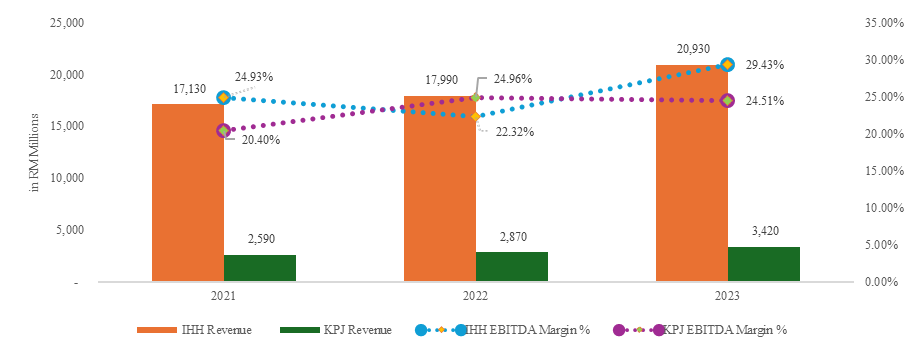
Note. Source: Developed by authors based on IHH’s Annual Reports (2021, 2022, 2023) and Morningstar.com (2025)
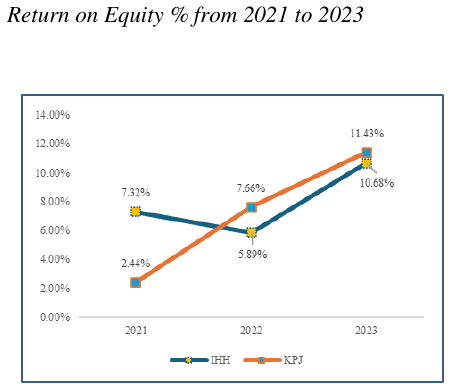
Note. Source: Developed by authors based on IHH’s Annual Reports (2021, 2022, 2023) and Morningstar.com (2025)
KPJ’s ROE also grew higher compared to IHH, indicating effective management of its shareholders’ equity. As shown in Figures 5 and 6, IHH's ROE and ROA declined significantly, while KPJ improved its ratios. Despite a huge dip in 2020, IHH's ROE and ROA rose in the following year, demonstrating effective asset utilisation and equity management. KPJ's inventory turnover ratio suggests higher risks, with an average turnover ratio of 29 times during the past three years, while IHH managed its inventory efficiently. However, IHH's liquidity ratios dropped, indicating short-term financial difficulties. On the other hand, KPJ improved its liquidity ratios, although they remain below a satisfactory level.

Note. Source: Developed by authors based on IHH’s Annual Reports (2021, 2022, 2023) and Morningstar.com (2025)
Figure 7 illustrates a decline in debt-to-equity ratio of IHH compared to KPJ, indicating IHH’s sound debt management. KPJ's debt-to-equity ratio demonstrates higher financial risks. To conclude, although IHH faced some challenges in its operations, the overall financial health of the company shows a commendable standing, with a promising future. Financial Ratio Analysis
| Financial Indicators | 2019 | 2020 | 2021 | 2022 | 2023 | ||
|---|---|---|---|---|---|---|---|
| Profitability Ratios | Net Profit Margin % | Value | 3.45 | 1.54 | 12.71 | 9.15 | 16.20 |
| % Changes | -55.36 | 725.32 | -28.01 | 77.05 | |||
| Operating Margin % | Value | 12.07 | 10.12 | 18.32 | 12.81 | 20.34 | |
| % Changes | -16.16 | 81.03 | -30.08 | 58.78 | |||
| Return on Asset % | Value | 1.03 | 0.44 | 3.94 | 3.18 | 5.98 | |
| % Changes | -57.28 | 795.45 | -19.29 | 88.05 | |||
| Return on Equity % | Value | 1.90 | 0.82 | 7.32 | 5.89 | 10.68 | |
| % Changes | -56.84 | 792.68 | -19.54 | 81.32 | |||
| Return on Invested Capital % | Value | 2.32 | 1.41 | 5.95 | 4.94 | 9.07 | |
| % Changes | -39.22 | 321.99 | -16.97 | 83.60 | |||
| Efficiency Ratios | Inventory Turnover | Value | 10.41 | 8.67 | 9.89 | 9.77 | 9.48 |
| % Changes | -16.71 | 14.07 | -1.21 | -2.97 | |||
| Asset Turnover | Value | 0.33 | 0.30 | 0.38 | 0.38 | 0.42 | |
| % Changes | -9.09 | 26.67 | 0.00 | 10.53 | |||
| Operation Ratios | Days Sales Outstanding | Value | 43.44 | 47.54 | 40.43 | 44.24 | 41.41 |
| % Changes | 9.44 | -14.96 | 9.42 | -6.40 | |||
| Payables Period | Value | 110.68 | 115.73 | 98.16 | 108.16 | 107.96 | |
| % Changes | 4.56 | -15.18 | 10.19 | -0.18 | |||
| Liquidity Ratios | Current Ratio | Value | 1.43 | 1.31 | 1.41 | 1.14 | 0.90 |
| % Changes | -8.39 | 7.63 | -19.15 | -21.05 | |||
| Quick Ratio | Value | 1.31 | 1.14 | 1.26 | 0.61 | 0.71 | |
| % Changes | -12.98 | 10.53 | -51.59 | 16.39 | |||
| Leverage Ratios | Financial Leverage | Value | 1.84 | 1.86 | 1.85 | 1.85 | 1.72 |
| % Changes | 1.09 | -0.54 | 0.00 | -7.03 | |||
| Debt to Equity | Value | 0.41 | 0.43 | 0.38 | 0.34 | 0.28 | |
| % Changes | 4.88 | -11.63 | -10.53 | -17.65 | |||
Note. Source: Developed by authors based on IHH’s Annual Reports (2020, 2021, 2022, 2023) and Morningstar.com (2025)
As highlighted in Table 8, IHH's profitability ratios show a fluctuating trend over the past five years. These ratios were at the peak in 2023, with improved investment returns. Efficiency ratios suggest effective asset management with an average inventory turnover ratio of nine times over the past five years. Operational ratios reached their highest point during the COVID-19 pandemic, with extended payment terms to suppliers and customers. However, an improvement in these ratios in the postpandemic demonstrates faster recovery from the economic downturn and increased sales conversion, with reduced payment terms. Liquidity ratios suggest challenges in meeting day-to-day running expenses, with a decreasing trend. Although the current ratio remained above 1, a quick ratio below 1 indicates liquidity risks. Leverage ratios indicate potential returns with higher risks, while the debt-to-equity ratio decreased with sound debt management. In summary, IHH has the potential of growth and improving its financial health in the future, with the ability to adapt to changing economic situations.
Discussion of Industry-Specific KPIs
| KPI | Measurement Method | Description | IHH Measurement | KPJ Measurement |
|---|---|---|---|---|
| Client Satisfaction | Net Promoter Score (NPS), Value-Driven Outcomes, Billing Accuracy, Accident & Emergency Admission Timeliness | Measures the quality of patient care, service timeliness, and compliance with international standards. | Target: Achieve top quartile in NPS by 2025; ensure 95.7% of VDO outcomes exceed benchmarks (157 indicators, 2023); attain billing accuracy of 87% (2023); achieve A&E admission timeliness of 54.6% (2023). | Maintain a patient satisfaction index of 90% or higher through regular customer satisfaction surveys. |
| Environmental Impact | Carbon emissions tracking and reduction of single-use plastics are evaluated. | Evaluates initiatives for minimising carbon emissions and waste, monitoring advancements in emission efficiency and plastic reduction. | Emissions intensity per patient bed-day decreased by 3.8% (2023); Total Scope 1 and 2 emissions increased by 5.1%; single-use virgin plastic reduced by 99% in non-clinical areas (Malaysia & Singapore); Scope 3 measurement initiated for Business Travel and Employee Commute. | Achieve a 25% reduction in emissions per patient, procure 10% of energy from renewable sources, and attain a 20% decrease in water usage per patient by 2025, relative to the 2021 baseline. |
| Employee Development & Welfare | Employee Engagement Survey (EES), Gender Diversity Ratio, Nursing Talent Pool, Workplace Safety Metrics | Assesses employee satisfaction, growth, and safety through the analysis of leadership diversity, skill development, and overall well-being. | Baseline established: 42.5% women in leadership; nursing talent pool up by 5.6%; no fatalities; lost time incident rate at 13.4; EES score exceeds Global Healthcare benchmark by 2%. | Employee satisfaction at 91% (Pulse People Happiness Survey) with training hours increased to 39 per employee in 2023 (up from 36 in 2022). |
Note. Source: Developed by authors based on IHH’s Annual Report (2023) and Sustainability Report (2023) Employee Development Welfare
Employee Engagement Survey (EES), Gender Diversity Ratio, Nursing Talent Pool, Workplace Safety Metrics
Achieve a 25% reduction in emissions per patient, procure 10% of energy from renewable sources, and attain a 20% decrease in water usage per patient by 2025, relative to the 2021 baseline.
Table 9 discusses major industry-specific key performance indicators (KPIs) between IHH Healthcare Berhad and KPJ Healthcare Berhad, which offers valuable insights into their operational effectiveness and strategic focus in the healthcare industry.
Client Satisfaction: IHH Healthcare uses the Net Promoter Score (NPS), Value-Driven outcomes, billing accuracy, and A&E admission timeliness to measure client satisfaction. IHH has impressive goals for 2025, including NPS in the top quartile and high VDO outcomes, all of which suggest an emphasis on patient care. The emphasis on billing accuracy and timely admissions also demonstrates an end-to-end approach to the patient journey. However, KPJ Healthcare has a patient satisfaction index of 90% and above, which is measured through periodic surveys. Although this approach is useful in capturing patients’ moment-to-moment feelings, it might not capture the complexity of IHH’s multi-dimensional approach. Recent studies show that organisations that use various measures of patient satisfaction fare better than those that do not (Kumar et al., 2022).
Environmental Impact: IHH Healthcare has good environmental initiatives, with the reduction of single-use virgin plastic by 99% in non-clinical areas and a 3.8% reduction in emissions intensity per patient bed-day. IHH’s target to decrease emissions by 25% per patient and to obtain 10% of energy from renewables by 2025 is evidence of a proactive stance towards sustainability. The environmental strategies of KPJ Healthcare are not as ambitious or quantifiable compared to IHH. Recent research stresses that healthcare organisations must meet strict environmental criteria to improve their sustainability position (Cheng et al., 2023). Because KPJ does not have metrics to demonstrate, it may not be able to position itself properly in this regard.
Employee Development and Welfare: IHH Healthcare has a strong framework for employee development, with a high EES score that surpasses the global healthcare norms. The focus on gender diversity, with 42.5% women leaders, and the commitment to increasing nursing talent are indicative of a contemporary approach to workforce management. The zero workplace fatalities and a lost time incident rate of 13.4 highlight the continued commitment of IHH to its employees’ safety. KPJ Healthcare’s 91% employee satisfaction score, reported according to the Pulse People Happiness Survey, is quite impressive. Nevertheless, KPJ seems to have low diversity and structured development programs compared to IHH. Research shows that companies with diverse leadership and good training programmes retain and satisfy their employees well (Smith & Lewis, 2023).
Conclusion: Both IHH and KPJ Healthcare Berhad aim to enhance patient satisfaction, environmental stewardship, and staff welfare; however, IHH adopts a more comprehensive approach to these performance metrics. In the context of global benchmarks, IHH's sustainability and workforce development initiatives confer a competitive advantage over KPJ Healthcare.
Appraisal of the Limitations of the Quantitative Analysis
Financial Performance Overview. Past performance may not accurately predict future results and may not fully address all aspects of IHH’s financial health. The use of a limited number of financial indicators may not accurately reflect the true financial position of the company and may be inadequate for analysing the current realities in a dynamic market.
Financial Metrics Comparison. Benchmarking with competitors involves subjective judgement and comparing with a single competitor may not be sufficient to determine the full potential of the company in terms of their performance within the broader health sector and competitive landscape. Data from multiple sources may lead to inconsistencies, which may result in biased judgement.
Ratio Analysis. Ratio analysis based on historical data may not accurately show the true picture of IHH’s future performance. Additionally, historical data are used to generate future financial ratio projections that are based on estimates. It may result in biased strategic recommendations as unforeseen circumstances may not be accounted for. Also, use of limited financial ratios may not provide a holistic assessment of IHH’s financial health.
Strategic Recommendations
Based upon our previous findings, we surmised that the following four recommendations are the most attractive and warrant further consideration for implementation.
| Strategic Recommendation | Brief Explanation |
|---|---|
| Medical Tourism | Essential healthcare combined with tourism – expanding upon existing resources for a more curated customer journey incorporating a healthcare and wellness retirement facility. |
| Backwards Integration | Securing a supply chain via acquisition of pharmaceutical and medical supply entities. |
| Public-Private Partnership (PPP) | Expand and increase PPP in Malaysia, which is at 4%; in other nations it is at 20% and above. |
| Technology and AI | To support and enhance current operations and expansion strategies. |
Brief Explanation
Medical Tourism
Essential healthcare combined with tourism – expanding upon existing resources for a more curated customer journey incorporating a healthcare and wellness retirement facility. Securing a supply chain via acquisition of pharmaceutical and medical supply entities. Expand and increase PPP in Malaysia, which is at 4%; in other nations it is at 20% and above. To support and enhance current operations and expansion strategies.
Backwards Integration Public-Private Partnership (PPP) Technology and AI
Note. Source: Developed by authors based on IHH’s Annual Report (2023) and Sustainability Report (2023)
| Medical Tourism | Integration | PPP Strategy | Tech & AI Strategy | ||||||
|---|---|---|---|---|---|---|---|---|---|
| Weight | R | WS | R | WS | R | WS | R | WS | |
| Key Internal Factor | |||||||||
| Strengths | |||||||||
| Market Leadership & Strong Brand Reputation | 0.135 | 4.0 | 0.540 | 3.5 | 0.473 | 3.5 | 0.473 | 4.0 | 0.540 |
| Extensive Hospital Network & Infrastructure | 0.065 | 3.5 | 0.228 | 3.0 | 0.195 | 4.0 | 0.260 | 3.0 | 0.195 |
| Strong Financial Position | 0.075 | 4.5 | 0.338 | 4.0 | 0.300 | 2.5 | 0.188 | 3.5 | 0.263 |
| High Quality Medical Professionals & Specialists | 0.075 | 4.0 | 0.300 | 3.0 | 0.225 | 3.5 | 0.263 | 2.5 | 0.188 |
| Accreditation & International Standards Compliance | 0.065 | 4.5 | 0.293 | 3.0 | 0.195 | 3.0 | 0.195 | 2.5 | 0.163 |
| Strong Presence in Medical Tourism | 0.135 | 4.5 | 0.608 | 3.0 | 0.405 | 2.5 | 0.338 | 2.5 | 0.338 |
| Weaknesses | |||||||||
| High Operating Costs & Expensive Treatment Fees | 0.125 | 2.0 | 0.250 | 4.0 | 0.500 | 4.0 | 0.500 | 3.5 | 0.063 |
| Dependence on Foreign Patients (Vulnerability to External Shocks) | 0.090 | 3.5 | 0.315 | 2.5 | 0.225 | 3.0 | 0.270 | 2.5 | 0.024 |
| Complex Organisational Structure | 0.0675 | 2.5 | 0.169 | 2.5 | 0.169 | 2.5 | 0.169 | 3.0 | 0.011 |
| Limited Market Penetration in Rural Areas | 0.055 | 2.5 | 0.138 | 1.5 | 0.083 | 4.5 | 0.248 | 3.5 | 0.014 |
| Regulatory & Compliance Challenges | 0.0775 | 3.0 | 0.233 | 2.5 | 0.194 | 3.0 | 0.233 | 1.5 | 0.018 |
| Divestment from Education (Sale of IMU) as Retention Strategy for Staff | 0.035 | 2.0 | 0.070 | 1.5 | 0.053 | 3.0 | 0.105 | 2.5 | 0.004 |
| Total | 1 | 3.479 | 3.015 | 3.239 | 1.818 | ||||
| Key External Factor | |||||||||
| Opportunities | |||||||||
| Malaysia’s Growth as Preferred Medical Tourism Destination | 0.150 | 5.0 | 0.750 | 3.0 | 0.450 | 3.0 | 0.450 | 3.0 | 0.450 |
| The Medical Device Market in Malaysia is Expected to Grow | 0.065 | 2.5 | 0.163 | 4.0 | 0.260 | 2.5 | 0.163 | 3.5 | 0.228 |
| The Malaysian Government has been Increasing Expenditure in Medical Industry in Recent Years | 0.100 | 3.5 | 0.350 | 4.0 | 0.400 | 4.0 | 0.400 | 3.0 | 0.300 |
| Partnerships between Public and Private Health Sectors as Option for Growth/Improvement of Both Sectors | 0.093 | 4.0 | 0.370 | 4.5 | 0.416 | 3.0 | 0.278 | 2.0 | 0.185 |
| Malaysia’s Percentage of Population Aged 65 and Above is Expected to Grow – Will Challenge Healthcare System | 0.040 | 3.5 | 0.140 | 3.0 | 0.120 | 2.0 | 0.080 | 3.0 | 0.120 |
| Strategic Acquisition (i.e. Island Hospital in Penang) | 0.085 | 5.0 | 0.425 | 2.5 | 0.213 | 2.5 | 0.213 | 1.5 | 0.128 |
| Threats | |||||||||
| Increasing Competition: KPJ Recently Recorded Highest Ever Milestone RM1 Billion in One Quarter; Other Players Expanding their Market Share: (Sunway becoming Listed in 2025, Columbia Asia expansion) | 0.090 | 3.5 | 0.315 | 3.0 | 0.270 | 3.0 | 0.270 | 3.0 | 0.024 |
| Rising Medical Inflation in Malaysia, Resulting in Health Premium Costs Too High and Unaffordable for Customers; Consideration to Introduce Diagnosis-Related Groups (DRG), and Case-Related Groups (CRG) Payment Systems | 0.090 | 2.5 | 0.225 | 4.0 | 0.360 | 3.0 | 0.270 | 3.5 | 0.024 |
| Shortage of Key Staff in Hospitals | 0.093 | 3.0 | 0.278 | 3.5 | 0.324 | 3.5 | 0.324 | 3.0 | 0.030 |
| Pressure to Conform to ESG | 0.078 | 3.5 | 0.271 | 3.0 | 0.233 | 4.0 | 0.310 | 2.5 | 0.024 |
| Economic Uncertainty and Rising Costs of Supplies as Highlighted by APHM | 0.118 | 3.5 | 0.411 | 3.5 | 0.411 | 3.0 | 0.353 | 2.5 | 0.041 |
| Total | 1 | 3.698 | 3.456 | 3.109 | 1.554 | ||||
| Grand Total | 7.176 | 6.471 | 6.348 | 3.372 | |||||
Note. R = Rating, WS = Weighted Score. Scores are determined based on strategic importance and authors’ consensus. Source: Developed by authors based on IHH’s Annual Report (2023) and Sustainability Report (2023)
The QSPM analysis above reveals that the strategy with the highest total attractiveness scores (TAS) is medical tourism, followed by backwards integration and PPP with similar TAS. This indicates that IHH Healthcare would do well to concentrate on medical tourism for the next few years and aligns well with the current company’s direction to improve their core businesses. We then lay out what each strategy entails below, followed by an estimation of costs for each.
| Strategic Initiative | Key Performance Metrics/Target | Expected Impact/Benefits | Expected Challenges | Implementation Timeline |
|---|---|---|---|---|
| 1. Medical Tourism (End-to-end luxury treatment and geriatric care with family/vacation packages) | - Increase international patient volume - Revenue growth rate: +15-20% per annum - Patient satisfaction: >90% - Improve occupancy rates in dedicated tourism packages | - Improve brand reputation as a premium healthcare services provider – become provider of choice - Diversify revenue streams via foreign patients - Higher patient experience quality | - Cultural and language - Resources to build international patient pipeline - Logistic coordination of comprehensive care packages across multiple services and borders | 1 – 3 years (Pilot, then scale gradually) Penang: |
| 2. Expansion into Backwards Integration (Acquire pharmaceutical and medical products supply chains) | - Reduce costs: target 10-15% - Increase on-time delivery to more than 95% - Improve quality control (QC) scores | - Reduce dependency on suppliers – derisk for fluctuations in price and delivery times - Improve margins through cost savings - Better quality of supplies | - Capital intensive - Integration with new company acquisitions may take time/resources - May have regulatory issues in securing supply chain (anti-competition laws, etc.) | 2 – 4 years (Begin with 1-2 key acquisitions, followed by integration phases) |
| 3. Public-Private Partnership (PPP) (Expand and increase healthcare PPP in Malaysia, which is at 4%; other nations are at 20% and above) | - Secure 3-5 successful PPP agreements in initial phase - Achieve cost savings from shared resources - Reduced patient wait times and improved service efficiency | - Strengthen collaboration with government (and potentially regulatory bodies) - Investments in healthcare innovation - Improve access and quality of care for communities | - Bureaucracy resulting in delays - Political resistance/lack of alignment with stakeholders - Complex contract negotiations and risk-sharing arrangements | 1 – 3 years (Pilot projects, and then scale up across strategic regions) |
| 4. Investing in Technology and AI (Support current operations and expansion strategies) | - 10% reduction in operational costs - Improve process efficiency: 20% faster diagnostics - Increase patient engagement via digital platforms: +25% usage | - Streamline operations - Faster decision-making processes - Improve patient outcomes using data-driven insights - Sharpen competitive edge in digital healthcare innovation – increase patient-preference | - High upfront costs to invest in technology infrastructure - Change management issues –time/resources - Staff adaptation challenges - Data security and integration issues in existing systems | 1 – 3 years (Begin with initial integrations and tweak for continuous improvements) |
Note. Source: Developed by authors based on IHH’s Annual Report (2023) and Sustainability Report (2023)
| Strategic Initiative | Proposed Activities | Estimated Implementation Costs |
|---|---|---|
| 1. Medical Tourism (End-to-end luxury treatment and geriatric care with family/vacation packages) | 1. KL (pilot with Prince Court Medical Centre): Refurbish and upgrade existing hospital facilities and sign partnerships with key partners (e.g., hotel chains, transportation services, and airlines). 2. Penang (pilot with Island Hospital): Phase One: Refurbish and upgrade existing hospital facilities and sign partnerships with key partners (e.g., hotel chains, transportation services, and airlines). Phase Two: On the plot next to Island Hospital, to begin construction of 1 hotel with 1 wing for patient/family stay (600 rooms) and 1 wing for geriatric assisted living facility (300 rooms). Phase Three: Set up and staffing costs. Total estimated costs: | RM5,000,000.00 RM10,000,000.00 RM800,000,000.00 RM100,000,000.00 RM915,000,000.00 |
| 2. Expansion into Backwards Integration (Acquire pharmaceutical and medical products supply chains) | Acquire pharmaceutical/medical supplies/distribution company Integration costs (assume 7%) Total estimated costs: | RM800,000,000.00 RM56,000,000.00 RM856,000,000.00 |
| 3. Public-Private Partnership (PPP) (Expand and increase healthcare PPP in Malaysia, which is at 4%; other nations are at 20% and above) | Implement a PPP initiative like Singapore with the introduction of Primary Care Networks. These networks would be a collaboration between government and private hospitals. | Budget of USD33.3 million per year for 5.6 million population |
| 4. Investing in Technology and AI (Support current operations and expansion strategies) | Develop a new Artificial Intelligence system that would seek to consolidate existing AI systems and further improve AI capabilities. | RM4,933,100 in the year of implementation |
Refurbish and upgrade existing hospital facilities and sign partnerships with key partners (e.g., hotel chains, transportation services, and airlines).
RM5,000,000.00
2. Penang (pilot with Island Hospital): Phase One: Refurbish and upgrade existing hospital facilities and sign partnerships with key partners (e.g., hotel chains, transportation services, and airlines). Phase Two: On the plot next to Island Hospital, to begin construction of 1 hotel with 1 wing for patient/family stay (600 rooms) and 1 wing for geriatric assisted living facility (300 rooms). Phase Three: Set up and staffing costs.
RM800,000,000.00 RM100,000,000.00
Total estimated costs:
RM915,000,000.00
Acquire pharmaceutical/medical company supplies/distribution
Integration costs (assume 7%)
RM10,000,000.00
RM800,000,000.00
RM56,000,000.00
Total estimated costs:
RM856,000,000.00
Implement a PPP initiative like Singapore with the introduction of Primary Care Networks. These networks would be a collaboration between government and private hospitals.
Budget of USD33.3 million per year for 5.6 million population
Develop a new Artificial Intelligence system that would seek to consolidate existing AI systems and further improve AI capabilities.
RM4,933,100 in the year of implementation
Note. Source: Developed by authors based on IHH’s Annual Report (2023) and Sustainability Report (2023)
Rationale for Each Recommendation
Strategic Recommendation 1: Medical Tourism Package and Retirement/Geriatric Assisted Living Facility. Adding to its existing two hospitals in Penang, IHH Healthcare acquired the 600-bed Island Hospital for RM3.92 billion cash (The Edge, 2024), which includes an adjacent plot of land with approvals for future development (The Star, 2024). Given the existing IHH network of consultant specialists and surgeons in Penang, Island Hospital’s 42,000 inpatient admissions per year, IHH’s strong financial standing, and IHH’s personalised customer journey for international patients (IHH, 2025), we believe that the time is right to take medical tourism one step further: build a hotel wing and a retirement assisted living facility next to Island Hospital in Penang. Penang is a renowned holiday destination that is served by an international airport and is easily accessible by cross-border patients. Affluent patients can come with their families to IHH hospitals in KL and Penang to receive treatment while their families enjoy Penang nearby. The retirement facility will be state-of-the-art, with medical professionals on standby 24/7. Residents (Malaysia My Second Home participants would be one ideal target) will enjoy living in a community with wellness activities with the support of medical staff should they need it. Families and friends visiting may avail themselves of the adjacent hotel facilities. Once the Penang medical tourism hub takes off, this model could be replicated in Kuching, Sarawak, as Timberland Medical Centre, owned by IHH, has a similar adjacent plot of land ready for development. On an international level, Acibedem Hospitals could target Eastern Europe and the Central Asian market. Reasons for (former Soviet nations such as Kazakhstan, Uzbekistan, and Azerbaijan) to visit Türkiye for medical tourism include the similarity of culture and language due to the common Turkaic ancestry and existing healthy inbound tourist numbers from countries such as Bulgaria, Georgia, Russia, and Kazakhstan (Türkiye Ministry of Culture and Tourism, 2025). Strategic Recommendation 2: Expansion into Backwards Integration. Given the strong brand presence and financial position, it makes financial sense to consider securing pharmaceutical/medical supply chains. This strategy could improve profit margins, quality, and timeliness of supplies. In this example, we benchmarked against Pharmaniaga, a medical/pharmaceutical distribution company purchased by Bousted Holdings in 2010 as a possible pharmaceutical distribution company to acquire. IHH’s large network of hospitals makes it less susceptible to supplier power compared to their competitors with less extensive hospital networks. This indicates that backwards integration may not be as important a strategy compared to their other competitors; perhaps this is seen as a pass-through cost. Moreover, given the recent divestment from education (sale of IMU Health), the acquisition of Island Hospital as well as the current refurbishment and upgrading exercises taking place across IHH hospitals, it would seem that vertical integration is not a strategy IHH is currently interested in pursuing at present to focus on core hospital operations (New Straits Times, 2023). Strategic Recommendation 3: Introduction of PPP initiatives like the Primary Care Networks introduced in Singapore. Public-private partnerships are an initiative of significant interest for the Malaysian government with the recent introduction of the Rakan KKM initiative, and the government also intends to increase collaboration with 91 private hospitals to outsource Ministry of Health patients (CodeBlue, 18 October 2024). This also extends to Bank Negara Malaysia contributing RM60 million to assist in health reforms in private hospitals like the DRG payment model (The Edge, 20 Dec 2024). IHH itself is also well-positioned to implement such initiatives because, firstly, IHH has a strong brand reputation, being one of the largest private healthcare groups in Asia, making them an appealing partner for the government (Wikipedia). Secondly, IHH has access to vast resources, including 18 hospitals within Malaysia (IHH Healthcare) and substantial financial capital in the form of almost RM2 billion cash (Yahoo Finance, 2025). Lastly, IHH has, within their system, both skilled medical professionals with 70,000 skilled professionals working at IHH as well as a skilled leadership team including Dr. Prem Kumar Nair, CEO of IHH who brings over three decades of healthcare experience to IHH (Global Data). Strategic Recommendation 4: Develop a new Artificial Intelligence system that would consolidate existing systems and improve upon current AI capabilities. Artificial intelligence is projected to grow significantly within the global healthcare sector, with an expected compound annual growth rate of 40.2% from 2022 to 2029 (16.3 billion USD in 2022 to 173.55 billion USD in 2029) (Binariks, 2024). The desire to further AI ventures also proves true within Malaysia with the Ministry of Health’s recent new key initiative in DR MATA—an advanced AIpowered diagnostic tool designed to address diabetic retinopathy (OpenGov Asia, 2024). IHH is well-positioned to develop a new AI system due to certain key factors: First, IHH currently has existing access to various essential AI tools through their partnerships with various companies that have created health-focused AI tools, such as Airdoc (AI retinal image analysis), Us2.ai (AI echocardiography software), and Virasoft (AI projects for cancer diagnoses) (IHH Sustainability Report, 2022; 2023). Second, IHH has a proven track record of AI initiatives with in-house developed AI systems. Feeadvisor.ai was successfully launched in IHH hospitals in Malaysia, Singapore, and Hong Kong, with an accuracy rate of 75% on hospital bill estimates for elective surgeries (IHH Sustainability report, 2022; 2023). Lastly, IHH has access to significant financial capital with large quantities of available cash, which they have used in ventures like the acquisition of the Island Hospital in Penang for RM3.92 billion (IHH Healthcare, 2024). Spreadsheet Modelling and Financial Forecasts Table 14 below shows a three-year scenario forecast for IHH Healthcare Berhad, based on the average past five-year financial ratio trend.
| SCENARIO FORECASTING | ||||||||||||
|---|---|---|---|---|---|---|---|---|---|---|---|---|
| Best Case +5% Over Past Trend | Moderate Case - Base Trend | Worst Case -5% Below Trend | ||||||||||
| Financial Indicators | +5% Trend | 2024 | 2025 | 2026 | Keep Trend | 2024 | 2025 | 2026 | -5% Trend | 2024 | 2025 | 2026 |
| Profitability Ratios | ||||||||||||
| Net Profit Margin % | 148.80 | 40.31 | 100.28 | 249.50 | 143.80 | 39.50 | 96.29 | 234.76 | 138.80 | 38.69 | 92.38 | 220.61 |
| Operating Margin % | 23.72 | 25.16 | 31.13 | 38.51 | 18.72 | 24.15 | 28.67 | 34.03 | 13.72 | 23.13 | 26.30 | 29.91 |
| Return on Asset % | 166.39 | 15.93 | 42.44 | 113.04 | 161.39 | 15.63 | 40.86 | 106.80 | 156.39 | 15.33 | 39.31 | 100.78 |
| Return on Equity % | 164.53 | 28.25 | 74.73 | 197.69 | 159.53 | 27.72 | 71.93 | 186.69 | 154.53 | 27.18 | 69.19 | 176.10 |
| Return on Invested Capital % | 74.88 | 15.86 | 27.74 | 48.51 | 69.88 | 15.41 | 26.17 | 44.47 | 64.88 | 14.95 | 24.66 | 40.65 |
| Efficiency Ratios | ||||||||||||
| Inventory Turnover | 3.64 | 9.82 | 10.18 | 10.55 | -1.36 | 9.35 | 9.22 | 9.10 | -6.36 | 8.88 | 8.31 | 7.78 |
| Asset Turnover | 10.62 | 0.46 | 0.51 | 0.57 | 5.62 | 0.44 | 0.47 | 0.49 | 0.62 | 0.42 | 0.43 | 0.43 |
| Operation Ratios | ||||||||||||
| Days Sales Outstanding | 4.50 | 43.27 | 45.22 | 47.26 | -0.50 | 41.20 | 41.00 | 40.79 | -5.50 | 39.13 | 36.98 | 34.95 |
| Payables Period | 4.88 | 113.22 | 118.75 | 124.54 | -0.12 | 107.83 | 107.69 | 107.56 | -5.12 | 102.43 | 97.18 | 92.20 |
| Liquidity Ratios | ||||||||||||
| Current Ratio | -3.19 | 0.87 | 0.84 | 0.82 | -8.19 | 0.83 | 0.76 | 0.70 | -13.19 | 0.78 | 0.68 | 0.59 |
| Quick Ratio | -2.53 | 0.69 | 0.67 | 0.66 | -7.53 | 0.66 | 0.61 | 0.56 | -12.53 | 0.62 | 0.54 | 0.48 |
| Leverage Ratios | ||||||||||||
| Financial Leverage | 3.70 | 1.78 | 1.85 | 1.92 | -1.30 | 1.70 | 1.68 | 1.65 | -6.30 | 1.61 | 1.51 | 1.42 |
| Debt to Equity | -1.98 | 0.27 | 0.27 | 0.26 | -6.98 | 0.26 | 0.24 | 0.23 | -11.98 | 0.25 | 0.22 | 0.19 |
Note. Source: Developed by authors based on IHH’s Annual Report (2023), Sustainability Report (2023), and morningstar.com (2025)
CONCLUSION
The comprehensive analysis we conducted shows that IHH has strong brand positioning, a wide market reach, strong management expertise, and a strong financial standing. While IHH remains vulnerable to regulatory risks, foreign exchange fluctuations, and stiff competition, IHH is well positioned to leverage existing strengths and widen their market reach with more products. The internal evaluation shows that, while IHH has a strong brand reputation, robust partnerships, and management expertise, IHH could enhance their competitive edge by maintaining their strong financial standing, coming up with talent retention strategies, and continuing investment in technology and AI. External evaluations such as EFE, Porter’s Five Forces, and PESTEL show that while IHH is scored as above average on their use of opportunities and dealing with threats, IHH remains vulnerable to regulatory and legal challenges, which can be expected of a highly regulated industry. The landscape is highly competitive, with existing players continuing to increase market reach. On the other hand, there is increasing government spending on the Malaysian healthcare sector, and current government measures regarding rising health premiums have not curbed the growth of the healthcare sector. Malaysia, alongside many countries of the world, faces a growing ageing population and will need more geriatric services. Financially, IHH’s overall performance is on a growth trajectory, with revenue peaking in 2023 at RM20,930 million (Table 7 and Figure 7). The assets portfolio has increased over the last few years (indicating continued investment into equipment), while their debt portfolio has reduced. Reduction in debt and growth in total equity contributed to an improved Basic Earnings Per Share and a higher book value per share (RM 3.30 in 2023). The highest revenues are contributed by their Singaporean and Turkish operations. In comparison to its closest competitor, KPJ Healthcare, IHH’s ROE is lower but IHH has a better debt-to-equity ratio as well as inventory turnover, indicative of efficient inventory management. Although IHH’s current ratio stayed above 1, the quick ratio was below 1, indicating liquidity risks. IHH also showed faster rebounding following the COVID-19 pandemic. Regarding KPIs, overall IHH shows stronger client and employee satisfaction, improving measurable environmental impact compared to KPJ.
Despite the depth of this strategic analysis, there are some limitations to consider. This study relies only on secondary data sources, such as annual reports, financial statements, and industry news. While these sources are reliable, they provide a backward-looking view and may not reflect the latest strategic changes happening inside IHH’s private boardroom. Additionally, the qualitative scoring for the EFE and QSPM matrices is based on industry trends but involves some subjectivity from the researcher. Lastly, although IHH operates globally, this analysis mainly focuses on its activities in Malaysia, which may overlook important regulatory and cultural differences in other markets like Türkiye and Central Europe. The strategic recommendations—from enhancing its current medical tourism model to embracing cutting-edge AI solutions—are meant to leverage existing strengths while addressing vulnerabilities. We considered these possible strategies as a way forward for IHH; however, the evaluations conducted pointed towards improving IHH’s offerings for medical tourism, including a retirement facility. The strategic path forward aims to balance operational efficiency with innovation and risk mitigation so that IHH continues to deliver high-quality healthcare services and good returns for its stakeholders in a fluctuating global healthcare market. To build upon the findings of this case study, future studies could employ qualitative interviews with IHH’s executive management and healthcare policymakers to validate the weightage and scoring used in this analysis. A comparative study between IHH and other global peers, such as Apollo Hospitals (India) or Bangkok Dusit Medical Services (Thailand), would provide deeper insights into the competitive dynamics of the Asian healthcare corridor. Additionally, researchers could conduct largescale surveys of medical tourists to quantify the specific "pull factors" that lead patients to choose IHH brands over regional competitors. As IHH integrates AI into diagnostics and hospital management, future research should investigate the cost-benefit ratio of these technologies on clinical outcomes and long-term EBITDA margins.
References
- Abu, N. H., Othman, A. A., Abidin, R., & Mansor, M. F. (2015). Keberkesanan Organisasi dalam Penyampaian Perkhidmatan: Penilaian Berdasarkan Paradigma Servqual dan Model Kano. Journal of Business Management and Accounting, 5, 123-139.
- Afsar, B., et al. (2022). Supplier dynamics and bargaining power in healthcare: The case of IHH Healthcare. International Journal of Healthcare Management, 15(4), 301–312.
- Asia Pacific Medical Technology Association. (2022, July). Digitizing healthcare: Understanding the key trends, benefits and challenges of digital health. APACMed Technology Association. https://apacmed.org/digitizing-healthcare/
- Barney, J. (1991). Firm resources and sustained competitive advantage. Journal of management, 17(1), 99-120.
- Beamish, P. W., & Chakravarty, D. (2021). Using the Resource-Based View in Multinational Enterprise Research. Journal of Management, 47(7), 1861-1877.
- BTI Project. (2024). Country report: Malaysia 2024. https://bti-project.org/en/reports/country-report/MYS https://doi.org/10.1177/0149206321995575 (Original work published 2021)
- Bursa Malaysia. (2023, September 5). Property: A broad-based recovery. Bursa Malaysia. https://www.bursamarketplace.com/t/bdr_download?s=property_a_broad_based_recovery-215&a=view
- Business Today. (2024, August 2). IHH gets thumbs up for ESG efforts. https://www.businesstoday.com.my/2024/08/02/ihh-gets-thumbs-up-for-esg efforts/#:~:text=With%20solar%20panels%20already%20installed%20in%208,private%20healt hcare%20and%20is%20on%20track%20to
- CGSI. (n.d.). IHH Healthcare through the ESG lens. Corporate Governance & Sustainability Insights. https://www.cgsi.com.my/cgsiresourcesmy/resources/MAL-IHH-Through-ESG-Lens.pdf
- Channel News Asia. (2024, February 20). Shortage of radiographers and pharmacists in Singapore: IHH’s proactive recruitment response. https://www.channelnewsasia.com/singapore/allied-health-professionals-healthcare-nurses-hospitals-shortage-radiographers-pharmacists-3861226
- Cheng, X., Wang, Y., & Zhang, L. (2023). Environmental sustainability in healthcare: A systematic review. Journal of Healthcare Management, 68(2), 105–120.
- CodeBlue Galen Centre. (2024, March 15). Federal court holds private hospital liable for medical negligence. https://codeblue.galencentre.org/2024/03/in-landmark-ruling-federal-court-holds-private-hospital-liable-for-medical-negligence-rejects-defence-of-doctors-being-independent-contractors/
- CodeBlue Galen Centre. (2024, December 1). Health insurance copay mandate. https://codeblue.galencentre.org/2024/12/the-year-of-the-payer-malaysian-health-care-in-2024/#:~:text=2024%20is%20the%20Year%20of,%27%20on-call%20allowance%20hike
- CodeBlue Galen Centre. (2024, December 5). Malaysia’s doctor shortage: Causes and solutions. https://codeblue.galencentre.org/2024/12/malaysias-doctor-shortage-causes-and-solutions-part-2-dr-sean-thum/#:~:text=This%20figure%20excludes%20the%201%2C086,burden%20distribution%20as %20critical%20challenges
- CodeBlue Galen Centre. (2024, December 10). Private hospitals complain about bureaucratic maze of regulations.https://codeblue.galencentre.org/2024/12/private-hospitals-complain-about-bureaucratic-maze-of-regulations/
- CodeBlue Galen Centre. (2024, October 5). Rakan KKM gets RM25 million to launch in five hospitals. https://codeblue.galencentre.org/2024/10/rakan-kkm-gets-rm25-million-to-launch-in-five-hospitals-including-cyberjaya-hospital-budget-2025/
- CodeBlue Galen Centre. (2024, September 10). Transforming Malaysia’s health care system: Building our health care workforce back better. https://codeblue.galencentre.org/2024/09/transforming-malaysias-health-care-system-building-our-health-care-workforce-back-better-part-2/#:~:text=After%20the%20Covid-19%20crisis,availability%20of%20fresh%20medical%20graduates
- Deloitte. (2022). 2022 global healthcare outlook: Are consumers ready for empowered health? https://www2.deloitte.com/global/en/pages/life-sciences-and-healthcare/articles/global-health-care-sector-outlook.html
- FactMR. (2024). Malaysia medical tourism market. https://www.factmr.com/report/malaysia-medical-tourism-market
- GlobalData. (n.d.). IHH Healthcare Berhad executive leadership.https://www.globaldata.com/ company-profile/ihh-healthcare-berhad/executives/
- Grant, R. M. (2016). Contemporary Strategy Analysis: Text and Cases Edition. Wiley.
- Gun & Partners. (2024). Healthcare regulation 2024 in Turkey. https://gun.av.tr/insights/ guides/healthcare-regulation-2024-in-turkey
- Healthcare Asia Magazine. (2024). IHH invests in Belun Technology: AI-powered sleep diagnostic technology.https://healthcareasiamagazine.com/healthcare/news/ihh-invests-in-belun-technology-ai-powered-sleep-diagnostic-technology
- IHH Healthcare. (2024, April 16). How AI is transforming patient care. https://www.ihhhealthcare.com/newsroom/care-in-action/how-is-ai-transforming-patient-care
- IHH Healthcare. (n.d.-a). Company overview. https://www.ihhhealthcare.com/our-company/overview
- IHH Healthcare. (n.d.-b). Careers at IHH. https://www.ihhhealthcare.com/our-company/careers/overview
- IHH Healthcare. (n.d.-c). Value-driven outcomes initiative. https://www.ihhhealthcare.com/docs/ ihhmylibraries/media-releases/media
- IHH Healthcare. (2022). Q3 2022 News Release: IHH Healthcare core operating performance improves, reports lower net income of RM251.8 million due to exceptional items. https://links.sgx.com/FileOpen/IHH%20Q3%202022%20%20Press%20Release%2029%2011.2 022.ashx?App=Announcement&FileID=740151
- IHH Healthcare. (2023). Annual report 2023. Kuala Lumpur: IHH Healthcare Berhad. https://www.ihhhealthcare.com/investors/reports-presentation/reports-and-presentations
- IHH Healthcare. (2023). Sustainability Report 2023. https://www.ihhhealthcare.com/docs/default-source/ihh-documents/sustainability/sustainability_report_2023.pdf?sfvrsn=ad386cb0_3
- IHH Healthcare. (2025). International patients. March 22, 2025,https://www. ihhhealthcare.com/my/ international-patients
- IJN. (2024). Malaysia healthcare budget expected to increase. https://www.ijn.com.my/6041-2/
- Ilkevich, A. (2024, June). Artificial intelligence in diagnostics market: The role of AI in clinical practice. Innowise. https://innowise.com/blog/artificial-intelligencein-the-diagnostics-market/
- Intellect. (2023). IHH Healthcare invests in digital mental health company Intellect to extend continuum of care. https://intellect.co/read/ihh-healthcare-invests-in-digital-mental-health-company-intellect-to-extend-continuum-of-care
- Insights10. (2024). Malaysia artificial intelligence (AI) in healthcare market analysis. https://www.insights10.com/report/malaysia-artificial-intelligence-ai-in-healthcare-market-analysis/#:~:text=The%20Malaysia%20Artificial%20Intelligence%20(AI,%2C%20Naluri%20 &%20Nova%20MSC%20Bhd.
- Khazanah Research Institute. (2024). Rising medical premiums: Can it be cured? Kuala Lumpur: Khazanah Research Institute. https://www.krinstitute.org/assets/contentMS/img/template/editor/Views_Medical%20Premium %20Increases%20in%20Malaysia.pdf
- KR Institute. (2024). Medical premium increases in Malaysia. https://www.krinstitute.org/assets/ contentMS/img/template/editor/Views_Medical%20Premium%20Increases%20in%20Malaysia.pdf
- Kumar, R., Gupta, A., & Sharma, P. (2022). The impact of diverse metrics on patient satisfaction in healthcare organizations. International Journal of Health Services, 52(3), 345–360.
- Liu, J., et al. (2017). Global health workforce labour market projections for 2030. Human Resources for Health, 15, Article 11. https://link.springer.com/article/10.1186/s12960-017-0187-2
- Malay Mail. (2024, October 14). Matrade: Malaysia’s healthcare market set to hit US$4,841b by 2028. https://www.malaymail.com/news/money/2024/10/14/matrade-malaysias-healthcare-market-set-to-hit-us4841b-by-2028/153603
- MalaysiaKini. (2024). Announcement on healthcare challenges. https://www.malaysiakini.com/ announcement/727033#google_vignette
- MIDA. (2024). Malaysian private healthcare, medical tourism sector to take in RM2.2 billion revenue this year. https://www.mida.gov.my/mida-news/malaysian-private-healthcare-medical-tourism-sector-to-take-in-rm2-2-billion-revenue-this-year/
- Ministry of Health Malaysia. (2016). Vol_1_MHSR_Contextual_Analysis_2016.pdf. Ministry of Health Malaysia. https://www.moh.gov.my/moh/resources/Vol_1_ MHSR_Contextual_Analysis_2016.pdf Ministry of Health (Malaysia) (2023). Malaysia Health Indicators 2023. Putrajaya, Malaysia: Ministry of Health (Malaysia).
- Nadeau, K. L. (2024, May). Healthcare provider and supplier collaboration: Unlocking better care. GHX. https://www.ghx.com/the-healthcare-hub/collaborationhealthcare-providers-suppliers/
- New Straits Times. (2023, March 7). IHH Healthcare's IMU sale to strengthen core hospital operations further. March 23, 2025, https://www.nst.com.my/business/2023/03/886589/ihh-healthcares-imu-sale-strengthen-core-hospital-operations-further
- Oracle. (2024, April 16). IHH Healthcare selects Oracle Exadata platform for cloud transformation. https://www.oracle.com/apac/news/announcement/ihh-healthcare-selects-oracle-exadata-platform-2024-04-16
- Ormond, M. (2013). Neoliberal governance and international medical travel in Malaysia. Routledge.
- Porter, M. E. (2008). The five competitive forces that shape strategy. Harvard business review, 86(1), 78.
- Qasem, A. M., & Baharun, R. (2011). The role of service quality and patient satisfaction in Malaysian private hospitals. Journal of Business Management and Accounting.
- Reuters. (2023). Asia’s hospital sector sees consolidation wave as competition intensifies. https://www.reuters.com/business/healthcare-pharmaceuticals/asias-hospital-sector-sees-consolidation-wave-2023
- SC Hospital Association. (n.d.). Collaborating with insurance companies to improve personcentered care. SCHA. https://scha.org/best-practices/collaborating-withinsurance-companies-to-improve-person-centered-ca
- Sheikh, A., et al. (2021). Health information technology and digital innovation for national learning health and care systems. The Lancet Digital Health, 3(6), e383–e396. https://www.thelancet.com/journals/landig/article/PIIS2589-7500(21)00005-4/fulltext
- Smith, J., & Lewis, M. (2023). The role of diversity in employee satisfaction and retention in healthcare. Journal of Human Resources in Hospitality & Tourism, 22(1), 15–30.
- Statista. (2023). Malaysia: Private health services revenue 2009–2021 [Graph]. April 27, 2024, https://www.statista.com/statistics/1473547/malaysia-private-health-services-revenue/#statisticContainer
- Statista. (2024). Medical tourism in Malaysia. https://www.statista.com/topics/12272/medical-tourism-in-malaysia/#topicOverview
- Strategic Management Insight. (2024). IFE and EFE matrix. https://strategicmanagementinsight.com/ tools/ife-efe-matrix/
- Sydle. (2024, October). Medical automation: How can it improve efficiency and hospital quality? Sydle. https://www.sydle.com/blog/medical-automation64d5500907bf1b4262313f8c
- Tan, L. H., & Lee, M. S. (2022). Emerging health service delivery models in Southeast Asia: Opportunities and risks. Asian Health Journal, 8(1), 54–63.
- Tan, Y., & Lee, J. (2022). The impact of alternative medicine on healthcare choices in Asia. Asian Journal of Health Economics, 10(1), 23–40.
- The Edge Malaysia. (2024, September). IHH to acquire Island Hospital for RM3.92bil, cash. March 22, 2025, https://theedgemalaysia.com/node/725519
- The Edge Malaysia. (2024). BNM works with private hospitals for reform. https://theedgemalaysia.com/node/738542
- The Edge Malaysia. (2024). KPJ and ESG. Retrieved from https://theedgemalaysia.com/node/731457
- The Malaysian Reserve. (2024, September 4). IHH Healthcare acquires Penang hospital for RM3.92b. https://themalaysianreserve.com/2024/09/04/ihh-healthcare-acquires-penang-hospital-for-rm3-92b/
- The Star. (2024, October 7). IHHS hospital acquisition – in the spotlight. March 22, 2025, https://www.thestar.com.my/business/business-news/2024/10/07/ihhs-hospital-acquisition------- ----in-the-spotlight
- Turkiye Ministry of Culture and Tourism. (2025). Border statistics. March 24, 2025, https://yigm.ktb.gov.tr/TR-249702/sinir-istatistikleri.html
- UNDP. (2024). Navigating future care for older persons in Malaysia 2040. https://www.undp.org/malaysia/blog/navigating-future-care-older-persons-malaysia-2040-community-support-technological-integration#:~:text=Malaysia%20is%20at%20a%20critical,trade-offs%20as%20they%20age
- University of Cumbria. (2024). What is ESG and why is it important? https://www.ucem.ac.uk/whats-happening/articles/what-is-esg-why-is-it-important/#:~:text=For%20businesses%2C%20it%27s%20a%20way,screen%20potential%20in vestments%20for%20risk.&text=ESG%20originates%20from%20around%202004,first%20coi ned%20by%20Global%20Compact.
- Porter, M. E. (2008). The five competitive forces that shape strategy. Harvard Business Review, 86(1), 78–93.
- World Bank Group, et al. (2016). Deepening health reform in China: Building high quality and value-based service delivery – Policy summary. https://openknowledge.worldbank.org/ server/api/core/bitstreams/ab618635-7f02-5459-bfd1-cee55d848960/content
- Yahoo Finance. (2025). IHH Healthcare Berhad (5225.KL) stock performance and financials. https://finance.yahoo.com/quote/5225.KL/
- YCP Solidiance. (2024). Malaysia healthcare market research. https://ycpsolidiance.com/lp/malaysia-healthcare-market-research#:~:text=Malaysia%27s%20total%20healthcare%20spend%20has,- on-year%20until%202025
- Yap, K., & Ong, S. (2021). Customer bargaining power in the healthcare sector: Implications for service delivery. Healthcare Economics.
- A. (2000). The art of writing a scientific article. Journal of Science Communication, 163, 51–59.