Membership Mechanisms and Member Engagement in Cooperatives: A Systematic Literature Review
- Department of Islamic Management and Finance, Academy of Islamic Studies, Universiti Malaya, Kuala Lumpur
Journal of Business Management and Accounting 16(2) (2026) · https://doi.org/10.32890/jbma2026.16.2.1
Abstract
This systematic literature review (SLR) explores how financial membership mechanisms affect member engagement in cooperatives. Guided by the Reporting Standards for Systematic Evidence Synthesis (ROSES) protocols, this review systematically analysed nine empirical studies sourced from Scopus and Web of Science. Thematic synthesis was conducted across studies that employed quantitative, qualitative, and mixed methods. The scope of this study is limited to articles published between 2015 and 2025. Four themes emerged: (1) forms and levels of member participation; (2) determinants of participation; (3) capital contribution and cooperative performance; and (4) shareholding and democratic governance. These four themes were divided into sixteen sub-themes. The findings reveal that financial commitment often motivates active participation but may also create barriers for youth and under-resourced members. Membership mechanisms must be equitably structured and supported by social trust and participatory opportunities. This review conceptualises financial mechanisms, social factors, and institutional support as crucial structural elements that promote member engagement in cooperatives. It fills a gap in cooperative research by synthesising how financial membership structures influence engagement, whereas previous reviews focused on governance determinants of member participation. This review contributes to the development of an integrative perspective linking financial membership mechanisms with multidimensional dynamics of cooperative member engagement and proposes directions for future research, especially within cooperative models.
Keywords: Membership share, member participation, membership mechanism, cooperative, systematic literature review.
INTRODUCTION
The cooperative movement has increasingly been recognised as a critical contributor to socio-economic development worldwide. In Italy, cooperatives have significantly contributed to economic growth and employment, aligning with the Sustainable Development Goals (Hacısüleyman, 2025; Terzo et al., 2024). Similar trends are evident in the United States, where the financial performance of agricultural cooperatives in terms of net profit margins has been associated with sustainable economic growth (Smart et al., 2019). In developing nations such as Nepal, cooperative expansion demonstrates a strong long-term correlation with national development (Paudel & Acharya, 2022). In Malaysia, the cooperative sector continues to thrive, comprising more than 16,000 registered cooperatives, 7.2 million members, and total assets reaching RM173.3 billion as of mid-2025 (Muzamir, 2025). These figures underscore the growing strategic role of cooperatives in national economic planning and inclusive development. Central to the identity and functioning of cooperatives is their membership structure. It differentiates cooperative institutions from conventional corporate entities (Pönkä, 2018). In many jurisdictions, cooperative membership is formalised through financial contributions such as membership shares. According to Fici (2013), these contributions serve as sources of capital and mechanisms for conferring both economic and governance rights. While governance rights entail voting and decision-making, economic rights include dividends and patronage refunds. Besides being legally and practically important, these mechanisms also reveal members' identities, commitments, and responsibilities more deeply. Even though financial membership plays a fundamental role, most empirical research on cooperative engagement has focused on behavioural aspects, such as governance involvement, voting behaviour, and general meeting attendance. Barraud-Didier et al. (2012) and Verhees et al. (2015) have discussed how trust, communication, and shared values within the cooperative can affect member involvement. In the meantime, Buang and Abu Samah (2021) identified a type of participation that ranges from passive to proactive and shows the different ways that members can be involved in governance. Nevertheless, not much attention has been paid to how financial membership systems affect how engaged members are. This gap is important because these systems not only indicate legal ownership but also reveal how influential, committed, and involved a member is in cooperative governance. The systematic literature review by Buang and Abu Samah (2021) was very helpful in understanding the many types of involvement. However, it has not yet looked into the structural or financial aspects of member engagement. Furthermore, modern literature reviews often use traditional narrative approaches, which are criticised for not being clear, reproducible, or methodologically sound. This makes them susceptible to biases such as author, retrieval, and publication bias (Durach et al., 2017; Shaffril et al., 2021). A comprehensive, organized, and meticulous review of the existing literature is advised to address these concerns. The goal of this study is to provide a comprehensive understanding of how financial membership mechanisms affect the participation of cooperative members so that appropriate actions can be taken. Finding data gaps and improving the technique may be possible with this strategy. Research and policy on cooperative membership structures in the future will benefit from this. The results of this research will be a useful guide for future research. This study narrows the scope of the phrase "financial membership mechanisms" to concentrate on membership shares in particular. This is done for the study’s objectives. While similar terms such as "capital contribution" and "equity-based mechanisms" are used in the literature, they are understood in this study to refer to the ownership shares that members hold in cooperatives. This Systematic Literature Review (SLR) aims to provide a systematic, thorough, and methodical integration of empirical studies on the effect of financial membership systems on member engagement.
METHODOLOGY Review Protocol The present research was conducted using existing review methods and reporting standards to ensure a rigorous, systematic, complete assessment. This study was also conducted following the Reporting Standards for Systematic Evidence Synthesis (ROSES) introduced by Haddaway et al. (2018). Although Preferred Reporting Items for Systematic reviews and Meta-Analyses (PRISMA) is widely used for reporting systematic reviews in health sciences and meta-analytical studies, ROSES was selected over PRISMA in this review because it is compatible with a broad range of evidence syntheses (qualitative, quantitative, and mixed-methods reviews) and offers methodological flexibility. It can be useful in numerous studies, from cooperative experiments to research works on social economics. Thus, this study is methodologically positioned as an integrative review rather than a statistical meta-analysis. Formulation of the Research Question Following the ROSES protocol, this review first identified researchable questions, then developed systematic search terms to help answer these questions; assessed the quality of the studies, and extracted necessary information for relevant data synthesis and analyses using thematic analysis. As suggested by Lockwood et al. (2015), this SLR used the PICo framework to develop study questions. P stands for Population, Problem; I for interest, and Co for context. PICo has a track record in narrative and thematic synthesis within qualitative systematic reviews. This framework enables researchers to focus on the core aspects of their research questions and improve their specificity and utility. Elements relevant to this review, as described in the PICo model, were identified. Using these constructs, population denotes cooperative members in any cooperative society, interest reflects financial membership mechanisms, and the operational context represents the operation and governance environment of cooperatives. Grounded in these components, the following research question was developed to guide the review process: "How do membership mechanisms affect the level of member engagement in cooperatives?" The search strategy, inclusion and exclusion criteria, data extraction process, and thematic synthesis for this systematic literature review were all developed based on this research question. Systematic Searching Strategies The systematic review followed the three-stage process of identification, screening, and eligibility proposed by Shaffril et al. (2018). This strategy aims to search for and synthesize related studies. Thus, this SLR can be managed in a structured, clear way based on comprehensive prior research. This strategy systematically searches for and collates all relevant studies to ensure the SLR is conducted in a systematic and transparent way.
Identification
Stage one involved developing a search string based on prior reviews and keyword thesauri. Boolean operators and truncation symbols (*) were used to capture variations of keywords such as "cooperatives", "participation", “membership mechanism”, “shares”, “capital”, and “fees”. Searches were conducted using two major databases: Scopus and Web of Science (WoS).
| Database | String |
|---|---|
| Scopus | TITLE-ABS-KEY (("cooperative*" OR "cooperatives*" OR "co-ops*") AND TITLE-ABS-KEY ( "participation*" OR "involvement*" OR "engagement*" ) AND TITLE-ABS-KEY ("membership*" OR "membership mechanism*" OR "member contribution*" OR "member equity*") AND TITLE-ABS-KEY ("share*" OR "capital" OR "fee")) AND PUBYEAR > 2014 AND PUBYEAR < 2026 AND ( LIMIT-TO (DOCTYPE, "ar")) AND ( LIMIT-TO (LANGUAGE, "English")) |
| Web of Science | TS=((“cooperatives*” OR “coops*”) AND ("participation*" OR "involvement*" OR "engagement*") AND ("membership*" OR "membership mechanism*" OR "member contribution*" OR "member equity*") AND ("share*" OR "capital" OR "fee") AND (Article) AND (2016 OR 2017 OR 2018 OR 2019 OR 2020 OR 2021 OR 2022 OR 2023 OR 2024 OR 2025) AND (English)) |
Web of Science
String
TITLE-ABS-KEY (("cooperative*" OR "cooperatives*" OR "co-ops*") AND TITLE-ABS-KEY ( "participation*" OR "involvement*" OR "engagement*" ) AND TITLE-ABS-KEY ("membership*" OR "membership mechanism*" OR "member contribution*" OR "member equity*") AND TITLE-ABS-KEY ("share*" OR "capital" OR "fee")) AND PUBYEAR > 2014 AND PUBYEAR < 2026 AND ( LIMIT-TO (DOCTYPE, "ar")) AND ( LIMIT-TO (LANGUAGE, "English")) TS=((“cooperatives*” OR “coops*”) AND ("participation*" OR "involvement*" OR "engagement*") AND ("membership*" OR "membership mechanism*" OR "member contribution*" OR "member equity*") AND ("share*" OR "capital" OR "fee") AND (Article) AND (2016 OR 2017 OR 2018 OR 2019 OR 2020 OR 2021 OR 2022 OR 2023 OR 2024 OR 2025) AND (English))
The initial search yielded 69 articles from Scopus and 52 from WoS, totalling 121 records. After screening titles and abstracts, excluding review articles and irrelevant studies, and removing 22 duplicate entries, a total of 31 unique articles remained. Screening To ensure the relevance and quality of the studies included in this systematic literature review, specific eligibility and exclusion criteria were established. Only peer-reviewed journal articles published in English between 2015 and 2025 were considered, reflecting ten years deemed appropriate for systematic review updates (Bashir et al., 2018). Articles were included if they addressed cooperatives and focused on themes related to member participation, engagement, or involvement in relation to financial membership mechanisms. Studies were sourced from Scopus and WoS to ensure relevance to the organizational and behavioural aspects of cooperative membership. Publications such as conference proceedings, books, book chapters, review articles, and studies not published in English were excluded. In addition, articles that lacked a clear focus on cooperative membership structure or member engagement, especially those that focused solely on financial outcomes, were excluded to maintain thematic consistency with the research objectives. Eligibility In the context of this SLR, all initially identified articles were subjected to a second-round screening process known as the eligibility phase, aimed at ensuring alignment with the research objectives. This process involved a careful review of the titles and abstracts of the remaining articles. Where ambiguity remained, the methodology, results, and discussion sections were consulted to verify relevance. A total of 21 articles were excluded at this stage for several reasons. The articles addressed cooperative membership in general terms, without mentioning capital contributions, stressed social capital, empowerment, or gender participation and without addressing financial engagement, or focused on the general effects of cooperatives without relating them to particular membership mechanisms. Articles that focused on leadership development, productivity, or poverty alleviation without relating them to shareholding were also excluded. The articles that expressly examined the influence of financial mechanisms on member engagement or participation were retained. Consequently, the quality assessment process involved ten items.
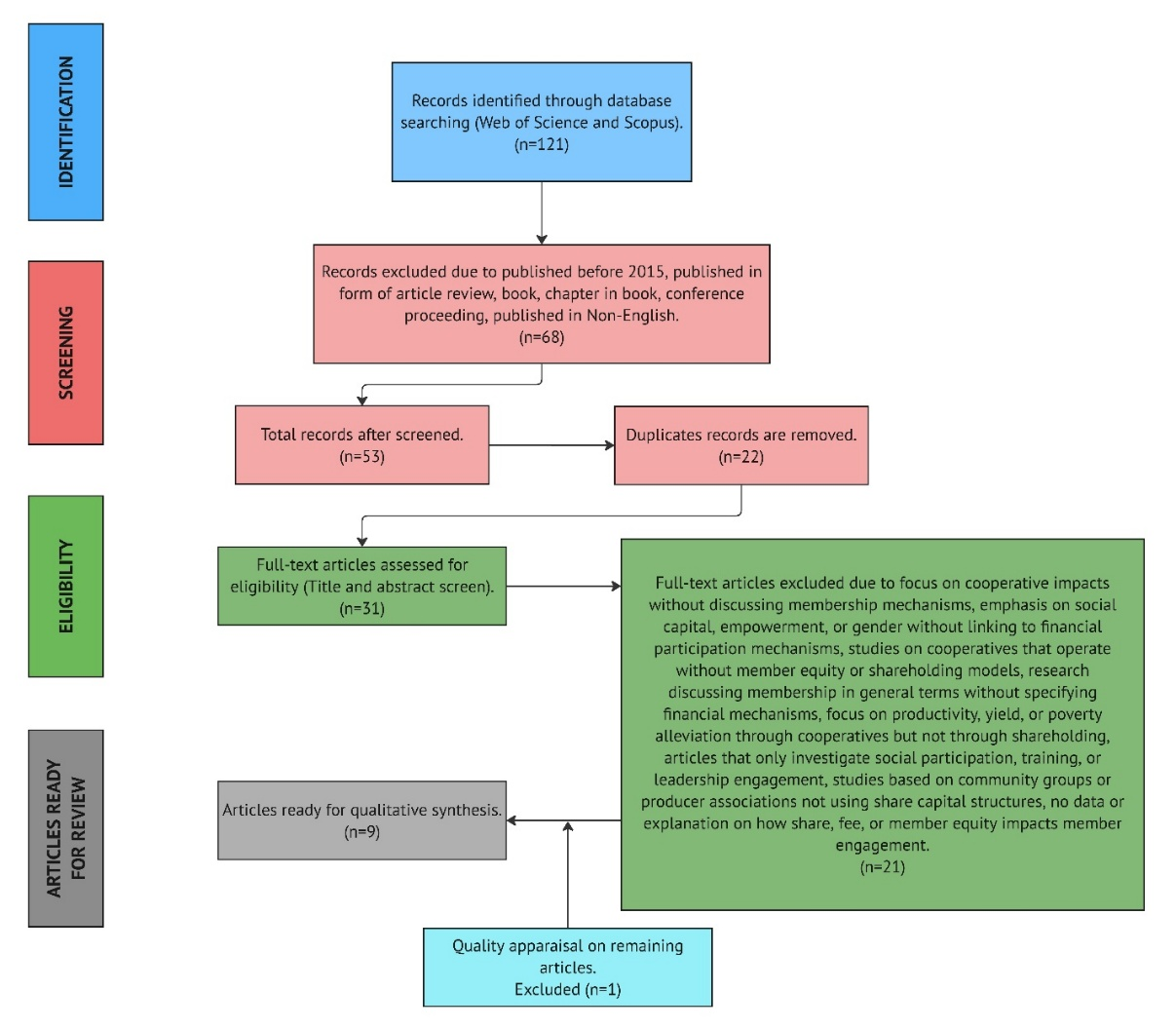
Quality Appraisal
The objective of the quality appraisal step was to verify that the methodologies and analyses used in each of the selected studies were sufficiently rigorous and aligned with the objectives of the review. The methodological quality of different study designs, including qualitative studies, quantitative nonrandomised studies, quantitative descriptive studies, and mixed methods studies, was evaluated using the Mixed Methods Appraisal Tool (MMAT) 2018 developed by Hong et al. (2018). The methods portion of each included article was used to screen it first, and then five main criteria related to its research design were used to rate it. In qualitative investigations, the evaluation focused on the coherence among study topics, data collection methods, and their analyses, including interpretation. For quantitative designs, including nonrandomized and descriptive research, the criteria were sampling technique, sample representativeness, measurement validity, risk of non-response bias, and appropriateness of statistical analysis. In mixed methods research, MMAT directed the evaluation of the justification for employing mixed methods, the integration of components, the interpretation of aggregated findings, and the consistency across methodological frameworks. Evaluations of each article were carried out independently by the research team. Studies were included if they met three of the five MMAT criteria. Nine publications met all five criteria. However, one study did not meet the minimum threshold and was excluded from the final synthesis. The studies retained were considered methodologically sound and appropriate for the thematic synthesis on the impact of capital contributions on cooperative performance and involvement. Each article was independently appraised, and decisions were made in consultation with the research team. An article was considered of acceptable quality if it met at least three out of five MMAT criteria, following precedents in earlier systematic reviews. Studies that failed to meet this threshold were excluded from the final synthesis. Based on this appraisal process, a total of nine studies were retained, all of which met the required criteria. The findings from these studies were deemed methodologically sound and supported the synthesis of evidence on the role of capital contributions in cooperative performance and participation.
| QA | QA | QA | QA | |||||
| Study | Research Design | 1 | 2 | 3 | 4 | QA 5 | Number of criteria fulfilled | Inclusion in the review |
| (Prasertsaeng et al., 2020) | QN (NR) | / | / | / | / | / | 5/5 | / |
| (Moses Mwesige et al., 2025) | QN (NR) | / | / | / | / | / | 5/5 | / |
| (Cele, 2022) | QN (NR) | / | / | / | / | / | 5/5 | / |
| (Hakelius & Nilsson, 2020) | QL | / | / | / | / | / | 5/5 | / |
| (Selhausen, 2016) | QN (NR) | / | / | / | / | / | 5/5 | / |
| (Hando et al., 2022) | QN (NR) | / | / | / | / | / | 5/5 | / |
| (Korkmaz & Gurer, 2018) | MX | - | C | - | / | - | 1/5 | - |
| (Woldeyes, 2023) | MX | / | / | / | / | / | 5/5 | / |
| (Pham, 2022) | QN (NR) | / | / | / | / | / | 5/5 | / |
| (Sebhatu et al., 2020) | QN (NR) | / | / | / | / | / | 5/5 | / |
| QA = Quality assessment; QN (NR) = Quantitative non-randomised; QL = Qualitative; MX = Mixed-Method; C = Cannot tell | ||||||||
QA = Quality assessment; QN (NR) = Quantitative non-randomised; QL = Qualitative; MX = Mixed-Method; C = Cannot tell
DATA ABSTRACTION AND ANALYSIS
The process of data extraction in this SLR was conducted carefully to strengthen the credibility and consistency of the evidence. Extraction focused on three primary sections of each article: the abstract, results, and discussion. When necessary, additional relevant information from the methodology or conclusion sections was also reviewed. To facilitate thematic categorization, a theme article matrix was developed to map each study’s contribution to the identified analytical themes (see Table 4). This step supported both the recognition of patterns across studies and the alignment of the data with the research objectives. As per Flemming et al. (2019) and Whittemore and Knafl (2005), qualitative thematic synthesis was the final step in data analysis, a fitting method for the integrative review, which includes varied study designs such as quantitative, qualitative, and mixed methods. Analysis was thematic to help identify the most common issues, overlapping concepts, and dimensions central to cooperative member participation. Each finding was inspected and grouped according to common characteristics or similar implications. These initial data clusters were iteratively refined and labelled to form distinct themes. A deductive coding strategy was employed, guided by the review’s research questions and conceptual focus on membership mechanisms and participation structures. As a result, four major themes were identified: forms and levels of member participation in cooperatives; determinants of member participation in cooperatives; the role of capital contributions in cooperative performance and participation; and shareholding and democratic governance in cooperatives. These themes were further reviewed for thematic consistency, relevance to the research questions, and non-redundancy. Any findings that were overly general, duplicate, or outside the scope of the review were excluded. The final themes reflect both empirical convergence and variation across studies.
RESULTS Background of the Selected Studies This systematic literature review identified nine empirical studies conducted between 2016 and 2025 that examined patterns of member participation in cooperatives. The studies span multiple geographic contexts, with a strong representation from Africa (Ethiopia and Uganda), Southeast Asia (Thailand and Vietnam), and Europe (Sweden and Ireland). Specifically, three studies were conducted in Ethiopia, and one each in Uganda, Thailand, Vietnam, Ireland, and Sweden. The studies employed a mix of quantitative and qualitative methods. The distribution of publication years shows that three studies were published in 2020, three in 2022, and the rest in 2016, 2023, and 2025. Notably, studies focused on agricultural and multipurpose cooperatives, with limited coverage of other types.
| Journal | Total number of selected articles | Indexed by WoS | WoS Quartile | Indexed by Scopus | Scopus Quartile |
|---|---|---|---|---|---|
| Feminist Economics | 1 | / | Q1 | / | Q1 |
| International Journal of Value Chain Management | 1 | / | Q4 | / | Q4 |
| Journal of International Food and Agribusiness Marketing | 1 | / | Q3 | / | Q2 |
| Advances in Agriculture | 1 | / | Q2 | / | Q2 |
| Journal of Agriculture and Rural Development in the Tropics and Subtropics | 1 | - | - | / | Q3 |
| Journal of Cooperative Organization and Management | 2 | / | - | / | Q2 |
| Sustainability | 1 | / | Q2 | / | Q1 |
| African Journal of Food, Agriculture, Nutrition and Development | 1 | - | - | / | Q3 |
| Author(s)/ Theme | Theme 1: Forms and Levels of Member Participation in Cooperatives | Theme 2: Determinants of Member Participation in Cooperatives | Theme 3: Role of Capital Contribution in Co-operative Performance and Participation | Theme 4: Shareholding and Democratic Governance in Cooperatives | ||||||||||||
| Sub-themes | FP | OE | GI | BP | FD | SD | IS | EV | CA | LR | GT | CM | SV | SM | GS | LM |
| (Selhausen, 2016) | / | / | / | |||||||||||||
| (Prasertsaeng et al., 2020) | / | / | ||||||||||||||
| (Moses Mwesige et al., 2025) | / | |||||||||||||||
| (Hando et al., 2022) | / | / | / | |||||||||||||
| (Pham, 2022) | / | / | ||||||||||||||
| (Cele, 2022) | / | / | / | / | ||||||||||||
| (Sebhatu et al., 2020) | / | / | ||||||||||||||
| (Woldeyes, 2023) | / | / | / | |||||||||||||
| (Hakelius & Nilsson, 2020) | / | / | / | |||||||||||||
Forms and Levels of Members’ Participation in Cooperatives
The first sub-theme relates to financial participation. Across several studies, financial contributions such as shareholding and equity investments emerged as key mechanisms of member involvement. In Thailand, Prasertsaeng et al. (2020) observed that members’ shares and financial stakes are positively associated with satisfaction and commitment to cooperative governance. Likewise, in Ethiopia, Woldeyes (2023) found that members with higher equity contributions were more likely to report benefits from cooperative involvement. However, the study also highlighted that while share purchases strengthened cooperative capital, they did not necessarily lead to proportionate individual benefits. This reflects a mismatch between financial input and expected returns. Among Irish youth, Cele (2022) found that although many were willing to engage, financial entry barriers, such as capital requirements, discouraged them from becoming formal members. This shows that equity-based membership systems may not always encourage active engagement. In sum, financial participation through membership shares is a foundational form of engagement in cooperatives. However, its effectiveness in fostering sustained participation depends on whether the benefits are equitable and the entry requirements are accessible, especially for new or younger members. The second sub-theme focuses on operational engagement. It refers to how members contribute through their day-to-day activities. Operational activities, including produce supply and informal contributions such as helping with cooperative tasks, were also important dimensions of member participation. According to Woldeyes (2023), both the quantity of produce and members’ capital investment significantly influenced the benefits they gained from the cooperative. Cele (2022) found that many young people in Irish dairy cooperatives participated informally through family-run farms rather than as formal members. There is a generational divide in cooperative groups, which limits their effectiveness. The results demonstrate that operational participation is an effective engagement strategy, even though it is more prevalent in less formal contexts. Members may not be able to convert their participation into dividends or voting rights unless they hold membership shares. This shows how important it is to combine operational tasks with share-based membership to make sure that more people can join cooperatives and have an impact.
Governance engagement is the subject of the third sub-theme. Members who vote, serve on the board, and attend general meetings participate in cooperative decision-making. Prasertsaeng et al. (2020) reported that members who regularly attended Annual General Meetings (AGMs) were generally happy. Cele (2022) also noted that many young members wanted to be involved in governance but could not because of financial and procedural barriers. Woldeyes (2023) found that the benefits members received were highly related to their meeting attendance. The ability to engage in governance is more determined by having a formal membership status through shares than by desire or willingness. If younger members' opinions fail to gain enough votes, they may not be considered when decisions are made. Shareholding arrangements must be made available to all in order to attract more members to participate in cooperative governance. As this sub-theme explains, governance involvement is a formal and significant form of participation that is possible only through shareholding. As a result, membership shares grant voting rights as well as a voice in the cooperative's direction and leadership. The last sub-theme addresses barriers to participation. It was determined that structural issues made it harder for members to become more involved. Cele (2022) said that capital requirements and limited share transfer mechanisms were significant barriers, especially for younger people who might want to join. These institutional frameworks benefit particular groups and make newcomers' participation harder. Investors in closed benefit-sharing clubs may be less engaged, according to Woldeyes (2023). These findings suggest that cooperative participation depends on the equity and accessibility of membership shares. Potential members cannot officially join when capital requirements are high or share transfer systems are not transparent. This shows that plans for owning shares can make it hard for some people to take part if they lack inclusive design. In short, this section indicates cooperative members participate financially, operationally, and institutionally. But to fully and formally take part in these areas, members are usually required to hold membership shares. Membership shares are the official way to access, whether it is for benefits, voting rights, or access to governance structures. Thus, they serve as both a financial tool and a structural underpinning for meaningful and persistent cooperative engagement. Determinants of Member Participation in Cooperatives The first theme explored the different ways and levels of member interaction, such as participation in governance, operations, and finances. This theme shifts the focus to the most important factors that affect these types of engagement. It highlights how membership shares, alongside social and institutional factors, shape the likelihood and depth of member participation in cooperatives. The first sub-theme is factors that affect financial contribution. Financial mechanisms have long been considered the main drivers of cooperation. Moses Mwesige et al. (2025) found that the cost of membership and the amount of land someone owned significantly influenced how engaged young people were in Uganda, often affecting their ability to invest. Selhausen (2016) also stressed that share capital contributions were a key indicator of active engagement in a Ugandan coffee cooperative run by women. Hando et al. (2022) found that members with more shares were more likely to attend more meetings and participate in decision-making. These results show that membership shares are required to join, and they serve as an incentive to get involved. Capital contributions and similar financial factors are very effective ways to sustain members' participation. Owning shares provides members with official membership status and encourages them to join meetings and help make decisions. These results show that access and affordability of membership shares are significant factors in whether and how people get involved with cooperatives.
The second sub-theme examines the social and demographic factors that have a significant impact on how people engage in cooperatives. Gender, age, land ownership, and period of membership are likely to be important factors in terms of who is able to become involved or remain engaged, especially via membership shares. Joint land ownership and longer membership duration contribute to women’s participation in collective action (Selhausen, 2016). Hando et al. (2022) showed that members with long-term tenure tend to take more interest in governance settings. As the two findings show, this involvement is also influenced by broader social conditions that affect both member access to benefits and thus participation. There are traits that have a significant influence on the ability of an individual to purchase membership shares and retain them over time. Participation requires individuals to obtain membership. The third sub-theme is how institutional support plays a role in getting members involved. Getting support through training, education, and extension services, along with outside advisory programs, helps members improve their participation in cooperatives. Selhausen (2016) discovered that extension services significantly boosted women’s knowledge and confidence, helping them get more involved in cooperative activities. These were services that helped members address structural and/or information challenges, especially for those who find it difficult to understand or know how to use membership mechanisms. This shows that improving the capacity of institutions is not only vital for getting more members to participate, but it also makes sure that participation opportunities are fairly distributed across different types of members. The final sub-theme links capital contributions to governance incentives. It demonstrates how ownership of shares encourages activity in decision-making processes for the cooperative. This found an obvious association between shareholdings and attendance at meetings and engagement in governance positions (Hando et al., 2022). This shows that having a financial stake is important for participating in the cooperative and gives members more political power and control. So, membership arrangements make it easier for them to get involved in governance. When these tools are added to supportive social and institutional settings, they assist members in staying involved in a meaningful way for a long time. The theme emphasizes the elements, encompassing economic, social, and institutional variables, that influence cooperative membership. Shareholding is the most constant membership instrument affecting governance rights and long-term commitment. Role of Capital Contribution in Cooperative Performance and Participation The first sub-theme deals with capital adequacy and how well the cooperative performs. Having enough capital contributions through membership shares is closely linked to better results for cooperatives. Pham (2022) found that Vietnamese cooperatives that generated more member capital had better assets and stock returns and were quicker to respond to their members. In addition, member shares can help with things like generating revenue, offering services, and being accountable as a group. Performance outcomes keep members involved and develop trust in cooperative management. The financial vulnerabilities linked to capital inadequacy are the subject of the second sub-theme. Pham (2022) pointed out that cooperatives with limited member capital run into significant operational challenges, like not having enough investment power and struggling to innovate or grow their services. The cooperative was unable to fulfil the needs of the members during periods of economic downturn due to a lack of resources. Therefore, weak internal capital endangers financial stability, confidence, and participation of members. The impact of less capital on governance and trust is the third sub-theme. Low member capital contribution not only undermines the integrity of the institution but also causes financial problems. Sebhatu et al. (2020) found issues in Ethiopian farming cooperatives: fraud, bad management, and a lot of mistrust among members. The authors concluded that members did not have enough capital to participate. When people think that money owed is being misused, they start to reduce their engagement and trust the leadership less. The breakdown of trust weakens the internal governance system, which in turn leads to a vicious cycle of disengagement and poor performance. This data demonstrates that a well-run membership system maintains responsibility, transparency, and the strong involvement of its members. In the final sub-theme, capital is, in fact, considered a means to retain member commitment and the institution’s operation. Pham (2022) asserted that members are more likely to stay involved and keep cooperative leaders accountable when they contribute more capital. To that end, the money that members put into the business serves as both an operational capital supply and a behavioural anchor. Cooperative members develop a stronger feeling of ownership and duty as a result. To sum up, this theme illustrates how membership shares, as a kind of capital contribution, significantly impact the efficiency and involvement of a cooperative. Lack of funding reduces oversight and engagement, but when there is enough investment, it boosts services, trust, and accountability. Membership shares raise funds and motivate members. Shareholding and Democratic Governance in Cooperatives The first sub-theme focuses on how shareholding ties into voting rights. Having a financial stake really appears to get members more involved in the governance processes. Woldeyes (2023) found that cooperative members who own equity shares are substantially more inclined to go to meetings and vote. How ownership is set up has a big impact on how members participate in democratic processes. This means that purchasing shares is about more than just gaining money, it also engages individuals. The second sub-theme falls under innovative share mechanisms. In practice, the introduction of tradable shares, dividend payouts, or equity redemption has been used to reconcile member participation with running a large-scale cooperative. Hakelius and Nilsson (2020) found that the tie between the governance system of the cooperative and its members could be strengthened by having a personal shareholding structure in which members could take advantage of liquidity as well as profits, while still maintaining democratic ownership. Governance satisfaction and ownership perception dominate the third sub-theme. When members believe that their shareholding has real power and returns, their satisfaction and commitment to the cooperative governance rise. Hakelius and Nilsson (2020) suggest that feeling a sense of belonging and having perceived control through share-based participation are important for keeping democratic legitimacy and member loyalty intact.
The last sub-theme is about the boundaries of monetarized solutions. Although the formal financial shareholding involvement of workers could steer governance in a more inclusive direction, there is no clear evidence of significantly improved corporate governance. However, Hakelius and Nilsson (2020) also warn that problems such as diversity of members, different generations, or organization size can diminish democratic participation. As such, other mechanisms lie at the core of extending democratic governance in cooperatives and related processes, such as trust-building and transparent communication, along with an inclusive culture. To sum up, this theme shows that membership shares are an important part of demonstrating democratic participation in cooperatives. Holding shares gives members voting and board privileges and an economic and psychological motivation to stay involved. Studies have shown that having a financial stake is important, but it has a greater effect on governance involvement when paired with member satisfaction, new share structures, and practices that include everyone. These findings indicate that share ownership may incentivize members to engage more actively in cooperative governance that more accurately reflects their views.
DISCUSSION
This investigation exposes a multifaceted relationship by emphasizing the influence of membership mechanisms, particularly financial contributions, on the engagement of cooperative members. When people contribute financially, it makes them feel like they are part of something larger. The configuration of these mechanisms, especially their accessibility, equity, and inclusion, dictates how successful this dynamic will be. A few studies have shown that members who contribute financially by buying shares tend to become more involved in governance and other activities at their institutions (Prasertsaeng et al., 2020; Woldeyes, 2023). They feel more ownership when they put money into something, and this often makes them want to get more involved. This link can be difficult to interpret at times. If members think the returns on equity are unclear, they might lose interest and withdraw, even after investing their funds. It appears that for equitable systems to successfully maintain member engagement and commitment, they must be institutionalized and visible (Kartika et al., 2020; Othman et al., 2012). Structural constraints, including high financial requirements and limits on generational participation, might make it even harder for people, especially young people, to get involved. Even when young people are eager to get involved, those equity-based rules might hold them back. This weakens practices of inclusive governance (Cele, 2022). Equity measures are crucial because policies that minimize generational economic and social inequities are the only way to boost cooperatives' bottom lines (Bezabih et al., 2021; Liu et al., 2024). For this reason, fair policies are essential to the long-term viability of cooperatives' financial operations. Intangible factors such as member satisfaction, trust, and social capital are also very important for keeping members involved, along with financial factors. Mahayasa and Martayanti (2020) and Musoke (2020) stated that members are more likely to remain in the group if their needs are met and they feel their voices are being heard. Contributions of money alone are not enough to build trust, though. In large cooperatives, where diversity and complicated governance may make democratic participation less strong, meaningful engagement needs good communication and a shared sense of identity (Hakelius & Nilsson, 2020; Pönkä, 2018).
Capital contributions let members participate and strengthen cooperative governance. People who work for cooperatives with larger capital bases tend to run them better, listen to their members better, and last longer (Pham, 2022). If members cannot contribute enough, the group might end up short on cash. This might result in inadequate supervision, detrimental financial management, and decreased trust among members (Sebhatu et al., 2020). In addition, active participation helps members develop organisational commitment and leadership experience. Muhamad Azmi et al. (2025) found that sustainable governance structures and structured planning, including succession planning, are important factors that support organisational survival in the long term. Thus, a larger and more active membership base allows cooperatives to have a broader pool of potential successors to govern the cooperative over the long term. Finally, to make financial contributions count, social and institutional supports are also needed. However, evidence suggests that shared values, trust, and interaction in social activities contribute to the dimensions of social capital. It stimulates member participation and reinforces cooperative performance (Liang et al., 2015; Yayeh & Mulugeta, 2024). Leading researchers agree that membership mechanisms work best when properly defined so members understand their entitlements and obligations, and when inclusive structures are underpinned by good training, transparency, and feedback mechanisms (Liu et al., 2024; Mugwe, 2024).
RECOMMENDATIONS FOR FUTURE STUDIES
This systematic literature review found a strong focus on empirical studies of agricultural cooperatives, especially in Africa, Southeast Asia, and parts of Europe. This work suggests a roadmap and future directions for research on cooperative banks and other types of cooperatives, including credit cooperatives, consumer cooperatives, service cooperatives, and Islamic cooperatives. Future inquiries to fully capture the diverse institutional environments and governance contexts driving member engagement across sectors should not focus solely on the dominant agricultural model. Of particular significance are Islamic cooperative movements that have become important in Organisation of Islamic Cooperation (OIC) member countries. As stated in a review conducted by Ahamed Elfaki and Che Embi (2023), Islamic cooperatives have emerged as a significant actor in the economic systems of OIC countries. Comparative studies can assess whether and how Shariah compliance enhances participatory mechanisms, improves trust, and fosters inclusive governance. Such analysis would also provide critical insights into whether Islamic principles of equity and risk-sharing offer a more inclusive model of membership engagement relative to conventional cooperative structures. By investigating these underexplored cooperative models and regional contexts, future research can offer explanations of how membership mechanisms function in practice and potentially inform cooperative development policy and institutional reform efforts across diverse socio-economic landscapes. Besides, future studies are encouraged to adopt the Theory of Planned Behaviour (TPB) to examine how psychological factors influence cooperative member participation, especially in relation to financial mechanisms. While past research has focused on structural and economic factors, TPB allows for a deeper understanding of how attitudes, subjective norms, and perceived behavioural control shape members’ intentions and actual engagement. This framework is relevant in explaining participation gaps among different demographic groups, such as youth or low-income members, who may face financial or procedural constraints. Applying TPB could help identify key behavioural drivers of participation and support more tailored strategies to enhance engagement across diverse cooperative contexts. Besides, TPB can be integrated into a testable model that combines structural factors such as financial membership mechanisms with behavioural determinants to develop a more comprehensive understanding of cooperative member engagement. Finally, given the limited conceptual frameworks available, future research should develop and test integrative models that reflect the multidimensional nature of member engagement. A proposed framework should encompass structural mechanisms, participatory enablers, and contextual factors. Such a model could guide more inclusive and sustainable cooperative development across diverse contexts.
CONCLUSION
In recent writing on the participation of cooperative members, there has been a limited understanding of how the kind and amount of member involvement are shaped by membership mechanisms. To address this gap, this study conducted a systematic literature review (SLR) to provide a more in-depth discussion and offer readers a transparent, step-by-step, and thorough overview of the empirical research that attempted to disentangle the relationship between financial membership mechanisms and participation levels in cooperatives. As with all research, there are limitations to this SLR. One limitation is that there appears to be an overrepresentation of studies on agriculture and dairy cooperatives, whereas research on other types, including credit cooperatives and community-based cooperatives, is severely under-researched. Yet all selected studies met strict inclusion criteria, and the themes were also closely examined in different contexts. This systematic literature review suggests that the dynamics of cooperative member participation are shaped by structural arrangements, participatory enablers, and contextual conditions. By synthesising empirical evidence across different cooperative settings, this review highlights the need for a holistic theoretical perspective that recognises the interaction between financial structures and the governance environment in shaping cooperative member engagement. The findings contribute to cooperative governance literature by providing practical, evidence-based recommendations on what inclusive, sustainable, and equitable membership systems entail. It may serve as a valuable reference for the future to strengthen member-driven governance for any type of cooperative.
AUTHOR DECLARATION ON THE USE OF GENERATIVE AI
“During the preparation of this manuscript, a generative AI tool (Grammarly) was used solely to improve the language and readability of the text. No content generated by AI contributed to the intellectual or analytical aspects of the research, including conceptual development, data interpretation, or conclusion formation. The final content was reviewed and approved by the authors, who take full responsibility for the accuracy and integrity of the work.”
ACKNOWLEDGEMENT
This research received no specific grant from any funding agency in the public, commercial, or not-forprofit sectors.
References
- Ahamed Elfaki, H. M. O., & Che Embi, N. A. (2023). Islamic cooperatives: Operations and evidence from Organization of Islamic Cooperation (OIC) countries. International Journal of Islamic Business, 8(1), 1–14. https://doi.org/10.32890/ijib2023.8.1.1
- Barraud-Didier, V., Henninger, M. C., & Akremi, A. El. (2012). The relationship between members’ trust and participation in the governance of cooperatives: The role of organizational commitment. International Food and Agribusiness Management Review, 15(1), 1–24.
- Bashir, R., Surian, D., & Dunn, A. G. (2018). Time-to-update of systematic reviews relative to the availability of new evidence. Systematic Reviews, 7(195), 1–8. https://doi.org/10.1186/s13643-018-0856-9
- Bezabih, T., Beyene, F., Haji, J., & Lemma, T. (2021). What factors are influencing members willingness to contribute equity capital in agricultural cooperatives? Review of Agricultural and Applied Economics, 24(2), 50–61. https://doi.org/10.15414/raae.2021.24.02.50-61
- Buang, M., & Abu Samah, A. (2021). Co-operative governance: A systematic review of member participation. International Journal of Academic Research in Business and Social Sciences, 11(10), 205–220. https://doi.org/10.6007/ijarbss/v11-i10/10997
- Cele, L. (2022). Youth perceptions of, and willingness to join Irish dairy cooperatives and their governance. Journal of Co-Operative Organization and Management, 10(2), 1–6. https://doi.org/10.1016/j.jcom.2022.100180
- Durach, C. F., Kembro, J., & Wieland, A. (2017). A new paradigm for systematic literature reviews in supply chain management. Journal of Supply Chain Management, 53(4), 67–85. https://doi.org/10.1111/jscm.12145
- Fici, A. (2013). An introduction to cooperative law. In D. Cracogna, A. Fici, & H. Henry (Eds.), International handbook of cooperative law (3–62). Springer. https://doi.org/10.1007/978-3-642-30129-2_1
- Flemming, K., Booth, A., Garside, R., Tunçalp, Ö., & Noyes, J. (2019). Qualitative evidence synthesis for complex interventions and guideline development: Clarification of the purpose, designs and relevant methods. BMJ Global Health, 4(Suppl 1), e000882. https://doi.org/10.1136/bmjgh-2018-000882
- Hacısüleyman, D. (2025). Impact of cooperatives on economic growth and employment in Italy. Kırklareli Üniversitesi İktisadi ve İdari Bilimler Fakültesi Dergisi, 14(1), 1–22. https://doi.org/10.53306/klujfeas.1506232
- Haddaway, N. R., Macura, B., Whaley, P., & Pullin, A. S. (2018). ROSES reporting standards for systematic evidence syntheses: Pro forma, flow-diagram and descriptive summary of the plan and conduct of environmental systematic reviews and systematic maps. Environmental Evidence, 7(7), 1-8. https://doi.org/10.1186/s13750-018-0121-7
- Hakelius, K., & Nilsson, J. (2020). The logic behind the internal governance of Sweden’s largest agricultural cooperatives. Sustainability (Switzerland), 12(21), 1–19. https://doi.org/10.3390/su12219073
- Hando, H., Senapathy, M., & Bojago, E. (2022). Determinants of member participation in activities of multipurpose primary cooperatives: The Case of Kindo Koysha District, Southern Ethiopia. Advances in Agriculture, 2022. https://doi.org/10.1155/2022/3569016
- Hong, Q. N., Fàbregues, S., Bartlett, G., Boardman, F., Cargo, M., Dagenais, P., Gagnon, M.-P., Griffiths, F., Nicolau, B., O’Cathain, A., Rousseau, M.-C., Vedel, I., & Pluye, P. (2018). The Mixed Methods Appraisal Tool (MMAT) version 2018 for information professionals and researchers. Education for Information, 34(4), 285–291. https://doi.org/10.3233/EFI-180221
- Kartika, A. I., Lubis, Z., & Saragih, F. H. (2020). Analisis faktor yang mempengaruhi tingkat partisipasi anggota koperasi (studi kasus: KPRI-SEDAR). Jurnal Ilmiah Pertanian ( JIPERTA), 2(2), 158–168. https://doi.org/10.31289/jiperta.v2i2.359
- Liang, Q., Huang, Z., Lu, H., & Wang, X. (2015). Social capital, member participation, and cooperative performance: Evidence from China’s Zhejiang. International Food and Agribusiness Management Review, 18(1), 49–78. https://doi.org/10.22004/ag.econ.197768
- Liu, Z., Qu, J., Wu, X., Niu, X., & Feng, S. (2024). Improving member satisfaction with cooperatives: The role of participation in governance. Annals of Public and Cooperative Economics, 95(3), 703–722. https://doi.org/10.1111/apce.12456
- Lockwood, C., Munn, Z., & Porritt, K. (2015). Qualitative research synthesis: Methodological guidance for systematic reviewers utilizing meta-aggregation. International Journal of Evidence-Based Healthcare, 13(3), 179–187. https://doi.org/10.1097/XEB.0000000000000062
- Mahayasa, I. G. A., & Martayanti, N. M. P. (2020). Analysis of the influence of member’s commitment and satisfaction on loyalty of cooperative members. Warmadewa Management and Business Journal (WMBJ), 2(1), 48–55. https://doi.org/10.22225/wmbj.2.1.1640.48-55
- Moses Mwesige, L., Pamela, A., & Mugonola, B. (2025). Determinants of youths’ participation in agricultural cooperatives: Evidence from Northern Uganda. Journal of International Food & Agribusiness Marketing, 37(2), 328–347. https://doi.org/10.1080/08974438.2024.2323559
- Mugwe, P. G. (2024). Influence of member participation on dairy cooperative development in Kiambu County, Kenya. African Quarterly Social Science Review, 1(1), 13–20. https://doi.org/10.51867/AQSSR.1.1.3
- Muhamad Azmi, M. ‘Abdin S., Ibrahim, M. A. A., Mohd Shukor, M. S. H. M., Abdul Rahim, A. A. I., Puteh, F., & Ahmad Kamal, A. N. (2025). Succession planning for organisational survival: Challenges and recommendations. Journal of Business Management and Accounting, 15(1), 1–13. https://doi.org/https://doi.org/10.32890/jbma2025.15.1.1
- Musoke, H. B. (2020). Member participation in savings and credit cooperatives: Benefits and challenges. International Journal of Social Sciences and Management Review, 03(06), 61–72. https://doi.org/10.37602/IJSSMR.2020.3605
- Muzamir, H. (2025, June 20). Bilangan koperasi meningkat, perolehan RM68.1 bilion, aset cecah RM173.3 bilion: Ewon. TVSarawak. https://www.tvsarawak.my/2025/06/19/bilangan-koperasi-negara-meningkat-catat-perolehan-berjumlah-rm68-1-bilion-ewon/
- Othman, A., Kari, F., Jani, R., & Hamdan, R. (2012). Factors influencing cooperative membership and share increment: An application of the logistic regression analysis in the Malaysian cooperatives. World Review of Business Research, 2(5), 24–35.
- Paudel, R. C., & Acharya, C. P. (2022). Cooperatives and economic growth in a developing country: The case of Nepal. Annals of Public and Cooperative Economics, 93(3), 797–815. https://doi.org/10.1111/apce.12323
- Pham, T. M. (2022). Influencing factors of performance of agricultural cooperatives in the Vietnamese Mekong Delta. Journal of Agriculture and Rural Development in the Tropics and Subtropics, 123(1), 97–108. https://doi.org/10.17170/kobra-202203085850
- Pönkä, V. (2018). The legal nature of cooperative membership. The Journal of Entrepreneurial and Organizational Diversity, 7(2), 39–61. https://doi.org/10.5947/jeod.2018.009
- Prasertsaeng, P., Routrary, J. K., Ahmad, M. M., & Kuwornu, J. K. M. (2020). Factors influencing farmers’ satisfaction with the activities of horticultural cooperatives in Thailand. International Journal of Value Chain Management, 11(1), 42. https://doi.org/10.1504/IJVCM.2020.105480
- Sebhatu, K. T., Gezahegn, T. W., Berhanu, T., Maertens, M., Van Passel, S., & D’Haese, M. (2020). Conflict, fraud, and distrust in Ethiopian agricultural cooperatives. Journal of Co-Operative Organization and Management, 8(1), 100106. https://doi.org/10.1016/j.jcom.2020.100106
- Selhausen, F. M. Z. (2016). What determines women’s participation in collective action? Evidence from a Western Ugandan Coffee Cooperative. Feminist Economics, 22(1), 130–157. https://doi.org/10.1080/13545701.2015.1088960
- Shaffril, H. A. M., Krauss, S. E., & Samsuddin, S. F. (2018). A systematic review on Asian’s farmers’ adaptation practices towards climate change. Science of The Total Environment, 644, 683–695. https://doi.org/10.1016/j.scitotenv.2018.06.349
- Shaffril, H. A. M., Samsuddin, S. F., & Abu Samah, A. (2021). The ABC of systematic literature review: the basic methodological guidance for beginners. Quality & Quantity, 55(4), 1319–1346. https://doi.org/10.1007/s11135-020-01059-6
- Smart, N., Briggeman, B. C., Tack, J., & Perry, E. (2019). Examining U.S. grain marketing and farm supply cooperatives’ sustainable growth rates. Agribusiness, 35(4), 625–638. https://doi.org/10.1002/agr.21609
- Terzo, G., Notarstefano, G., & Di Maggio, U. (2024). Strengthening local economies through social capital: The role of cooperative firms in driving economic growth in Italy. Annals of Public and Cooperative Economics, 95(3), 863–882. https://doi.org/10.1111/apce.12463
- Verhees, F. J. H. M., Sergaki, P., & Van Dijk, G. (2015). Building up active membership in cooperatives. New Medit, 14(1), 42–52.
- Whittemore, R., & Knafl, K. (2005). The integrative review: Updated methodology. Journal of Advanced Nursing, 52(5), 546–553. https://doi.org/10.1111/j.1365-2648.2005.03621.x
- Woldeyes, Z. W. (2023). Participation and equity shareholding benefits among wheat farmers’ multipurpose cooperatives in Southern Ethiopia. African Journal of Food, Agriculture, Nutrition and Development, 23(6), 23724–23736. https://doi.org/10.18697/ajfand.121.22415
- Yayeh, F. A., & Mulugeta, W. (2024). Social capital and economic performance of financial cooperatives: Evidence from the Amhara Region. Technium EconomiA, 1, 22–63. https://doi.org/10.47577/economia.v1i.10680