The Internal Audit Effectiveness of Public Limited Companies in Cameroon: A Study of Its Determinants
- Faculty of Economics and Management Sciences, The University of Bamenda, Bamenda-Cameroon. Professeur associé à l'Institut Supérieur Pédagogique de Kabare (ISP-Kabare), Republique Démocratique du Congo (RDC)
- Faculty of Economics and Management Sciences, The University of Bamenda, Bamenda-Cameroon
- Department of Accounting and Finance, Faculty of Economics and Management Sciences, University of Yaounde 2 Soa, Yaounde-Cameroon
Journal of Business Management and Accounting 16(1) (2026) · https://doi.org/10.32890/jbma2026.16.1.2
Abstract
Internal audit effectiveness plays a crucial role in enhancing corporate governance, financial transparency, and risk management, yet its determinants remain a subject of debate, especially in developing economies. This study examines the key factors influencing internal audit effectiveness in public limited companies across the three regions of Cameroon. Using a quantitative research approach, data were collected through structured questionnaires from 60 public limited companies operating in these three regions. The ordinary least squares enable us to highlight that the relationship between internal and external auditors and the outsourcing of internal audit functions significantly enhance internal audit effectiveness, supporting the agency theory by demonstrating the value of independent monitoring mechanisms. However, the size of the internal audit team, the presence of an internal control system, board independence, and CEO duality do not exhibit a significant effect, suggesting that audit quality depends more on governance structures, enforcement mechanisms, and auditor competence rather than these traditional factors. These results have important implications for corporate governance in Cameroon, pointing out that it's necessary to improve coordination between auditors, strategic outsourcing, and stronger regulatory enforcement rather than merely expanding audit teams or relying on internal controls. The study contributes to the growing body of literature on internal auditing in emerging markets and provides recommendations for policymakers, corporate leaders, and future research.
Keywords: Internal audit effectiveness, outsourcing of internal audit functions, size of internal audit team, presence of an internal control system, PLC, Cameroon
INTRODUCTION
Internal auditing plays a crucial role in corporate governance, particularly within Public Limited Companies (PLCs). It serves as a safeguard against financial mismanagement, ensures regulatory compliance, and maintains investor confidence. According to Geraldo (2025), internal auditing has evolved from a traditional compliance function into a strategic mechanism for promoting ethical governance and institutional integrity. PLCs in Cameroon, like their global counterparts, face governance challenges such as fraud, financial mismanagement, and weak internal controls, which can undermine their financial stability and market reputation. Globally, financial scandals have highlighted the importance of strong internal audit frameworks. The 2001 Enron scandal, stemming from accounting fraud and corporate mismanagement at the once-leading energy company, led to the implementation of the Sarbanes-Oxley Act and stricter financial reporting standards (Healy & Palepu, 2003), profoundly impacting corporate governance worldwide. Similarly, the Volkswagen emissions scandal in 2015, known as "Dieselgate," exposed serious governance failures. Volkswagen, one of the world’s largest car manufacturers, was found to have installed software in its diesel vehicles to cheat emissions tests. This practice allowed the company to falsely market their vehicles as environmentally friendly, leading to billions of euros in fines, compensation payments, and an overall loss of public trust in the brand (Hotten, 2016). The Wirecard scandal in Germany (2020) further revealed weaknesses in financial oversight, with €1.9 billion in missing assets (Jones, 2020). These incidents underscore the necessity of robust internal audits in corporate governance. In Africa, financial scandals also highlight the risks of ineffective internal audits. In 2017, Steinhoff International, a global retail company, admitted to accounting irregularities that had inflated the company’s profits over several years. This revelation caused an 80% decline in Steinhoff’s share price, wiping out billions of dollars in shareholder value (Fourie, 2020). In the same vein, the Gupta family corruption scandal (2017) exposed gaps in the internal controls of state-owned enterprises such as Eskom and Transnet. The internal audits of these SOEs were unable to identify the misallocation of public funds and the manipulation of contracts, resulting in substantial financial losses for the South African government (Mahlaka, 2018). Nigeria’s fuel subsidy scandal (2012) demonstrated how weak audits facilitated the loss of $6.8 billion in fraudulent claims (Owolabi & Oluwaleyimu, 2019). Cameroon has faced similar corporate governance failures. The 2019 SONARA scandal involved financial mismanagement in the country’s national oil refinery, revealing significant lapses in internal auditing (Fombad, 2021). The ongoing financial instability of Camair-Co, Cameroon’s national airline, has also been linked to ineffective internal governance (Tangri, 2020). These cases reflect systemic challenges in ensuring audit effectiveness in major corporations.PLCs play a significant role in Cameroon’s economy, accounting for 45% of corporate sector output and dominating industries such as telecommunications, energy, and finance (National Institute of Statistics, 2020). Their governance is regulated by the OHADA Uniform Act, which sets financial reporting and corporate transparency standards (Koffi, 2019). Additionally, anti-corruption laws, such as Cameroon’s Law No. 2017/011, mandate internal audits to detect fraud and enforce accountability (Nfor, 2020). Despite these regulations, corporate governance challenges persist, with financial losses due to corruption rising from 43 billion FCFA in 2022 to 114 billion FCFA in 2023 (CONAC, 2023). The importance of public limited companies extends beyond Cameroon. Globally, public limited companies are key drivers of economic activity, contributing significantly to employment and tax revenues. The World Bank (2019) estimates that corporations, including public limited companies, account for about 80% of global economic output. In African countries such as South Africa and Nigeria, public limited companies play a crucial role in sectors like mining, telecommunications, and finance. These companies contribute approximately 50% of formal sector employment and generate over 30% of tax revenues, highlighting their economic significance (World Bank, 2019). In Cameroon, the energy sector, in which public limited companies like SONARA and ENEO operate, contributes around 25% of the country's GDP and provides essential services to millions of citizens. The financial stability and operational integrity of these companies are therefore critical to the broader economy (National Institute of Statistics, 2020). In conclusion, financial scandals both internationally and within Cameroon highlight the importance of effective internal audits in corporate governance. The role of internal audits in preventing fraud, ensuring regulatory compliance, and maintaining investor confidence is critical to the stability of public limited companies. Given the significant economic role these companies play in Cameroon, understanding the determinants of internal audit effectiveness is essential. By examining the factors that influence internal audit systems in public limited companies in the Littoral, Center, and Northwest regions, this study aims to provide insights that can enhance corporate governance and financial oversight.
LITERATURE REVIEW The internal audit effectiveness: Myth or reality? Internal audit effectiveness refers to the ability of internal audit functions to provide independent and objective assurance on the effectiveness of an organization's governance, risk management, and control processes (The Institute of Internal Auditors, 2019). However, recent financial scandals such as Binance (2023) and FTX (2022) highlight persistent weaknesses in internal audit mechanisms, raising concerns about their effectiveness. In Cameroon, financial losses due to corruption surged from 43 billion FCFA in 2022 to 114 billion FCFA in 2023 (CONAC, 2023), emphasizing the need for stronger internal audit functions. Research has shown that auditor competence (Haffar et al., 2020), independence (Oghogho and Akingbola, 2022), management support (Ababio et al., 2020), and objectivity (Mohamed et al., 2021) are key determinants of audit effectiveness. However, there is limited research on factors such as outsourcing of internal audit functions, internal-external auditor collaboration, audit team size, and internal control systems in Cameroon. This study seeks to examine these determinants within public limited companies in the Littoral, Center, and Northwest regions. The internal audit effectiveness in the light of theories In this paper, three theories, namely agency, stakeholder, and institutional theories, enable us to understand the problem of internal audit effectiveness. Agency theory, introduced by Jensen and Meckling (1976), explains the conflicts of interest that arise between principals (shareholders) and agents (managers). Managers, entrusted with decision-making authority, may prioritize their personal interests over maximizing shareholder value, resulting in agency costs. These costs include monitoring expenses, incentive misalignment, and the risk of financial mismanagement. Internal auditing acts as a key monitoring mechanism to mitigate these issues by providing independent oversight, ensuring transparency, and detecting financial irregularities (Fama & Jensen, 1983). Public limited companies face heightened agency problems due to dispersed ownership, where shareholders have limited control over managerial actions. In such cases, internal auditors play a critical role in reducing information asymmetry by evaluating management’s adherence to financial regulations and corporate policies. Additionally, the presence of independent internal auditors strengthens corporate governance and reassures shareholders of the company’s financial integrity (Adams, 1994). The collapse of major corporations like Enron and WorldCom demonstrated the catastrophic consequences of ineffective internal audits, leading to the enactment of regulatory reforms such as the Sarbanes-Oxley Act of 2002, which further emphasized the importance of internal audits in mitigating agency risks (Healy & Palepu, 2003). In the context of Cameroonian PLCs, internal audits are particularly significant in reducing fraud and managerial misconduct, reinforcing investor confidence, and promoting long-term corporate sustainability. Stakeholder Theory, developed by Freeman (1984), argues that companies are responsible not only to shareholders but also to a broader group of stakeholders, including employees, customers, suppliers, regulators, and society at large. The theory emphasizes the need for companies to balance the interests of all stakeholders to achieve long-term success and maintain corporate legitimacy. Unlike agency theory, which focuses primarily on the principal-agent relationship, stakeholder theory advocates for ethical decision-making, corporate social responsibility (CSR), and sustainable business practices (Donaldson & Preston, 1995). In public limited companies, internal auditors play a vital role in ensuring that stakeholder interests are protected by assessing the effectiveness of governance structures, verifying compliance with legal and ethical standards, and identifying risks that may impact stakeholder value. Through regular evaluations, internal auditors provide assurance that the company adheres to environmental, social, and governance (ESG) practices, thereby reducing reputational risks and fostering public trust (Greenwood, 2007). For example, companies with robust internal audits are more likely to detect unethical practices like financial fraud, human rights violations, or environmental harm before they escalate into major scandals. In Cameroon, PLCs operate within a regulatory environment governed by OHADA laws, which emphasize corporate transparency and stakeholder accountability. Effective internal audits ensure compliance with these regulations, aligning corporate actions with stakeholder expectations. Furthermore, internal auditors’ independent assessments provide valuable insights for management to make informed decisions that enhance stakeholder value, ultimately contributing to the company’s sustainable growth. Institutional theory, as explained by DiMaggio and Powell (1983), describes how external pressures such as regulations, industry norms, and public expectations influence corporate governance. Organizations adopt internal audit functions to comply with these pressures and gain legitimacy (Scott, 2008). Laws like the Sarbanes-Oxley Act (2002) in the U.S. and OHADA regulations in Cameroon enforce internal audit requirements, shaping governance practices. Internal audits evolve in response to changing regulatory environments, ensuring firms meet compliance obligations and stakeholder expectations. In PLCs, institutional pressures necessitate robust audit functions to align with global corporate governance standards. The failure of firms like Wirecard (2020) underscores the risks of weak institutional oversight and the critical role of internal auditing in maintaining transparency and regulatory adherence (Meyer & Rowan, 1977).
Empirical literature and hypothesis development
Previous studies have widely explored the determinants of internal audit effectiveness, with a strong emphasis on auditor competence. Mihret and Yismaw (2007) in Ethiopia, Cohen and Sayag (2010) in Israel, Haffar et al. (2020) in the UAE, Adeyemi et al. (2018) in Nigeria, and Javed et al. (2019) in Pakistan all found that competent auditors significantly enhance audit quality. Auditor independence is also a key factor, with Al-Twaijry et al. (2004), Abbott et al. (2010), Oghogho and Akingbola (2022), and Akinbuli et al. (2022) emphasizing that independence from management fosters objectivity and audit integrity. Management support has been shown to empower auditors and improve audit outcomes, as found by Mihret and Yismaw (2007), Ababio et al. (2020), Nneka et al. (2022), Kessy et al. (2021), and Juhmani and AlQudah (2021). Objectivity, closely tied to ethical behavior, is essential for unbiased audits, supported by findings from Cohen and Sayag (2010), Fadzil et al. (2005), Okwu et al. (2019), Mohamed et al. (2021), Ameen et al. (2021), and Nanda and Sinha (2021). However, these factors have been studied mostly outside Cameroon. Furthermore, determinants such as outsourcing of internal audit functions, the relationship between internal and external auditors, internal audit team size, and the existence of internal control systems have received limited attention, especially in Cameroonian contexts. As noted by Mihret and Yismaw (2007) and Alzeban and Gwilliam (2014), there is a need for context-specific research. Outsourcing of internal audit functions and IAE Outsourcing of internal audit functions means hiring an external firm to perform internal audit tasks instead of using an in-house audit team. According to Hass et al. (2012), outsourcing can bring in expert auditors who have specialized knowledge and experience. Lindow and Race (2010) argue that outsourcing is a cost-effective way for companies to improve the quality of audits, especially if they cannot afford a full-time internal audit team. The impact of outsourcing internal audit functions has been studied in different contexts. Dellai and Omri (2016) examined outsourcing in Tunisia and found that it did not have a significant effect on internal audit effectiveness. However, Everett et al. (2012) caution that outsourcing may reduce the company’s control over the audit process and could make the auditors less independent, especially if they have other business dealings with the company. Therefore, outsourcing can improve internal audit effectiveness, but it also comes with risks that companies must carefully manage. H1: The Outsourcing of the internal audit function has a positive and significant effect on internal audit effectiveness. The size of the internal audit team and the IAE The size of the internal audit team refers to the number of auditors working within a company. A larger audit team can conduct more detailed audits and cover more areas of the company. Arena and Azzone (2009) found that bigger audit teams are more effective because they can assign different members to specific tasks, improving audit coverage. Similarly, Mihret and Yismaw (2011) state that a large audit team allows for specialization, where some auditors focus on financial audits, while others handle risk management. Also, Alhassan et al. (2018) found that in Ghana, the size of the internal audit team significantly affects audit effectiveness, particularly in state-owned enterprises. Pizzini et al. (2015) assessed internal audit team size and concluded that teams with specialized skills produce better audit results. However, Dittenhofer (2011) warns that if the team is too small, they may struggle to complete audits on time, leading to weak financial oversight. Therefore, having a well-sized and well-trained audit team is important for ensuring the company follows proper financial procedures. H2: The size of the internal audit team has a positive and significant effect on internal audit effectiveness. The relationship between internal and external auditors The relationship between internal and external auditors refers to how well these two groups work together to improve the audit process. According to Schneider (2010), good communication between internal and external auditors helps in reducing the risk of errors and duplication of work. Christopher et al. (2011) state that external auditors benefit from internal auditors' knowledge of the company, making their audits more efficient. Messier et al. (2014) argue that when internal and external auditors share information and collaborate, it improves the overall quality of financial reports. Several studies highlight the importance of collaboration between internal and external auditors. Roba et al. (2023) found that cooperation between these auditors strengthens audit effectiveness in Ethiopian banks. Onay (2021) reported that Turkish firms with strong internal-external auditor relationships achieved better financial oversight. However, if there is a lack of trust or poor communication between them, it can lead to audit failures. Therefore, strong cooperation between internal and external auditors ensures better financial reporting and reduces business risks. H3: The relationship between the internal and external auditors has a positive and significant effect on internal audit effectiveness. An internal control system and the IAE An internal control system refers to the policies and procedures a company puts in place to prevent fraud, ensure accurate financial reporting, and improve efficiency. According to COSO (2013), internal controls help safeguard company assets and reduce financial risks. Whittington and Pany (2016) explain that internal controls are not only about detecting fraud but also about making sure business operations run smoothly. Other studies reveal that a strong internal control system is linked to better financial reporting. Ibhawaegbele (2024) studied Nigerian public universities and found that internal controls and management support significantly improve audit effectiveness. Liyala and Mburu (2023) examined Kenyan universities and found a strong positive relationship between internal control systems and internal audit effectiveness. Mihret and Yismaw (2011) emphasize that a strong internal control system helps companies prevent financial losses and increases trust among investors. If a company has weak internal controls, it is more likely to suffer from financial fraud, accounting errors, and regulatory penalties. Therefore, having a well-structured internal control system is crucial for ensuring financial stability and business success. H4: The presence of internal control system has a positive and significant effect on internal audit effectiveness. Despite the wealth of literature examining competence, independence, management support, and objectivity, these factors have largely been explored in contexts outside Cameroon. Moreover, limited attention has been given to other crucial determinants such as the outsourcing of internal audit functions, the relationship between internal and external auditors, the size of internal audit teams, and the existence of an internal audit system. These areas represent significant gaps in the literature, particularly in the context of Cameroon, where internal audit practices are underdeveloped relative to other regions.
Although researchers like Mihret and Yismaw (2007) and Alzeban and Gwilliam (2014) have long called for more investigations into diverse contexts, the specific focus on the outsourcing of internal audit functions and related determinants in Cameroonian organizations remains underexplored. As such, this research aims to address these gaps by examining how outsourcing of internal audit functions, the relationship between internal and external auditors, the size of internal audit teams, and the presence of internal control system affect the effectiveness of internal audits in Cameroon’s public limited companies, specifically in the Littoral, Center, and Northwest regions.
METHODOLOGY Population and sample size The population of this study embodies all public limited companies located in Cameroon. A sample of 60 public limited companies, operating in three regions (Littoral, Centre and Northwest), was used for this research following the clustered sampling and convenience sampling technique. According to the statistics of national Institute of statistics of 2016, these chosen regions bear 71.1% of companies in Cameroon. Since the total population of public limited companies in Cameroon could not be clearly determined, the Cochran’s (1963) formula was applied to determine the sample size. Model specification Within the context of this research, we have only one dependent variable: internal audit effectiveness (IAE) and four independent variables: outsourcing of internal audit functions (OIAF), the size of internal audit team (SIAT), relationship between internal and external auditors (RIEA) and the presence of an internal control system (PICS). In addition, Board Independence (BI) and CEO duality (CEOD) were included as control variables. To analyse the effect of these independent variables on the dependent variable, Ordinary Least Square regression (OLS) was used. Specifically, the Ordinary Least Square regression model used in this study is: IAE = β0 + β1OIAF + β2SIAT + β3RIEA + β4PICS + β5BI + β6CEOD + £ Measurement of variables The dependent variable, internal audit effectiveness, was measured using Likert scale 5 points. For this study, 9 items were established to capture the capacity of internal audit in achieving its objectives of risk management, corporate governance and compliance. To assess internal audit effectiveness, a synthetic index was built. The items showed good reliability, with a Cronbach’s Alpha of 0.796. Principal Component Analysis (PCA), following Correia et al. (2009), Djoutsa et al. (2018), and Wamba et al. (2018), identified one key factor with an eigenvalue above 1, explaining 62.26% of the variance. The KMO value was 0.772 and Bartlett’s test confirmed the data’s suitability for PCA. For the independent variables, the outsourcing of internal audit functions was measured as a binary variable, taking the value one (1) if the organization outsourced its internal audit functions and zero (0) if otherwise. The relationship between internal and external auditor was measured using Likert scale 5 points. For this variable, we design 6 items to assess whether there’s a good relationship between the two audits or not. To assess the relationship between internal and external auditors, a synthetic index was also constructed. The items demonstrated good reliability, with a Cronbach’s Alpha of 0.773. Principal Component Analysis (PCA), as recommended by Correia et al. (2009), Djoutsa et al. (2018), and Wamba et al. (2018), identified one principal factor with an eigenvalue greater than 1, explaining 52.861% of the total variance. The KMO value of 0.753 and a significant Bartlett’s test confirmed the data's adequacy for PCA. Concerning the size of the internal audit team it was measured as a nominal variable taking the value 1 for less than or equal to 6 members, 7 to 10 members, and 3 for above 10 members in the internal audit team. The presence of an internal control system was measured as a binary variable taking the value one (1) if the PLC have an internal control system and zero (0) if otherwise. Regarding control variables, board independence was measured as a binary variable taking the value 1 if there are non-executive members in the board of directors and zero (0) if otherwise, and similarly, for CEO duality it was measured as a binary variable taking the value 1 if the CEO is at the same time the chair of board and zero (0) if otherwise.
FINDINGS Results of Descriptive Statistics This section is made up of two parts: the summary statistics and the behavior of companies with regard to internal audit effectiveness. The summary statistics
| Variables | N | Min | Max | Mean | Std. Dev |
|---|---|---|---|---|---|
| INDEX of internal audit effectiveness | 60 | 0.00 | 1.00 | 0.9333 | 0.25155 |
| Outsourcing of internal audit functions | 60 | 0 | 1 | 0.77 | 0.427 |
| Size of internal audit team | 60 | 1 | 3 | 1.27 | 0.607 |
| INDEX Relationship | 60 | 0.00 | 1.00 | 0.8333 | 0.37582 |
| Presence of an internal control system | 60 | 0 | 1 | 0.90 | 0.303 |
| Board Independence | 60 | 0 | 1 | 0.77 | 0.427 |
| CEO Duality | 60 | 0 | 1 | 0.73 | 0.446 |
Source: From SPSS 25
This table presents the descriptive statistics of key variables related to internal audit effectiveness in public limited companies. The Index of Internal Audit Effectiveness has a high mean value of 0.9333, suggesting that internal audits are generally perceived as effective. The outsourcing of internal audit functions has a mean of 0.77, reflecting a high rate of external audit service usage among companies. Also, the size of internal audit team has a mean of 1.27, indicating that the sampled companies have but a relatively small audit team size. The Index of Relationship between Internal and External Auditors also has a relatively high mean (0.8333), indicating positive collaboration between audit teams. Meanwhile, the presence of an internal control system has a mean of 0.90, reinforcing that most firms have control mechanisms in place. Board independence has a mean of 0.77, reflecting a high rate of independent board members usage among companies. Meanwhile, the CEO duality has a mean of 0.73, reinforcing that most companies have CEOs that are at the same time the chair of the board. This statistical summary provides an overview of the key factors influencing internal audit effectiveness in public limited companies.
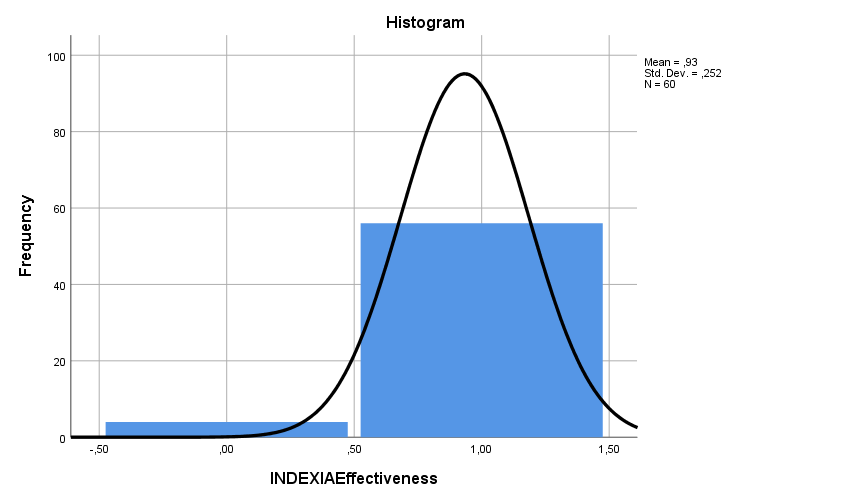
Behavior of companies with regard to effectiveness of internal audit The figure bellow highlights a statistical distribution concentrated to the right. According to a scientific approach, the probability that a company taken at random in this sample has effective internal audit is 90%. This statistic is in line with financial reporting quality (Kueda et al, 2023) but opposes the financial reporting crisis as described by multiple authors in Cameroon (Djongoué, 2007; Djoutsa et al. 2015, Foka et al, 2018, 2023 and Kueda et al. 2020).
Source: From SPSS 25
Results of inferential statistics
This section contents the correlation table and the results of the OLS.
| 1 | 2 | 3 | 4 | 5 | 6 | 7 | |
|---|---|---|---|---|---|---|---|
| 1 | 1 | ||||||
| 2 | .326** | 1 | |||||
| 3 | .118 | .048 | 1 | ||||
| 4 | .418*** | .176 | .198 | 1 | |||
| 5 | .134 | .079 | .148 | .000 | 1 | ||
| 6 | .292** | .291** | .017 | .539*** | .176 | 1 | |
| 7 | .011 | .161 | .244 | .282** | -.053 | .113 | 1 |
| 1 = INDEX of IAE, 2 = Outsourcing internal audit, 3 = IA size, 4 = INDEX of Relationship between internal and external Auditors, 5 = Presence of internal control system, 6 = Board Independence and 7 = CEO Duality | |||||||
1 = INDEX of IAE, 2 = Outsourcing internal audit, 3 = IA size, 4 = INDEX of Relationship between internal and external Auditors, 5 = Presence of internal control system, 6 = Board Independence and 7 = CEO Duality *. Correlation is significant at the 0.05 level. **. Correlation is significant at the 0.01 level. Source: From SPSS 25
The correlation matrix shows that no independent variable has a correlation above 0.80, indicating that multicollinearity is not a significant concern in this study. This means that the independent variables outsourcing of internal audit functions, internal audit team size, presence of an internal control system, and relationship between internal and external auditors do not exhibit redundancy and can be reliably included in the regression model.
| Tolerance | VIF | |
|---|---|---|
| Outsourcing internal audit | .896 | 1.117 |
| Size of internal audit team | ||
| Less or equal to 6 | .453 | 2.206 |
| 7-10 | .476 | 2.099 |
| INDEX of the Relationship between internal and external Auditors | .627 | 1.596 |
| Presence of internal control system | .918 | 1.090 |
| Board Independence | .603 | 1.659 |
| CEO Duality | .854 | 1.171 |
Source: From SPSS 25
From the table above, it can be observed that the tolerance values are above the commonly used threshold of 0.1 and all VIF values are below the critical value of 10. This indicates that the predictors in the model are not highly correlated and can be reliably used in the regression analysis.
| Model | R | R Square | Adjusted R Square | Std. Error of the Estimate |
|---|---|---|---|---|
| 1 | .524 | .275 | .177 | .22818 |
Source: From SPSS 25
The results show that the R value of 0.524 indicates a moderate positive relationship between the independent variables and internal audit effectiveness. The R-Square value of 0.275 suggests that 27.5% of the variation in internal audit effectiveness is explained by the model, while the remaining 71.5% is explained by other factors. The Adjusted R-Square of 0.177 being lower than R-Square indicates that some independent variables may not strongly contribute to the model.
| Model | Sum of Squares | Df | Mean Square | F | Sig. |
|---|---|---|---|---|---|
| Regression | 1.026 | 7 | .147 | 2.814 | .015 |
| Residual | 2.708 | 52 | .052 | ||
| Total | 3.733 | 59 |
Source: From SPSS 25
The F-statistic of 1.952 with a p-value of 0.015 shows that the model is globally significant at the 5% level of significance.
| Unstandardized Coefficients | Standardized Coefficients | t | Sig. | ||
|---|---|---|---|---|---|
| B | Std. Error | Beta | |||
| (Constant) | .611 | .183 | 3.347 | *** | |
| Outsourcing internal audit | .161 | .074 | .272 | 2.182 | ** |
| Size of internal audit team | |||||
| Less or equal to 6 | -.034 | .113 | -.052 | -.299 | |
| 7-10 | -.003 | .142 | -.003 | -.018 | |
| INDEX of the Relationship between internal and external Auditors | .275 | .100 | .410 | 2.749 | *** |
| Presence of internal control system | .082 | .103 | .098 | .797 | |
| Board Independence | -.007 | .086 | -.012 | -.080 | |
| CEO Duality | -.092 | .075 | -.156 | -1.219 | |
| *. Correlation is significant at the 0.1 level. **. Correlation is significant at the 0.05 level. ***. Correlation is significant at the 0.01 level. | |||||
*. Correlation is significant at the 0.05 level. **. Correlation is significant at the 0.01 level. Source : From SPSS 25
The regression coefficients provide insights into the individual contribution of each identified determinants of internal audit effectiveness in public limited companies. The constant term is positive and has a p-value of 0.002, indicating that when all independent variables are held at zero, the predicted level of internal audit effectiveness remains positive and statistically significant at the 1% level. The outsourcing of internal audit functions has a positive and significant effect at 5% level of significance on the IAE. Therefore, we reject the null hypothesis and accept the alternative hypothesis which states that the outsourcing of internal audit functions has a positive and significant effect on internal audit effectiveness. Furthermore, the coefficients for different internal audit team sizes (Less or equal to 6 and 7-10) are all negative and statistically insignificant (p value = 0.766 and 0.986), implying that a change in the size of the internal audit team will have no significant effect on internal audit effectiveness in this study. Here, we accept the null hypothesis and reject the alternative hypothesis which states that the size of the internal audit team has a positive and significant effect on internal audit effectiveness. From the above table, the coefficient for the relationship between internal and external auditors is positive and statistically significant (p-value = 0.008), implying that this relationship has an effect on internal audit effectiveness at the 1% level. Base on this, we reject the null hypothesis and accept the alternative hypothesis which states that the relationship between internal and external auditors has a positive and significant effect on internal audit effectiveness. Also, the coefficient for the presence of an internal control system is positive and statistically insignificant (p value > 0.05). This suggests that it does not have an effect on internal audit effectiveness. Thus, null hypotheses were supported against the alternative which states that the presence of internal control system has a positive and significant effect on internal audit effectiveness. Lastly, the coefficients for board independence and the CEO duality are negative and statistically insignificant (p value > 0.05), suggesting that they do not have an effect on internal audit effectiveness within the sampled public limited companies.
DISCUSSION OF FINDINGS
The results also indicate that outsourcing of internal audit functions significantly improves internal audit effectiveness. This suggests that public limited companies benefit from outsourcing because external firms provide specialized expertise, ensure greater audits, and implement advanced technologies that enhance audit quality. However, outsourcing may also create risks related to loss of internal control and confidentiality breaches. The positive impact of outsourcing is supported by agency theory, which suggests that independent monitoring mechanisms, such as external auditors, improve transparency and reduce financial misstatements. This result is consistent with findings by Hass et al. (2012) in European multinational corporations and Lindow and Race (2010) in U.S. firms, both of whom confirmed that outsourcing enhances internal audit effectiveness. Conversely, Everett et al. (2012) found that outsourcing reduced internal control and accountability in Australian companies, implying that the governance environment plays a role in determining its effectiveness. In the Cameroonian context, outsourcing is particularly useful due to resource constraints and a shortage of highly skilled internal auditors, making it a viable strategy for improving audit effectiveness in PLCs. Interestingly, the size of the internal audit team does not have a significant effect on internal audit effectiveness across all categories. This implies that the number of internal auditors alone does not determine the internal audit effectiveness. The size of internal audit teams may face inefficiencies if they lack proper training, technological tools, or clear communication structures. This result challenges agency theory, which assumes that stronger oversight through larger teams should enhance governance. Instead, the findings align with institutional theory, which argues that firms may expand audit teams to meet regulatory requirements rather than to improve effectiveness. Communication theory also provides insight, as poor coordination within large teams can reduce effectiveness, whereas smaller, wellstructured teams may perform better. This result is consistent with Kebede et al. (2019) in Ethiopian financial institutions and Alhassan et al. (2018) in Ghanaian state-owned enterprises, both of whom found no significant impact of team size on audit effectiveness. However, Carcello et al. (2017) in U.S. corporations and Pizzini et al. (2015) in European firms reported a positive effect, suggesting that wellresourced teams in developed economies may benefit more from larger audit units. In Cameroonian PLCs, where resources are often limited, audit effectiveness may depend more on auditor competence and regulatory oversight than on team size. The findings reveal that the relationship between internal and external auditors has a significant positive effect on internal audit effectiveness. This suggests that effective collaboration between internal and external auditors enhances the overall audit process by reducing duplication of efforts, ensuring more thorough audits, and strengthening corporate governance. A well-integrated relationship allows external auditors to place greater reliance on internal audit work, thereby increasing efficiency and reducing audit costs. This result aligns with agency theory, which emphasizes the importance of strong monitoring mechanisms in reducing information asymmetry and agency conflicts between managers and shareholders. The findings support prior research by Roba et al. (2023) in Ethiopian commercial banks, Sishumba et al. (2022) in Zambian commercial banks, and Onay (2021) in the Turkish private sector, all of whom found that strong collaboration between internal and external auditors enhances financial reporting quality. Contradictorily, Dellai and Omri (2016) contradict these findings in the Tunisian organisations, by reporting that this relationship was not significant. The findings in this study suggest that Cameroonian PLCs can improve audit effectiveness by fostering stronger collaboration between internal and external auditors, aligning with global best practices despite regional governance differences.
Similarly, the presence of an internal control system does not significantly influence internal audit effectiveness. This finding suggests that merely having internal control mechanisms is not enough to improve audit effectiveness. What matters is how well these controls are implemented and monitored. Weak enforcement, lack of integration into daily operations, and inadequate oversight may explain why internal controls do not significantly impact the internal audit effectiveness in this study. This contradicts agency theory, which assumes that strong internal controls should enhance monitoring and reduce financial mismanagement. However, institutional theory offers an alternative perspective, suggesting that firms may establish internal controls to meet compliance requirements rather than to improve operational efficiency. Ibhawaegbele (2024) in Nigerian public universities reported similar findings, where weak enforcement undermined the effectiveness of internal controls. On the other hand, Liyala and Mburu (2023) in Kenyan public universities found that properly enforced internal controls significantly improved internal audit effectiveness, demonstrating the importance of enforcement mechanisms. In Cameroon, regulatory weaknesses and insufficient oversight may limit the impact of internal controls, making it essential for PLCs to focus on proper enforcement rather than merely establishing control systems. Overall, the findings of this study emphasize the importance of collaboration between internal and external auditors and the strategic use of outsourcing, while challenging assumptions about team size and the presence of internal controls. These insights are particularly relevant for public limited companies in Cameroon, where corporate governance practices may differ from those in more developed economies. Strengthening regulatory enforcement, improving management support, and enhancing auditor competence may be more critical to internal audit effectiveness than structural factors alone.
CONCLUSION
This study examined the determinants of internal audit effectiveness in public limited companies (PLCs) in Cameroon. The findings revealed that outsourcing the internal audit function and the relationship between internal and external auditors significantly enhance internal audit effectiveness, while internal audit team size, internal control systems, board independence, and CEO duality do not have a significant effect. From a theoretical perspective, the study confirms the relevance of agency theory, as the relationship between internal and external auditors strengthens monitoring and reduces information asymmetry. However, institutional theory also provides a strong foundation, as companies often adopt internal control systems and large audit teams more for compliance than for effectiveness. Therefore, these findings suggest that traditional governance mechanisms are no longer sufficient on their own; dynamic, collaborative, and competence-driven practices such as outsourcing and auditor collaboration play a more critical role in enhancing internal audit effectiveness in contemporary corporate settings. From a practical perspective, the study highlights the need for PLCs in Cameroon to focus on strengthening cooperation between internal and external auditors and to consider strategic outsourcing to enhance effectiveness. However, this must be done cautiously to avoid excessive reliance on external auditors, which could compromise internal governance. The study also points to a governance gap in the enforcement of internal controls, suggesting that internal controls must be well implemented and supported by management to be effective.
While this research provides valuable insights, it is limited to some PLC operating in three regions of Cameroon, meaning that results may not be generalizable to other enterprises. Moreover, the sample size used, while statistically acceptable, may not capture the full diversity of audit practices across all sectors. The study also focused only on a limited number of independent variables, excluding other potential determinants such as audit committee characteristics, organizational culture, or the use of advanced audit technologies, which may also influence internal audit effectiveness. Future studies could expand the scope to other corporate structures and examine the long-term impact of outsourcing internal audit functions on corporate governance. Additionally, exploring how technological advancements such as artificial intelligence and data analytics influence internal audit effectiveness would be valuable for modern auditing practices. This study underscores that internal audit effectiveness is driven by collaboration, and outsourcing of internal audit functions rather than just structural factors like audit team size. The findings offer practical recommendations for corporate governance improvements in Cameroon’s business sector and contribute to the broader academic discussion on internal audit effectiveness in emerging markets.
ACKNOWLEDGEMENT
This research received no specific grant from any funding agency in the public, commercial, or not-for profit sectors.
References
- Ababio, E. M., Asiedu, K. F., & Amankwah, A. E. (2020). The effect of management support on internal audit effectiveness: Evidence from Ghana. African Journal of Accounting, Auditing and Finance, 6(4), 391-408. https://doi.org/10.1504/AJAAF.2020.110125.
- Abbott, L. J., Parker, S., & Peters, G. F. (2010). Serving two masters: The association between audit committee internal audit oversight and internal audit activities. Accounting Horizons, 24(1), 1-24. https://doi.org/10.2308/acch.2010.24.1.1.
- Adams, M. B. (1994). Agency theory and the internal audit. Managerial Auditing Journal, 9(8), 8-12. https://doi.org/10.1108/02686909410071133.
- Adeyemi, S. B., Okpala, O. B., & Dabor, E. L. (2018). Factors affecting audit quality in Nigeria. International Journal of Business and Management, 6(9), 198-209. https://doi.org/10.5539/ ijbm.v6n9p198.
- Akinbuli, S. F., Asaolu, T. O., & Alao, T. O. (2022). Auditor independence and internal audit effectiveness: Evidence from Ghana. International Journal of Auditing, 26(3), 214-230. https://doi.org/10.1111/ijau.12218.
- Alhassan, M., Musah, A., Gapketor, E. D., & Anokye, F. K. (2018). Determinants of internal audit effectiveness in state-owned enterprises (SOEs) in Ghana. The Journal of Accounting and Management, 8, 52-68.
- Al-Twaijry, A. A. M., Brierley, J. A., & Gwilliam, D. R. (2004). An examination of the relationship between internal and external audit in the Saudi Arabian corporate sector. Managerial Auditing Journal, 19(7), 929-944.
- Alzeban, A., & Gwilliam, D. (2014). Factors affecting the internal audit effectiveness: A survey of tharenae. https://doi.org/10.1016/j.intaccaudtax.2014.05.002
- Ameen, E. M., Hassan, M. K., & Adel, H. A. (2021). Auditor objectivity and credibility in the public sector: Evidence from developing countries. Journal of Public Sector Auditing, 3(1), 34-49. https://doi.org/10.1108/JPSA-11-2020-0023.
- Arena, M., & Azzone, G. (2009). Identifying organizational drivers of internal audit effectiveness. International Journal of Auditing, 13(1), 43-60.
- Carcello, J. V., Hollingsworth, C. W., & Mastrolia, S. A. (2017). The role of internal auditors in financial reporting: Evidence from the Sarbanes-Oxley Act. Accounting Review, 92(3), 169-192.
- Christopher, J., Sarens, G., & Leung, P. (2011). A critical analysis of the independence of the internal audit function: Evidence from Australia. Accounting, Auditing & Accountability Journal, 24(2), 234-270.
- Cohen, A., & Sayag, G. (2010). The effectiveness of internal auditing: An empirical examination of its determinants in Israeli organisations. Australian Accounting Review, 20(3), 296-307. https://doi.org/10.1111/j.1835-2561.2010.00108.x.
- CONAC. (2023). Annual report on corruption in Cameroon.
- Correia, C., Flynn, D., Uliana, E., & Wormald, M. (2009). Financial management (7th ed.). Juta and Company Ltd. COSO (Committee of Sponsoring Organizations of the Treadway Commission). (2013). Internal control Integrated framework: Executive summary. COSO.
- Dellai, H., & Omri, M. A. B. (2016). Factors affecting the internal audit effectiveness in Tunisian organizations. Research Journal of Finance and Accounting, 7(16), 2222-1697.
- DiMaggio, P. J., & Powell, W. W. (1983). The iron cage revisited: Institutional isomorphism and collective rationality in organizational fields. American Sociological Review, 48(2), 147-160. https://doi.org/10.2307/2095101
- Dittenhofer, M. (2011). Internal auditing effectiveness: An expansion of present methods. Managerial Auditing Journal, 16(8), 443-450.
- Djongoue, G. (2007). Fiabilité de l’information comptable et gouvernance d’entreprise : une analyse de l’audit légal dans les entreprises Camerounaises, colloque international la gouvernance : quelles pratiques promouvoir pour le développement économique de l’Afrique. Université catholique de Lille France, 3-16.
- Djoutsa, W. G., Tchamyou, V. S., & Asongu, S. A. (2018). Determinants of audit quality in Sub-Saharan Africa: A quantitative study. African Governance and Development Institute Working Paper Series, No. 18/045.
- Djoutsa, W. L., Takoudjou, N. A., & Wamba, H. (2015). Efficacité des mécanismes de gouvernance dans la lutte contre les distorsions à l’image fidèle de l’entreprise. Revue Camerounaise de Management, (30), 1-16.
- Donaldson, T., & Preston, L. E. (1995). The stakeholder theory of the corporation: Concepts, evidence, and implications. Academy of Management Review, 20(1), 65-91.
- Everett, J., Neu, D., & Rahaman, A. S. (2012). Accounting and the global fight against corruption. Accounting, Organizations and Society, 37(6), 316-328.
- Fadzil, F. H., Haron, H., & Jantan, M. (2005). Internal auditing practices and internal control system. Managerial Auditing Journal, 20(8), 844-866.
- Fama, E. F., & Jensen, M. C. (1983). Separation of ownership and control. The Journal of Law and Economics, 26(2), 301-325. https://doi.org/10.1086/467037.
- Foka, T. A. G., Hikouatcha, K. P. D., Mbaduet, J. F., & Ndassi, Y. J. (2018). Qualité d’audit, concentration de l’actionnariat et reporting financier : une étude auprès des préparateurs des comptes aux Cameroun. Journal of Academic Finance, 9(1), 29-39.
- Fombad, C. M. (2021). Strengthening internal audit practices in Cameroonian public limited companies: Lessons from SONARA. Journal of Financial Regulation and Compliance, 29(2), 133-151. https://doi.org/10.1108/JFRC-04-2020-0015.
- Fourie, J. (2020). The Steinhoff scandal: An analysis of internal audit failures in South African companies. Journal of Forensic and Investigative Accounting, 12(3), 84-101.
- Freeman, R. E. (1984). Strategic management: A stakeholder approach. Pitman.
- Geraldo, J. E. (2025). The role of internal audit in promoting organisational ethics and integrity. Journal of Business Management and Accounting, 15(2), 209-217. https://doi.org/10.32890/jbma 2025.15.2.7.
- Greenwood, M. (2007). Stakeholder engagement: Beyond the myth of corporate responsibility. Journal of Business Ethics, 74(4), 315-327. https://doi.org/10.1007/s10551-007-9509-y
- Haffar, M., Alam, M., & Aktaruzzaman, M. (2020). Impact of auditor competence on internal audit effectiveness.
- Hass, S., Abdolmohammadi, M. J., & Burnaby, P. (2012). The Americas literature review on internal auditing. Managerial Auditing Journal, 21(8), 835-844.
- Healy, P. M., & Palepu, K. G. (2003). The fall of Enron. Journal of Economic Perspectives, 17(2), 3-26. https://doi.org/10.1257/089533003765888403.
- Hotten, R. (2016). Volkswagen: The scandal explained. BBC News. https://doi.org/10.1108/ 02686900610703787.
- Ibhawaegbele, P. A. (2024). Determinants of Internal Control Effectiveness in Public Organizations in Nigeria. International Journal of Engineering Research and Development, 20(1), 10-15. https://www.ijerd.com/paper/vol20-issue1/B20011015.pdf
- Institute of Internal Auditors. (2019). International professional practices framework (IPPF).
- Javed, A., & Saghir, J. (2019). The role of auditor competence in ensuring effective financial reporting in Pakistan's banking sector. Journal of Financial Reporting and Accounting, 17(1), 104-122. https://doi.org/10.1108/JFRA-06-2017-0050.
- Jensen, M. C., & Meckling, W. H. (1976). Theory of the firm: Managerial behavior, agency costs and ownership structure. Journal of Financial Economics, 3(4), 305-360.
- Jones, H. (2020,). Wirecard scandal exposes audit failures in European markets. Financial Times. https://www.ft.com/content/c20c907c-3bc3-44b3-b0ad-08e464fc619e.
- Juhmani, O., & Al-Qudah, M. (2021). Management support and its effect on internal audit effectiveness: The case of Jordanian firms. International Journal of Auditing and Accountability, 29(2), 124-142. https://doi.org/10.1108/IJAA-05-2021-0087.
- Kebede, S., Teferi, A., & Tadele, W. (2019). Determinants of internal audit effectiveness in Ethiopian public enterprises. Journal of Resources Development and Management, 52, 15-23. https://doi.org/10.7176/JRDM/52-02.
- Kessy, S. S., & Mahanga, A. J. (2021). Role of management support in enhancing internal audit performance: Evidence from public entities in Tanzania. Journal of Public Administration and Governance, 11(1), 44-59. https://doi.org/10.5296/jpag.v11i1.18352.
- Koffi, M. T. (2019). The role of OHADA in promoting corporate governance in Central Africa. African Journal of Business Ethics, 13(1), 45-59.
- Kueda, W. B., Ngassa, M. & Omenguele, G. R., (2020). External Audit, Institutional Ownership and Quality of Accounting Information in Cameroon. Journal of Economics and Management Sciences, 2(1), 189-211.
- Kueda, W. B., Ngassa, M., & Fomo Kengni, G. A. (2023). External Audit Quality and Quality of Financial Reporting in a Developing Economy: How Does Institutional Ownership Moderate? Journal of Economics and Management Sciences, 4(2), 1-16.
- Lindow, P. E., & Race, J. D. (2010). Beyond traditional audit techniques. Internal Auditor, 67(5), 28-33.
- Liyala, S. A., & Mburu, K. (2023). The effect of internal control systems on the effectiveness of internal audit in public universities in Kenya. Journal of Public Administration, 12(1), 88-102.
- Mahlaka, R. (2018). Gupta family’s businesses collapse: What’s next for South Africa? Business Maverick.https://www.dailymaverick.co.za/article/2018-10-11-gupta-businesses-collapse/.
- Mazzi, C. (2016). Family business and financial performance: Current state of knowledge and future research challenges. Journal of Family Business Strategy, 2(3), 166-181.
- Messier, W. F., Glover, S. M., & Prawitt, D. F. (2012). Auditing and assurance services: A systematic approach (8th ed.). McGraw-Hill.
- Meyer, J. W., & Rowan, B. (1977). Institutionalized organizations: Formal structure as myth and ceremony. American Journal of Sociology, 83(2), 340-363.
- Mihret, D. G., & Yismaw, A. W. (2007). Internal audit effectiveness: An Ethiopian public sector case study. Managerial Auditing Journal, 22(5), 470-484.
- Mihret, D. G., & Yismaw, A. W. (2011). Internal audit effectiveness: An Ethiopian public sector case study. Managerial Auditing Journal, 22(5), 470-484.
- Mohamed, I., Yusuf, N., & Ahmad, R. (2021). The role of auditor objectivity in enhancing financial reporting credibility.
- Nanda, P., & Sinha, R. (2021). The ethics of auditor objectivity and its impact on audit effectiveness: A critical analysis. Journal of Financial Ethics, 16(2), 121-138.
- National Institute of Statistics. (2020). Annual statistical report on Cameroon’s corporate sector. Government of Cameroon.
- Nfor, F. F. (2020). Anti-corruption laws and internal auditing in Cameroon: An analysis of law No. 2017/011. African Journal of Law and Criminology, 10(2), 25-41.
- Nneka, E., Akintola, F. O., & Balogun, S. O. (2022). The influence of management support on the effectiveness of internal auditing in the Nigerian public sector. Public Administration and Development, 42(4), 295-310. https://doi.org/10.1002/pad.1981.
- Oghogho, U., & Akingbola, R. A. (2022). Enhancing internal audit effectiveness through auditor independence: Evidence from Nigerian firms. Journal of Auditing, Fraud, and Ethics, 3(2), 98-116. https://doi.org/10.1002/jafe.2287.
- Okwu, E. O., & Ihemeje, M. S. (2019). The role of objectivity in audit effectiveness: Evidence from Nigerian companies. International Journal of Economics and Financial Management, 7(3), 115-129. https://doi.org/10.1080/ije.fm.2019.73.119.
- Onay, A. (2021). Factors Affecting the Internal Audit Effectiveness. Ege Academic Review, 21(1), 1-15. https://doi.org/10.21121/eab.873867.
- Owolabi, S., & Oluwaleyimu, K. (2019). An analysis of the 2012 Nigerian fuel subsidy scandal: Implications for corporate governance and auditing practices. International Journal of Business and Management, 14(4), 65-78. https://doi.org/10.5539/ijbm.v14n4p65.
- Parker, L. (2011). Governance and the ethics of enterprise. Strategic Change, 20(5-6), 215-229.
- Pizzini, M., Lin, S., & Ziegenfuss, D. E. (2015). The impact of internal audit function quality and contribution on audit delay. Auditing: A Journal of Practice & Theory, 34(1), 25-58.
- Roba, H. A., Legass, H. A., & Jemal, S. (2023). Internal Audit Effectiveness and Its Determinant Factors in Commercial Banks of Ethiopia: The Case of Bale Robe Town. International Journal of Accounting, Finance and Risk Management, 8(2), 49-56.
- Sarbanes-Oxley Act. (2002). Public Law No. 107-204. United States Congress..
- Schneider, A. (2010). The nature, impact, and facilitation of external auditor reliance on internal auditing. Academy of Accounting and Financial Studies Journal, 14(3), 41-53.
- Scott, W. R. (2008). Institutions and organizations: Ideas and interests (3rd ed.). Sage Publications.
- Sishumba, J., Saidi, L., & Nyambe, M. (2022). A Study into the Effects of Internal Audit on the Financial Performance of Commercial Banks in Zambia (A case of Standard Chartered). International Journal of Current Science Research and Review, 5(11), 4156-4175.
- Tangri, R. (2020). Financial mismanagement and governance failures in Cameroon’s public enterprises: A case study of Camair-Co. Journal of African Business, 21(3), 381-398.
- Wamba, S. F., Gunasekaran, A., Akter, S., Ren, S. J.-F., Dubey, R., & Childe, S. J. (2017). Big data analytics and firm performance: Effects of dynamic capabilities. Journal of Business Research, 70, 356–365. https://doi.org/10.1016/j.jbusres.2016.08.009.
- Whittington, O. R., & Pany, K. (2016). Principles of auditing and other assurance services (20th ed.). McGraw-Hill.
- World Bank. (2019). World Development Report 2019: The changing nature of work. https://www.worldbank.org/en/publication/wdr2019