The Moderation Effects of Access to Finance on the Impact of Market Orientation and Entrepreneurial Orientation on the Performances of SMEs in Nigeria
- Federal University Dutse
- Universiti Utara Malaysia
Journal of Business Management and Accounting 15(2) (2025) · https://doi.org/10.32890/jbma2025.15.2.5
Abstract
Nigerian Small and Medium Enterprises (SMEs) are the biggest business industry and a bedrock of the country’s economic development. However, few studies have been conducted on strategic orientation to improve performance. Therefore, this paper determines the effect of strategic orientations on the SMEs performance in Nigeria, which plays an imperative role in the nation's growth. The rareness of this study focuses on access to finance, which is central for SMEs to progress and to compete in domestic and global markets. The main purpose of this study is to investigate the moderating influence of access to finance on the nexus between market orientation, entrepreneurial orientation, and SMEs’ performance in Nigeria. The surveys were administered to 300 owners and managers of SMEs in North-West Nigeria. A total of 251 effective responses, or 83.66% of the response rates, were put for data analysis. The finding indicated that entrepreneurial orientation and access to finance have a significant effect on SMEs' performance. However, market orientation has indicated a non-significant effect on SMEs' performance. In addition, access to finance has shown a non-significant moderating effect on both market orientation and entrepreneurial orientation on SMEs' performance. The research implication shows that managers should focus more on entrepreneurship orientation.
Keywords: Market orientation, entrepreneurial orientation, access to finance, firm performance and Nigeria
INTRODUCTION
Nigerian small and medium enterprises (SMEs) are now operating in a globalized economy with intense competition and are continually seeking to increase their performance (Abor & Quartey, 2010; Amin et al.., 2016). The constructs of strategic orientations, namely market orientation (MO) and entrepreneurial orientation (EO) have gained imperative cognizance in the body of knowledge on strategic management as core concepts that determine the performance of SMEs (Fairoz et al., 2010; Polat & Mutlu, 2012). Small firms in Nigeria seeking to achieve competitive advantage and performance need strategic orientations (Abiodun & Kida, 2016; Mahmoud et al., 2018). Strategic orientation is a belief or culture that guides decision-making practice and strategic implementation through the use of scarce resources to attain greater performance (Ra’ed et al., 2018; Schulze et al., 2022; Zamani et al., 2016). A firm's strategic orientation has a direct impact on its operation, investment decisions, and how it relates to customers, subsequently resulting in higher performance (Rezaei & Ortt, 2018). These strategic orientations help firms to overcome problems through developing new capabilities or resources and improve performance (Smirnova et al., 2011; Sok & O’Cass, 2011; Zamani et al., 2016). It guides the procedure for the firm to access resources, exploit opportunities, and deliver greater value to customers at a profit (Brockman et al., 2012; A. M. Mahmoud et al., 2016; Racela, 2014). Good strategies help firms build capabilities that will align with external environmental requirements (Asmat‐Nizam, 2013; Irwin et al.., 2018). To actualise these aims, a small firm requires resource commitment (Gupta & Batra, 2016; Rodríguez-Gutiérrez et al., 2015). Some scholars argued that an enterprise’s strategic orientation gives clear direction for managing its resources and operations to attain superior performance (Alayo et al., 2019; Arzubiaga et al., 2018; Sa’id et al., 2019b). Despite SMEs' role in the nation’s economic growth and advancement, the majority of them in Nigeria cannot adopt multiple strategic orientations (Abdul Talib, 2005; Sa’id et al., 2019a). This is connected to a shortage of resources among SMEs, especially in developing countries (Al-Ansaari et al., 2015; Battisti et al., 2019; Elllawule et al., 2024). In other words, access to finance is found to be an important variable that influences SMEs' performance (Adomako et al., 2016; Babatunde, 2024; Fatoki, 2012; Mamun, 2016). Access to finance is defined as the availability of financial resources among SMEs from financial institutions without financial restriction. In this regard, achieving better performance of strategic orientation requires a large resources commitment (Braun et al., 2019; Jiang & Liu, 2018; Su et al., 2015). Precisely, resources are an essential ingredient for firms’ operations. Without enough access to resources/finance, a firm’s strategic orientation might not be sound, and its potential impact on performance could be endangered (Wiklund & Shepherd, 2005). However, the available literature on strategic orientation has not pointed the clear role of access to finance in relation to firm strategic management and how it supports an enterprise’s multiple strategic orientations (Al-Swidi & Mahmood, 2012; Timsit et al., 2015). Consequently, how and in what way access to finance affects the connection among strategic orientations and firm performance represents an important research problem. Given the limited resources of small firms in emerging countries and the shortage of empirical research on multiple strategic orientations (Engelen et al., 2015; Grewal & Tansuhaj, 2001; Kiessling et al., 2016; Mahmoud et al., 2016) and even the available ones are mostly conducted in developed countries (Anning-Dorson, 2018; Lau & Bruton, 2011; Smirnova et al., 2011) and multinational companies (Liu et al., 2015; May-Chiun et al., 2015; Ozkaya et al., 2015). In addition, the available empirical studies examining the direct connection between these orientations and firm performance are inconclusive. for instance, some studies reported that MO has a positive effect on performance(Eris & Ozmen, 2012; Mamun et al., 2018; Su et al., 2015), while others report MO has an insignificant effect on performance (Haugland et al., 2007; Kajalo & Lindblom, 2015; Lomberg et al., 2016). Similarly, several studies have revealed a positive effect of EO on firm performance (Brouthers et al., 2015; Gupta & Batra, 2016; Nasir et al., 2017), yet there are inconsistent studies indicating an inverse U-shape association and nonsignificant relationship between EO and performance (Alegre & Chiva, 2013; Kajalo & Lindblom, 2015; Lonial & Carter, 2015). Several scholars have opined that contextual differences within the advanced economies of the US and Europe and between developing economies of African countries could affect the empirical results in the field of strategic management. Considering this mixture of finding access to finance would be a critical moderator that determines the value creation of strategic orientation, thereby achieving firm performance. Equally, the theory on the resource-based view regards access to finance as unique, infrequent, and difficult to imitate as a key factor in describing the creation and maintenance of a firm's competitive benefit (Campbell & Park, 2017; Zheng et al., 2010). Equally, many researchers suggested investigating other contingencies that could moderate the relationship in certain contextual positions (Kajalo & Lindblom, 2015; Lonial & Carter, 2015). Hence, our study aims to answer these research questions by examining the influences of multiple strategic orientations on firms' performance and the moderating effect of access to finance. More precisely, the study determines to attain the mentioned research objectives: (1) examine the influence of market orientation on firms' performance (2) determine the effect of entrepreneurial orientation on the performance of firms, (3) examine whether access to finance moderate the connection between market orientation and firms’ performance (4) determine whether access to finance moderate the association between entrepreneurial orientation and firms’ performance. The outcome of the study will spread the knowledge of strategic orientation, especially market and entrepreneurial orientation, as well as their relationship with access to finance, to boost SME performance. Precisely, the findings are likely to aid owners/managers in devising and executing various strategic orientations, particularly market orientation and entrepreneurial orientation. This paper starts with an introduction describing the need for strategic orientation for SMEs regarding intense competition in the globalized business environment. Followed by a literature review and hypothesis development on the association among variables. The subsequent part enumerates the methodology employed in this study. Adapting primary data from SMEs occupied in services and manufacturing activities, the fourth part portrays the findings of the research, managerial implications, recommendations, and conclusions drawn.
LITERATURE REVIEW Market Orientation and Firm Performance Market orientation is defined as the commitment to provide superior value to customers through three basic components: competitor orientation, customer orientation, and inter-functional coordination (Cross et al., 2007; Slater & Narver, 1994). Some scholars defined market orientation as the ability of a firm to generate market information concerning the current and future needs of consumers and distribute such information within the organization to provide superior value to the customer, better than competitors (Kohli & Jaworski, 1990; Matsuno & Mentzer, 2000). Market orientation is important because it emphasizes the firm constant collection or gathering of information about selected markets and customer needs, as well as monitoring competitors’ actions and tapping such information into the appropriate unit for the provision of better value to customers (Maurya et al., 2015; Pinho, 2008). Scholars established ample theories that describe the behaviour and effect of market orientation (Kohli & Jaworski, 1990; Sadiku-Dushi et al., 2019; Slater & Narver, 1994) causing a body of literature that probed the nexus between market orientation and firm consistent performance (Deshpandé et al., 1993; Eris & Ozmen, 2012; Mamun et al., 2018; Ruekert, 1992).
According to Day (1994), market orientation is described as not only an effective strategy for a firm to pursue but also a customer-centric practice. It enables an aspect for seeking unsatisfied consumer needs, pairing these with firm capabilities, and then receiving feedback from customers on the acceptability of the new products. In practice, market orientation requires firms to observe constant customer changing needs and wants and determine the effect of such changes on customer satisfaction, enhance product modification, and execute tactics that nurture the firm’s competitive edge. The significant connection between market orientations and firm sustainable performance is confirmed in the literature. However, the research on the effect of market orientation on firm performance is contradictory because of mixed findings in both advanced and emerging economies. While some findings have affirmed the linear association between market orientation and firm performance, other findings revealed an inverse or insignificant connection (Haugland et al., 2007; Keskin, 2006) For researchers, the mixed findings concerning this association recommended that only market orientation could not be a major factor for a viable competitive benefit in all situation (Baker & Sinkula, 1999) and therefore suggested matching it with other strategic variables (Mahmoud, 2011). Therefore, this study integrates entrepreneurial orientation and market orientation into a single model to improve small firm performance. However, this study determined to confirm the link between market orientation and small firm performance and therefore suggested that: H1. Market Orientation will be positively associated with SMEs' performance. Entrepreneurial Orientation and Performance According to Mason et al. (2015) Henry Mintzberg was recognized as the original author who identified entrepreneurship as an organizational strategic-making variable. However, after the publication of Miller (1983), the attention of scholars was focused on entrepreneurial firms. In his related article, Miller (1983) advocated that an entrepreneurial venture involves product market innovation, pursues calculated risky ventures, and pioneering pro-activeness innovations, thrashing competitors to the punch. These three features, innovation, pro-activeness, and risk-taking behaviour, were developed by Miller (1983) as the core of entrepreneurial orientation and are commonly integrated to establish a higher-order measure of firm entrepreneurship (Covin & Wales, 2011; Rauch et al., 2009). The importance of Miller’s (1983) donation is apparent in the number of citations per annum that his paper has because of its publication, getting it the position of a classic article (Mason et al., 2015). Although Miller contributed theoretically, before the publication of Covin and Slevin, (1989) The empirical research of entrepreneurship as a firm-level construct started gaining momentum after Covin and Slevin created a nine-item measurement scale, which has consequently become prevalent in entrepreneurship literature, with a great number of researchers applying this instrument (Rauch et al., 2009). Building upon previous studies, Lumpkin and Dess (1996) recommended that entrepreneurial orientation can be comprehended as a multidimensional construct in which the element denotes independent predictors. The author debated that the other elements of entrepreneurial orientation need not correlate for a business firm to be recognized as entrepreneurial. Lumpkin and Dess (1996) brought significant change from the preceding application and conceptualization of the initial entrepreneurial concept. This reconceptualization of entrepreneurial orientation manifests the creation of a theoretical division. Lumpkin and Dess (1996) also recommended two additional elements, autonomy and competitive aggression, which go beyond the initial three dimensions and further explain the field of entrepreneurial orientation. The authors described competitive aggressiveness as a firm action to overcome its marketplace challenges by sustaining a hostile posture, and autonomy is a firm’s capability to independently chase and champion potential opportunities in the business environment. The instruments for measuring autonomy and competitive aggressiveness have been comparatively new additions to the entrepreneurial orientation literature (Covin & Wales, 2011; V. Gupta & Gupta, 2015; Lumpkin & Dess, 1996). Precisely, entrepreneurial orientation involves a readiness to innovate, to recreate market or products, test risky ventures through offering new and uncertain goods, services, or markets, and first to come up with pro-activeness than opponents toward novel market opportunities (Covin & Slevin, 1989, 1991; Yuwono & Lena, 2025; Zahra, 2005). The innovation as an element of entrepreneurship mirrors a propensity to be involved in and back novel ideas, newness, experimentation, and process creation, in that way departing from old methods of production or technology (Al-shaikh & Hanaysha, 2023). An increase in technological, process and product innovation is described as the most effective method an enterprise can apply to pursue new opportunities and deliver superior value to customers.(Lumpkin & Dess, 1996). A proactive nature denotes a boldness of predicting and acting on the expected needs and wants of customers, thereby establishing a first-mover benefit ahead of the competitors (Lomberg et al., 2016; Polat & Mutlu, 2012). With such foresight, proactive small firms have the aspiration to be the pioneers by exploiting possible opportunities. Risk-taking is related to a readiness to commit huge capital to a venture where there is high uncertainty of return (Zahra, 2005). It is also described as investing resources in ventures where there is a high cost of failure. Regarding the entrepreneurial orientation dimension as an independent predictor, previous studies recommend that each can impact business performance positively. Innovative firms, establishing and presenting new products and services, can get unexpected economic advantages and could be viewed as the bedrock of economic development (Shin et al., 2015). Proactive firms can have pioneer benefits, target promising market sectors, and charge premium prices ahead of opponents (Gunawan et al., 2016; Zahra, 2005). The firm can dictate the market by being the first mover, dominating distribution channels and creating brand recognition. However, the nexus between risk-taking and firm performance is less apparent. Based on the above discussion, this study suggested that: H2. Entrepreneurial Orientation will be positively associated with SMEs performance. Entrepreneurial Orientation on the Performance of SMEs The quest for strategic orientation needs resources (Adomako et al., 2016). The strategic options exposed to a firm are wider, and enough resources need to be available (Biggs & Shah, 2006; Sok & O’Cass, 2011). Market orientation and entrepreneurial orientation is a resource resource-consuming strategic orientations (Covin & Slevin, 1991; Ozkaya et al., 2015; Polat & Mutlu, 2012; ). Therefore, access to finance enhances strategic orientation (Adomako et al., 2016; Wiklund & Shepherd, 2005). Access to finance seems to be of specific significance to business firms. Since it is the simplest form of assets that can easily be transformed into other forms of assets (Fornoni et al., 2012). Therefore, financial constraints for other functions can be mitigated to some extent by access to finance (Adomako et al., 2016; Fornoni et al., 2012). Furthermore, small firms usually encounter troubles in accessing equity and debt finance, putting extreme constraints on their growth (Biggs & Shah, 2006; Ferrando & Senad, 2018; Wang et al., 2015) but small businesses engaged in innovation and struggling for greater performance will have a strong need for capital (Verreynne & Kastelle, 2012; Zhou et al., 2007). This is mirrored in venture capitalist markets that supply huge amounts of money to small firms, generally offering to innovative firms with the propensity to accomplish outstanding performance (Verreynne & Kastelle, 2012).
More precisely, access to finance would interact with marketing orientation and entrepreneurship orientation in elucidation performance. Access to finance offers small businesses the slack to try out new tactics and innovative ventures that could not be permitted in a more financially restricted environment (Adomako et al., 2016; Fornoni et al., 2012; Verreynne & Kastelle, 2012). Excess finance nurtures a habit of experimentation since it safeguards businesses from the uncertain results of those ventures and also enables experimentation with novel strategy and practice (Oura et al., 2016; Real et al., 2014), including product market innovation (Rauch et al., 2009). Thus, access to finance stimulates innovation and product modification, thereby offering superior value to customers. Furthermore, small firms are increasingly vital to the overall economic growth in terms of their contribution to job creation (Battisti et al., 2019; Osei et al., 2024). Considering their nature of insufficient funds with an emphasis on direct interactions with customers paves the way for the need for access to finance for effective strategic orientation (Aloulou, 2019; Babatunde, 2025; Ferrando & Senad, 2018; Jeong et al., 2019). Moreover, marketing orientation and entrepreneurship orientation are key to discussions of strategic orientation (Jalali et al., 2014; Polat & Mutlu, 2012). Research papers that discover the effect of market orientation on firm consistent performance are well documented in the available literature (Eris & Ozmen, 2012; Kohli & Jaworski, 1990; Mamun et al., 2018; Slater & Narver, 1994). Although some research revealed significant positive associations, others did not, proposing that possibly some moderating variable may be considered (Braun et al., 2019; Gupta & Batra, 2016; Presutti & Odorici, 2018). Equally, past research on the influence of entrepreneurial orientation on small performance has revealed mixed findings in both developed and developing economies. While some findings have reaffirmed the linear association between entrepreneurial orientation and firm performance (Baker & Sinkula, 1999; Brouthers et al., 2015) other findings revealed an inverse or insignificant connection (Alegre & Chiva, 2013; Lonial & Carter, 2015). Similarly, for researchers, the mixed findings regarding this link recommended that only entrepreneurial orientation could not be a major factor for a viable competitive benefit in all situations (Baker & Sinkula, 1999; Kajalo & Lindblom, 2015; Morgan et al., 2009) and therefore suggested for matching it with other variables. Based on the foregoing discussion. Braun et al. (2019) suggest that access to finance might be a possible moderator of the market orientation, entrepreneurial orientation and firm performance association. H3. Access to finance strengthens the association between market orientation and SME’s performance. H4. Access to finance strengthens the association between entrepreneurial orientation and SME’s performance. H5. Access to finance will be positively associated with small SME’s performance.
METHODOLOGY Measurement The survey questionnaires were adapted from preceding studies, with little alterations made where necessary. Market orientation refers to the firm's intensity to obtain, disseminate and respond to customers’ information through the action of customer orientation, competition orientation and interfunctional coordination. A total of 13 items were adapted from the work of Distinguished and Farley (1998) to gauge market orientation. Entrepreneurial orientation refers to the approach, patterns, and decision-making system directed to firms’ intensity to identify novel opportunities (Amin et al., 2016).12 items were adapted from the work of Wolff, Pett, and Kirk (2015) with a few alterations to match the study scope and measure entrepreneurial orientation. Access to finance refers to the availability of financial resources to SMEs from financial institutions without financial constraints (Braun et al., 2019). Five items were modified from the study conducted by Martin et al. (2007) to gauge access to finance. Firm performance is a multidimensional construct, which could be gauged with subjective or objective measures. This study is designed on SMEs across different sectors and is hence based upon adapted subjective indicators of firm performance from the study carried out by Suliyanto and Rahab (2012). The performance measures gauged subjective performance in relation to respective competitors. Precisely six items were adapted to measure firm performance. The seven-point Likert scale (strongly disagree, disagree, moderately disagree, neutral, moderately agree, agree and strongly agree) was used for the independent, moderating and dependent variables. Data Collection and Sample We collected primary data from SMEs functioning in North-West Nigeria for the empirical study. The contact information was gained from the Small and Medium Enterprises Agency of Nigeria (SMEDAN), which listed around 16,286 firms in Kano. To ascertain generalizability or acceptability, the sampling frame covered all categories of business firms from several industries (e.g. manufacturing, information and technology, trade and commerce, agriculture and tourism, hotel and restaurant and other firms). A systematic sampling technique is employed to choose respondents based on industry type, and then a respondent is randomly chosen. To facilitate response, the researcher used phone calls and personal visitations to various companies' offices. This procedure gave a total of 300 completed and returned questionnaires. Forty-nine (49) of these questionnaires were removed due to univariate outlier (Tabachnick & Fidell, 2007) and, thus, not put in for further analysis. The final stage of analysis, therefore, depends on the respondents from 251 reliable and valid data, with a response estimate of 83.66%. This study contrasts early respondents and late respondents in terms of general features and research variables. The comparisons have not identified any substantial differences, indicating non-response bias. To ensure whether the data is reliable, 50 non-responses were randomly chosen for the pilot test. The reliability check outcome for the 50 non-responses samples indicates that Cronbach’s coefficient was greater than 0.70, which recommends appropriate reliability.
Data Analysis
To determine the connections between the main variable by employing the partial least squares (PLS) method, SmartPLS 3.2.4 was employed to assess the outer (measurement) model and (inner) structural model. The PLS technique was chosen since it can evaluate all paths concurrently and does not require too much sample size. Another rationale for employing PLS-SEM was when the data is abnormal, novel associations, and the predictive nature of this study (Hair et al., 2020; Hair et al., 2017). Therefore, this paper considered PLS SEM for the evaluation of the measurement and structural model as the most appropriate technique. Because the analysis is determined to estimate the relationship between the variables.
RESULT Evaluation of the measurement model Table I discloses that the factor loadings of all items are greater than the least value of 0.7. The convergent validity for each latent variable is larger than the least value of 0.5. Equally, composite reliability (CR) is also higher than 0.6 for each construct. Additionally, applying the Fornell–Larcker rules, the discriminant validity is verified as revealed in Table II since the square root of average variance extracted (AVE) of each of the constructs is higher than its interrelation with any other of the latent variables of the model (Hair et al., 2020; Hair et al., 2017). Henseler et al., (2014) suggested the evaluation of the interrelations’ heterotrait–monotrait ratio (HTMT) to examine the discriminant validity. This new method indicates the gauge of the actual interrelation among the constructs under investigation. A threshold figure of 0.90 for HTMT and the interval confidence level of the HTMT below have been recommended as the verge figure for ascertaining the discriminant validity via HTMT (Henseler et al., 2014; Sarstedt et al., 2020). Table III demonstrates that HTMT rules have been satisfied for the PLS model application. Consequently, the below results lead to the fulfilment of the measurement model standard, considering its satisfactory level of reliability, convergent validity, and discriminant validity. The next stage of data analysis to engage is the structural model analysis and testing of research hypotheses.
Table I Measurement Model Constructs Entrepreneurial Orientation
Dimension Innovativeness
Risk-Taking
Pro-activeness
Market Orientation
Customer Orientation
Competitive Orientation
Inter-functional Coordination
Access to Finance
Firm Performance
Items EO01 EO02 EO03 EO04 EO05 EO06 EO07 EO08 EO09 EO10 EO11 EO12 MO01
Loading 0.709 0.700 0.709 0.687 0.699 0.680 0.716 0.654 0.708 0.700 0.702 0.652 0.465
CR 0.88
AVE 0.65
MO02 MO04 MO05 MO06
MO07 MO08 MO09 MO10
MO11 MO12 MO13 AF01 AF02 AF03 AF04 AF05 EP01 EP02 EP03 EP04 EP05 EP06
Table II Discriminant Validity Fornell-Larcker Criteria Constructs
Access to Finance
Entrepreneurial Orientation
Firm Performance
Market Orientation
Table III Discriminant Validity Heterotrait–Monotrait Ratio (HTMT) Access to Finance
Entrepreneurial Orientation
Firm Performance
Market Orientation
Structural Model Evaluation
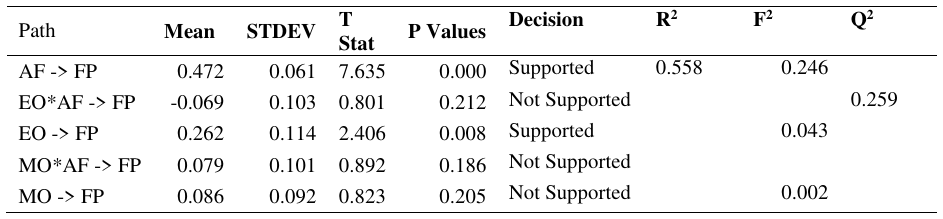
A structural path model is used to determine the coefficient of determination (R2), predictive relevance (Q2), effect size ( f2), and coefficients ( β), The bootstrapping was performed with 500 samples employing PLS 3.0 to measure path coefficients, t-values, and standard errors to determine the direct significance relationships of formulated hypotheses (Hair et al., 2020; Hair et al., 2017). The moderation test was also winnowed on the basis of Baron and Kenny, (1986). Following the computation with the inclusion of the interaction variable in Figure 1. The result from Table IV specifies that the path coefficient established that access to finance does not moderate the connection between entrepreneurial orientation and small firm performance (β = -0.069; t = 0.801; p<0.212). Equally, after insertion of the interaction term, the outcome of the path coefficient evaluated that access to finance is found not to moderate the association between market orientation and small firm performance (β = 0.079; t = 0.892; p<0.186). Therefore, Hypotheses 3 and 4 are not supported. The direct hypothesis was also tested. As displayed in Table IV, the statistical analysis provides detailed results as follows: Hypothesis 1, the result revealed that market orientation is not significantly positive with small firm performance (β = 0.079; t = 0.892; p< 0.186); therefore, Hypothesis 1 is not supported. However, Hypothesis 2 is supported because the result indicates a significant positive impact of entrepreneurial orientation on small firm performance (β = 0.262; t = 2.406; p< 0.008). On the other hand, in Hypothesis 5, the result discloses a significant positive influence of access to finance on small firm performance (β = 0.472; t = 7.635; p< 0.000); hence, Hypothesis 5 is supported. After assessing, the coefficient of determination (R2) was found to be 0.558 for small firm performance. Cohen, (1992) recommended R values of 0.67, 0.33, and 0.19 for the structural model are regarded as substantial, average and weak, respectively. Therefore, the coefficient of determination (R2) value of 0.558 should be regarded as average and satisfy the requirement because they were more than 0.10, indicating a moderate PLS model.
Then, in determining the effect size (f2). According to the rule of thumb stated by Cohen and Manion (1980), the figure of effect size (F2) should be 0.02, 0.15, and 0.35 regarded as small, average, and substantial effects of the exogenous variable, respectively. So, going by the rule of Cohen, (1992) Table IV shows that access to finance has a substantial influence on small firm performance. Likewise, entrepreneurial orientation has a small effect on small firm performance. However, Market orientation has no any influence on small firm performance. Additionally, by utilizing the blindfolding method, it is discovered that Q2 figures are substantially greater than zero, which supports the predictive relevance of this model regarding criterion variables. Table IV Result of Hypotheses Decision
Supported
T Stat 7.635
Not Supported
EO -> FP
Supported
MO*AF -> FP
Not Supported
MO -> FP
Not Supported
Path AF -> FP EO*AF -> FP
Mean
STDEV
P Values
DISCUSSION
The main objective of this research is to investigate the moderating influence of access to finance between entrepreneurial orientation, market orientation, and small firm performance in Nigeria. The findings from the investigation brought important theoretical implications in connection with small firm performance. Specifically, based on the outcome, small firm performance is significantly impacted by access to finance in direct relationships. However, after insertion, the interaction effect of access to financing in connection with market orientation, entrepreneurial orientation, and small firm performance. The findings revealed that access to financing has not moderated the association between market orientation and small firm performance. Equally, access to finance has no any moderating effect between entrepreneurial orientation and small firm performance. This non-moderation effect is inconsistent with (Fang et al., 2014; Hartono, 2013) Nevertheless, it should be recorded that the outcome was insignificant via moderation. The possible elucidation of these insignificant moderation impacts of access to finance on these strategic orientations, namely market orientation and entrepreneurial orientation on business firm performance, is that Nigerian SMEs have been facing significant challenges in their business environment since 2015 (Mohd Aris et al., 2023; Sa’id et al., 2019b). As a result, access to finance might moderate the association in more favourable business surroundings where other infrastructural facilities are available (Adomako et al., 2016). However, the result of the direct connection between market orientation and small firm consistent performance was found to be not significant. Thus, market orientation has been revealed to have no significant relationship with small firm performance. This indicates that most entrepreneurs or small business firms have no competency or capacity to go hand in hand with customer demand. Since market orientation is always focusing on customer demand, most small businesses do not have the resources to keep up with changing customer needs. On the other hand, the result of the direct association between entrepreneurial orientation and firm performance was revealed as positively significant. Thus, entrepreneurial orientation has been revealed to have a significant connection with small firm performance. This indicates that Nigerian entrepreneurs have the competency that survive the dynamism of the environment and formulate or execute a sound strategy that will link them with customers, suppliers and other business partners to achieve performance. The contributions of this study are various. First, the study contributed to the knowledge by conducting and testing noble empirical research that combines the moderation impact of access to finance in the association between entrepreneurship orientation, marketing orientation, and small firm performance. The study has contributed to the existing literature by discovering a non-moderation effect of access to finance in the relationship between entrepreneurial orientation, market orientation, and SMEs’ performance. The findings indicated that despite the positive importance of access to finance to SMEs, it has not supported their performance through moderation, especially in the unstable environment of emerging countries. The study contradicts some studies that recognized the significance of access to finance in improving the performance of SMEs via moderation (Adomako et al., 2016; Braun et al., 2019; Fatoki, 2011). Accordingly, the performance of small firms is solely dependent upon entrepreneurial orientation (Brouthers et al., 2015; Gupta & Batra, 2016; Jalali et al., 2014; Nasir et al., 2017). Nevertheless, the outcome of this study contradicts the statement of Kajalo and Lindblom (2015). The relationship between entrepreneurial orientation and small business performance is disputed because of the inconsistency of results in the available literature. This study argues that the nonconformity of results in the literature is a result of limited studies in emerging countries that examine the direct effect of entrepreneurial orientation on SMEs’ performance. The study results suggest that being an entrepreneur is important if you have the competency and capacity to create a sound strategy to drive small firm performance through innovation and connecting with customers directly to serve them better than competitors. Specifically in the Nigerian context of SMEs, these findings display the greatest importance of entrepreneurial orientation on small firm performance. Secondly, this research's findings on entrepreneurial orientation also concur with the fundamental assumption of the resources-based view (RBV) theory. Intangible assets, which are valued, scarce, difficult to imitate, and non-substitutable resources, are considered to be pillars for entrepreneurial triumph and competitive benefit (Barney, 1986). The result of this study expands this knowledge in the literature by validating that entrepreneurial orientation, as studied, possesses these features because they contribute to the performance of SMEs. Precisely, this finding backs the advocate of RBV theory that entrepreneurial orientation is a valuable asset of small business firms (Barney, 1991) as they significantly improve the SMEs' performance. In conformity with some studies, the study concludes that entrepreneurial orientation is the critical internal asset that leads to the performance of SMEs (Alayo et al., 2019; Karami & Tang, 2019). The outcome of this study also confirms the argument that firm survival and growth are related to a few assets, of which entrepreneurial orientation is the most essential and strategically reliable (Azmi et al., 2025; Campbell & Park, 2017; Tehseen et al., 2019). Finally, considering the limited knowledge of the factors responsible for SMEs’ performance in developing economies, the study contributed to the body of knowledge by bridging this gap of knowledge in the literature. Though the economic development of developing countries is mostly determined by SMEs, empirical knowledge remains scarce on how SMEs or entrepreneurship businesses strive and perform in competitive and unstable market environments of developing countries (Amin et al., 2016; Chin et al., 2014; Jalali et al., 2014). There is abundant literature on the performance of SMEs in the context of advanced countries. Nevertheless, empirical knowledge of SMEs in advanced economies might be difficult to use and interpret in the context of SMEs in emerging countries (Frank et al., 2010). This could be related to the fact that research on small businesses or entrepreneurs is unique due to its multifaceted nature (Engelen et al., 2015; Yuwono & Lena, 2025). Moreover, SMEs in developing countries undertake business activities in unfavourable business environments in contrast to those in advanced nations. A better understanding of the SMEs' performance in different contexts, especially developing countries, is significantly relevant (Kajalo & Lindblom, 2015; Lonial & Carter, 2015) for business practitioners, academics, and policymakers. Precisely, comprehension of the direct and indirect influence of strategic orientations on the SMEs' performance in other contexts, like developing countries, is important.
CONCLUSION
This research contributed to the recent body of knowledge by investigating the important role of strategic orientation, namely, market orientation and entrepreneurial orientation, on the performance of SMEs in the situation of confronting unstable market environments. In particular, the establishment of moderating effects of access to finance in relation to marketing orientation and entrepreneurial orientation on SMEs’ performance has provided foresight, which brings new knowledge to the present literature of SMEs’ performance.
The study should be viewed at some angle of limitations. First, the study is narrowed to only one country, and thus, this conclusion must be translated with caution. The sampling of 251 small firms is comparatively small and could not give a thorough comprehension of the determinant factors on SMEs’ performance. Evidence shows that access to study populations in the quest to collect data is very difficult in developing countries. Also, the study is confined to the investigation of the moderating influence of access to finance on the relationship between the only two strategic orientations, namely market orientation and entrepreneurial orientation, on SMEs’ performance. In addition, the validity of this model is only tested in the context of SMEs in Nigeria. These limitations suggest further research recommendations: a multi-national study and huge sample may be meaningful in examining the validity of this model and can increase the generalization of the research outcome; it might be important to explore the moderation effect of access to finance between other strategic orientations variable (such relationship orientation, technological orientation, competitive orientation and innovation orientation) and performance of SMEs.
ACKNOWLEDGMENT
This research received no specific grant from any funding agency.
References
- Abdul Talib, A. N. (2005). Differences in market-oriented behaviour levels across firms’ domestic and export marketing operations: a study of antecedents and consequences. Aston University.
- Abiodun, T., & Kida, M. (2016). Impact of strategic orientations on performance of small and medium enterprises: The roles of entrepreneurial orientation in promoting economic development. International Journal of Economics, Commerce and Management, IV(4), 206–219.
- Abor, J., & Quartey, P. (2010). Issues in SME development in Ghana and South Africa. International Research Journal of Finance and Economics, 39(6), 215–228.
- Adomako, S., Danso, A., & Damoah, J. O. (2016). The moderating influence of financial literacy on the relationship between access to finance and firm growth in Ghana. Venture Capital, 18(1), 43–61. https://doi.org/10.1080/13691066.2015.1079952
- Al-Ansaari, Y., Bederr, H., & Chen, C. (2015). Strategic orientation and business performance. Management Decision, 53(10), 2287–2302. https://doi.org/10.1108/MD-01-2015-0034
- Al-shaikh, M. E., & Hanaysha, J. R. (2023). A conceptual review on entrepreneurial marketing and business sustainability in small and medium enterprises. World Development Sustainability, 2(May 2022), 100039. https://doi.org/10.1016/j.wds.2022.100039
- Al-Swidi, A. K., & Mahmood, R. (2012). Total quality management, entrepreneurial orientation and organizational performance: The role of organizational culture. African Journal of Business Management, 6(13), 4717–4727. https://doi.org/10.5897/AJBM11.2016
- Alayo, M., Maseda, A., Iturralde, T., & Arzubiaga, U. (2019). Internationalization and entrepreneurial orientation of family SMEs: The influence of the family character. International Business Review, 28(1), 48–59. https://doi.org/10.1016/j.ibusrev.2018.06.003
- Alegre, J., & Chiva, R. (2013). Linking entrepreneurial orientation and firm performance: The role of organisational learning capability and innovation performance. Journal of Business Management, 51(4), 491–507. https://doi.org/10.1111/jsbm.12005
- Alizadeh, A., Alipour, H., & Hasanzadeh, M. (2013). Market orientation and business performance among SMEs in Ghana. Journal of Business Management Review, 2(7), 241–251. https://doi.org/10.5539/ibr.v4n1p241
- Aloulou, W. J. (2019). Impacts of strategic orientations on new product development and firm performances: Insights from Saudi industrial firms. European Journal of Innovation, 22(2), 257–280. https://doi.org/10.1108/EJIM-05-2018-0092
- Amin, M., Thurasamy, R., Aldakhil, A. M., & Kaswuri, A. H. Bin. (2016). The effect of market orientation as a mediating variable in the relationship between entrepreneurial orientation and SMEs performance. Nankai Business Review International, 7(1), 39–59. https://doi.org/10.1108/NBRI-08-2015-0019
- Anning-Dorson, T. (2018). Customer involvement capability and service firm performance: The mediating role of innovation. Journal of Business Research, 86, 269–280. https://doi.org/10.1016/j.jbusres.2017.07.015
- Arzubiaga, U., Iturralde, T., Maseda, A., & Kotlar, J. (2018). Entrepreneurial orientation and firm performance in family SMEs: the moderating effects of family, women, and strategic involvement in the board of directors. International Entrepreneurship and Management Journal, 14(1), 217–244. https://doi.org/10.1007/s11365-017-0473-4 Asmat‐Nizam, A. (2013). Cultivating export market oriented behavior in halal marketing. Journal of Islamic Marketing, 4(2), 187–197. https://doi.org/10.1108/17590831311329304
- Azmi, M. A. S. M., Ibrahim, M. A. A. I., Shukor, M. S. hakimi M., Rahim, A. A. I. A., Puteh, F., & Kamal, A. N. A. (2025). Succession planning for organisational survival: Challenges and recommendations. Journal of Business Management and Accounting, 15(1), 1–13.
- Babatunde, A. A. (2025). Financial literacy, infrastructual facility and financial inclusion of micro, small and medium enterprise owners in Nigeria. Journal of Business Management and Accounting, 15(1), 79–90.
- Baker, W. E., & Sinkula, J. M. (1999). The synergistic effect of market orientation and learning orientation on organizational performance. Academy of Marketing Science, 27(4), 411–427.
- Barney, J. B. (1986). Organizational culture: Can it be a source of sustained competitive advantage? The Academy of Management, 11(3), 656–665.
- Barney, J. B. (1991). Firm resources and sustained competitive advantage. In Journal of Management (Vol. 17, Issue 1, pp. 99–120). https://doi.org/10.1177/014920639101700108
- Baron, R. M., & Kenny, D. A. (1986). The Moderator-mediator variable distinction in social psychological research: Conceptual, strategic, and statistical considerations. 6, 1173–1182.
- Battisti, M., Beynon, M., Pickernell, D., & Deakins, D. (2019). Surviving or thriving: The role of learning for the resilient performance of small firms. Journal of Business Research, 100, 38–50. https://doi.org/10.1016/j.jbusres.2019.03.006
- Biggs, T., & Shah, M. K. (2006). African SMES, networks, and manufacturing performance. Journal of Banking and Finance, 30(11), 3043–3066. https://doi.org/10.1016/j.jbankfin.2006.05.004
- Braun, M., Briones, I., & Islas, G. (2019). Interlocking directorates, access to credit, and business performance in Chile during early industrialization. Journal of Business Research, 105, 381–388. https://doi.org/10.1016/j.jbusres.2017.12.052
- Brockman, B., Jones, M., & Becherer, R. (2012). Customer orientation and performance in small firms: Examining the moderating influence of risk taking, innovativeness, and opportunity focus. Journal of Small Business Management, 50(3), 429–446. https://doi.org/10.1111/j.1540-627X.2012.00361.x
- Brouthers, K. D., Nakos, G., & Dimitratos, P. (2015). SME entrepreneurial orientation, international performance, and the moderating role of strategic alliances. Entrepreneurship: Theory and Practice, 39(5), 1161–1187. https://doi.org/10.1111/etap.12101
- Campbell, J. M., & Park, J. (2017). Extending the resource-based view: Effects of strategic orientation toward community on small business performance. Journal of Retailing and Consumer Services, 34, 302–308. https://doi.org/10.1016/j.jretconser.2016.01.013
- Chin, C. H., Lo, M. C., & Ramayah, T. (2014). Market orientation and organizational performance: The moderating role of service quality. SAGE Open, 3(4). https://doi.org/10.1177/2158244013512664
- Cohen, J. (1992). Quantitative methods in psychology. Psychological Bulletin, 112(1), 155–159. https://doi.org/10.1016/j.jorganchem.2011.01.025
- Cohen, L., & Manion, L. (1980). Research methods in education. London: Groom Helm Ltd.
- Covin, J. G., & Slevin, D. P. (1989). Strategic management of small firms in hostile and benign environments. Strategic Management Journal, 10(1), 75–87.
- Covin, J. G., & Slevin, D. P. (1991). A conceptual model of entrepreneurship as firm behavior. Entrepreneurship Theory and Practice, 3, 5–28.
- Covin, J. G., & Wales, W. J. (2011). The measurement of entrepreneurial orientation. Entrepreneurship Theory and Practice, 540, 1–26. https://doi.org/10.1111/j.1540-6520.2010.00432.x
- Cross, M. E., Brashear, T. G., Rigdon, E. E., & Bellenger, D. N. (2007). Customer orientation and salesperson performance. European Journal of Marketing, 41(7/8), 821–835. https://doi.org/10.1108/03090560710752410
- Day, G. S. (1994). The capabilities of market-driven organisation. Journal of Marketing, 58(4), 37–52. https://doi.org/10.2307/1251915
- Deshpandé, R., Farley, J. U., Webster, F. E., Deshpande, R., Farley, J. U., Webster, F. E., & Farley, J. U. (1993). Corporate culture, customer orientation and innovativeness in Japanese firms : A quadrad analysis. Journal of Marketing, 57(1), 23–37.
- Distinguished, R., & Farley, J. U. (1998). Measuring Market Orientation : Generalization and Synthesis. 232, 213–232.
- Elllawule, A., Bashir, Y. M., Dalhat, B. S., & Suleiman, N. (2024). Effect of tax incentive on MSMEs tax compliance in Nigeria. Journal of Business Management and Accounting, 14(2), 339–365.
- Engelen, A., Gupta, V., Strenger, L., & Brettel, M. (2015). Entrepreneurial orientation, firm performance, and the moderating role of transformational leadership behaviors. Journal of Management, 41(4), 1069–1097. https://doi.org/10.1177/0149206312455244
- Eris, E. D., & Ozmen, N. O. T. (2012). The effect of market orientation, learning orientation and innovativeness on firm performance: A research from Turkish logistics sector. International Journal of Economics Science and Applied Research, 5(1), 77–108.
- Fairoz, F. M., Hirobumi, T., & Yukiko, T. (2010). Entrepreneurial orientation and business performance of small and medium scale enterprises of Hambantota District Sri Lanka. Asian Social Science, 6(3), 34–46.
- Fang, S.-R., Chang, E., Ou, C.-C., & Chou, C.-H. (2014). Internal market orientation, market capabilities and learning orientation. European Journal of Marketing, 48(1), 170–192. https://doi.org/10.1108/EJM-06-2010-0353
- Fatoki, O. (2011). The impact of human, social and financial capital on the performance of small and medium-sized enterprises (SMEs) in South Africa. Journal of Social Sciences, 29(3), 193–204.
- Fatoki, O. (2012). The Impact of entrepreneurial orientation on access to debt finance and performance of small and medium enterprises in South Africa. Journal of Social Sciences, 32(2), 121–131. https://doi.org/10.1080/09718923.2012.11893058
- Ferrando, A., & Senad, L. (2018). Access to finance and innovative activity of EU firms: A Cluster analysis.
- Fornoni, M., Arribas, I., & Vila, J. E. (2012). An entrepreneur’s social capital and performance: The role of access to information in the Argentinean case. Journal of Organizational Change Management, 25(5), 682–698. https://doi.org/10.1108/09534811211254572
- Frank, H., Kessler, A., & Fink, M. (2010). Entrepreneurial orientation and business performance – A replication study. Entrepreneurial Orientation, 175–198.
- Grewal, R., & Tansuhaj, P. (2001). Building organizational capabilities for managing economic crisis: The role of market orientation and strategie flexibility. Journal of Marketing, 65(2), 67–80.
- Gunawan, T., Jacob, J., & Duysters, G. (2016). Network ties and entrepreneurial orientation: Innovative performance of SMEs in a developing country. International Entrepreneurship and Management Journal, 12(2), 575–599. https://doi.org/10.1007/s11365-014-0355-y
- Gupta, V., & Gupta, A. (2015). The concept of entrepreneurial orientation. 11(2), 55–137. https://doi.org/10.1561/0300000054
- Gupta, V. K., & Batra, S. (2016). Entrepreneurial orientation and firm performance in Indian SMEs: Universal and contingency perspectives. International Small Business Journal, 34(5), 660–682. https://doi.org/10.1177/0266242615577708
- Hair, J. F., Howard, M. C., & Nitzl, C. (2020). Assessing measurement model quality in PLS-SEM using confirmatory composite analysis. Journal of Business Research, 109(November 2019), 101–110. https://doi.org/10.1016/j.jbusres.2019.11.069
- Hair Jr., J. F., Hult, G. T. M., Ringle, C. M., & Sarstedt, M. (2017). A primer on partial least squares structural equation modeling (PLS-SEM) (2nd ed.).
- Hartono, A. (2013). Investigating market orientation — business performance relationships in the Yogyakarta ( Indonesia ) Batik Family Firms. International Journal of Marketing Studies, 5(5). https://doi.org/10.5539/ijms.v5n5p31
- Haugland, S. A., Myrtveit, I., & Nygaard, A. (2007). Market orientation and performance in the service industry: A data envelopment analysis. Journal of Business Research, 60(11), 1191–1197. https://doi.org/10.1016/j.jbusres.2007.03.005
- Henseler, J., Ringle, C. M., & Sarstedt, M. (2014). A new criterion for assessing discriminant validity in variance-based structural equation modeling. Journal of the Academy of Marketing Science, 43(1), 115–135. https://doi.org/10.1007/s11747-014-0403-8
- Irwin, K. C., Landay, K. M., Aaron, J. R., McDowell, W. C., Marino, L. D., & Geho, P. R. (2018). Entrepreneurial orientation (EO) and human resources outsourcing (HRO): A “HERO” combination for SME performance. Journal of Business Research, 90(May), 134–140. https://doi.org/10.1016/j.jbusres.2018.05.016
- Jalali, A., Jaafar, M., & Ramayah, T. (2014). Entrepreneurial orientation and performance the interaction effect of customer capital. Green Supply Chain Management, 10(1), 48–68. https://doi.org/10.1108/WJEMSD-05-2014-0012
- Jeong, Y. min, Ali, M., Zacca, R., & Park, K. (2019). The effect of entrepreneurship orientation on firm performance: A multiple mediation model. Journal of East-West Business, 25(2), 166–193. https://doi.org/10.1080/10669868.2018.1536013
- Jiang, X., & Liu, H. (2018). Entrepreneurial orientation, network resource acquisition, and firm performance: A network approach. Journal of Business Research, 87, 46–57. https://doi.org/10.1016/j.jbusres.2018.02.021
- Kajalo, S., & Lindblom, A. (2015). Market orientation, entrepreneurial orientation and business performance among small retailers. International Journal of Retail & Distribution Management, 43(7), 580–596. https://doi.org/10.1108/IJRDM-04-2014-0044
- Karami, M., & Tang, J. (2019). Entrepreneurial orientation and SME international performance: The mediating role of networking capability and experiential learning. International Small Business Journal, 37(2), 105–124. https://doi.org/10.1177/0266242618807275
- Keskin, H. (2006). Market orientation, learning orientation, and innovation capabilities in SMEs: An extended model. European Journal of Innovation Management, 9(4), 396–417. https://doi.org/10.1108/14601060610707849
- Kiessling, T., Isaksson, L., & Yasar, B. (2016). Market Orientation and CSR: Performance Implications. Journal of Business Ethics, 137(2), 269–284. https://doi.org/10.1007/s10551-015-2555-y
- Kohli, A. K., & Jaworski, B. J. (1990). Market orientation: The construct, research propositions, and managerial implications. Journal of Marketing, 54(2), 1–18. https://doi.org/10.2307/1251866
- Lau, C. M., & Bruton, G. D. (2011). Strategic orientations and strategies of high technology ventures in two transition economies. Journal of World Business, 46(3), 371–380. https://doi.org/10.1016/j.jwb.2010.07.011
- Liu, X., Wright, M., & Filatotchev, I. (2015). Learning, firm age and performance: An investigation of returnee entrepreneurs in Chinese high-tech industries. International Small Business Journal, 33(5), 467–487. https://doi.org/10.1177/0266242613508147
- Lomberg, C., Urbig, D., Stockman, C., Marino, L. D., & Dickson, P. H. (2016). Entrepreneurial orientation: The dimensions’ shared effects in explaining firm performance. Entrepreneurship: Theory and Practice, 1–26. https://doi.org/10.1111/etap.12237
- Lonial, S. C., & Carter, R. E. (2015). The impact of organizational orientations on medium and small firm performance: A resource-based perspective. Journal of Small Business Management, 53(1), 94–113. https://doi.org/10.1111/jsbm.12054
- Lumpkin, G. T., & Dess, G.. (1996). Clarifying the entrepreneurial orientation construct and linking it to performance. Academy of Management Review, 21(1), 135–172. https://doi.org/10.2307/258632
- Mahmoud, A. M., Ahmad, S., & Poespowidjojo, D. A. L. (2018). The role of psychological safety and psychological empowerment on intrapreneurial behavior towards successful individual performance: A conceptual framework. Sains Humanika, 3, 65–72.
- Mahmoud, A. M., Blankson, C., Owusu-Frimpong, N., Nwankwo, S., & Trang, T. P. (2016). Market orientation, learning orientation and business performance: The mediating role of innovation. International Journal of Bank Marketing, 34(5), 623–648. https://doi.org/10.1108/IJBM-04-2015-0057
- Mahmoud, M. A. (2011). Market orientation and business performance among SMEs in Ghana. International Business Research, 4(1), 241–251. https://doi.org/10.5539/ibr.v4n1p241
- Mamun, A. Al. (2016). Access to credit, education and entrepreneurial competencies: A study among women micro-entrepreneurs in Malaysia. Vision, 20(3), 159–168. https://doi.org/10.1177/0972262916651510
- Mamun, A. Al, Mohiuddin, M., Fazal, S. A., & Ahmad, G. Bin. (2018). Effect of entrepreneurial and market orientation on consumer engagement and performance of manufacturing SMEs. Manufacturing Research Review, 41(1), 133–147. https://doi.org/10.1108/MRR-04-2017-0102
- Martin, K. D., Cullen, J. B., Johnson, J. L., & Parboteeah, K. P. (2007). Deciding to bribe: A cross-level analysis of firm and home country influences on bribery activity. Academy of Management Journal, 50(6), 1401–1422.
- Mason, M. C., Floreani, J., Miani, S., Beltrame, F., & Cappelletto, R. (2015). Understanding the impact of entrepreneurial orientation on SMEs performance. The role of the financing structure. Procedia Economics and Finance, 23(October 2014), 1649–1661. https://doi.org/10.1016/S2212-5671(15)00470-0
- Matsuno, K., & Mentzer, J. T. (2000). The effects of strategy type on the market orientation performance. Journal of Marketing, 64, 1–16.
- Maurya, U. K., Mishra, P., Anand, S., & Kumar, N. (2015). Corporate identity, customer orientation and performance of SMEs: Exploring the linkages. IIMB Management Review, 27(3), 159–174. https://doi.org/10.1016/j.iimb.2015.05.001
- May-Chiun, L., Mohamad, A. A., Ramayah, T., & Chai, W. Y. (2015). Examining the effects of leadership, market orientation and leader member exchange (LMX) on organisational performance. Engineering Economics, 26(4), 409–421. https://doi.org/10.5755/j01.ee.26.4.7656
- Miller, D. (1983). The correlates of entrepreneurship in three types of firms. Management Science, 29(7), 770–791.
- Mohd Aris, N. F., Omar, S. S., & Angsor, M. A. M. (2023). The exposition of HR management in a micro-business: Kak Yus Soya case study. Journal of Business Management and Accounting, 13(2), 285–323. https://doi.org/10.32890/jbma2023.13.2.6
- Morgan, N. A., Vorhies, D. W., & Mason, C. H. (2009). Market orientation, marketing capabilities and firm performance. Strategic Maanagement Journal, 30(8), 909–920. https://doi.org/10.1002/smj
- Naman, J. L., & Slevin, D. P. (1993). Entrepreneurship and the concept of fit : A model and empirical tests. Strategic Management Journal, 14(2), 137–153.
- Nasir, W. M. N. bin W. M., Al Mamun, A., & Breen, J. (2017). Strategic orientation and performance of SMEs in Malaysia. SAGE Open, 7(2). https://doi.org/10.1177/2158244017712768
- Osei, F., Abakah, A. H., & Kankam-Kwarteng, C. (2024). Impact of celebrity endorsements on sales performance: A study of the beverage industry in Ghana. Journal of Business Management and Accounting, 14(2), 277–305.
- Oura, M. M., Zilber, S. N., & Lopes, E. L. (2016). Innovation capacity, international experience and export performance of SMEs in Brazil. International Business Review, 25(4), 921–932. https://doi.org/10.1016/j.ibusrev.2015.12.002
- Ozkaya, H. E., Droge, C., Hult, G. T. M., Calantone, R., & Ozkaya, E. (2015). Market orientation, knowledge competence, and innovation. International Journal of Research in Marketing, 32(3), 309–318. https://doi.org/10.1016/j.ijresmar.2014.10.004
- Pinho, J. C. (2008). TQM and performance in small medium entreprises: The mediating effect of customer orientation and innovation. International Journal of Quality & Reliability Management, 25(3), 256–275.
- Polat, I., & Mutlu, H. M. (2012). The impacts of market orientation, entrepreneurial orientation, environmental uncertainty and internationalization speed on firm performance. European Researcher, 27(8), 1248–1254.
- Presutti, M., & Odorici, V. (2018). Linking entrepreneurial and market orientation to the SME ’ s performance growth: The moderating role of entrepreneurial experience and networks. Int Entrep Manag J.
- Ra’ed, M., Al-Henzab, J., Tarhini, A., & Obeidat, B. Y. (2018). The associations among market orientation, technology orientation, entrepreneurial orientation and organizational performance. Benchmarking: An International Journal, 25(8), 3117–3142. https://doi.org/10.1108/BIJ-02-2017-0024
- Racela, O. C. (2014). Customer Orientation, Innovation Competencies, and Firm Performance: A Proposed Conceptual Model. Procedia - Social and Behavioral Sciences, 148, 16–23. https://doi.org/10.1016/j.sbspro.2014.07.010
- Rauch, A., Wiklund, J., Lumpkin, G. T., & Frese, M. (2009). Entrepreneurial orientation and business performance: An assessment of past research and suggestions for the future. Entrepreneurship Theory and Practice, 33(3), 761–787. https://doi.org/10.1111/j.1540-6520.2009.00308.x
- Real, J. C., Roldán, J. L., & Leal, A. (2014). From entrepreneurial orientation and learning orientation to business performance: Analysing the mediating role of organisational learning and the moderating effects of organizational size. British Journal of Management, 25, 186–208. https://doi.org/10.1111/j.1467-8551.2012.00848.x
- Rezaei, J., & Ortt, R. (2018). Entrepreneurial orientation and firm performance: The mediating role of functional performances. Management Research Review, 41(7), 878–900. https://doi.org/10.1108/MRR-03-2017-0092
- Rodríguez-Gutiérrez, M. J., Moreno, P., & Tejada, P. (2015). Entrepreneurial orientation and performance of SMEs in the services industry. Journal of Organizational Change Management, 28(2), 194–212. https://doi.org/10.1108/JOCM-01-2015-0020
- Ruekert, R. W. (1992). Developing a market orientation: An organizational strategy perspective. International Journal of Research in Marketing, 9, 225–245.
- Sa’id, K. S., Talib, A. B. A., & Hassan, R. (2019a). The role of access to capital and the component of strategic orientations on smes performance: A conceptual framework. International Journal of Business, Economics and Law, 19(5), 311–321.
- Sa’id, K. S., Talib, A. B. A., & Hassan, R. (2019b). The role of access to finance, relational capabilities and the omponent of strategic on SMEs performance in Nigeria: A pilot study. Asian Journal of Multidisciplinary Studies, 7(12), 8–19.
- Sadiku-Dushi, N., Dana, L. P., & Ramadani, V. (2019). Entrepreneurial marketing dimensions and SMEs performance. Journal of Business Research, 100, 86–99. https://doi.org/10.1016/j.jbusres.2019.03.025
- Sarstedt, M., Ringle, C. M., & Hair, J. F. (2020). Handbook of Market Research. In Handbook of Market Research (Issue July). https://doi.org/10.1007/978-3-319-05542-8
- Schulze, A., Townsend, J. D., & Talay, M. B. (2022). Completing the market orientation matrix: The impact of proactive competitor orientation on innovation and firm performance. Industrial Marketing Management, 103, 198–214. https://doi.org/10.1016/j.indmarman.2022.03.013
- Shin, H., Lee, J. N., Kim, D., & Rhim, H. (2015). Strategic agility of Korean small and medium enterprises and its influence on operational and firm performance. International Journal of Production Economics, 168, 181–196. https://doi.org/10.1016/j.ijpe.2015.06.015
- Slater, S., & Narver, J. C. (1994). Market orientation, customer value and superior performance. Bussiness Horizons, 22–28.
- Smirnova, M., Naudé, P., Henneberg, S. C., Mouzas, S., & Kouchtch, S. P. (2011). The impact of market orientation on the development of relational capabilities and performance outcomes: The case of Russian industrial firms. Industrial Marketing Management, 40(1), 44–53. https://doi.org/10.1016/j.indmarman.2010.09.009
- Sok, P., & O’Cass, A. (2011). Achieving superior innovation-based performance outcome in SMEs through innovation resource-capability complementarity. Industrial Marketing Management, 40(8), 1285–1293. https://doi.org/10.1016/j.indmarman.2011.10.007
- Su, Z., Xie, E., & Wang, D. (2015). Entrepreneurial orientation, managerial networking, and new venture performance in China. Journal of Small Business Management, 53(1), 228–248. https://doi.org/10.1111/jsbm.12069
- Suliyanto, & Rahab. (2012). The role of market orientation and learning orientation in improving innovativeness and performance of small and medium enterprises. Asian Social Science, 8(1), 134–145. https://doi.org/10.5539/ass.v8n1p134
- Tabachnick, B. G., & Fidell, L. S. (2007). Using multivariate statistics (Vol. 5). Pearson.
- Tehseen, S., Ahmed, F. U., Qureshi, Z. H., Uddin, M. J., & Ramayah, T. (2019). Entrepreneurial competencies and SMEs’ growth: The mediating role of network competence. Asia-Pacific Journal of Business Administration, 11(1), 2–29. https://doi.org/10.1108/APJBA-05-2018-0084
- Timsit, J.-P., Castiaux, A., Truong, Y., Athaide, G., & Klink, R. (2015). The effect of market pull vs. resource-push orientation on performance when entering new markets. Journal of Business Research, 68, 2014–2016.
- Verreynne, M., & Kastelle, T. (2012). The role of networks in small and medium-sized enterprise innovation and performance. Journal of Small Business Management, 50(2), 257–282.
- Wang, C. L., Senaratne, C., & Rafiq, M. (2015). Success traps, dynamic capabilities and firm performance. British Journal of Management, 26(1), 26–44. https://doi.org/10.1111/1467-8551.12066
- Wiklund, J., & Shepherd, D. (2005). Entrepreneurial orientation and small business performance: A configurational approach. Journal of Business Venturing, 20(1), 71–91. https://doi.org/10.1016/j.jbusvent.2004.01.001
- Yuwono, M. A., & Lena, E. (2025). Implementation of enterprise risk management as a strategy for increasing competitive advantages: Study at companies in central Kalimantan. Journal of Business Management and Accounting, 15(1), 55–78.
- Zahra, S. A. (2005). Entrepreneurial risk taking in family firms. Family Business Review, 18(1), 23–40.
- Zamani, S. N. M., Abdul-Talib, A. N., & Ashari, H. (2016). Strategic orientations and new product success: The mediating impact of innovation speed. International Information Institute (Tokyo), information(19), 2785.
- Zheng, W., Yang, B., & McLean, G. N. (2010). Linking organizational culture, structure, strategy, and organizational effectiveness: Mediating role of knowledge management. Journal of Business Research, 63(7), 763–771. https://doi.org/10.1016/j.jbusres.2009.06.005
- Zhou, L., Wu, W., & Luo, X. (2007). Internationalization and the performance of born-global SMEs : The mediating role of social networks. Journal of International Business Studies, 38, 673–690. https://doi.org/10.1057/palgrave.jibs.8400282