Exploring the Evolution of Social Loafing Research: A Bibliometric Perspective
- Department of Business and Public Administration, Faculty of Business and Finance, Universiti Tunku Abdul Rahman
Journal of Business Management and Accounting 15(1) (2025) · https://doi.org/10.32890/jbma2025.15.1.2
Abstract
This study explores various aspects of current social loafing research by sampling and analyzing behavioral science publications. This study used bibliographic analysis to examine publications on social loafing in the Scopus database from 1991 to 2023. Analysis includes co-occurrence, co-authorship, visualization, and bibliographic binding. The research findings highlight the most important studies, research topics, and citations in the field of social loafing. Results also highlight important authors, sources/journals, and top keywords. Two of the most influential authors are Williams K.D. and Karau S.J. The focus of their research has been the conceptualization of group dynamics, organizational behavior, and social loafing behavior. This study not only reveals a wide range of research interests, but also highlights the top keywords and the complexity and scope of the concept of social loafing. First, this is the first study to map an organized conceptual structure using bibliographic visualization techniques and represents the first detailed bibliographic analysis of the social loafing literature. The results provide insights into research trends, sources and publications, notable authors, and research topics, helping researchers identify gaps and future directions in the field of social loafing research. The results may facilitate the development and application of social loafing theory to improve team performance and organizational outcomes.
Keywords: Social Loafing, Bibliometric, VOSviewer, scopus database, co-citation analysis
INTRODUCTION
Max Ringelmann's research from 1913 is cited as the source of social loafing. The term "Ringelmann Effect" refers to the negative correlation that German psychologist Ringelmann found between the size of the team and productivity. Ringelman documented several experiments in this work. Rope-pulling is the name of one of the tests. In this method, he utilized a strain gauge to measure the amount of pressure that the German workers applied to a rope—either alone or in groups of one, two, or seven—and then recorded the workers' exerted effort in kilograms. On the other hand, Ringelmann's findings indicated that performance generally declined as group size increased. It clarifies why people have a propensity to be less productive in groups. Later research (Kravitz & Martin, 1986; Latané et al., 1979) considered this effect the Ringelmann effect. Since its beginning, social loafing has been defined differently by various authors. When this concept was first being conceptualized, Latane et al. (1979) defined it as a tendency for individuals to exert less effort when working in groups. Ye et al. (2023) have provided a more recent explanation of this phenomenon, referring to social loafers as group members who neglect their responsibilities with the intention of reaping the benefits of others' workers. As a result, the team performs below expectations in real terms. This phenomenon is more obvious as the perceived group size expands (Latane et al. 1979; Williams and Karau 1991). This concept clarifies the level of effort that workers put forth at work. Furthermore, a more thorough investigation shows that social loafing may have detrimental effects on a range of widespread group situations (Karau and Williams, 1993). Previous research on social loafing (e.g., Aggarwal and O’Brien, 2008; Jassawalla, Sashital, & Malshe, 2009) has focused on how social loafing negatively affects other group members. It also tried to explain why people behave this way and to offer preventive measures. Research on the relationship between social loafing and organizational performance is quite common (e.g. Bokhari and Aftab 2022; Ye et al., 2023; Akgunduz and Eryilmaz, 2018). Several studies in this area have been published in prestigious management journals (e.g. Aggarwal and O’Brien 2008, Lee et al., 2015), sports (Høigaard et al., 2006), education (Aggarwal and Huang 2009), nursing (Etemadi et al., 2015) and the public sector (Lee et al., 2015). These researchers discovered that factors such as the level of clarity in group tasks, the extent to which individual efforts are visible, and the overall motivation of group members all influence social loafing (Fransen et al., 2018). Furthermore, the literature on social loafing emphasizes that interventions like setting clear goals, establishing individual accountability, and promoting a positive group environment can help reduce social loafing and improve group performance (Zare & Bakhshandeh, 2021). As a result, social loafing is a well-documented phenomenon in the literature, with numerous studies highlighting its impact on group performance. Furthermore, the literature on social loafing provides valuable insights into the behavior of individuals in group settings and emphasizes the importance of addressing this phenomenon in order to improve group performance (Fransen et al., 2018). While social loafing has been extensively researched and documented, studies indicate the presence of opposing phenomena such as social laboring. According to a meta-analysis conducted by Karau and Wilhau (2020), social loafing is not a universal behavior and can be influenced by a variety of factors. Social laboring, the inverse of social loafing, appears to occur when complex or highly involving tasks are performed within the group. Furthermore, the group's perceived importance for its members, as well as prevailing values favoring collectivism over individualism, can influence the presence of social laboring. It is critical to recognize that group behavior dynamics are complex, and while social loafing has been widely observed, it is critical to consider the various conditions and factors that can influence group performance. Although research on social loafing provides useful insights into group dynamics, it is critical to remain open to the possibility of alternative behaviors and phenomena within group settings. Although previous interdisciplinary research on social loafing has refined social loafing theory over the decades, research on social loafing is fragmented across disciplines and needs integration (Dinh et al.,
2020). This issue drives the bibliometric analysis of social loafing in this study. Donthu et al. (2021) argue that one statistical method for determining the scientific impact of published work is bibliometric research. Ellegaard and Wallin (2015) define it as also referring to the process of creating representative summaries of existing literature in order to evaluate and classify bibliographic material. In contrast to systematic reviews, bibliometric studies prioritize the analysis of bibliographic data by considering emerging trends in the functioning of articles and journals, the influence and effects of publication collaboration models among researchers, institutions, and countries, as well as considerations related to research intellectual structure within the existing literature (Donthu et al., 2020, 2021). Social loafing, a phenomenon in which individuals exert less effort in group settings than when working alone, is of critical interest due to its profound implications for productivity, organizational behavior, and collaboration in a variety of contexts. Although there is plenty of literature on the subject, there are still substantial gaps in our understanding of its overall trends and patterns. To the best of our knowledge, social loafing studies have not been the subject of bibliometric analysis, particularly when utilizing the Scopus database. This represents a wasted opportunity, as bibliometric studies provide distinctive benefits, including the identification of developing themes, finding of influential research, and the mapping of collaborative networks. This research attempts to address a critical need in the literature by conducting a bibliometric analysis, which will provide an exhaustive overview of the field, highlight underexplored areas, and guide future investigations. To address these research gaps, this study conducts a bibliometric analysis of the most cited social loafing studies using the Scopus data source, which includes more journals than the Web of Science and allows publication citation analysis published after 1995 (Falagas et al., 2008). Therefore, the study aimed to provide a comprehensive picture of the trends, characteristics and contributions of very important studies in the field by analyzing the most cited articles. By reading these articles, which are among the best known and most-cited works in the field of social loafing, readers can learn more about the field and its key themes, authors, collaborations, and citations. The study specifically seeks to answer the following research questions: (1) What are the research trends and citation patterns found in the publications that study social loafing? (2) Which research publications on social loafing are the most active and reliable? (3) Who are the most prolific authors and co-citation networks in the research articles on social loafing? (4) Which keywords appear frequently in the studies that discuss social loafing?
METHODOLOGY
Based on bibliometric analysis techniques, this study seeks to determine patterns in the distribution of articles within specific topics and time periods using quantitative and statistical methods (Geng et al., 2017). The Scopus database was the main source used to obtain the bibliographical data for the literature on social loafing. With over 5000 publications indexed, a robust search engine, and suitable article quality requirements, among other advantages, Scopus is the recommended choice (Sanchez et al., 2017; Gusenbauer & Haddaway, 2020). With 23,700 peer-reviewed journals with 24,000 titles, 360 commercial publications, 750 book series, 195,000 nonserial volumes, and 23,700 trade publications, Scopus's literature database currently has 60 million items (Mansor et al., 2023). The goal of this massive database is to present a comprehensive picture of social loafing research from all around the world. On September 21, 2023, the data was directly taken from the Scopus database. The keyword combination "social loafing" was used to find all relevant papers. Using the article title in the main search field provided accurate and relevant results for social loafing. The query TITLE-ABS-KEY (social AND loafing) was used. The search yielded 546 articles from the social loafing literature. The fact that the search query was limited to the article title suggests that the topic of all publications found is social loafing, which is the focus of this study. No articles were removed after review. This meant that all 546 articles could be included in the bibliometric analysis. The search strategy flow used in this study is shown in Figure 1.
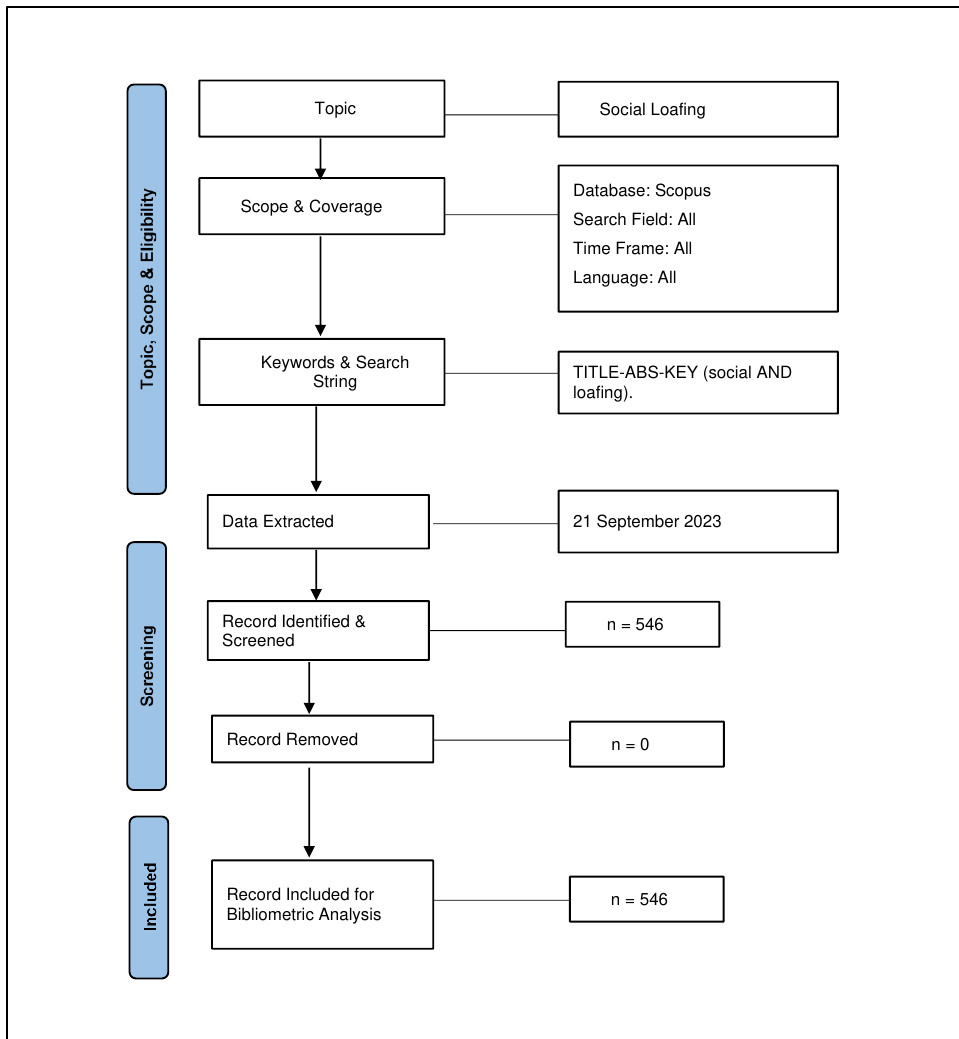
21September 2023
Record Identified & Screened
Record Removed
Record Included for Bibliometric Analysis
This study used bibliographic methods to investigate research trends on social loafing. The database contains information about article authors and affiliations, year of publication, language used, topic, title, and keywords. Microsoft Excel, Harzings Publish or Perish, and VOS Viewer software were used in that order for data collection and visualization. In addition, the study used VOS viewer software to complete key parts of the mapping analysis (Bastian et al., 2009; Van Eck, Waltman, 2022). Harzing's Publish or Perish software was used to analyze the citation rate and impact factor of Research Information System .ris. RESULTS This section addresses the findings about the research questions presented in the introduction. Research Trends and Patterns of Citations The first question looks at research trends and citation patterns in studies of social loafing. Figure 2 lists all articles written on social loafing between 1991 and 2023, along with all publications cited in those articles. Since its founding in 1991, and especially since the turn of the century, the study of social loafing has expanded dramatically. In 2016, there was a peak of 33 publications, showing a growing interest in the field (Figure 2). The peak of 33 articles in 2016 demonstrates an increasing scholarly interest in social loafing, which could be attributed to a variety of circumstances. Around this time, increased globalization and reliance on virtual teams underlined the necessity of understanding group dynamics, especially social loafing, as an important obstacle to productivity. The growth of digital collaboration tools and remote work situations has certainly prompted researchers to look into how these tools affect group performance and individual contributions. Furthermore, the advent of interdisciplinary study in organizational behavior, psychology, and technology at this time may have broadened the scope and importance of social loafing studies. By addressing this peak in publications, we not only highlight an important point in the field, but also lay the groundwork for future scholars to investigate emerging topics, trends, and gaps in the study of social loafing. This helps to advance theoretical frameworks and practical applications, ensuring that future academics can build on an established grasp of the topic. Figure 2 illustrates this remarkable growth story by charting the trend in total publications and citations over time. The bar graph shows that there have been more releases, with some significant increases in recent years. The graph also shows that the number of citations increased to 2000 references in 2000 before starting to decrease. A plausible explanation could be the time required to collect references for these published works (Mohammed et al., 2020). In the meantime, more high-quality articles may be needed, as the number of publications has increased along with the growing interest in social permission research.

Table 1 presents a list of the ten research studies that receive the highest citations. Each of these studies has been published in a reputable journal, including the Journal of Applied Psychology, the Journal of Organizational Behaviour, and the Journal of Personality and Social Psychology. The most often cited work was Karau et al. (1993), who carried out a meta-analysis of 78 studies to show that social loafing is resilient and applies to a variety of tasks and demographics. It was discovered that a wide range of factors, including evaluation potential, expectations for co-worker performance, task significance, and culture, all had a significant impact on social loafing. The third-most-cited paper by Williams and Sommer (1997). According to the study, people who have been rejected by their peers are more likely to socially compensate by working harder on the group as a whole rather than individually in an effort to feel like they belong. This discovery has major implications for understanding and combating social loafing at work. Conversely, the results of Williams and Karau (1991), the sixth-ranked study, clarified that coworkers' performance expectations—regardless of how they are measured or manipulated—have a substantial impact on social loafing. In general, novice researchers searching for relevant literature in this field may find a place to start by consulting the most well-known studies on social loafing. The Most Productive Sources Examining the most productive sources and their characteristics in relation to social loafing is the next research question. According to Table 2, the top three journals are Computers in Human Behavior (publications=6, Total Citation = 331, Average Citation =52.6), Proceedings of The Human Factors and Ergonomics Society (publications=7, Total Citation = 16, Average Citation= 1), and Journal of Personality and Social Psychology (publications= 7, Total Citation = 2113, Average Citation = 71.82). The Journal of Personality and Social Psychology, the most productive journal, was placed first. The findings showed that the majority of the most cited works in the field of social loafing are found in journals with a Q1 or higher ranking. This publication uses interdisciplinary and cross-disciplinary methods to address a wide range of topics.
| Cite Score | SJR | ||||
|---|---|---|---|---|---|
| Sources | Number of Articles | Total Citation | Average Citation | (2022) | (2022) |
| 1.Journal of Personality and Social Psychology | 7 | 2113 | 71.82 | 11.7 | 3.799 |
| 2.Proceedings of The Human Factors and Ergonomics Society | 7 | 16 | 1 | 1.3 | 0.103 |
| 3.Computers in Human Behaviour | 6 | 331 | 52.6 | 17.8 | 2.464 |
| 4.Group Dynamics | 6 | 332 | 14.2 | 4.2 | 0.858 |
| 5.Journal of Marketing Education | 6 | 346 | 28.4 | 6.3 | 0.743 |
| 6.Journal of Social Psychology | 6 | 43 | 3.92 | 4.5 | 0.953 |
| 7.Small Group Research | 6 | 759 | 39.4 | 5.4 | 1.13 |
| 8.International Journal of Hospitality Management | 5 | 110 | 34.9 | 18.3 | 2.93 |
| 9.Journal of Applied Psychology | 5 | 886 | 37.2 | 14.0 | 6.13 |
| 10.Journal of Management | 5 | 817 | 43.6 | 22.4 | 7.21 |
Prolific Authors and Co-citation Networks
In the publications on social loafing, the third question looks for the most productive authors and cocitation networks. The person or people who created or conceived of a publication are its author(s), and as such, they are ultimately responsible for its contents. The top ten authors who have contributed the most to publications on social loafing are displayed in Figure 3.

Studies were published by 187 authors in total. With 13 articles, Karau S.J. was the most prolific author, followed by Williams, K.D. (n = 8) and Høigaard, R. (n = 5), according to the analysis. The writers of the four articles were Messé, L.A., Hertel, G., Kerr, N.L., Glasø, L.Harkin, S.G., and Thompson, G followed by three articles published by Ali,R.. In Figure 4's co-citation network analysis, circles represent authors, colors indicate groups of writers who have similar research topics, and lines indicate the relationships between various authors. The co-citation network analysis yielded four clusters. Based on a cluster analysis, the green cluster's center was identified as Williams K.D. (TLS = 28883), the red cluster's center as George J.M. (TLS = 6893), the blue cluster's center as Paulus, P.B. (TLS = 7498), and the yellow cluster's center as Hogg M.A. (TLS = 7579). A co-citation network provides a list of references that have been included in multiple publications as co-citations (Cho et al., 2022).

Keywords
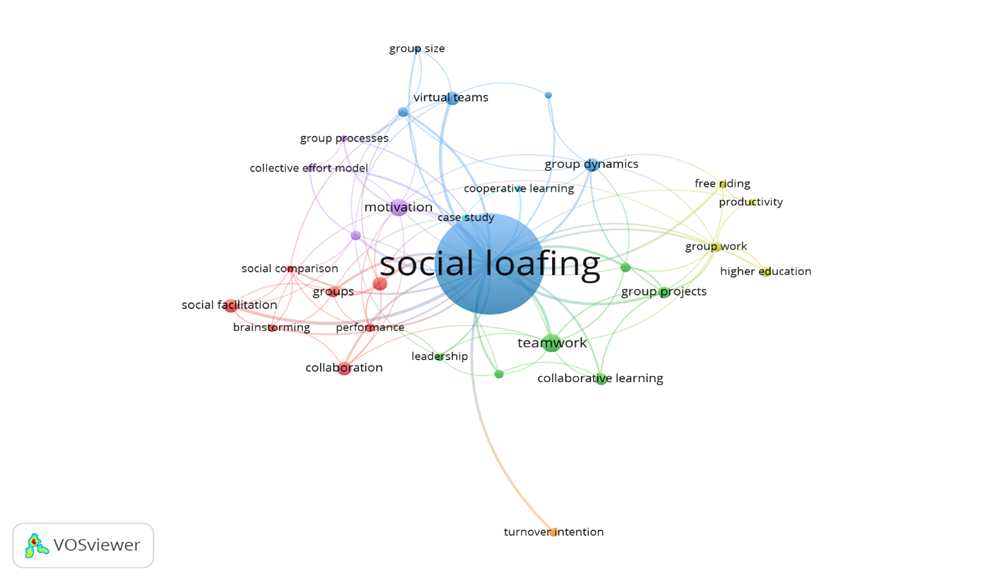
The fourth research question focused on the social loafing article's top keywords. The VOSviewer software's co-occurrence of author keywords was used to achieve this. Co-occurrence analysis took into account the author's keywords. As they aid in providing crucial details regarding a domain's literature databases, keywords are significant indicators in research domains (Zupic and Cater, 2015). When two or more keywords show up in an article at the same time, it's called keyword co-occurrence. A keyword cooccurrence network analysis tracks the evolution of scientific knowledge research frontiers and finds research hotspots within a particular field (Donthu et al., 2021). 30 of the 1218 keywords met the criterion, with a minimum of five occurrences per keyword. The author's keywords were categorized into seven clusters, as shown in Figure 5. The most crucial terms associated with these clusters were group projects, social facilitation, motivation, group dynamics, and motivation. The enormous number of clusters shows how widely studied social loafing research is among academics. With 197 occurrences, the author keyword "social loafing" is utilized frequently. Figure 5 shows the occurrences of several factors that are studied in relation to the concept of social loafing. Some useful insights were obtained from the analysis of keyword co-occurrences. First, it was demonstrated that researchers looked at social comparison, social facilitation, group dynamics, brainstorming, and virtual teams among other areas when studying the idea of social loafing. Second, concepts from theory that are used interchangeably include free riding, withholding effort, and collective effort. Numerous studies assess the influence of these constructs in order to explore the idea of social loafing. Finally, it illustrates the most recent advancements in the field by highlighting terms like social compensation, virtual teams, group dynamics, cooperative learning, and collaborative learning that are carefully researched by scholars in addition to the idea of social loafing and open up novel possibilities for investigation in the future.
FINDING AND DISCUSSION
By using bibliometric analysis, the social loafing research trend has been analyzed based on the articles from Scopus database between 1991-2023 in this study. Bibliometric analysis could help to provide a more comprehensive results of evaluation on the articles of social loafing (Cao et al., 2023). From the perspective of research trends, this study noticed that the growth of social loafing research has increased significantly from 1991-2016. After 2016, there was a slightly decrease in quantity of publication from 2016 until 2023. However, if compared with the years1991-2015, it still keeps the quantity of publication at 20 or more than 20. This shows that the interest among the researchers in the issue of social loafing is still high. For the patterns of citations, the total number of citations has been up and down since 1991 until 2000, hitting its highest point in 2000. Then, it began to decline in after 2000. Although the total number of publications remained at 20, or more than 20 after 2016, the number of citations continued to decline after 2016. Furthermore, the top 10 most influential papers cited are from the 2005 and before 2005. There were three and two most influential cited papers in 1991 and 1993, respectively. Then, there was one influential cited paper in 1997, 1999, 2002, 2004 and 2005 respectively. After 2005, none of the papers have been on the list of the top 10 most influential cited papers. This shows that the remarkable growth of publications on social loafing after 2005 might be contributed from those new researchers who were lacking in experience in doing research, and their papers might not be so frequently cited. Time is required to accumulate the citations in order to increase the total number of citations for those new researchers (Chalgynbayeva et al., 2023). As a good practice for future new researchers, they could make use of these highly impactful paper (top 10) as a suitable starting point to review the literature related to social loafing. These most influential cited papers might serve as good reference and they are useful for enhancing the quality of papers among the new researchers. Thus, this study highlighted that the issue of social loafing requires further review with higher quality of paper. From the perspective of the most productive sources, this study found that the Journal of Personality and Social Psychology is the most active and influential source of research publications on social loafing. The source title for the most frequently cited papers by Karau et al. (1993), Williams (1991) and Williams (1997) is Journal of Personality and Social Psychology. It was the higher-ranked journal (ranked in Q1). The quality of publication under Q1 is high, where Q1 represents the top-performing 25% of journals within the related field (Fry et al., 2023; Rauhvargers, 2014). This demonstrates that the most cited papers on social loafing, such as those by Karau et al. (1993), Williams (1991) and Williams (1997), are predominantly in the top 25% of journals within the social loafing field. This publication used cross-disciplinary and multidisciplinary approaches to address a wide range of topics. The broad and wide coverage of disciplines could potentially draw the researchers’ attention and citations from different fields of study. Besides, from the perspective of prolific author, based on 187 authors’ analysis, this study discovered that the most prolific author was Karau (13 articles published), followed by Williams and Høigaard, with 8 and 5 articles published respectively. This draws attention to their important contributions in social loafing studies. This insight helps in recognizing the influential authors and their impact in social loafing research field. On top of that, in the analysis of co-citation networks, there are four different clusters in which each cluster focus on different research interest. William, George, Paulus and Hogg were positioned at center of green, red, blue and yellow clusters accordingly. Their centrality in the clusters indicates their critical and important roles in their research area (Xu et al., 2023). Their different clusters in the co-citation network reveal cohesive groups of researchers with related areas of interest. Based on these findings from the most productive sources, prolific authors and co-citation networks analysis, it would encourage more collaboration among the researchers from various research areas for future researchers. This study suggests collaboration among the researchers, which could breakthrough and enhance knowledge sharing within the related-subject area. Consequently, it could enhance the chances of increasing the number of citations in the social loafing research area. Additionally, from the perspective of frequent keywords, the VOSviewer software has been used to analyse the co-occurrence of author keywords. Based on the analysis of keyword co-occurrence, the author’s keywords could be separated into numerous clusters (Masoumi & Khajavi, 2023), such as social loafing, social facilitation, social comparison collaboration, group projects, motivation, group dynamics, brainstorming, and virtual teams. This shows that social loafing could be examined with a variety of related variables. Therefore, for future researchers, there is a need for a comprehensive investigation to examine social loafing with a variety of related variables. Furthermore, the interchangeable theoretical constructs, such as free riding, withhold effort and collective effort, demonstrate the complexity and difficulty in conceptualizing social loafing. Apart from this, based on the latest development, researchers have studied the additional of new keywords, such as group dynamics, virtual team, social compensation, cooperative learning and collaborative learning, to the social loafing discussion. This indicates the evolution trends in the research of social loafing and how the new dimensions of social loafing are developing. These new dimensions would provide new direction for future investigation. As such, it is appeared necessary for future researchers to understand these concepts comprehensively and thoroughly while studying social loafing in diverse setting.
Research Limitations and Future Research
This study has various limitations. Firstly, this study performed the bibliometric analysis mostly focused on the subject of social loafing in general. This means that this study merely produces general overview evaluation of articles pertaining to the topic of social loafing. As such, the bibliometric analysis of social loafing pertaining to more specific sector is not available in this study. For Future researchers, they could conduct bibliometric analysis on social loafing in more specific sector, such as hotel, banking, food and electronic sectors. This could assist in gaining a more comprehensive and clearer understanding on how social loafing articles to be produced across different sectors. Secondly, this study searched for relevant and suitable articles by using a keyword list that was suggested by previous studies. Using a list of keywords recommended by earlier research, this investigation looked for appropriate and pertinent literature. This is due to the fact that some studies might use different keywords and terminology in describing social loafing. As such, it is appeared necessary for future researchers to conduct study on social loafing from different terminology in different viewpoints. Lastly, the analysis of this study is primarily based on bibliometric analysis, which uses quantitative analysis to determine the distribution trends of articles on the topic of social loafing. The distribution trends of articles were not investigated by using qualitative analysis in this study. Therefore, future researchers might consider improving the evaluation by using a mixed method that includes quantitative and qualitative analysis in evaluating the articles about social loafing.
CONCLUSION
This study provided an extensive review and evaluation of articles on the topic of social loafing by using bibliometric analysis. A database with a wider range of journals covered, the Scopus database, was used to generate the results. The most often cited research articles on social loafing were thoroughly analysed by this study. The main contribution of this study is to fill the research gap by conducting a bibliometric study in which it hasn't received much attention in the social loafing literature. The findings of this study provided the answer for the four research questions related to the social loafing research trends and their citation pattern, the most productive sources and their characteristics on social loafing, the most productive authors and co-citation networks in the publications on social loafing as well as the top keywords in the social loafing article. This study also discussed its implications, limitations and future research directions. This study is beneficial in getting a comprehensive evaluation of articles on social loafing, which would offer ideas for future researchers to expand the research on social loafing.
ACKNOWLEDGMENT
This research received no specific grant from any funding agency.
References
- Aggarwal, P., & O'Brien, C. L. (2008). Social loafing on group projects: Structural antecedents and effect on student satisfaction. Journal of marketing education, 30(3), 255-264.
- Akgunduz, Y., & Eryilmaz, G. (2018). Does turnover intention mediate the effects of job insecurity and co-worker support on social loafing?. International Journal of Hospitality Management, 68, 41-49.
- Anderson, C. A., Lindsay, J. J., & Bushman, B. J. (1999). Research in the psychological laboratory: Truth or triviality?. Current directions in psychological science, 8(1), 3-9.
- Bastian, M., Heymann, S., & Jacomy, M. (2009, March). Gephi: an open source software for exploring and manipulating networks. In Proceedings of the international AAAI conference on web and social media 3(1), 361-362.
- Bettenhausen, K. L. (1991). Five years of groups research: What we have learned and what needs to be addressed. Journal of management, 17(2), 345-381.
- Bokhari, S. A. A., & Aftab, M. (2022). Personality traits and social loafing among employees working in teams at small and medium enterprises: A cultural perspective data from emerging economies. Data in brief, 42, 108085.
- Cao, Y., Wang, X., Yang, Z., Wang, J., Wang, H., & Liu, Z. (2023). Research in marine accidents: A bibliometric analysis, systematic review and future directions. Ocean Engineering, 284, 115048.
- Chalgynbayeva, A., Gabnai, Z., Lengyel, P., Pestisha, A., & Bai, A. (2023). Worldwide Research Trends in Agrivoltaic Systems—A Bibliometric Review. Energies, 16(2), 611.
- Chen, F., Zhang, L., & Latimer, J. (2014). How much has my co-worker contributed? The impact of anonymity and feedback on social loafing in asynchronous virtual collaboration. International Journal of Information Management, 34(5), 652-659.
- Cho, I., Kim, D., & Park, H. (2022). Bibliometrics and co-citation network analysis of systematic reviews of evidence-based nursing guidelines for preventing inpatient falls. CIN: Computers, Informatics, Nursing, 40(2), 95-103.
- Dinh, J. V., Traylor, A. M., Kilcullen, M. P., Perez, J. A., Schweissing, E. J., Venkatesh, A., & Salas, E. (2020). Cross-disciplinary care: a systematic review on teamwork processes in health care. Small Group Research, 51(1), 125-166.
- Donthu, N., Kumar, S., & Pattnaik, D. (2020). Forty-five years of Journal of Business Research: A bibliometric analysis. Journal of business research, 109, 1-14.
- Donthu, N., Kumar, S., Mukherjee, D., Pandey, N., & Lim, W. M. (2021). How to conduct a bibliometric analysis: An overview and guidelines. Journal of business research, 133, 285-296.
- Ellegaard, O., & Wallin, J. A. (2015). The bibliometric analysis of scholarly production: How great is the impact?. Scientometrics, 105, 1809-1831.
- Etemadi, M., Darab, M. G., Khorasani, E., Moradi, F., & Vazirinasab, H. (2015). Social loafing among nurses and its relation with organizational justice. International Journal of Educational and Psychological Researches, 1(2), 125.
- Falagas, M. E., Pitsouni, E. I., Malietzis, G. A., & Pappas, G. (2008). Comparison of PubMed, Scopus, web of science, and Google scholar: strengths and weaknesses. The FASEB journal, 22(2), 338-342.
- Fransen, K., Vansteenkiste, M., Vande Broek, G., & Boen, F. (2018). The competence-supportive and competence-thwarting role of athlete leaders: an experimental test in a soccer context. PloS one, 13(7), e0200480.
- Fry, C. V., Lynham, J., & Tran, S. (2023). Ranking researchers: Evidence from Indonesia. Research Policy, 52(5), 104753. https://doi.org/10.1016/j.respol.2023.104753
- Gallupe, R. B., Bastianutti, L. M., & Cooper, W. H. (1991). Unblocking brainstorms. Journal of applied psychology, 76(1), 137.
- Gusenbauer, M., & Haddaway, N. R. (2020). Which academic search systems are suitable for systematic reviews or meta‐analyses? Evaluating retrieval qualities of Google Scholar, PubMed, and 26 other resources. Research synthesis methods, 11(2), 181-217.
- Geng, S., Wang, Y., Zuo, J., Zhou, Z., Du, H., & Mao, G. (2017). Building life cycle assessment research: A review by bibliometric analysis. Renewable and Sustainable Energy Reviews, 76, 176-184.
- Høigaard, R., Säfvenbom, R., & Tønnessen, F. E. (2006). The relationship between group cohesion, group norms, and perceived social loafing in soccer teams. Small group research, 37(3), 217-232.
- Hogg, M. A., Abrams, D., Otten, S., & Hinkle, S. (2004). The social identity perspective: Intergroup relations, self-conception, and small groups. Small group research, 35(3), 246-276.
- Jassawalla A., Sashital H. & Malshe A. (2009) Students’ perceptions of social loafing: Its antecedents and consequences in undergraduate. Operations Management, 8(1), 42–54.
- Karau, S. J., & Williams, K. D. (1993). Social loafing: A meta-analytic review and theoretical integration. Journal of personality and social psychology, 65(4), 681.
- Karau, S. J., & Wilhau, A. J. (2020). Social loafing and motivation gains in groups: An integrative review. Individual motivation within groups, 3-51.
- Kravitz, D. A., & Martin, B. (1986). Ringelmann rediscovered: The original article.
- Latané, B., Williams, K., & Harkins, S. (1979). Many hands make light the work: The causes and consequences of social loafing. Journal of personality and social psychology, 37(6), 822.
- Lee, P. C., Chen, C. M., & Liou, K. T. (2015). Using citizens’ leadership behaviors to enhance worker motivation: Reducing perceived social loafing in a coproductive tax service program. Public Performance & Management Review, 39(1), 172-197.
- Lim, V. K. (2002). The IT way of loafing on the job: Cyberloafing, neutralizing and organizational justice. Journal of organizational behavior: the international journal of industrial, occupational and Organizational Psychology and Behavior, 23(5), 675-694.
- Lin, T. C., & Huang, C. C. (2009). Understanding social loafing in knowledge contribution from the perspectives of justice and trust. Expert Systems with Applications, 36(3), 6156-6163.
- Ling, K., Beenen, G., Ludford, P., Wang, X., Chang, K., Li, X.,... & Kraut, R. (2005). Using social psychology to motivate contributions to online communities. Journal of Computer‐Mediated Communication, 10(4), 00-00.
- Luo, Z., Marnburg, E., Øgaard, T., & Okumus, F. (2021). Exploring antecedents of social loafing in students’ group work: A mixed-methods approach. Journal of Hospitality, Leisure, Sport & Tourism Education, 28, 100314.
- Mansor, N. S., Awang, H., Zolkipli, M. F., Zaini, K. M., Taiye, M. A., Al-Mashhadani, A. F. S., & Mustapha, R. (2023). IoT Knowledge among Indigenous Youngsters: A Recent Ten-Year Research Trend. Journal of Contemporary Social Science and Education Studies (JOCSSES), 3(1), 111-120.
- Masoumi, N., & Khajavi, R. (2023). A fuzzy classifier for evaluation of research topics by using keyword co-occurrence network and sponsors information. Scientometrics, 128(3), 1485-1512.
- Rauhvargers, A. (2014). Where are the global rankings leading us? An analysis of recent methodological changes and new developments. European Journal of Education, 49(1), 29-44. https://doi.org/10.1111/ejed.12066
- Sánchez, A. D., Del Río, M. D. L. C., & García, J. Á. (2017). Bibliometric analysis of publications on wine tourism in the databases Scopus and WoS. European Research on Management and Business Economics, 23(1), 8-15.
- Shepperd, J. A. (1993). Productivity loss in performance groups: A motivation analysis. Psychological bulletin, 113(1), 67.
- Van Eck, N. J., & Waltman, L. (2022). Crossref as a source of open bibliographic metadata.
- Williams, K. D., & Karau, S. J. (1991). Social loafing and social compensation: The effects of expectations of co-worker performance. Journal of personality and social psychology, 61(4), 570.
- Williams, K. D., & Sommer, K. L. (1997). Social ostracism by coworkers: Does rejection lead to loafing or compensation?. Personality and Social Psychology Bulletin, 23(7), 693-706.
- Xu, S., Liu, S., Jing, C., & Li, S. (2023). Event knowledge graph: A review based on scientometric analysis. Applied Sciences, 13(22), 12338. https://doi.org/10.3390/app132212338
- Ye, Y., Chen, M., Wu, L. Z., & Kwan, H. K. (2023). Why do they slack off in teamwork? Understanding frontline hospitality employees’ social loafing when faced with exploitative leadership. International Journal of Hospitality Management, 109, 103420.
- Zare, S., & Bakhshandeh, E. (2021). The mediating role of Social Loafing and job insecurity in the effect of organizational forgetfulness on organizational commitment in government organizations, 74(1), 16-16.
- Zupic, I., & Čater, T. (2015). Bibliometric methods in management and organization. Organizational research methods, 18(3), 429-472.