Attracting Customers Using Sustainability: A Look at the Datai, Langkawi
- School of Tourism, Hospitality and Event Management, Universiti Utara Malaysia, Kedah
- The Datai Langkawi, Jalan Teluk Datai, Langkawi, Kedah
Journal of Business Management and Accounting 13(1) (2023) · https://doi.org/10.32890/jbma2023.13.1.3
Abstract
As natural disaster becomes more common, environmental sustainabilityhasbeguntogainmoreattention. Manyenvironmentalists originating from developed countries have been working towards creating awareness on global warming. Considering the conservation of the environment, the Datai’s target market is the nature lovers from rich and developed countries who are willing to pay more than RM1000 per night for a room. The objective of this case study is to discover the Datai’s sustainability initiatives in its effort to attract customers. Based on a semi-structured interview with the Datai’s Human Resource Director, it is discovered that the luxury resort that is rich in wildlife and faces the Datai Bay invested up to RM 2 million for environmental sustainability. The Datai sustainable environment initiative covers all aspects of life, addressing sustainability issues head on by raising awareness among schoolchildren, the local community, and visitors.
Keywords: Langkawi, environmental sustainability, hotel
principle in their practices is challenging and will increase their operational cost (Salehudin et al., 2013). The motivation to spend on sustainable practices is low as not many customers are willing to pay extra to appreciate sustainability initiatives (Kasim, 2004). Social consciousness on the importance of environmental sustainability is still inadequate (Mokhtar et al., 2017; Salehudin et al., 2013). Although the level of environmental sustainability awareness in Malaysia is rather low compared to developed countries, it is undeniable that consciousness regarding human impact on the environment and sustainability issues faced throughout the world is growing. Growing awareness of the importance of sustainability has led to environmental practises such as eliminating plastic use and living a waste-free lifestyle, and some people are willing to pay more for sustainable goods and services (Djanogly, 2018). This makes the Datai’s initiatives to sustain the environment an exemplary as it has the potential to attract visitors. To win the market share from the upscale market and succeed in the competitive business environment, it is crucial to focus on sustainability (Oxenswardh, 2020). Furthermore, hotel industry, especially resorts is one of the industries with major negative impact towards the environment, making it crucial for them to restore the environment (Elkhwesky et al., 2022). According to Elkhwesky et al. (2022), studies on sustainable practices in hospitality from the developing and emerging nations is still very few, especially since Covid-19 outbreak. The pandemic has tremendously reduced the number of hotels occupancy rate due to inability or hesitation to travel. As the result, competing in the competitive market is more difficult than before. Therefore, Elkhwesky et al. (2022) suggested for more studies on environmental sustainability in hospitality industry especially resort, as most of existing studies focus on hotels. In Malaysia, Hamid et al. (2021) studied sustainable practices at the Palace Hotel, Kota Kinabalu. There is a difference between a hotel and a resort. A resort is commonly addressed as a resort hotel. While both provide food and lodging, a resort hotel is a self-contained luxury facility that can provide entertainment, shopping, and other activities within its huge property. In addition, a resort hotel is located in destination with special attractions, and it is intended primarily for vacationers. Thus, more sustainability initiatives can be carried out at a resort hotel. The aim of this study is to discover the Datai’s environment sustainability initiatives, and its ability to attract customers. It seeks to discover how the Datai conserve its natural surrounding that includes 10 million years old rainforest, mangrove, the Datai Bay and the wildlife that exists within its surrounding. In addition, the sustainability initiatives effectiveness in attracting customers is also revealed based on the guests’ online reviews. The finding of this study is beneficial as it may encourage other hoteliers to follow the Datai’s lead. LITERATURE REVIEW Singapore avoids air pollution from carbon dioxide emissions by planting many trees through the Garden City initiative (Azam et al., 2013). The trees help stop climate change by removing carbon dioxide from the air, storing carbon in the trees and soil, and releasing oxygen into the atmosphere. Sustainable landscape management as done in Singapore is important because it protects and enhances the ecosystem or the flora and fauna. Green space in the development of a city along with their necessary ecosystem services that ranges from maintenance of biodiversity to regulation of urban climate enables biodiversity conservation. Sustainable landscape management offers numerous ecosystem benefits, such as regulating ambient temperatures, filtering air, reducing noise pollution, insulating carbon, and attenuating storm water (Mohamad Muslim et al., 2018). However, this effort is made possible as Singapore is a rich country. In contrast to Malaysia, sustaining the environment is costly and difficult, especially in Langkawi, an island with no bridge connecting it to the mainland. Most of the recycling facilities in Langkawi do not recycle glass and metal due to the high cost as metal and glass wastes need to be transported to the mainland, the southern part of peninsula Malaysia (Salehudin et al., 2013). According to the Ministry of Tourism, it is challenging to encourage resort and hotel operators in Malaysia to adopt the recommendations of international sustainable assessment systems due to lack of infrastructure, expensive assessment process, limited social awareness of sustainable development and poor understanding of why sustainability is needed (Salehudin et al., 2013). Therefore, companies need to help Malaysia increase awareness and care for environment sustainability and implement a good waste management system, especially in managing the issues and challenges relating to the collection, transportation and handling of solid waste as it will ensure sustainable and environmentally friendly operations and lifestyle (Mat Zin et al., 2016). Despite the fact that many policies related to environmental sustainability have been outlined, the coastal environment of Langkawi continues to deteriorate as the number of hotels increases (Mokhtar et al., 2017, Salehudin et al., 2013). Hence, Mokhtar et al. (2017) suggested empowering the stakeholders to play the environmental stewardship role to ensure better governance of coastal ecosystem and effective implementation of policies. Stakeholders refer to groups of people who are vital to the survival and success of the corporation which consist of customers, owners, employees, local communities, government agencies, suppliers, politicians, environmentalists, the media and financial institutions (Freeman, 2004). Studies from developed country have noted the sacrifice needed to preserve the environment when there is no guarantee of financial return (Moeller et al., 2011; Vagasi 2004). According to Moeller et al. (2011), sustaining the environment is typically associated with time and financial sacrifice implying additional costs to hotel operators, when customers are unwilling to spend enough money to compensate for the extra cost and effort. Based on their findings, Moeller highlighted the need for market segmentation targeting tourists who leave minimum environmental footprints while maintaining high expenditure. The segmentation should be coupled with marketing strategy. Due to the high cost, there is common assumption that sustainability is a luxury where many companies in emerging markets such as Malaysia cannot afford. However, the call for sustainability cannot be ignored as businesses are increasingly affected (Vagasi, 2004). Hotels in North America create environmental sustainability authenticity by placing an emphasis on differentiation through environmental sustainability branding (Walsh & Dodds, 2017). These hotels use environmental sustainability branding to attract customers due to increasing public pressure. To create a competitive advantage, they emphasise on differentiation strategy by promoting sustainability brand, providing sustainability education to customers, and developing sustainable product. Less emphasis is given on low-cost strategy that sustains the environment through more efficient use of water, energy, and waste management.
Sustaining the natural environment requires collaboration and commitment from all stakeholders (Freeman, 2004; Mokhtar et al., 2017). Community involvement and cooperation is crucial for protecting and preserving the natural beauty of Langkawi and its ecotourism appeal. There is a need to educate the local community and tourism operators in ensuring the success of such effort (Mokhtar et al., 2017; Salehudin et al., 2013). However, this is challenging as most people are more concerned about what they can gain, and they prefer monetary benefits compared to preserving the natural environment (Mokhtar et al., 2017). METHODOLOGY Qualitative research method was used in this case study. Qualitative approach is a form of interpretive inquiry which helps the researcher to develop a complex overview of the problems and issues under study, and generates primary data to explain the phenomenon holistically (Creswell, 2014). Qualitative research necessitates the collection of data in a real-world setting where participants are confronted with the issue under investigation (Creswell, 2014). Due to rising cases of Covid-19, the interview was conducted online. Qualitative method is costly and time-consuming, but enables the data to be gathered from a small sample size (Sekaran & Bougie, 2013). An in-depth interview with the Datai’s Human Resource Director and a Teacher from Sekolah Menegah Kebangsaan Tunku Putra who is in charge of Eco-school Program was deemed sufficient to answer the research questions of this study. Furthermore, secondary data of the Datai’s initiative to sustain the environment such as slides, organization chart, and links were also provided by the protagonist. In addition, the Datai’s customers online review and newspaper articles were also used as secondary data. For a qualitative case study, sample size is not the main concern, but it is important that the participants could provide in-depth answer, and there are varieties of data sources (Yin, 2012). The primary and secondary data were combined and reported in the findings. An interview was conducted with The Datai’s Human Resource Director who plays an active role in The Datai’s sustainability initiatives to answer the research question “How does The Datai contribute to environmental sustainability?”. An interview protocol was used to guide the researcher during the interview. The interview protocol helps ensuring that the interview session captures necessary information. The semi-structured and open-ended questions in the interview protocol require active listening and interrogation on part of the interviewer in order to gain in-depth information. The interview began by asking The Human Resource Director “Why does The Datai preserve the environment?”. The interview took more than one hour. The interview was transcribed, and thematic content analysis was used to analyze the data. Thematic content analysis is a method for identifying, analysing and reporting patterns within data. It requires searching across a data set to find repeated patterns of meaning. It organizes and describes data set in detail and offers flexibility. It is a useful research tool due to its potential in providing a rich, detailed and complex data. It produces good qualitative analysis as it can generate unanticipated information (Clarke & Braun, 2013). Thematic content analysis of this study started with the familiarisation stage. During the familiarisation stage, all the audio data were transcribed, and the transcript was cross checked with the recorded audio to ensure the accuracy of the transcription. The researcher took note of all the initial ideas identified from the transcripts. The second stage was coding the ideas. Due to small amount of data as it was collected from only one participant, the coding was done manually. The third stage was data reduction. During this stage, all the inter-related code in the data set was compiled and categorised under the same theme. The theme was clearly defined. Miles and Huberman (1994), referred to this stage as data reduction as it includes discarding, sharpening and organizing the data until conclusions can be verified. The fourth step in the analysis was reviewing the themes. During this step, the researcher asked another researcher to cross check the coded transcript and the themes to ensure accuracy. The final stage in the thematic content analysis was interpretation or producing the report. The interpretation from primary data was combined with secondary data. Then, the data were organized to answer the research questions as reported in the findings. FINDINGS Sustainability is an Initiative to Attract Customers The Datai’s effort to preserve its natural surrounding is recognised at local and international level. The Datai has been awarded the
ASEAN Green Hotel Standard for year 2020-2022. In 2019 it was certified as meeting Silver Certification requirements of the Earth Check, Australia. At the national level, it is certified by the Ministry of Tourism, Arts and Culture, Malaysia as a Green Hotel. Earth Check is the world’s leading scientific benchmarking certification and advisory group for the hotel and tourism industries, based in Australia. Since 1987, Earth Check has worked with businesses, communities, and governments to provide travellers with clean, safe, prosperous, and healthy places to visit, live, work, and enjoy (Abdullah, 2021). In addition to the concern for the environment, The Datai took the initiative to sustain the environment to attract tourists from Scandinavian countries to Langkawi, especially The Datai. The environmental sustainability initiatives involve all stakeholders with the aim of contributing towards environmental sustainability. The green effort is then promoted and publicised. The Datai’s Human Resource Director stated the following: Scandinavian countries are very sensitive towards environmental sustainability and the impact of tourism such as carbon footprint, for example. To appeal to these countries, we must project certain images. It is good to take charge of promotion and development. Public Relation. Put all stakeholders in Langkawi together. What are the green initiatives they are doing? We need to put things together and sell it. Market it to this Scandinavian market. A lot of things are gearing towards Tourism sustainability. So, we need to be aware and sensitive about this. The Datai realised that it is impossible to sustain the environment without the cooperation from the local community. “Here we are protecting and breeding the coral reefs and the fishes, then come the fishermen and take away everything. On land, there are hills of rubbish. Awareness is very much lacking”, said the Human Resource Director. Therefore, the Datai creates awareness amongst Langkawi’s youth and community through Kedah eco-school program and community outreach programme. Collaboration with Kedah state Education Department on Eco-School Program was a significant move towards promoting environmental sustainability, and it nicely aligned with Youths for the Future Program. However, the Human Resource
Director was not certain about the programme’s achievement and effectiveness. He said “Kedah eco school program, when we try to assess the outcome… we cannot interview the students because of Covid”. One of the major challenges faced by the Human Resource Director was Covid-19 Pandemic that requires them to place physical activities related to Eco-School Program on hold. Kedah Eco-School Program was gazetted on 10th November 2019 (“36 Eco-Schools in Kedah next year to raise environmental awareness”, 2019), but officiated on 4th May 2021 at the Datai (“More eco-schools in Kedah”, 2021). Until 21st March 2022, the Datai still cannot proceed with any face-to-face activities with the schools. As for the selected schools, the activities carried out were webinar and online workshops on 15th July 2021, 5th August 2021 and 17th August 2021. According to Cikgu Norazlina Nizam, the webinar and workshops introduced the teachers and students to Eco-School Program, its objectives and activities. The webinar and workshops were organised by Kedah state Education Department in collaboration with Green Growth Asia Foundation. The webinar and workshops were attended by twelve schools from Langkawi that were selected for Kedah Eco-School Programme. Each school was required to send representatives comprising of a co-curriculum advisor and three students. The representatives from Sekolah Menengah Tunku Putra were Cikgu Norazlina Nizam and three form-four students. During the workshop they were informed about the Eco-School Program action plan and the seven stages that they will go through. On 21st March 2022, Sekolah Menengah Tunku Putra was still waiting to receive Eco-School Programme module which was needed as a reference to carry out eco-school activities. In addition to creating awareness, the Datai also protects wildlife and the natural heritage. This will provide its guests with more exciting experiences when they visit the property that is surrounded by rainforest, mangrove and beach. To engage its guests, the Datai sustainability programme includes a participatory element for guests as explained below. Attraction is based on Nature and its Sustainability To attract customers, the Datai develops a lab, a garden and a Nature Centre. The lab is meant to serve as an upcycling hub and educational centre. It offers educational experience of recycling and recycling products to its visitors. The lab building is made of 6,465 recycled bottles of champagne, wine, spirits and beer. The Datai collaborates with local artists to host upcycling workshops. Among the activities in the lab are soap making, batik painting, upcycle-candle making and stingless bee honey production and merchandising. The lab also displays recycled products and products produced from the Datai’s surrounding. Among the products are garden herbs, fragrance oil, organic mosquito repellent with dill, citronella, and mint from the Datai’s garden. These products can be purchased by its guests as souvenirs (Abdullah, 2021). The Datai’s garden adopts permaculture concept which uses agricultural ecosystem to be sustainable and self-sufficient. The garden is watered using the hotel’s wastewater that is purified on its own wetland. Furthermore, the garden has its own worm farms for composting and offering up to 50 types of herbs, plants and fruits. Stingless bee honey farms are also a part of the garden. The herbs, plants, fruits and honey are used for consumption in the hotel’s restaurants and cooking classes and some of the herbs are medicinal. A nursery for reforestation of native trees and wildlife corridor projects is also a part of the garden. Activities offered at the garden are labelled as Permaculture Walk, Little Gardener and The Beekeeper (Abdullah, 2021). The Nature Centre serves as an information and research centre. The building is open-air, and the architecture is inspired by a tribal bamboo longhouse. The Nature Centre is a starting point for excursions to discover the flora and fauna of Teluk Datai area. The nature-centric educational walk is led by the Datai’s Resident Naturalist, and his team of naturalists and marine biologists (Abdullah, 2021). This excursion allows the Datai’s guests to observe the hotel’s initiative in sustaining the environment through two pillars, namely Wildlife for the Future and Fish for the Future. The Datai’s Customers are Attracted by Nature’s Sustainability Online search on 13th April 2022 of hotel guests’ reviews (Google reviews) that ranges from “a week ago” to “four years ago” discovered that Nature was mentioned in 75 of the reviews and 85% of the reviews were positive with indication of returning to the hotel. In addition, the guests also recommended others to visit the hotel. Following are three quotations of guests’ reviews (Google reviews) taken from the Datai’s website. Beautiful location, excellent private beach and friendly staff. Spacious and yet built in an conscious way. Nature walks are worth booking, and use of all boating equipment is included. Dolphins swim close by in the bay! Coral nursery is very interesting and commendable. Highly recommended! (Tim Evans) Really loved our stay there. From the lovely chocolates at turn down service to the beautiful well preserved beach. They even grow corals and replant them back into the ocean-we were lucky enough to see some clown fish, sea urchin and a few other fish while snorkelling. We also a booked a slot to go out with the catamaran. Food was good, service impeccable. Would definitely come back again! (Ayisha Sabrina) We stayed in a forest villa. The Villa itself was beautiful and the hospitality was great. We really enjoyed trail walks and the beach everyday while staying. This hotel offers good selections of in-room dining and baby’s solid food too. The forest tour with their own botanists are such a great experience… We really like the resort itself so hopefully we could go back again. (Mayuko K) The Datai Environmental Sustainability Initiatives The Datai has its team of naturalists and marine biologists. The Datai sustainability team formed a partnership with local NGOs and social enterprises who are selected based on their shared vision and relevant expertise. The Datai sustainability programme comprises a number of initiatives that are new and serve as an example to other hotels in Langkawi. It is based on four pillars namely Fish for the Future, Pure for the Future, Wildlife for the Future and Youth for the Future (Abdullah, 2021). The Datai Pledge Trustees organization chart is visualised in Figure 1.
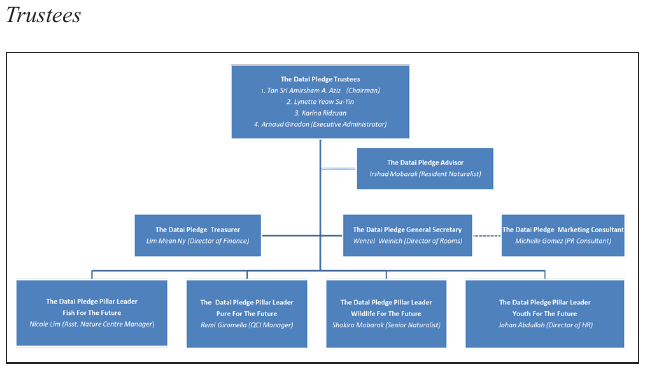
Organizational structure and management team of the Datai Pledge Trustees
Fish for the Future Fish for the Future The function of Fish for the Future is to protect marine life within Datai Bay through the rehabilitation of coral reefs and promotion of sustainable fishing. Among the initiatives are planting artificial reef to enablefunction coral reef rehabilitation the community marine ecosystem its fragility. The of Fish and foreducating the Future is toabout protect marine and life within This is deemed necessary as unsustainable fishing practices, extensive use of non-selective fishing Datai Bay through the rehabilitation of coral reefs and promotion equipment, fishing over coral reefs and discarding of fishing gear make recovery of marine life more ofdifficult. sustainable fishing. Among initiatives are planting To protect the marine life, the Dataithe collaborates with MareCet, a Malaysianartificial non-profit conservation group dedicated to therehabilitation research and conservation of marine mammals as well as the reef to enable coral reef and educating the community greater marine environment within Malaysia (Abdullah, 2021). about marine ecosystem and its fragility. This is deemed necessary as unsustainable Pure for the Future fishing practices, extensive use of non-selective fishing The function of fishing Pure for the Future is to act responsibly and place sustainability at thegear heart of The equipment, over coral reefs and discarding of fishing make Datai Langkawi’s business operations. It aims to achieve zero waste to the landfill by integrating recovery marine more To protect the marine the sustainabilityof in every aspectlife of the resort’sdifficult. operations through the 7Rs (Reduce, Recover,life, Recycle, Repurpose, Replace, Return and Rethink) of sustainability principles of resource management. Instead Datai collaborates with MareCet, a Malaysian non-profit conservation of purchasing mineral water in plastic bottles, the Datai has its own water bottling plant. The plant group dedicated to the research and conservation of marine mammals purifies water through reverse osmosis process and fills the water in glass bottles. The Datai has its asUpcycling well asCentre thetogreater marine environment within Malaysia crush bottles and shred plastic. The Datai’s Pure Centre separates(Abdullah, dry waste and compacts food waste while The Datai’s Garden produced fertilizer from compost and The Datai’s lab 2021). produces concrete slabs. Pure for the Future pillar collaborates with Sahabat Alam Langkawi, a Malaysian non-profit corporation dedicated to environmental conservation (Abdullah, 2021).
Pure for the Future
Wildlife for the Future
The function of Wildlife for the Future pillar is to protect, restore and reconnect Langkawi’s forests to
The Pure tofor theForFuture is to anda place ensurefunction that wildlifeof continues thrive. this purpose, the act Datairesponsibly teamed up with Gaia, social sustainability the heart of The DataiGaia’s Langkawi’s business enterprise dedicated at to the wildlife conservation in Malaysia. activities are focussed on increasing scientific knowledge, implementing actions and creating awareness of operations. It aims to achieve zero conservation waste to the landfill by integrating sustainability in every aspect of the resort’s operations through the 7Rs (Reduce, Recover, Recycle, Repurpose, Replace, Return and Rethink) of sustainability principles of resource management. Instead of purchasing mineral water in plastic bottles, the Datai has its own water bottling plant. The plant purifies water through reverse osmosis process and fills the water in glass bottles. The Datai has its Upcycling Centre to crush bottles and shred plastic. The Datai’s Pure Centre separates dry waste and compacts food waste while The Datai’s Garden produced fertilizer from compost and The Datai’s lab produces concrete slabs. Pure for the Future pillar collaborates with Sahabat Alam Langkawi, a Malaysian non-profit corporation dedicated to environmental conservation (Abdullah, 2021). Wildlife for the Future The function of Wildlife for the Future pillar is to protect, restore and reconnect Langkawi’s forests to ensure that wildlife continues to thrive. For this purpose, the Datai teamed up with Gaia, a social enterprise dedicated to the wildlife conservation in Malaysia. Gaia’s activities are focussed on increasing scientific knowledge, implementing conservation actions and creating awareness of wildlife in Malaysia (Abdullah, 2021). Camera trappings for wildlife research and Tree Native Nursery at the Datai’s garden are among the effort to restore Langkawi’s forest. Youth for the Future Led by The Datai’s Human Resource Director, the function of Youth for the Future pillar is to promote education programmes on sustainability and nature protection awareness aimed at local youths. Through teamwork and community engagement, Youth for the Future fosters an appreciation of nature among youths. It also encourages young people to live a more sustainable lifestyle. An example of a situation of which a schoolteacher from Malacca brought his fellow students to a fast food restaurant exemplifies the level of awareness that the Datai’s Human Resource Director wishes to develop among youths in Malaysia. We focus on Langkawi to make sure its success. Then, we sell it to Kedah. The teachers from Green School in Malacca create awareness amongst the students. I remember this schoolteacher who brought his students to a fast-food restaurant. When the food and drinks arrived, the students looked at one another and then, their teacher. They were annoyed. Then a student said “teacher, the restaurant uses plastic straw”. They were shocked to see plastic straws. That is a true success. You embed it into them. The mentality and behaviour. It is not the certificates. It took them 3 years to create the awareness. (The Datai’s Human Resource Director) The Datai instils love and care for the environment and promotes environmental sustainability attitude among the youth by giving them knowledge, exposure and experience. The Datai’s Human Resource Director believes that love and care for the environment should be instilled at an early age. Kalau nak melentur buluh biar dari rebung. If possible, we got to start from kindergarten. But not too much. Use pictures, field trips, and others. Create their interest to appreciate nature first. They need to like the nature. The challenge is to build their interest in nature. You need to bring them camping. Let them see and feel the rivers so that they become attached to nature. Make them love and appreciate nature. Create the love for nature. The kindies, what we did was we brought them to Datai. We let them go to the stream. Ask them questions. Memories from childhood is very strong. (The Datai’s Human Resource Director) The Datai collaborates with the Ministry of Education to enhance awareness of environmental sustainability and its importance. Collaboration with Kedah state Education Department on Ecoschool program sees that environmental sustainability is integrated into primary and secondary school’s curriculum. Teachers are sent to schools to guide students on projects focusing on environmental sustainability issues at the school. Together, they solve the issues with the help of The Datai’s marine biologists and engineering team, resulting in a greener environment. Thus, through Kedah Ecoschool Programme involving Sekolah Kebangsaan Ewa and Sekolah Menegah Kebangsaan Tunku Putra, the youths are empowered with the knowledge and skills to lead a sustainable lifestyle. Only two companies sponsored Kedah eco school program; Sime Darby and The Datai. The Datai gives money and a place for them to learn. We also send teachers to go to school. At schools, the eco-school program will come out with projects. What is the issue at your school. Let’s resolve it so that it becomes more green. Who can help? We have marine biologists here. We have engineering team. We have the expertise. We are also looking for sponsorship to install solar panel at the school (The Datai’s Human Resource Director) Enhancing Environmental Sustainability Awareness among the Workforces The Datai’s Human Resource Director enhances environmental sustainability awareness among his workforces. He encourages them to contribute to nature by prioritising environmental sustainability in everything that they do through policy, drive, consistent training and monitoring. Integrating his staff contribution to nature as their Key Performance Indicator for Best Employee Reward is an example of the policy that helps enforced environmental sustainability attitude. In addition, selecting the schools where most of the Datai’s staff send their children to study for Kedah Eco-school programme may also contribute to the success pf environmental sustainability practice at home, school and workplace. The employer, staff and their children will monitor and remind one another. When consistently practiced throughout their daily life, it will become their routine. They will also influence the people around them to conserve the environment. The Human Resource Director also sets an example of prioritising environmental sustainability for his staff to follow. He gave gifts that can help sustain the environment for their staff party. He gave water bottle and mangkuk tingkat (tiffin carriers). These gifts can stop them from using plastic bottles for mineral water and Styrofoam to pack their food. Our employees, I can’t be proud to say that we have created such awareness. Policy, drive, consistent training, monitoring. Even that we are not sure if they practice environment sustainability at home. The real win is they come back with some sensitivity. In any decision that we do, think of something that we can do to contribute to nature. During our staff party, we give gifts that can help to contribute to the environment. We give water bottle, mangkuk tingkat so that they don’t have to use plastic bottles for mineral water and Styrofoam to pack their food. But we can’t do everything at a time. (The Datai’s Human Resource Director)
DISCUSSIONS
The Datai’s sustainability initiative appears to be the most extensive compared to other green hotels in Malaysia as it covers the Datai Bay and its marine life, mangrove, and rainforest and its wildlife. The Datai’s flora and fauna restoration effort includes having its own native tree nursery, planting artificial reefs, and camera trapping for wildlife research. In addition, the Datai has its own water bottling plant and recycling facilities. These sustainability initiatives were not found in previous studies of hotel sustainability such as the Palace Hotel, Kota Kinabalu (Hamid et al., 2021), Melia Hotel, Kuala Lumpur, ShangriLa Hotel, Kuala Lumpur, Golden Palm Tree Resort, Selangor and Andaman Resort, Langkawi (Yusof & Jamaludin, 2013). The Datai’s approach to attract customers using sustainability is consistent with previous literature on sustainability. Vagasi (2004) recommends integrating sustainability concept into strategy and marketing. The Datai uses differentiation strategy instead of low-cost strategy in its sustainability approach. This is consistent with its luxury hotel status, and the practice of hotels in North America (Walsh & Dodds, 2017). Adopting low-cost strategy may jeopardise the comfort of luxury resort guests. The Datai’s sustainability approach makes it more appealing to its target market. Segmenting and focusing on the luxury market which not only cares about the environment but also has the purchasing power to purchase green products is consistent with the recommendation by Moeller et al. (2011). The market segmentation can help ensure that the Datai gets a return on its investment to sustain its natural environment. The Datai’s initiative towards environmental sustainability reflects its Corporate Social Responsibility (CSR). CSR is organizational policies and actions that take into account stakeholders’ expectations and the economic, social, and environmental performance (Ertuna et al., 2019). Seems that most of the recycling facilities in Langkawi do not recycle glass and metal (Salehudin et al., 2013), the Datai developed its own recycling facilities which also upcycle and function as a learning hub. The Datai’s mutual emphasis towards environmental sustainability is due to the necessity of balancing economic prosperity, social and ethical integrity and environmental responsibility. Its initiatives and reputation as a luxury resort that sustains the environment can help attract its target market to Langkawi, especially The Datai as people travel to Langkawi to enjoy its natural environment.
Consistent with Mokhtar et al. (2017) who suggested empowering the stakeholders to play the environmental stewardship role to ensure better control of coastal ecosystem, the Datai with its financial strength is an example of an empowered stakeholder who is taking care of its environment. In fact, the Datai’s initiative to sustain the environment involves other stakeholders. Among the stakeholders are the Datai’s employees and customers, Langkawi’s community, Kedah state Education Department for Eco-School Programme, and non-government organizations such as MareCet and Sahabat Alam Langkawi. Eco-School Programme is the largest global sustainable school programme in the world. It is a programme aimed at instilling environmental conservation awareness among school children. It integrates environmental conservation awareness into school curriculum, and it is carried out through project-based learning. Ecoschool program is an initiative to empower young people with the knowledge and skills to lead a sustainable lifestyle. In Malaysia, this effort was first initiated in Malacca with many schools being awarded the Green Flag. The Green Flag was awarded by Green Growth Asia Foundation (GGAF) to recognise the schools for their effort and contribution to sustain the environment under the programme. After its success in Malacca, GGAF started to expand the Eco-School Programme to Kedah and known as Kedah Eco-School Programme (WWF Malaysia, 2021). Thirty-six schools in Kedah have been selected. Twelve of the schools selected are situated in Langkawi (WWF Malaysia, 2021). Under the guidance of GGAF representatives, the students and all the population at the selected schools are exposed towards caring and conserving the environment, and to becoming agents in ensuring the state’s environmental sustainability. The programme is carried out in a three-year cycle phase that begins with preparation, and followed by implementation, report and finally, award. The programme module comprises of five key elements namely eco-schools’ workshop, environmental action workshop, pedagogy workshop, international collaboration and, rewards and recognition. The programme educates students to embrace good habits in caring for the environment from a young age. Through the Eco-school programme, local students connect virtually with students from other countries whose schools are also involved in the programme. Such activity promotes knowledge exchange among teachers and students. The teachers would become competent in the field of environmental education (WWF Malaysia, 2021). The exposure provides the school population with experience and in depth understanding of lifecycle and sustainability, thus encouraging them to becoming the agent pf change who promotes environmental sustainability among their peers and community. The approaches taken by the Datai to enhance awareness on sustainability issues and instil love towards nature among the youth, the community and its guests are consistent with the Theory of Planned Behaviour. According to the theory, conduct, subjective norms and perceived behavioural control influence behavioural intention which affects human behaviour. TPB suggests that the more favourable a person’s attitude toward a behaviour, the more likely the individual will copy that behaviour (Amoako et al., 2020). When people’s knowledge of the environment is enhanced, and they perceived that the people around them positively evaluate the outcome of environmental sustainability practices, they are more likely to engage in behaviours that will sustain the environment. IMPLICATIONS This paper contributes to practice by providing examples of sustainability initiatives in the hotel industry. While many of the initiatives can be duplicated only by hotels with strong support and financial funding as it requires a big sum of money, a few can be carried out even by small and medium hotel, motel and chalet operators. Among these are planting herbs garden, composing food wastage to produce organic fertilizer, and bottling reverse osmosis water. This study has several contributions. Firstly, it adds the number of sustainability literature in tourism and hospitality industry as suggested by Hamid et al. (2021). Secondly, this study provides examples of resort hotel sustainable practices that integrates various forms of green approaches. In previous studies, the areas of sustainability with the most participation were energy, waste and water (Hamid et al., 2021; Yusof & Jamaludin, 2013). Sustainability practices in these areas enables companies to save costs, and the sustainability effort requires smaller amount of money compared to the amount the Datai has spent for its environmental management sustainability. Thirdly, this study provides new information of sustainable practices in the resort hotel sector which includes sustainable management of mangrove, marine and forest, and collaboration in eco-school program. Fourthly, it exemplifies how the sustainability initiatives can be used to attract customers. The limitation of this study is it is merely a case study of one resort hotel. The finding is based on information given by a small number of respondents from two different entities and an online search of the Datai’s customers review. Despite the small number of respondents, the consistency of various sources of information validates that the information obtained is legitimate. CONCLUSION This paper investigated The Datai’s sustainability approaches to attract customers. Besides attracting customers, the resort is committed in creating awareness. Online guests’ reviews of the resort hotel indicates that customers are delighted and attracted by the sustainability initiatives. Consciousness on the importance of environmental sustainability may result in customers’ willingness to pay more for sustainable goods and services, making sustainability initiatives a win-win situation for the Datai and the nature lovers. Future research can investigate small and medium sized hotel managers’ perspective of sustainability initiatives by large hotels and its effectiveness in sustaining the environment. It is also beneficial to discover the extent of green practices in the small and medium sized hotels, its benefits and challenges, and how they can further enhance their contribution towards environmental sustainability. ACKNOWLEDGMENT This research is funded by Case Study Grant, SO code 21011.
References
- Abdullah, A. L. & Yasin, Z. (2010). Booming coastal tourism dooming coastal marine environment: The case of Teluk Datai Langkawi. In Tourism Research in Malaysia: What, which way and so what edited by Kadir Din and Jabil Mapjabil. UUM Press: Malaysia.
- Abdullah, J. E., 2021. Sustainability in the hospitality sector: Industry trends and best practices at The Datai Langkawi [PowerPoint slides]. SlideShare.
- Amoako, G. K., Dzogbenuku, R. K., & Abubakari, A. (2020). Do green knowledge and attitude influence the youth’s green purchasing? Theory of planned behavior. International Journal of Productivity and Performance Management, 69(8), 1609-1626.
- Azam, M., Alam, M. M., & Hafeez, M. H. (2018). Effect of tourism on environmental pollution: Further evidence from Malaysia, Singapore and Thailand. Journal of Cleaner Production, 190, 330-338.
- Clarke, V., & Braun, V. (2013). Teaching thematic Analysis: Overcoming Challenges and Developing Strategies for Effective Learning. The Psychologist, 26(2), 120-123.
- Creswell, J. W. (2014). Research Design: Qualitative, Quantitative & Mixed Methods Approaches (4th ed., pp. 1-273). London: Sage Publications.
- Djanogly, H. (2018). Why going green can have a positive impact on attracting customers. https://customerthink.com/why-going-green-can-have-a-positive-impact-on-attracting-customers/
- Elkhwesky, Z., Salem, I. E., Varmus, M., & Ramkissoon, H. (2022). Sustainable practices in hospitality pre and amid COVID-19 pandemic: Looking back for moving forward post-COVID-19. Sustainable Development, 1-23. https://doi.org/10.1002/ sd.2304
- Ertuna, B., Karatas-Ozkan, M. & Yamak, S. (2019). Diffusion of sustainability and CSR discourse in hospitality industry: Dynamics of local context. International Journal of Contemporary Hospitality Management, 31(6), 2564-2581.
- Foroughi, B., Arjuna, N., Iranmanesh, M., Kumar, K. M., Tseng, M. & Leung, N. (2022). Determinants of hotel guests’ pro-environmental behaviour: Past behaviour as moderator. International Journal of Hospitality Management, 102, 103167.
- Freeman, R. E. (2004). A Stakeholder Theory of Modern Corporations. In T. L., Beauchamp & N. E., Bowie (eds.) Ethical Theory and Business, Prentice Hall, Upper Saddle River, pp.56-65.
- Hamid, S. R., Cheong, C. B., & Shamsuddin, A. (2021). Sustainable development practices in services sector: A case of the palace hotel from Malaysia. Evergreen, 8(4), 693-705.
- Mat Zin, R., Othman, S. N. & Abdullah, Z. (2016). A case study of solid waste management in Malaysia: Issues, challenges and its business management practices. Journal of Business Management and Accounting, 6(2), 91-104.
- Miles, M. B., & Huberman, A. M. (1994). Qualitative Data Analysis: A Sourcebook of New Methods. Thousand Oaks, California: Sage Publications.
- Mohamad Muslim, H. F., Yahya, N. A., & Mamat, M. P. (2018). Personal and environment factors associated with attraction to tropical urban parks in peninsular Malaysia. Journal of Business Management and Accounting, 8(2), 49-64.
- Moeller, T., Dolnicar, S. & Leisch, F. (2011). The sustainability– profitability trade-off in tourism: can it be overcome? Journal of Sustainable Tourism, 9(2), 155-169.
- Mokhtar, M., Ahmed, M. F., Lee, K. E., Alam, L., Goh, C. T., Elfithri, R., Tajam, J. & Wong, K. H. (2017). Achieving sustainable coastal environment in Langkawi, Malaysia. Borneo Journal of Marine Science and Aquaculture, 1(1), 7-15.
- More eco-schools in Kedah. (2021, July 11). The Star. https://www.thestar.com.my/news/education/2021/07/11/more-eco-schools-in-kedah
- Oxenswardh, A. (2020). Sustainability practice at hotels on the Island of Gotland in Sweden–an exploratory study. European Journal of Tourism, Hospitality and Recreation, 10(3), 203-212.
- Salehudin, M. S., Prasad, D. K. & Osmond, P. W. (2013). Challenges to sustainable resort and hotel development in Malaysia. https://www.researchgate.net/publication/265051282
- Sekaran, U., & Bougie, R. (2013). Research Methods for Business: A Skill-building Approach (6th Ed., pp. 1-423). West Sussex: John Wiley & Sons, Inc.
- The Datai (n.d). The Datai Pledge. https://www.thedatai.com/ media/1946/the-datai-pledge-brochure-2.pdf
- The Datai Langkawi. (2022, April 13). Reviews-Nature. h t t p s : / / w w w. g o o g l e. c o m / t r a v e l / h o t e l s / e n t i t y / ChoI84Oay_KKvveCARoNL2cvMTFjNTJrMHp0aw/ reviews?gsas=1&rp=yAEB&utm_campaign=sharing&utm_ medium=link&utm_source=htls&ts=CAESABogCgIaABIaEh QKBwjmDxAFGBMSBwjmDxAFGBQYATICEAAqCQoFO gNNWVIaAA&ved=0CAAQ5JsGahcKEwjohM2R39T3AhU AAAAAHQAAAAAQEg 36 Eco-Schools in Kedah next year to raise environmental awareness. (2019, November 10). https://www.freemalaysiatoday.com/ category/nation/2019/11/10/36-eco-schools-in-kedah-next-year-to-raise-environmental-awareness/
- Vagasi, M. (2004). Integration of the sustainability concept into strategy and marketing. Periodica Polytechnica Social and Management Science, 48(2), 245-260.
- Walsh, P. R. & Dodds, R. (2017). Measuring the Choice of Environmental Sustainability Strategies in Creating a Competitive Advantage. Business Strategy and the Environment, 26(5), 672-687.
- WWF Malaysia. (2021). Expanding the Eco-Schools Programme in the Jewel of Kedah. https://www.wwf.org.my/?28765/Expanding-the-Eco-Schools-Programme-in-the-Jewel-of-Kedah
- Yin, R. K. (2012). Applications of Case Study Research (3rd ed.). Sage.