A Review of Digital Transformation of Education in Oman
- Faculty of Business and Accountancy, Universiti Selangor
Journal of Business Management and Accounting 11(2) (2021) · https://doi.org/10.32890/jbma2021.11.2.3
Abstract
This article reviewed the digital transformation of education in Oman. There are many problems facing regular education in Oman. In this study, the issue of digital transformation in Omani education is mainly discussed. The aim of this study is to review the impact of the environment, human and financial resources, and educational knowledge on the speed of digital transformation of education, as the speed of digital transformation leads to the development of digital transformation performance in the Sultanate of Oman. The results indicated that the environment, human resources, finance and knowledge have a significant impact on the performance of digital transformation. The inclusion of digital transformation revealed the conceptual model for the effect of complementary mediation on the relationship between digital knowledge and digital transformation as well as the performance of technology as a whole. This study 42 Journal of Business Management and Accounting, Vol. 11, Number 2 (July) 2021, pp: 41–59 demonstrates the importance of digital transformation along with e-learning and meeting user expectations. The Secondary Research Approach method was used by reviewing many articles from various sources such as websites, books, journals, and scholarly research, from July to November 2020.The results contributes significantly to both theory and practice by promoting the use of digital transformation.
Keywords: Digital transformation, online education, environment, human, knowledge
INTRODUCTION
With digitization, the traditional teaching methods is changing with varying roles for teachers. The role of the teacher develops in a direction that provides information rather than imparting knowledge. With digitization in education, it is expected that students are active participants by participating in their learning processes. In the digital age, educators Depend on the increase in technological opportunities, home schooling, in other words, “e-learning” is also growing rapidly in the world. Schools, higher education institutions and other vocational education are now being provided online. The aim of this study is to investigate the effect of the environment, human, financial resources, and educational Knowledge on the speed of digital transformation of education as the speed of digital transformation leads to the development of the performance of digital transformation in the Sultanate of Oman. The increase in these educational alternatives also changes the e-learning model. Technological tools and learning processes change the way people think and communicate, while creating an interactive learning environment. It is now expected that students today will learn not only basic educational information, but also compete for the organization of data sources, the development of effective cooperation, the collection, evaluation and use of information. The concept of digital skills identifies competencies such as coding, and software creation capability (Van Laar, et al, 2017).
METHODOLOGY
Due to the paucity of empirical research on digital transformation, this study is exploratory. The study includes an analysis of the digital transformation in the Sultanate of Oman. Data was collected between July to November 2020 using journals, magazines, books, the Internet and various newspapers. In this study, the researchers reviewed research information and the study plan on which researchers relied to obtain data. The researchers also used a quantitative survey system to collect information. The researchers used the inference method because it is suitable for this research. The analyst also explained the types of data such as basic data and secondary data such as magazines, books, internet, journal and newspapers. Keywords containing the following terms: digital transformation, e-learning, and online education were utilized. The researchers also prepared a list of all the references that were consulted. The researchers also clarified and explained the relationship between independent and unexpected variables affecting digital transformation.
THE DIGITAL TRANSFORMATION OF EDUCATION IN THE WORLD
The framework of the National Plan for Education Technology
in the Ministry of Education in the United States of America was developed in the nineteenth century. It differs from the model of the industrial period in which classrooms are places for education. The transition to a new understanding of education continues in life-long learning. It eliminates the commitment to space, and does not place the teacher in the center as a primary source of knowledge. In order to achieve digital transformation in education, it should be assumed that learning is a lifelong process that is not limited to the time spent in school or in the classroom. Technology provides a broader and more flexible learning tool than offered in the classroom, and connects all stakeholders (teachers, parents, and experts) with education. A personalized learning program and simulation is believed to help students solve complex problems in the context of social problems. It was also mentioned that history and science lessons imparted using virtual and augmented reality methods would make student-learning processes more permanent. Some of the goals of the US Department of Education digital transformation that provide a broader educational framework supported by technology are as follows (Ustundag et al, 2017): • Research and development among middle school teachers who do research and development between teachers and students.
They explore how to use integrated assessment techniques such as simulation collaboration environments, virtual worlds, games, and coaches to attract and stimulate complex skills, such as simulation, collaboration environments, virtual worlds and games.
To reach all students at all times and anywhere via social networking, technologies and platforms to create application communities that provide long personal learning opportunities for educational institutions and professional organizations. • Ensure that every student and educator has at least one device to access the Internet, appropriate software and resources for research and communication, and the creation of multimedia Knowledge and use in school and outside of school.
It is believed that countries that successfully implement the digital transformation of education in the world have also climbed to the top in assessments that measure education outcomes such as PISA. Over 80 million hours of digital Knowledge has been created for training globally. For example, in the University of India, one of the countries that has successfully achieved digital transformation in education, has been providing this educational Knowledge free. In Singapore, which has made its name with its impressive score in the results of the International Standards Assessment Program, the IT infrastructure has constantly developed. As part of the digital transformation in education, Malay, one of the indigenous languages spoken in the country, has been utilized to create an e-learning platforms as well as Mandarin and Tamil. Access to digital education Knowledge is facilitated by providing free internet throughout the country in Taiwan. According to the 2015-2035 Global Transformation forecast, digital innovations in education systems are expected by 2035 (Herold, 2016). For example, globalization in education is about the development of global learning platforms. A digital system, known as customization, will also be created, which is the transition to lifelong personal learning. It leads to the rise of societies as a dominant form of education. Besides, Ludic Learning means learning to play as a dominant form of work. Moreover, the other innovation is called neuro web. It is a device used to connect minds and it is connected to wearable devices.
THE DIGITAL TRANSFORMATION AND DEVELOPMENT IN HIGHER EDUCATION
The globalized world has now become digital. Digitization can also be considered as a continuation of the globalization process. With industry, the interaction with technology has increased, and the implications of this interaction in education / training have been imperative. The role of education has is providing flexible and qualified workforce needed by the economy (No. 2001). It said that the qualified human resources that industry needs could only be provided by universities that have completed their digital transformation. Computer science emerged as a science major in the 1960s. Japan’s digital transformation efforts in education and higher education have also begun during these years. The Japanese government started converting universities for the first time by establishing a network system. In 1986, Japanese private companies began using the Internet. In the process of digital transformation, the transfer of printed resources to the virtual environment was one of the first works. The Japanese government has taken an important step in digital transformation by making print articles and educational resources ready for the scientific media.
By the 21st century, more than 30% of Japanese citizens had access to computers. Plato, a computer-assisted educational application at Illinois University in the 1960s, was accepted as a starting point for the use of information technology in scientific studies. This program is also the basis for online learning platforms. In the 1980s, the spread of computers and the implementation of educational/ training activities were more common by taking advantage of these technological innovations. One of the developments that accelerated the digitization process in education/training was the introduction of modern computers in the 1970s and subsequent high usage after the 1980s. With computers sold more easily, higher education institutions and academics have been able to access them. The first benefits of the digital transformation in higher education were enabling academics to write their articles more easily and quickly and to communicate with each other via email. Over time, the transfer of academic publications to the virtual environment was also a factor facilitating access to information. In this context, the electronic academic journal Higher Education can be considered one of the first fruits of digital transformation. Electronic academic publications have made it possible to exchange information globally.
The world’s higher education system underwent radical reforms after the 1990s. One of the most important steps in the higher education system was the European Union’s Bologna process aimed at harmonizing higher education systems [10]. One of the important stages of digital transformation in higher education globally was Yot-Domínguez, & Marcelo (2017) defining the influence factor and classifying articles in academic journals through citation numbers. The inclusion of academic journals in indexes also facilitated access to scientific knowledge. Ensuring universities achieve digital transformation has made it easier to adapt to innovations. Universities have begun to obtain standardized Knowledge and equivalent curriculum between departments in this process. The formulas reached also allowed comparisons between universities and increased competition. The increased competition between universities to use all kinds of technological innovations that could give them a competitive advantage. Kaplan and Heineline (2016) said there are several things to do to achieve a successful digital transformation in universities. For example, awareness of digital transformation has been disseminated in all units of higher education institutions Also, the allocation of resources to talented digital innovators is also linked to the university’s visions and strategies. In addition, the concept of design is developed according to the needs of the educational institution and the public that meets it. The purpose of the digital transformation in higher education is to redefine and redevelop operational processes (Seres et al, March 2018). Three different transformations have been identified to achieve this goal. First, shifting the priority of the service means focusing on changing and redefining services. Second, the priority transformation process means targeting new and improved digital processes to redefine the services provided. Finally, combining service and operations to achieve an integrated transformation in terms of service and operation.
Although the United States and Japan have completed digital
transformation very early in education and higher education, there are still many developed and developing countries such as the Sultanate of Oman that have not completed digital transformation; among these countries is China. The Chinese Ministry of Education has set its goal of achieving the digital transformation in education for the period 2010-2020. In line with this goal, the scope of the Internet application has expanded, the speed of the Internet has increased, and the Internet infrastructure has been established in every school. There are availability of online workrooms for all, and the creation of educational resources for the public services platform. The stated goals are to provide digital transformation for 530,000 educational institutions and 270 million students in China. The size of the online education market in 2014 was $13 billion, compared to $28 billion in 2015 (Al-Sawi, 2018). The level of digital transformation in education and higher education in China has also placed the country in a respectable position on software and e-commerce platforms. The digital transformation process has come to fruition in a very short time. Online education, companies and online education platforms have become very popular in China since 2013 and have continued to grow. An average of 2.6 online training companies have been created. Since 2015, nine online training programs have been published daily. In order to achieve the digital transformation of higher education in China, many online education portals have been launched and published through the preparation of university and online courses in many subjects, especially in the Chinese language.
In Germany, 99.4% of students who study in schools have computers at home and spend an average of 144 minutes on weekdays using technology to participate in educational activities. Whereas, learning times at school using technological tools are 14 minutes. More than 99% of students in higher education in Germany have access to the Internet in their homes and digitally equipped devices. Russia began the digital transformation movement in education during the period covering the period 2013-2020. Within the scope of this transformation project, goals such as modernizing the education system and transforming education programs into programs compatible with digital needs identified. In addition, “2017-2030, within the framework of the “Information Society Development Strategy “in the Russian Federation, the digital transformation of the economy aims to achieve this. In Russia, in 2019, various models of digital transformation were developed for higher education institutions and special resources allocated for that. In line with the goal of the digital university, goals have been identified such as creating university management information systems in Russia, providing online support in the educational process, preparing online training courses according to the growing reality, and providing a personalized learning experience through the use of artificial intelligence. Digital universities in Russia by 2024 (Rozhkova, et al 2019).
DIGITAL UNIVERSITY
The last link to the development of universities and the theme of this article is the concept of digital university. The digital university process is still considered a draft. This concept is linked to the development of digital platforms, analytical applications and the new industrial revolution. In this age when universities are beginning to digitize, education centers, curricula and educational resources are also changing. The great change in technology and development has made it imperative for universities to adapt to this era. Access to educational resources has become easier, and virtual classes are beginning to take shape. At digital university, old storage methods, information processing and retrieval of information have changed. The University relies on interaction in the physical, digital and biological fields (Nicolescu, 2018). Higher education is develops based on cloud, individual and remote education. The concept of lifelong learning is replaced with periodic education. The virtual university model has allowed individuals to have a positive impact on the economic and social development of society by providing quality education to universities, complying with the market requirements of graduates and high-quality research innovation skills. The University includes a model for developing a new business model (matrix structure, working new markets), creating new values and positions, international cooperation, promoting with new markets), creating new values and positions, international entrepreneurship, installing e-learning and information technology infrastructure. cooperation, promoting entrepreneurship, installing e-learning and Figure1 information technology infrastructure.
UniversityFigure1
4.0Model (Bachir et al,2019)
University 4.0 Model (Bachir et al,2019)
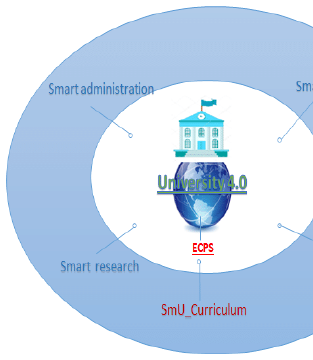
processes. Many models have developed in the world to bring about the digital transformations of universities. What these models have in common is that they aim to design universities to be part of the global academic network. The first stage of digitization of higher education institutions is the internal and external stakeholders .
technologies and the restructuring of interlocking educational processes. Many models have developed in the world to bring about the digital transformations of universities. What these models have in common is that they aim to design universities to be part of the global academic network. The first stage of digitization of higher education institutions is the internal and external stakeholders. They need to determine the curriculum according to the needs of these stakeholders. In-university wireless network applications, the creation of online libraries and access to international databases are also some of the stages needed for the digital transformation of universities. The concept of digital university is also a tool for strategic development. For digital universities, “literacy” is information literacy. There are many models and approaches discussed in the world on how digital universities is one of the most reasonable approaches and models.
Table1
Digital University Conceptual Matrix
Source: Source: Smyth Smyth et et al, al, 2015 2015
            Table 1the
Table 1 shows         shows      the digital
                           digital            university
                                      university          conceptual
                                                   conceptual           matrix.
                                                                   matrix.   It Itconsists
                                                                                    consistsof digital
            of  digital  participation,    information   literacy,
participation, information literacy, curriculum & Course design     curriculum   &   Course
                                                                                         and learning
            design and learning environment. The assumptions of the digital
environment. The assumptions of the digital university model are based on the
            university model are based on the relationships described in Table 1.
relationships described in Table 1. Digital participation refers to digitization that
            Digital participation refers to digitization that contributes to university
contributesteaching.
             to university      teaching.
                        Information         Information
                                        literacy is one ofliteracy   is one of the
                                                             the consequences      of consequences
                                                                                      digital        of
digital participation.   It isItalso
            participation.           important
                                 is also         to organize
                                         important  to organize learning  environments
                                                                   learning  environmentsthat enable
the development    of knowledge       of  information.  It  also accepted
            that enable the development of knowledge of information.        that theseIt elements
                                                                                         also     have
an impact on the curriculum and the design of courses. It recognized that universities
wishing to achieve the digital transformation of higher education should 49                 develop the
four categories specified in Table 1 and elements of the subsectors. The change in these
dimensions will be possible after the modernization of university-related educational
accepted that these elements have an impact on the curriculum and the design of courses. It recognized that universities wishing to achieve the digital transformation of higher education should develop the four categories specified in Table 1 and elements of the subsectors. The change in these dimensions will be possible after the modernization of university-related educational literature, the analysis of their institutional structures and the identification of reasonable action plans for digital transformation. Employability, creativity, digital literacy levels and digital skills for university and postgraduate students are of great importance in the digital university age. The development of these skills and competencies will be possible not only by modernizing learning environments, but also through the development of curricula and educational learning approaches appropriate to this era. The transfer of resources to the virtual environment in higher education also raises questions about the role and existence of libraries. Although the general trend supports the use of resources on the Internet, the study of academic opinions on this issue provides striking data.
LEARNING MODELS RESULTING FROM TRANSFORMATION
Technological changes and developments, social media applications, increased use of multimedia Knowledge, interactive Knowledge creation, faster and easier sharing are changing learning models in higher education institutions Asiri & Al-Serihi, (2019) is called “process-oriented education”. It to teach and guide information goals change the expectations of faculty members working in higher education institutions. Because of the digital transformation, faculty expectations have become more complex, and they are expected to organize their educational processes in this new era. Learning models have been updated with the digital transformation of education/ training (Al-Busaidy & Weerakkody, 2009). Learning models that show the result of digitization can interpreted as follows: • Mixed learning: a learning model that occurs in the classroom environment and on online platforms. • Rotation model: A model that allows students to perform learning processes at their own pace with one-to-one courses in the classroom environment and includes online learning support. • Flexible learning model: a model where a large part of the program is run online and students can provide instant online responses in time of need. and includes online learning support. • Flexible learning model: Journal of Business a modeland Management where a large Accounting, part Vol. 11, of the Number program 2 (July) 2021, pp: is run online and 41–59 students can provide instant online responses in time of need. • Blended• personal model: amodel: Blended personal modela where model one where or one moreor courses offered online more courses according offered to students' online needs, as well according to as learning students’ in theasclassroom needs, environment. well as learning in the classroom environment. • Online •Lab Model: Online LabAModel: model A based model onbased all courses on all in the school courses in theenvironment school that given on online platforms environment thatbut allows given on students to apply but online platforms to their teachers allows for materials students they have difficulty to apply understanding. to their teachers for materials they have difficulty understanding. • Default• model: Defaultamodel: modela model wherewhere therethere are are no nostudents students in thephysical in the physical school environment and education provided by the online platform. school environment and education provided by the online platform • Connected Learning Model: A model that deals with what students • Connectedlearn, Learning Model: A and highlights model that immediate deals with or non-instant what processes. learning students learn, and highlights immediate or non-instant learning processes. • Volumetric learning: a learning model that focuses on network size. Social learning model: learning model for gaining competence for Volumetricsocial learning: groups. a learning model that focuses on network size. • Focused learning model: game-oriented and collaborative learning • Social learning model: learning model for gaining competence for social groups. model. • Focused learning model: game-oriented and collaborative learning model. Adaptive learning model: a learning model that plans to learn according Adaptive learning to theastudent’s model: learning needs. model With the digitization that plans of education/ to learn according to the student's training activities, the skills expected to be passed to students in needs. With the digitization of education/training activities, the skills expected to be higher education institutions have changed and increased. The skills passed to students in higher education institutions have changed and increased. The that students can gain a competitive advantage if acquired in higher skills that education students can gain a competitive institutions can be as advantage if acquired in higher follows: communication skills, education institutionsindependent can be as learning follows:skills, communication skills, independent principles of ethics and responsibility, learning skills, principles teamwork, of ethics and flexibility, critical thinking, digital problem-solving skills, digital responsibility, teamwork, flexibility, critical thinking, problem-solving skills,management information informationand management and digital digital documents, etc.documents, etc.
The figure itself is in the PDF version.
Oman-going-at-accelerated-toward-digitization (Source:(Source: Oman-going-at-accelerated-toward-digitization khaleej,khaleej, 2020) 2020)
OMAN'S OMAN’SDIGITAL DIGITAL TRANSFORMATION TRANSFORMATION
              A British international research institution has predicted that Oman’s
              digitalization will accelerate and attract significant investment, as it
              confirms that there are promising opportunities for the growth of the
              country’s ICT
A British international          sector, due
                              research        to the emerging
                                          institution              CORONA
                                                         has predicted      thatvirus.
                                                                                  Oman's According
                                                                                              digitalization will
accelerate andto The    Oxford
                   attract        Businessinvestment,
                             significant      Group, Oman      as has   respondedthat
                                                                   it confirms        decisively
                                                                                          there areto promising
              the  Corona     epidemic     after  the  first cases    recorded   by
opportunities for the growth of the country's ICT sector, due to the emerging CORONA  immediately
              halting flights from Iran and taking broad measures to limit the
virus. According to The Oxford Business Group, Oman has responded decisively to the
              country’s entry and movement of citizens (Al-Ruzaiqi & Baghdadi,
Corona epidemic
              2016). after   the first cases
                        “Companies               recorded
                                         are reaping      the by  immediately
                                                               benefits    of workinghalting   flights from Iran
                                                                                           remotely
and taking broad
              and reducing travel costs.” Rishi Kimji, director of The Kimji of
                      measures      to  limit  the   country's     entry   and  movement         Ajitcitizens (Al-
Ruzaiqi & Baghdadi,            adding“Companies
              Group, said,2016).                        are reaping
                                       that this is likely    to continuetheeven
                                                                             benefits
                                                                                    afterof
                                                                                          theworking
                                                                                               status remotely
and reducing  quo is over. Oxford Business Group explained that the need for mostsaid, adding
                 travel   costs.”   Rishi   Kimji,   director    of  The    Kimji    Ajit  Group,
that this is likely
              onlineto    continuecould
                       businesses     evenaccelerate
                                              after the status      quo is
                                                           digitization   andover  . Oxford
                                                                               attract          Business Group
                                                                                        investment
explained that     theICT
              in the     need    for stressing
                            sector,  most online        businesses
                                                  that this  shift willcould
                                                                          be in accelerate      digitization and
                                                                                line with current
              strategies
attract investment     in to
                           thesupport    ICT development,
                                 ICT sector,     stressing thata keythis pillar of thebelong-term
                                                                          shift will        in line with current
              development       agenda   “Vision    Oman     2040»
strategies to support ICT development, a key pillar of the long-term   (Shatat, 2017).    On 29-3- development
agenda "Vision2020, Oman
                      the Oman      Fund
                                 2040       for technology
                                       " (Shatat,      2017). launched       an onlinethe
                                                                  On 29-3-2020,            platform
                                                                                               Oman Fund for
technology called
              launched“Sailor” to purchase fish remotely. The aim of facilitating the
                            an online platform called "Sailor" to purchase fish remotely. The
              purchase of fish products in bulk. Additionally, the “Sailor Plus”
aim of facilitating    the  purchase of fish products in bulk. Additionally, the "Sailor Plus"
              program will allow fish sellers and stores to sell products directly to
program will       allow customers,
              individual    fish sellersin line
                                             and with
                                                    stores    to sell
                                                          the “stay       products
                                                                      at home”         directly to individual
                                                                                 guidelines.
customers, in line with the "stay at home" guidelines.
The figure itself is in the PDF version.
initiatives and electronic services for government and private institutions. The vision has the aim 52 of promoting active community participation with all segments and sectors of society. Introducing the vision, its most important objectives, and hubs. Highlighting its website, supporting future trends in the field of technologies. The fourth industrial private institutions. The vision has the aim of promoting active community participation with all segments and sectors of society. Introducing the vision, its most important objectives, and hubs. Highlighting its website, supporting future trends in the field of technologies. The fourth industrial revolution and information in the future of Oman 2040, and activating vision trends and linking them to future technologies to enable them to catch up with developed countries in digital transformation, cognitive transformation and transformation in performance. As part of its participation in comex, Vision 2040 organized a number of events and accompanying activities, most notably discussing a number of technological topics such as electronic payment, robotics education and 3D printing at The Vision Amman 2040 platform. This initiative aims to highlight these promising projects and provide an opportunity to learn more about the nature of their work and services. An open panel discussion was also prepared on The Vision of Oman 2040 and the importance of the Fourth Industrial Revolution and the electronic transformation in achieving the vision presented by Dr. Yousef Al Balushi, an economist at the Oman Vision Office, with some members of the committees involved in the subject (Bachir et al 2019).
VISION AND MISSION OF MINISTRY OF TECHNOLOGY IN OMAN The Ministry of Technology and Communications is working to transform Oman into a sustainable knowledge society. It is activating information and communication technologies to enhance government services, enrich business and enable individuals to digitally engage. In addition, it is leading plans to implement Oman’s digital initiative. The plan includes a series of projects and mechanisms designed to raise the efficiency and effectiveness of government services. It also, aim to enhance the business sector and provide citizens with the skills and knowledge needed to interact with electronic services, in order to serve and meet the needs and aspirations of society and in an effort to support the Sultanate’s orientation towards a sustainable, knowledge- based economy (Schuchmann & Seufert, 2015).
THE OMAN’S DIGITAL STRATEGY
The adoption of Oman’s digital strategy in March 2003 was one-step towards achieving His Majesty Sultan Qaboos bin Saeed’s vision of transforming Oman into a knowledge-based economy where the strategy is concerned with the development of Oman’s knowledge society and e-government (Schuchmann, & Seufert, 2015). In his high-profile speech at the Council of Oman in November 2008, His Majesty said, “The interest in human resources and the provision of various means to develop its performance, stimulate its energies and potential. Also, diversify its creative capabilities, improve its scientific and practical competencies is the foundation of real development and the cornerstone of its building based on solid rules”. His Majesty also directed the Government to facilitate its operations and harness modern technologies to serve its daily activities and focus on providing its services through electronic means (Sarrab, 2015). Following these guidelines, Oman’s digital strategy has been updated to give more attention and focus over the next five years in order to develop the IT industry, empower the community and individuals and to develop electronic services.
THE IMPORTANCE OF DIGITAL TRANSFORMATION IN EDUCATION
The importance of digital transformation appears in education in Oman, where modern technological tools have been used. According to the same report, Oman is one of the countries that has focused on e-learning. When the Ministry of Education introduced computers to all schools in the Sultanate of Oman and established modern computer laboratories and learning resource centers that rely on computers and the Internet, and trained teachers on how to use these devices and use the Internet to teach students and do research, the country’s results in this field has been very encouraging. It has led to a positive transformation in digital education in Oman. Oman was due to complete its quantitative development in terms of the use of technology in education, but it needs a qualitative development too. In this article, I present some ideas that contribute to the digital transformation of education in Oman, including good teacher preparation in educational institutions. To keep pace with the concept of the global teacher, the knowledge teacher, the enabler, who is able to provide students with the tools of learning and the search for knowledge, far from memorization and traditional methods of indoctrination, as well as preparing advanced educational curricula that create generations of researchers and innovators through the development of higher thinking skills, creative thinking, development contemporary skills and other life skills, with modern educational methods and methods. As well as preparing administrators, educators and support jobs who are able to keep pace with the generation of knowledge and the fourth generation of the industrial revolution. To take their hands and provide appropriate support to achieve the goals of the educational process, by providing a stimulating learning environment that supports creativity and innovation and with community participation, and to support digital knowledge learning processes for digital transformation, cybersecurity, strengthening the internet and encouraging parents to buy digital devices for their children. In addition, and to implement activities, big data and artificial intelligence under one roof, the Oman Vision 2040 aims at digital transformation, which works under the slogan “Digital Oman”, to achieve digital transformation in Oman through cooperation with the public sector, the private sector, universities and non-governmental organizations. It is aligned with Oman 2040 goals (Al-Maamari, 2020).
CONCLUSION AND DISCUSSION
In this study, the independent variables are affecting the digital transfer of education in Oman. The potential and analysis of data and perceptions in the context discussed as the first part of the study of digital transformation. The analysis results in four proposals on the factors influencing digital transformation. Our goal is to further develop these proposals into a testable model and derive hypotheses about the relationships between these factors. For this purpose, we collected data on digital transformation in e learning in Oman to determine our proposed theoretical framework in the study. Through a quantitative research approach, quantitative results can be further supported for digital transformation with quantitative evidence and thus enhance preliminary results. Therefore, stakeholders in the digital transformation decision can supported through this process by using data-driven insights to find the optimal time for digital transformation in organizations. The results also show great interest and applicability of data analysis in a context of enabling faster and more evidence- based decision-making. A thorough research into literature resulted in 32 studies, including magazine articles, conference papers and doctoral theses. The study looked at definitions in the selected sample from previous studies. The study analyses previous studies and make recommendations. In addition to providing a deeper understanding of the digital conversion process and giving suggestions on how and how important the use of data analysis can support this process in the future. Based on these preliminary findings, future studies can use specific features to address issues related to digital transformation.
the effects of the environment, human resources, finance and Knowledge on improving the interconnection between technology improvement and digital technology in digital transformation. Finally, promoting digital transformation in Oman can contribute to the rapid completion of business and can develop Oman's economy.
ACKNOWLEDGMENT
This article not gotten any particular funding from any funding organization in the community, commercial, or not-for profit sectors. Also, we thank all the colleagues and people who helped us complete this article.
References
- Asiri, I, & Al-Serihi, M. (2019). Open data platform and its activation through the e-government portals of the GULF Cooperation Council: A comparative study. Journal of Information Studies & Technology (JIS&T), 2(14), 12-26.
- Al-Balushia, N., al-Harasi, N. & al-Oufi, A. (2020). The reality of digital transformation in Omani institutions. Journal of Information Studies & Technology (JIS&T), 1(2), 14-16.
- Al-Busaidy, M., & Weerakkody, V. (2009). E-government diffusion in Oman: A public sector employees’ perspective. Transforming Government: People, Process and Policy, Vol. 3 No. 4, pp. 375-393.
- AL MAAMARI, N. A. S. S. R. (2020, January). A Conceptual Paper: The Efficient of E-Services delivery and Digital Transformation on selected Public Sector in the Sultanate of Oman. In Postgraduate Research Symposium-January 2020, 1(1), 15-16.
- Al-Ruzaiqi, S. S., & Baghdadi, Y. (2016). Government Approach to Integration in Oman. IT Professional, 18(4), 10-13.
- Al-Sawi, S. (2018). National Archives for Training in Electronic Document Management: U.S. National Archives model. Journal of Information Studies & Technology (JIS&T), 1(4), 12-16.
- Bachir, S., Gallon, L., Abenia, A., Aniorte, P., & Exposito, E. (2019, August). Towards Autonomic Educational Cyber Physical Systems. In 2019 IEEE SmartWorld, Ubiquitous Intelligence & Computing, Advanced & Trusted Computing, Scalable Computing & Communications, Cloud & Big Data Computing, Internet of People and Smart City Innovation (SmartWorld/ SCALCOM/UIC/ATC/CBDCom/IOP/SCI) (pp. 1198-1204). IEEE.
- Chanias, S., Myers, M. D., & Hess, T. (2019). Digital transformation strategy making in pre-digital organizations: The case of a financial services provider. The Journal of Strategic Information Systems, 28(1), 17-33.
- Comex (2019), “comex, commodity exchange, in 2019 at Oman Convention and Exhibition Centre”, Accessed on 10-8-2020 from https://www.2040.om/news/vision-Oman-2040-participating-in-exhibition-comex-2019/.
- Doloreux, D., Shearmur, R., & Guillaume, R. (2015). Collaboration, Transferable and Non-transferable Knowledge, and Innovation: A Study of a Cool Climate Wine Industry (Canada). Growth and Change, 46(1), 16-37.
- Herold, B. (2016). Technology in education: An overview. Education Week, 20, 129-141.
- Kaplan, A. M., & Haenlein, M. (2016). Higher education and the digital revolution: About MOOCs, SPOCs, social media, and the Cookie Monster. Business Horizons, 59(4), 441-450.
- Khaleej (2020), “science-and technology/because-corona-oman-going-at-accelerated-toward-digitization”, Accessed on 10-8-2020 from http://khaleej.online/NNNDov
- Nicolescu, B. (2018). The transdisciplinary evolution of the university condition for sustainable development. In Transdisciplinary theory, practice and education (pp. 73-81). Springer, Cham.
- Pinchuk, O. P., Sokolyuk, O. M., Burov, O. Y., & Shyshkina, M. P. (2019). Digital transformation of learning environment: Aspect of cognitive activity of students. Pedagogy of the middle school, 52, 22–38.
- Rozhkova, D., Rozhkova, N., & Blinova, U. (2019, October). Digital Universities in Russia: Prospects and Problems. In The 2018 International Conference on Digital Science (pp. 252-262). Springer, Cham.
- Sarrab, M. (2015). M-learning in education: Omani Undergraduate students perspective. Procedia-Social and Behavioral Sciences, 176, 834-839.
- Schuchmann, D., & Seufert, S. (2015). Corporate learning in times of digital transformation: a conceptual framework and service portfolio for the learning function in banking organisations. International Journal of Advanced Corporate Learning (iJAC), 8(1), 31-39. Shatat, A. (2017). Factors affecting the adoption and usage of online services in Oman. Journal of Internet Banking and Commerce, 22(S7), 1.
- Seres, L., Pavlicevic, V., & Tumbas, P. (2018, March). Digital transformation of higher education: Competing on analytics. In Conference proceedings, INTED2018 Conference (pp. 5-7).
- Smyth, K., MacNeill, S., & Johnston, B. (2015). Visioning the Digital University–From institutional strategy to academic practice. Educational Developments, 16(2), 13-17.
- Sousa, M. J., & Rocha, Á. (2019). Digital learning: Developing skills for digital transformation of organizations. Future Generation Computer Systems, 91, 327-334.
- Ting, D. S. W., Carin, L., Dzau, V., & Wong, T. Y. (2020). Digital technology and COVID-19. Nature Medicine, 26(4), 459-461.
- Ustundag, A., & Cevikcan, E. (2017). Industry 4.0: managing the digital transformation. Springer.
- Van Laar, E., Van Deursen, A. J., Van Dijk, J. A., & De Haan, J. (2017). The relation between 21st-century skills and digital skills: A systematic literature review. Computers in Human Behavior, 72, 577-588.
- Yot-Domínguez, C., & Marcelo, C. (2017). University students’ self-regulated learning using digital technologies. International Journal of Educational Technology in Higher Education, 14(1), 1-18.