Size of Public Sector in Malaysia: Premiership of Prime Ministers
- Tunku Puteri Intan Safinaz School of Accountancy, Universiti Utara Malaysia
Journal of Business Management and Accounting 12(2) (2022) · https://doi.org/10.32890/jbma2022.12.2.3
Abstract
This study aims to evaluate the size of the public sector during the premiership of three former prime ministers of Malaysia. The size of the public sector in Malaysia was measured based on total expenditure for the period 1982 - 2015. A comparison of public sector size based on the percentage of total public sector expenditure to GDP suggests that the size of the public sector was bigger during the early years of Tun Dr. Mahathir’s premiership; the percentage remained at a low level from 1994 onwards and continued during the tenure of his successors. The trend in the size of the public sector of the three prime ministers ranges from 15% to 30%, which means that the Malaysian government's sizing practices are consistent with other countries. Taking into account the government’s operating expenditure to total expenditure, the percentage of operating expenditure increased during the premiership of Dato’ Sri Najib. The government policy in the days of Dato’ Sri Najib focused on implementing government reform programs and increasing employment, which could have led to higher operating expenditure compared to development expenditure. Based on trends in government spending, the size of the government can be related to political or policy changes and economic conditions during the said prime ministers’ tenure.
Keywords: Public sector, government, size, Malaysia, public sector expenditure
INTRODUCTION
In relation to the study of the public sector size, there are two conflicting views about government intervention in the economy. Based on research by Adam Smith and Jeremy Bentham, as quoted by Borre & Viegas (1995), from a liberal point of view, the government need to limit intervention by reducing government spending and tax cuts, allowing the private sector to manage more resources. A study by Borcherding, Pommerehne, and Schneider (1982) revealed that the private sector uses resources more efficiently than the public sector to produce goods of equal value. Opponents of government intervention have argued that there is no strong tendency for the government to make profits or to increase returns on capital usage, and that it not likely to make a decision to efficiently distribute resources domestically.
In contrast, the nationalist (Keynesian) view is that the government needs to intervene in the economy to correct economic failures (Borre & Viegas, 1995). For example, governments have a duty to improve the welfare of their communities through the redistribution of income and wealth. In addition, governments must help countries achieve solid economic growth and reduce problems. Opponents of government intervention in the economy believe that a large public sector size is not suitable for economic development; whereas the proponents argue that smaller government size means the government is ignoring public welfare (Sagua, 2017). Basically, it is important for the government to safeguard citizens and resources as they are the foundation for the efficient functioning of a market economy. In fact, restricted provision of public goods, for instance, for hospitals, schools and national defence, may affect the development of the economy (Chobanav & Mladenova, 2009). Gwartney, Lawson, and Holcombe (1998) mentioned that if governments have high intervention in the economy, they might adversely affect economic growth, such as via higher taxes and interference in the wealth creation process. High government intervention is not good as the government has less ability compared to markets to adapt to changing conditions and surroundings. Moreover, the government is less effective in discovering new ways to enhance the value of resources. Hence, it is important that the government size is not too big or too small in order to ensure that it can operate effectively and efficiently.
In contrast to the private sector, which focus on profit maximization, the goal of public sector is to provide goods and services to citizens, fulfill legal requirements and ensure accountability. To achieve these objectives, the public sector must ensure that public funds or resources are effectively, efficiently and economically utilized. Previous researchers have suggested what the optimum government size to maximize economic growth based on government spending should be. Even though it varies from country to country, it can still be used as a benchmark for the measurement of government effectiveness. Therefore, it is important to look at the Malaysian government’s spending trends so that government practices related to government size can be assessed.
There were three Prime Ministers of Malaysia in the period of the study from 1981-2015: (1) Tun Dr. Mahathir (1981 - 2003); (2) Tun Abdullah (2003 - 2009); and (3) Dato’ Sri Najib (2009 - 2018). The uniqueness of the economic management of Tun Dr. Mahathir can be discussed in three different phases (Jomo, 2003). Each phase can be seen not only as a response to a previous crisis, but also, as a form of new phase and development. Tun Dr. Mahathir promoted heavy industrialization and domestic imitation of Japanese “Sogoshas” in the first phase (1981-1985). He then pushed for selective economic and cultural deregulation and partial privatization in the second phase (1986-1997). The final phase (1998-2003) was the period in which he began to facilitate economic recovery and sustainable growth. When Tun Abdullah was the Prime Minister, he faced a number of challenges due to the global financial and international oil crises (UKEssays, 2018). The global oil crisis forced governments to cut spending. Governments also had to reallocate developmental resources to meet the more urgent needs of society. Under Najib’s leadership, Malaysia embarked on a transformation of Malaysia’s multi-ethnic and multi- religious landscape, including the “1Malaysia” initiative, which emphasized national unity. The Government Transformation Program
(GTP) was also launched by Najib with the goal of improving the quality, efficiency and transparency of government services. Over the years, it can be seen that each Prime Minister utilized a different leadership style, to lead the people of the country towards a common goal. Therefore, comparisons of the trends of Malaysian public sector size during the different premierships can provide valuable input, information and guidelines to determine the direction of appropriate fiscal policies. Although Tun Dr. Mahathir’s tenure is longer than that of the other two prime ministers, it is still worth looking at the trend as it relates to several periods of economic governance during his tenure.
Malaysian Finance Minister II, Datuk Johari Abdul Ghani (2016 – 2018) stated that the 1.6 million employees in Malaysia’s public sector form the biggest percentage of the civil service globally (Anonymous, 5 February 2017). Therefore, it turns out that the operating expenditure of the government may increase due to rising emoluments. As a result, the Malaysian Government faces a great challenge in controlling the increasing operating costs of the public sector system. This issue also motivated the current research to look at the current practice of public sector size based on public sector expenditure. In addition, research focusing on the size of the Malaysia’s public sector is limited. Generally, the purpose of this study is to evaluate the trend of the public sector size based on public sector expenditure during the premiership of three former prime ministers. Thus, this study fills the existing gap and makes a substantial contribution to the body of knowledge on public sector size based on each premiership.
LITERATURE REVIEW
This section has three sub-sections. The first begins with a description of the public sector in Malaysia in general. The second presents an overview of the Prime Ministers of Malaysia and specific sub- sections provide detailed information about the three Prime Ministers mentioned in this study. The last sub-section presents a description of the public sector size and the measures used in this study.
The Public Sector in Malaysia
Malaysia is a federal constitutional monarchy, consisting of three federal territories and 13 states. The country practices parliamentary democracy based on the federal system. The Parliament of Malaysia is based on the Westminster system and it consists of the “Yang di-Pertuan Agong” (the King), the “Dewan Rakyat” (House of Representatives) and the “Dewan Negara” (Senate). The Government of Malaysia adopted the federalism concept, whereby the federal government and the state governments have their own powers and are free to govern without interference. The power and duties of the States and Federal Governments are specified in the Ninth Schedule of the Federal Constitution. Basically, the Government of Malaysia comprises of three levels, namely, the federal government, the state governments and the local authorities. Local authorities are the lowest tier in the government structure and their administration comes under the jurisdiction of the respective state government, except for the three federal territories.
The state government is the second tier of the government structure, and is headed by a Sultan/Raja. However, in states with no heredity ruler, a Governor is the head of state, appointed by the “Yang di- Pertuan Agong”. The “Sultan/Raja” or the Governor acts on the advice of the elected State Executive Council (EXCO), helmed by a “Menteri Besar”/Chief Minister.
The first tier of the government structure is the federal government, under the “Yang di-Pertuan Agong”. Although the executive power is vested in the hands of the “Yang di-Pertuan Agong”, it is implemented by a Cabinet, consisting of ministers and deputy ministers with different portfolios, led by a prime minister. The prime minister is officially appointed by the “Yang di-Pertuan Agong” and heads the government. The federal government is responsible for developing public policies and plans, and for monitoring and coordinating ministerial matters. The Prime Minister’s office, on the other hand, is responsible for assisting the prime minister in performing his duties and responsibilities for building an effective government and serving the citizens and the nation with integrity. The following sections describe the three former prime ministers of Malaysia.
Prime Ministers of Malaysia
The head of the Government in Malaysia is a prime minister (political leader). The first Malaysian prime minister was Tunku Abdul Rahman Putra Al-Haj ibni Almarhum Sultan Abdul Hamid Halim Shah II, from 1957 - 1970. He is also known as the “Father of Independence”, for his contribution in securing independence for the country from the British colonialists. The second prime minister, Tun Abdul Razak bin Hussein, headed the country from 1970 - 1976. After his demise, Tun Hussein bin Onn was appointed as the third prime minister from 1976 - 1981. Tun Dr. Mahathir bin Mohamad, led the country for 22 years from 1981 – 2003 as the fourth prime minister. The fifth prime minister was Tun Abdullah bin Ahmad Badawi from 2003 – 2009. Dato’ Sri Najib bin Tun Abdul Razak became the sixth prime minister from 2009 - 2018. Tun Dr. Mahathir was re-elected as the seventh prime minister in 2018. Tan Sri Muhyiddin bin Haji Muhammad Yassin was appointed on 29 February 2020 as the eighth Prime Minister of Malaysia after Tun Dr. Mahathir unexpectedly resigned on 24 February 2020 due to a political crisis. Tan Sri Muhyiddin resigned after 17 months of being the Prime Minister. On 21 August 2021, Dato’ Sri Ismail Sabri bin Yaakob was sworn in as the ninth Prime Minister. The following sections provide detailed information about three Prime Ministers: (1) Tun Dr. Mahathir (1981 - 2003); (2) Tun Abdullah (2003 - 2009); and (3) Dato’ Sri Najib (2009 - 2018).
(1) Tun Dr. Mahathir bin Mohamad (1981 - 2003, 2018 -2020)
Tun Dr. Mahathir was appointed as the fourth prime minister on 16 July 1981 and is longest-serving prime minister in Malaysia. Born in the state of Kedah (20 December 1925), Tun Dr. Mahathir was excellent at school and became a doctor. He practiced medicine in his hometown in Alor Setar. He has been involved in politics since 1946 as a member of UMNO (the United Malays Nationals Organisation). After the 1974 general election, he was appointed Minister of Education. After being appointed Minister of Trade and Industry in 1978, he led some investment promotions overseas (Prime Minister’s Office, 2017). Tun Dr. Mahathir became Deputy Prime Minister in 1976, in addition to his educational portfolio. In 1981, he was appointed as the Vice President of UMNO.
A few policies were implemented during Tun Dr. Mahathir’s administration. Among others, he proposed the Malaysian Cooperation Policy to promote active engagement with the private sector in national development (Shuib, 2007; Shuib, Keling, and Ajis, 2008). It was believed that the relationship between the public as well as private sectors could contribute to national development. Therefore, through the Malaysian Cooperation Policy, the Prime
Minister hoped that public-private sector engagement could enhance various developmental processes. Another agenda introduced by Tun Dr. Mahathir in 1983 was the privatization policy. The government believed that effectiveness and efficiency could be increased by privatizing specific services (Shuib, 2007; Shuib, Keling, and Ajis, 2008).
A main figure behind the implementation of Vision 2020 was Tun Dr. Mahathir. He presented a paper entitled “Malaysia: The Way Forward” in 1991 where he proposed nine important challenges that Malaysia must face in order to become a newly industrialized country. By 2020, he expected Malaysia to become a developed country. He also mentioned that “in year 2020, Malaysia will be a united country with citizens who are confident, with high moral values and strong ethics, democratic, liberal and compromising, caring, fair in terms of economic distribution, progressive and prosperous and have full control over the competitive, dynamic, active and viscous economy” (Shuib, 2007; Shuib, Keling, and Ajis, 2008).
Tun Dr. Mahathir also introduced the National Development Policy (NDP) with the main aim of reducing poverty. The objectives of the NDP are to attain “a balanced development in establishing a united and fair society” (Shuib, 2007; Shuib, Keling and Ajis, 2008). Tun Dr. Mahathir’s efforts and approaches helped in Malaysia’s economic recovery and overall sovereignty. His actions were considered successful and also respected worldwide (Shuib, 2007; Shuib, Keling and Ajis, 2009).
Yusof and Bhattasali (2008) stated that Tun Dr. Mahathir was “critical of the West and the legacy of colonial rule”. He revived the “rhetoric of economic imperialism” and also proposed a “Look East” Policy, whereby he encouraged Malaysians to turn to the East. He urged Malaysians to focus on East Asian Countries (Japan was singled out as model), not only on the work ethics but also their approaches toward growth and development. Many Malaysians were sent to Japan for training or further studies (tertiary-level education), which was a major shift away from the United Kingdom previously.
Shuib, Saludin, Feigenblatt, Keling and Ajis (2010) stated that Tun Dr. Mahathir was very determined in ensuring that Malaysia became the number one player internationally. Specifically, he encouraged Malaysians to play a leadership role in the developing world. Malaysia was appointed as the chair for the Non-Alignment Movement (NAM), and the Organization of Islamic Conference in 2003. Shuib et al., (2010) opined that Tun Dr. Mahathir’s policies were successful. His approach helped Malaysia to become a major player in the world. Tun Dr. Mahathir is regarded as a “controversial and outspoken leader” by the West. He is also viewed as a leader who will never give up in ensuring a successful Malaysia. For instance, Tun Dr. Mahathir did not lose his sense of direction, when dealing with a crisis. The Asian currency crisis occurred in early 1997 and affected Malaysia as well. Tun Dr. Mahathir fixed the exchange rates and imposed capital controls, rather than following the economic regulations of the International Monetary Fund (IMF) and the World Bank. Tun Dr. Mahathir’s measures were successful since Malaysia achieved economic recovery by the end of 1999.
Tun Dr. Mahathir retired in 2003. Fifteen years after his retirement, he made a comeback to politics in 2018. He joined the opposition alliance after he broke away from UMNO (the ruling party) in 2016. After Malaysia’s 14th General Election, Tun Dr. Mahathir was appointed as the seventh prime minister of Malaysia, thus making a stunning election comeback, defeating the coalition that had ruled Malaysia for six decades since independence from Britain. He became the prime minister at the age of 92. However, Tun Dr. Mahathir unexpectedly resigned on 24 February 2020.
(2) Tun Abdullah bin Ahmad Badawi (2003-2009)
Born 26 November 1939, Tun Abdullah was appointed prime minister of Malaysia on 31 October 2003, and served the country for five years. Tun Abdullah graduated from University of Malaya with a bachelor’s degree in Islamic studies. In 1964, Tun Abdullah began his work as an Assistant Secretary in the Public Services Department. He was promoted to Director General in 1971. In 1974, he was appointed Deputy Secretary General of the Ministry of Culture, Youth and Sports. He has been a member of UMNO since 1965. Tun Abdullah became Deputy President of UMNO in 2000. After the general election in 1978, Tun Abdullah was appointed Parliamentary Secretary to the Federal Territory Ministry. In 1980, he was promoted to Deputy Minister in the same Ministry. Tun Abdullah was also appointed minister in different ministries (the Prime Minister’s Department, the Education Ministry, the Defence Ministry and Foreign Affairs
Ministry). Tun Abdullah became Deputy Prime Minister and Minister of Home Affairs in 1999. He served the country as the prime minister from 31 October 2003 until 3 April 2009.
Tun Abdullah promoted Islam Hadhari as a development model in Malaysia (Bashir, 2005). According to him, Islam Hadhari encourages the ummah (nation) to go back to the fundamentals, as highlighted in the Quran and the Hadith, which are the foundations of Islamic civilization. If Islam Hadhari is sincerely explained and understood clearly, it will not lead Muslims astray from righteousness. Islam Hadhari is simply an approach to cultivating an Islamic civilization based on Islamic values and noble ideals. It emphasizes development in accordance with the principles of Islam and focuses on improving the quality of life of all citizens, regardless of their religion. This approach is also inspired by the unwavering belief of Malaysian Muslims that waves of radicalism and extremism can be contained and reversed through good governance and sound democratic practices, citizenry and employment through education as well as equitable sharing of the benefits of economic growth.
Tun Abdullah focused on performance improvement and anti-
corruption. However, the record of his government was anything but satisfactory. In fact, the “colossal failure” of Tun Abdullah’s administration made the public more concerned as evidenced in the 2008 general election (Chin, 2010). This forced him to make way for his deputy, Dato’ Sri Najib bin Tun Abdul Razak to take over the reins of power.
(3) Dato’ Sri Najib bin Tun Abdul Razak (2009 - 2018)
The sixth prime minister of Malaysia was Dato’ Sri Najib. He was born in Pahang and is the eldest son of Tun Abdul Razak, the second prime minister. After graduating from the University of Nottingham in 1974 in Industrial Economics, he joined Petronas as an executive, where he served for two years before becoming actively involved in politics from an early age. He began his political career after the sudden death of his father in 1976. He represented the “Barisan Nasional” coalition to contest in his home constituency of Pekan, left vacant by his late father, and was elected Member of Parliament at the age of 23. In the same year, he was appointed as the Deputy
Minister of Energy, Telecommunications and Post. He was also the Deputy Minister of Education and Deputy Minister of Finance. After the 1982 general election, he was appointed Chief Minister of Pahang until 1986. He also held the position as Minister of other ministries, namely, the Culture, Youth and Sports Ministry, Defence Ministry and Education Ministries. He then became the Deputy Prime Minister in 2004 and was elected President of UMNO in year 2009. He was appointed the sixth prime minister on 3 April 2009 and he served the country until 9th May 2018.
According to Thaib (2015), as a leader, Dato’ Sri Najib inspired his followers to strive and achieve set goals. Recognizing the challenges facing the government and the importance of restoring public confidence in order to stay in power, Dato` Sri Najib launched a series of reforms and political directives. The transformation agenda during his administration included the introduction of the 1Malaysia concept, the GTP, the Political Transformation Program (PTP), the Economic Transformation Program (ETP) and the New Economic Policy (NEP), all aimed at turning Malaysia into a high-income country.
Thaib (2015) noted that the GTP was launched by the government of Malaysia in 2010 to help realize Malaysia’s vision of becoming a developed and high-income country (Prime Minister’s Office, 2017). With the introduction of the GTP, the government became more transparent and accountable. It was designed to change the way the government works in the face of public concerns with education, the rising cost of living, corruption and crime. There was a complete shift of attitude and the public was encouraged to raise concerns and criticize the GTP. The government was also committed that each concern was addressed through an extensive consultation process with experts, the public and the government, which was how the seven National Key Outcome Areas (NKRAs) were determined: (1) reducing crime (2) fighting corruption (3) improving student outcomes (4) raising living standard of low-income households (5) improving rural basic infrastructure (6) improving urban public transport and (7) addressing the cost of living. These NKRAs are the central concerns of the GTP program which was divided into three horizons: in 2012, the first horizon (GTP1.0) was completed; the second horizon ran from 2013 to 2015 and final horizon was from 2015 to 2012.
The GTP directly targeted the economic sector to be transformed into a high value-added and income generating industry. Dato` Sri
Najib launched the ETP in September 2010 to stimulate new jobs, investment and knowledge growth, despite the economic crisis impacting Europe and North America at that time. According to Yusof and Bhattali (2005), the ETP comprised 12 National Key Economic Areas (NKEAs) and eight Strategic Reform Initiatives (SRIs) and was spearheaded by the Performance Management and Delivery Unit (PEMANDU) in the Prime Minister’s Department. The NKEAs are “agriculture, business services, education, electrical and electronics, financial services, healthcare, Greater Kuala Lumpur/Klang Valley, oil, gas and energy, palm oil, communications and infrastructure, tourism and wholesale and retail businesses”. The eight SRIs are: “(i) to enhance the private sector to promote growth (ii) to develop a quality workforce and reduce dependency on foreign workers (iii) to create a competitive domestic economy (iv) to strengthen the sector public (v) to have a transparent and market-friendly affirmative action (vi) to build a knowledge-based infrastructure (vii) to raise sources of growth and (viii) to ensure sustainability of growth”. Through the NKEAs and SRIs, it was hoped that the ETP could help to achieve Vision 2020, i.e., for Malaysia to become a developed country by 2020.
Dato’ Sri Najib also launched 117 high impact initiatives through the National Blue Ocean Strategy (NBOS) launched in 2009 to address a wide range of economic and social issues (The Star, 2014). He said he realized that this country must clearly break away from past policies. In his speech at the International Conference on Blue Ocean Strategy, he stated that:
“If we had continued with the old policies, we would have found the Government and country swimming in an ocean of red. We had to make a paradigm shift and create a new economic model, one driven by knowledge, creativity and innovation – a ‘blue ocean’ of new opportunities,” (The Star, 2016).
Datuk Seri Najib Razak also claimed that many NBOS initiatives can change the way the government provides services. For example, through innovative collaboration, the government converted 15 under- utilized buildings as Urban Transformation Centre (UTC)s across the country (The Star, 2016). As mentioned earlier, Malaysia held its 14th General Election in May 2018 and Barisan Nasional suffered a surprising defeat as it failed to secure a majority for the first time in the country’s history.
Public Sector Size
Public sector size denotes the portion of the government resources in a national economy (Lee, 2005). Public sector size is essential for the performance of an economy. Through its taxing, expenditure and regulatory roles, the public sector can influence allocation of resources and economic development (Di Matteo, 2016). Statistics Sweden (2006) reports that there are several metrics that can be used to assess public sector size. Total public expenditure and total revenue relative to gross domestic product (GDP), tax collection and the number of public sector employees relative to total employment, are some of the measures used as proxies for the size of the public sector. However, the size is usually measured in terms of the proportion of public spending to the national aggregate income (Brown and Jackson (1986). The combined expenditure of the state and federal governments were used to calculate the public expenditure amount. A study done by Mithani and Khoon (1999) discovered that the public sector in Malaysia is influenced by public spending decisions. Therefore, the focus of this paper is only on the size of the public sector measured by public sector expenditure.
Public sector expenditure is divided into two categories: (1) operating expenditure and (2) development expenditure. Operating expenditure is expenses incurred for public administration (Azhar et al., 2019). Operating expenditure consists of charged expenditure and supply expenditure. Charged expenditure is the prioritized expenditure and the obligation to allocate the expenditure as stated in Article 98 of the Federal Constitution. Charged expenditure needs annual appropriations as the expenditure is charged directly to the Consolidated Fund. Examples of charged expenditures are royal allowances, pension allowances, gratuities, etc. On the other hand, supply expenditure is allocated to the governments departments and agencies as provided under the Supply Act. Supply expenditure is allocated for: (i) Emolument (ii) Supplies and services (iii) Fixed charges and grants (iv) Office fixture and fittings and (v) Other administrative expenses (Azhar et at., 2019). In contrast, development expenditure is a long- term capital expenditure and is often non-repetitive in nature (Azhar et al., 2019). The amount involved in development expenditure is normally huge. Hence, the government usually obtains loans, either from internal or external financial institutions to sponsor some of the projects.
Alberto and Wacziarg (1998) measured the size of government using the government consumption in GDP, not including interest payments, transfers and public investments. The researchers agreed that the size of government should be measured in terms of the resources it controls. This is evident in the purchase of goods and services by the government and in the hiring of personnel. These resources are provided by the private sector and are used for government purposes. If these purposes are worth more than the alternative value (opportunity cost) in private use, society as a whole will improve.
In general, population growth could increase the public sector size. In addition, the public sector size has the potential to scale up to meet the growing needs of most welfare countries in the world. But, a bigger public sector size, based on the portion of government expenses in GDP, does not necessarily indicate better satisfaction of people’s need (Afonso & Furceri, 2008). Gupta, Leruth, De Mello and Chakravarti (2003) documented trends and changes in public sector size for transition economies. They stated that the decline of the public sector size in the transition economies is not due to targeted policy but to the inability to find a way to support higher government spending.
Stein (1998) found that changes in government size were uneven based on evidence from Latin America. It developed rapidly during the 1970s and early 1980s. Public sector size in Latin America reduced significantly in the late 1980s due to the debt crisis and has been relatively stable since the early 1990s. The average public sector size was 28% of GDP in the 1990s. According to a report by Statistics Sweden (2006), the size of public sector in Sweden has varied between 54 to 56%, based on data from 1999 to 2004.
Siti Alida and Halimah (2001) compared public sector sizes of Malaysia and other ASEAN countries in their study based on 1998- 2000 data. They used percentage of public sector expenditure to GDP as a proxy for the public sector size. The result shows that the public sector of Malaysia is larger than Singapore and Thailand. They also compared Malaysia’s public sector size to OECD (Organization for Economic Cooperation and Development) countries. They found that
Malaysia’s public sector size ranked second among the five OECD countries (Sweden, United Kingdom, Germany, the United States and Turkey).
DiPeitro and Anoruo (2011) investigated the impact of the size of public sector (fraction of public sector expenditure to GDP) and public debt on the real economic growth in 175 countries around the world. They suggested that the size of the public sector and public debt has a negative impact on the growth of the real economy. Ghali (1998) used quarterly data from 10 OECD countries from the first quarter of 1970 to the third quarter of 1994 to test the causal relationship between public sector size and economic growth. He suggested that the public sector size influenced the growth of economy. Moreover, the size of public sector has an indirect influence on economic growth via international trade and investment.
Previous researchers have suggested the optimum size of government to maximize economic growth based on government spending. Sheehey (1993) found that there is a positive relationship between government size and economic growth when the size of the government is less than 15%, but if the size of the government exceeds 15%, the relationship is negative. Chobanov and Mladenova (2009) indicated that the optimum size of the government should be no greater than 25% of GDP based on data from the OECD countries. On the other hand, Eykut Ekinci (2011) suggested that the optimal government size could be kept at around 13.4% in a healthy and growing economy. Yuksel (2019) proposed that the optimal level of public expenditure that maximizes economic growth in Turkey is 16% of GDP. In general, James (2011) stated that studies on the relationship between the size of the government and economic growth have proposed an optimal government size ranging from 15% to 30% of GDP. However, he argued that such exercises were likely not well designed for many reasons. One argument is that government action has a long-term impact primarily on the level of economic activity, not on growth rates.
RESEARCH METHODOLOGY
This study adopted a quantitative approach using descriptive analysis to investigate public sector size in Malaysia. The evaluation of the public sector size in Malaysia was based on public sector expenditure during the premiership of three prime ministers, namely, Tun Dr. Mahathir, Tun Abdullah and Dato’ Sri Najib.
Data on the size of Malaysia’s public sector were obtained from economic reports issued by the Ministry of Finance in 1982-2015. The data for year 1981 was not included as Tun Dr. Mahathir became premier during the second half of the year. Data was only available until 2015 when the study was conducted in 2017. Due to the availability of the data (1982-2015), the focus is only for the three former prime ministers.
In this study, we used the following variables to determine the public sector size: 1) Percentage of Public Sector Total Expenditures to GDP (% PSE to GDP) 2) Percentage of Federal Government Total Expenditure to GDP (% FGE to GDP) 3) Comparative percentage of Federal Government Operating Expenditure to Federal Government Total Expenditure (% FGOE to FGE) and percentage of Federal Government Development Expenditure to Federal Government Total Expenditure (% FGDE to FGE). 4) Comparative percentage of Federal Government Operating Expenditure to GDP (% FGOE to GDP) and Federal Government Development Expenditure to GDP (% FGDE to GDP).
Public sector data (nominal values) was collected and analyzed using descriptive and trend analysis from 1982 to 2015. The variables used in this study were mainly based on the scale of the economy (i.e., GDP) on market price. More precisely, we compared the variable’s nominal size with nominal GDP to get the percentage of economic share for the use of the variables.
FINDINGS
Every prime minister has his own style of leading the country towards a common goal. Each prime minister’s approach may differ from others in terms of formulating policies that shape the size of the Malaysian government. The prime minister must also maintain an image of fairness and openness in the face of diverse political views as well as have the ability to resolve political differences (Means, 1991). Therefore, this study compared the size of the government under the premiership of three different prime ministers which may have significant implications for the development of macroeconomic policies in Malaysia and other developing countries. This study emphasized on the administrative periods of three prime ministers: (i) Tun Dr. Mahathir (1981 - 2003) (ii) Tun Abdullah (2004 - 2009) and (iii) Dato’ Sri Najib (2010 - 2015). The experiences of these three former prime ministers in shaping the size of the Malaysian government are discussed in terms of the public sector expenditures.
Public Sector Expenditures
Figure 1 summarizes the changes in the % PSE to GDP according to the administrative periods of the three prime ministers. Tun Dr. Mahathir, headed the country for more than 22 years. In the beginning of the period of the study, a higher percentage of expenditure to GDP was recorded at more than 25% for all years with the highest percentage recorded in 1986. The government began to allocate more resources to heavy industries in the early 1980s in response to the economic slowdown. The annual economic growth rate was 4.9% (1981 - 1983), which was lower than the target annual growth rate of 7.6% per year that was set under the Fourth Malaysia Plan (1981 - 1985). The bigger size of the public sector in the 1980s was discussed in the Economic Report (1985) and by Siti Alida and Halimah (2001). They suggested that the possible explanation was the expansionary fiscal policy that was in place at the time to control the impact of the global recession by overwhelmingly the country’s economy. In short, the increase in public spending reported in the 1980s was the government’s approach to stimulating weak aggregate demand and private investment (Economic Report, 1985; Siti Alida & Halimah, 2001). Among others, the government established an automobile company (Perusahaan Otomobil Nasional Berhad (Proton)1) in 1983 which commenced operations in 1985. From 1987, there has been a declining trend in the % PSE to GDP to not more than 20% per year with the lowest percentages recorded during the 1997 – 2000 period. The reason could be the economic crisis that began in July
Perusahaan Otomobil Nasional Sdn. Bhd. was officially incorporated on 7 May 1983. It is Malaysia’s leading automotive manufacturer.
1997, which is consistent with the Government’s efforts to reduce non-essential expenditure (Economic Report, 1998/99).
The second period refers to Tun Abdullah’s administration. McCreedy (2003) viewed Tun Abdullah’s personal style (mild, incremental, consensual) as different from the fiery tone of his predecessor (Tun Dr. Mahathir), which perhaps contributed to an improvement in relations with the West. During Tun Abdullah’s premiership, the government policies did not change much. Unlike Tun Dr. Mahathir, his personality was not as aggressive. He tried to achieve economic liberalisation, declare war on corruption, improve governance and open up democratic space (Ahmad Fauzi & Muhammad Takiyuddin, 2012). Figure 1 highlights that the % PSE to GDP was stable at 20% throughout the period except for the last two years. Athukorala (2010) reported that the 2008 global financial crisis affected the world capital flow, trade flow and commodity prices. Malaysia was also affected by the economic crisis and it impacted government policies under Tun Abdullah. The results show that an increasing trend in government size was reported for 2008 and 2009 and this scenario highlighted the influence of the global financial crisis and the international oil crisis on government spending during his tenure.
The third period (2010 - 2015) evaluated was led by Dato’ Sri Najib. Results as reported in Figure 1 show an increasing trend for the percentage of expenditure under Dato’ Sri Najib and the highest The The thirdthird period percentages period (2010 (2010 - 2015) were - 2015) in was evaluated 2012 evaluated ledand was by 2013 ledDato' by Sriat Dato' approximately Najib. Sri Najib. Results Results as25% as reported inbefore reportedFigure it in Figure 1 show 1 show an increasing an increasing trendtrend decreased forinthe forpercentage thethe percentage followingof expenditure of expenditure years. under under Dato’Dato’ Sri Najib Sri Najib and the andhighest the highest percentages percentages were The were in 2012 third in 2012 and period and 2013 (2010 - 2013 at approximately 2015) at approximately evaluated was25% 25% led bybefore before Dato' it decreased Sri it decreased Najib. in the Results inreported as following the following in Figure years. 1 show an increasing trend for the percentage of expenditure under Dato’ Sri Najib and the highest years. Figure were percentages 1 in 2012 and 2013 at approximately 25% before it decreased in the following Figure Figure 1 1 years. % PSE to GDP % PSE % PSE toFigure to GDP GDP 1 % PSE to GDPTunbin Dr. bin Mahathir bin Tun Abdullah bin Dato’ SriNajib Najib binTun Tun Tun Dr. Mahathir Dr. Mahathir Tun Tun Abdullah Abdullah bin Ahmad bin Ahmad Dato’ Dato’ Sri Najib Sri bin Tun bin Mohamad Mohamad Mohamad BadawiAhmad Badawi Tun Abdul Razak Tun Dr. Mahathir bin TunBadawi Abdullah bin Ahmad Abdul Abdul Razak Dato’ SriRazak Najib bin Tun Mohamad Badawi Abdul Razak
ThisThis studystudy did not didtest not the testrelationship the relationship between between the size the size of Malaysian of Malaysian government government and growth. and growth. As As This study did not test the relationship between the size of Malaysian government and growth. As mentioned mentionedearlier, earlier, the optimal the optimal size size of a of government a governmentto maximize to maximizeeconomic economic growth growth varies varies amongamong mentioned earlier, the optimal size of a government to maximize economic growth varies 55 among countries countries andcountries and is influenced is influenced and is by the by quality influenced thebyquality theof quality the of government. theof government. Thus, the government. Thus, comparing comparing Thus, Malaysian comparingMalaysian Malaysian government government size size withwith government other other size countries withcountries othercannot cannot be cannot countries done be done inbea done in straightforward a straightforward manner. manner. in a straightforward However, However, manner. it it it However, maymay still still be useful be useful may to be still look touseful look at trends at look to trends inatgeneral in general trends with in with regards general regards withtoregards Malaysian to Malaysian government government to Malaysian size size governmentand and size and
This study did not test the relationship between the size of Malaysian government and growth. As mentioned earlier, the optimal size of a government to maximize economic growth varies among countries and is influenced by the quality of the government. Thus, comparing Malaysian government size with other countries cannot be done in a straightforward manner. However, it may still be useful to look at trends in general with regards to Malaysian government size and global practices to gain some insights. Studies on the relationship between the size of the government and economic growth have proposed an optimal government size ranging from 15% to 30% (James, 2011). The trend in the size of the public sector of the three Prime Ministers is within the range, which means that the Malaysian government’s sizing practices are consistent with those of other countries.
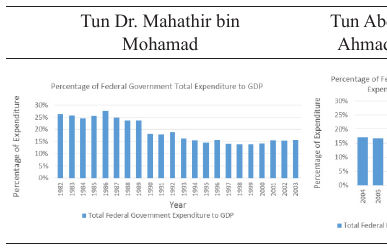
The trend in the % FGE to GDP shown in Figure 2 is almost similar to the trend in % PSE to GDP. The size of the federal government’s public sector certainly influences Malaysian public sector trends as it represents the largest component of Malaysia’s public sector relative to state and local governments. It also shows the importance of the federal government in the public sector of the country. In Malaysia, the Federal Constitution (Articles 96 to 112) gives the federal government greater fiscal power and responsibility than state and local governments.
The figure itself is in the PDF version.
The figure itself is in the PDF version.
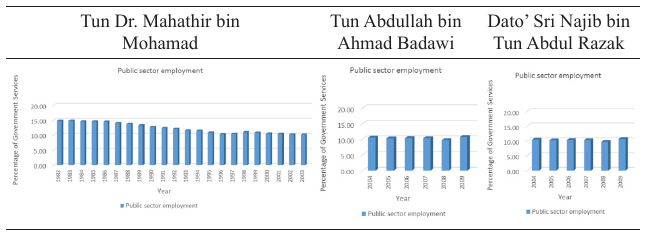
reform programs and increasing employment, which could have led to higher operating expenditure compared to development expenditure. Based on government spending trends, the size of the government may be related to political or policy changes and economic conditions during a prime minister’s tenure.
There are some limitations in this study. The study is descriptive and does not test the relationship between the Malaysian government size and government efficiency or growth. Since the optimal size of a government that maximizes economic growth varies among countries and may be influenced by the quality of the government, future studies may focus on examining the effect of public sector size on variables, such as government efficiency and economic growth.
ACKNOWLEDGMENT
This work was supported by the Geran Penjanaan (SO Code: 13512, 2016)
References
- Afonso, A. & Furceri, D. (2008). EMU enlargement, stabilization and finance. Journal of International Money and Finance, 27(2), 169-187.
- Afonso, A., & Furceri, D. (2010). Government size, composition, volatility and economic growth. European Journal of Political Economy, 26(4), 517-532.
- Alberto, A. & Wacziarg. R. (1998). Openness, country size and government. Journal of Public Economics, 69(3), 305-321. Annonymous. (5 February, 2017). An Effective Civil Service Does Not Burden Government. The Star Online. Available at: https://wcoats.wordpress.com/ 2008/09/06/how-to-measure-the-size-of-government/
- Azhar, Z., Norhisham, M., Ahmad, Z. & Mohamed, M. (2019). Public Sector Accounting: Governance and Accountability in the Malaysian Context. Oxford University Press.
- Borcherding, T., Pommerehne, W.W. & Schneider, F. (1982). Comparing the Efficiency of Private and Public Production: The Evidence from five Countries. Zeitschrift für National Ekonomie, Supplementum, 2, 127-156.
- Borre, O. & Vegis, J. M. (1995). The Scope of Government. Oxford University Press: New York.
- Brown, C. V. & Jackson, P. M. L. (1986). Public Sector Economics (3rd Edition). Oxford: Basil Blackwell Ltd.
- Chobanav, D. & Mladenova, A. (2009). What is the Optimum Size of Government? Working Paper 335309. Institute of Market Economics, Bulgaria.
- DiPeitro, W.R. & Anoruo, E. (2012). Government size, public debt and real economic growth: A panel analysis. Journal of Economic Studies, 39(4), 410-419.
- Aykut Ekinci (2011). What is the optimum size of government: A suggestion, International Journal of Economics and Finance Studies, 3(1), 201.
- Economic Report (1980-2017). Ministry of Finance, Malaysia. Kuala Lumpur: Percetakan Nasional. Federal Constitution 1957
- Ghali,K.H. (1998). Public Investment and Private Capital Formation in a Vector, Error-Correction Model of Growth. Applied Economics, 30(6), 837-844.
- Gupta,S., Leruth, L., De Mello, L.R. & Chakravarti, S. (2003). Transition economies: How appropriate is the size and scope of government? Comparative Economic Studies, 45(40), 554-576.
- Gwartney, J., Lawson, R. & Holcombe, R. (1998). The Size and Functions of Government and Economic Growth. Joint Economic Committee, Washington, D.C. April.
- Jomo K. S. (2003), Kyoto Review of Southeast Asia. Issue 4 (October 2003). Regional Economic Integration, Retrieved from https://kyotoreview.org/issue-4/mahathirs-economic-legacy/
- Kahn, J. A (2017). Can We Determine the Optimal Size of Government? CATO Institute, Development Policy Briefing Paper No.7. Mid-Term Review of the Fifth Malaysian Plan 1986-1990, Malaysian Government.
- Ministry of Finance Malaysia, (2016). Available at: http://www. treasury.gov.my/index.php/en/economy/economic-data.html
- Mithani, D. M. & Khoon, G. S. (1999). Casuality between Government Expenditures and Revenues in Malaysia: A Seasonal Cointergration Test. Asean Economic Bulletin. 16(1), 68-79.
- McCreedy, A. (2003). Passing the mantle: A new leadership for Malaysia. Washington, D.C: Asia Program Special Report.
- Mutascu, M. & Milos M. C. (2009). Optimal Size of Government Spending. The case of European Union Member States”, Annales Universitatis Apulensis Series Oeconomica, 1(11), 447–456.
- Patton, M. (2013). The Growth of Government: 1980 to 2012 Forbes. Available at: http://www.forbes.com/sites mikepatton/2013/01/ 24/the-growth-of-the-federal-government-1980-to-2012/
- Romero-Avila, D., & Strauch, R. (2008). Public finances and long-term growth in Europe: Evidence from a panel data analysis. European Journal of Political Economy, 24(1), 172-191.
- Sagua, M. (2017). An Analysis on the Size of Government in Malaysia. Retrieved on 14 February 2017 https://www.academia. edu/5140736/Govermnent_Size_-_Malaysia.
- Shuib, M. S. (2007). ‘Mahathiriskonomisme’: Mengekang ancaman kedaulatan negara melalui ekonomi (Mahathiriskonomisme: To protect State Sovereignty Threats through Economic). Dewan Ekonomi. August.
- Shuib, M. S., Keling M. F., & Ajis, M. N. (2008). The concept of Mahathiriskonomism: A significant model for economic turmoil. Paper work presented at The International Conference on International Studies (ICIS) (2008). Institute Diplomacy and Foreign Relations (IDFR), Kuala Lumpur, 4-6 Disember.
- Shuib, M. S., Keling M. F., & Ajis, M. N. (2009). The concept of Mahathiriskonomisme: An economic recovery model during crisis. Journal of Politic and Law, 2(1), 75-85
- Siti Alida, J. A. & Halimah, N. A. (2001). Penilaian Saiz Sektor Awam di Malaysia Semenjak Dasar Ekonomi Baru dan Perbandingan Dengan Beberapa Buah Negara. Sekolah Pembangunan Sosial. Universiti Utara Malaysia.
- Statistics Sweden (2006). Public Finance in Sweden available at www. scb.sè/statistik_publikationer/OE0903_2004AO1_BR_07_ OEO6SA0602.pdf. UKEssays. (November 2018). Abdullah Badawi’s Effect on Political Economy. Retrieved from https://www.ukessays.com/essays/ politics/abdullah-badawis-effect-political-7674.php
- Yuksel, C. (2019). The Size of the Public Sector and the Armey Curve: The Case of Turkey, Critical Debates in Public Finance, Peter Lang.
- Yusof, Z.A., & Bhattasali, D. (2008). Economic Growth and Development in Malaysia: Policy Making and Leadership, Working Paper No.27, The International Bank for Reconstruction and Development / The World Bank On behalf of the Commission on Growth and Development.