DTPB as a Better Voluntary Tax Compliance Predictor - A Comparison Study
- Tunku Puteri Intan Safinaz School of Accountancy, Universiti Utara Malaysia, Kedah
Journal of Business Management and Accounting 10(2) (2020) · https://doi.org/10.32890/jbma2020.10.2.3
Abstract
Tax administrators have been trying to maximise its voluntary tax compliance rate where e-filing system has been the preferable compliance tool by taxpayers in submitting their income tax return forms. Despite the effort to provide better services to taxpayers, the heterogeneous taxpayers in Malaysia face difficulties in extracting information and tax knowledge that would require assistance or advice from other sources, like their peers and mass media, while some may have financial difficulties. This comparative study proposes to utilise the multidimensional model of Decomposed Theory of Planned Behaviour (DTPB) that incorporates general tax knowledge, mass media referent, and ability to pay as addition to the original DTPB model. The findings showed that general tax filing knowledge, mass media referent, and ability to pay have significant influence on intention to comply with tax laws. However, perceived usefulness, perceived ease of use, compatibility, and self-efficacy were found to be not significant when the DTPB model was adopted. Nevertheless, it is advantageous to use the DTPB model that provides predictiveness and explanation toward understanding voluntary tax compliance behaviour. This model is useful as a guide for improving voluntary tax compliance rates while promoting the advantages of using e-filing system as the preferable tool for compliance.
Keywords: Voluntary tax compliance intention, theory of reasoned action (TRA), theory of planned behaviour (TPB), Decomposed Theory of Planned Behaviour (DTPB)
Introduction
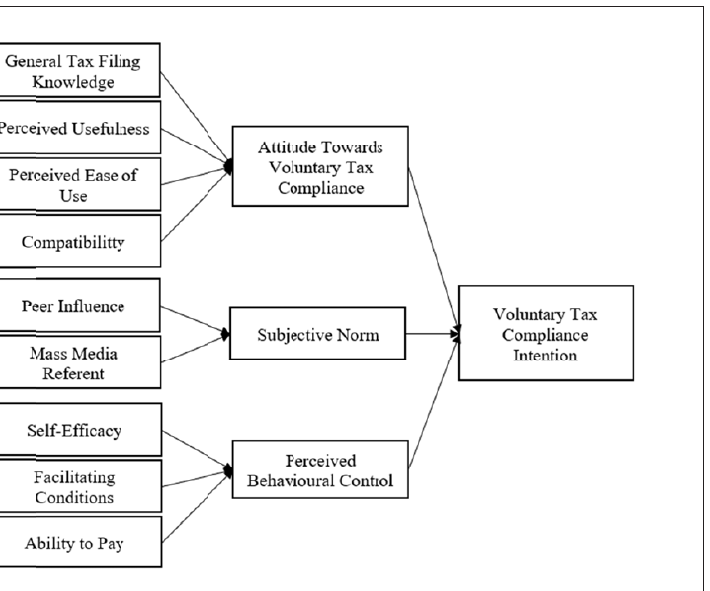
Tax compliance is very complex with many countries face serious problems toward maximising tax compliance rate (Oh & Lim, 2011). In providing efficient, convenient, and effective services, tax administrators have been improvising to accommodate taxpayers with the ease of submitting income tax return voluntarily. Many countries had adopted the Self-Assessment System (SAS) with Canada and United States as the earliest countries implementing in 1910s, Ireland in 1988, and New Zealand in 1988, also including Asian countries like Japan in 1947, Pakistan in 1979, and Indonesia in 1984 (Okello, 2014). However, it is still difficult for many tax administrators worldwide to motivate taxpayers toward voluntary compliance (James & Alley, 2004). Hence, tax administrators provide the options for taxpayers to comply voluntarily by way of manual or electronic forms. Although taxpayers have the option to file their income tax return forms either manually or electronically, many tax administrators focus on the usage of e-filing systems as the main tool to increase voluntary tax compliance rates. The e-filing system provides an efficient and effective way for taxpayers to voluntarily file their income tax return form conveniently. In 2017, there were a total of 5,536,265 registered active individual taxpayers (IRBM, 2018) with only 2,742,701 filing their tax return forms (Tax Operation Department, IRBM), of which 96.8% filed online through the e-filing system. The compliance rate was just 49.54% in terms of timely income tax return form submission, which is far from the maximum compliance rate. Even with the establishment of Section 112 of ITA 1967 as a serious offence under Schedule 2 of Anti-Money Laundering, Anti-Terrorism Financing and Proceeds of Unlawful Activities Act 2001 (AMLATFPUAA 2001) (IRBM, 2013) with a fine less than RM5 million or less than five years imprisonment or both, has not facilitate IRBM with an increase in compliance rate. Hence, compliance determinants should be further examined. Moreover, extensive studies on e-filing user acceptance are still insufficient to understand the behavioural issues of e-filing system, which is more important than just technological acceptance (Hung, Chang, & Yu, 2006). Hence, the aim of this study was to predict voluntary tax compliance intention among individual taxpayers in Malaysia. To examine the factors that would affect individual taxpayer’s intention to comply voluntarily toward filing income tax returns on timely basis, constructs were decomposed based on the Decomposed Theory of Planned Behaviour (DTPB) (Taylor & Todd, 1995b). In the study by Taylor and Todd (1995a), attitude, subjective norm, and perceived behavioural control are decomposed into multidimensional constructs to provide better intention predictive power. This study focused on decomposing the attitude construct with general tax knowledge, perceived usefulness, perceived ease of use, and compatibility, the subjective norm construct with peer influence and mass media referent, and perceived behavioural construct with selfefficacy, facilitating conditions, and ability to pay; towards voluntary tax compliance intention.
The objective of this study was to identify predictive power as well as the effect size of the competing theories utilised for tax compliance. Subsequent section discusses the use of variables in the study by first investigating other behaviour intention theory, such as TRA, TPB, and DTPB. The purpose of this paper was to investigate the predictive power of each of these theories in predicting voluntary tax compliance.
Literature Review
Theory of Reasoned Action
Theory of Reasoned Action (TRA) was founded by Ajzen and Fishbein (1980) in order to provide a solution for the limitations of the Expectancy Value Theory (EVT) originating from the field of psychology. The purpose of this theory is for the prediction of human behavioural a prediction of Fishbein attitude(1980) and behaviour. Theory of Reasonedintention Action (TRA) ( by providing was founded bby Ajzen an nd in order to This theory that individual’s determined by T) intentions which provideesuggested originatiing a solution for thean limi itations of th hebehaviour ExpectanncyisValue T Theory (EV from the field d of psycho ology. The p purpose of t this theory i is for the pr ediction of human beh havioural are influenced by individual’s attitude toward the behaviour and subjective norms intentioonthe by provid ding a pred diction of atttitude and & d that by an behaviour. This1980). theoryy suggested surrounding behaviour performance (Ajzen Fishbein, As defined individuual’s behav viour is dettermined by b intentionns which arre influenced by indiividual’s Fishbein and Ajzen (1975, p. 201), behavioural intention is “an individual’s subjective attitudee toward thee behaviourr and subjecctive normss surroundinng the behaaviour perfoormance probability he orn,she will perform a specified behaviour”. The diagram is an (Ajzen that & Fishbein 1980). A defined As b Fishbein by n and Ajzenn (1975, p.. 201),below behhavioural illustration of is the“an Theory of Reasoned Action (TRA): intentioon in ndividual’s subjective probability p y that he orr she will perform p a specified s behavioour”. The diiagram beloow is an illuustration of the t Theory of Reasoneed Action (T TRA):
Figure 1: Theory oReasoned Reasonedd Action Action (TR RA) Figure 1: Theory ofof (TRA) Source: A Ajzen and Fishhbein (1980)
Source: and Fishbein (1980) ab AsAjzen indicated in thee diagram bove (Figurre 1), both constructs c of o attitude and a subjectivve norm are seenn as unidim mensional measurement m ts of beliefss as well as the evaluattion of a behhaviour. This theeory is espeecially helpfful in explaiining intenttions in certain settingss, such as stuudies on AIDS-ppreventive behaviour b (F Fisher, Fish her, & Rye, 1995), brannd loyalty (Ha, ( 1998), coupon usage (Shimp & Kavas, K 19844), condom usage (Kasshima, Galllois, & McC Camish, 19993), fast food reestaurant paatronage deecisions (Bagozzi, Woong, Abe, & Bergamii, 2000), reecycling
As indicated in the diagram above (Figure 1), both constructs of attitude and subjective norm are seen as unidimensional measurements of beliefs as well as the evaluation of a behaviour. This theory is especially helpful in explaining intentions in certain settings, such as studies on AIDS-preventive behaviour (Fisher, Fisher, & Rye, 1995), brand loyalty (Ha, 1998), coupon usage (Shimp & Kavas, 1984), condom usage (Kashima, Gallois, & McCamish, 1993), fast food restaurant patronage decisions (Bagozzi, Wong, Abe, & Bergami, 2000), recycling behaviour prediction (Goldenhar & Connell, 1992), teen sexual behaviour (Gillmore et al., 2002), user acceptance of system usage (Liker & Sindi, 1997), as well as consumer motivation (Fitzmaurice, 2005). This theory is still fully adopted in recent studies on Goods and Services Tax (GST) compliance (Bidin & Mohd Shamsudin, 2013), cyberbullying (Doane, Kelley, & Pearson, 2016; Doane, Pearson, & Kelley, 2014), green information technology (Mishra, Akman, & Mishra, 2014), and digital piracy (Woolley, 2015). Despite the many contributions of this theory in explaining behaviour intentions, it is not without limitations. Both internal and external controlled factors are not accounted for in this theory. Examples like resources constraints and facilitating conditions are excluded. This theory may only be applicable under rational, thoughtful, and systematic behaviour (Kang, Hahn, Fortin, Hyun, & Eom, 2006) where under incomplete volitional control it is not influential. Hence the Theory of Planned Behaviour (TPB) was proposed as an alternative to providing a better explanation of an individual’s behaviour intentions. 2.2
Theory of Planned Behaviour (TPB)
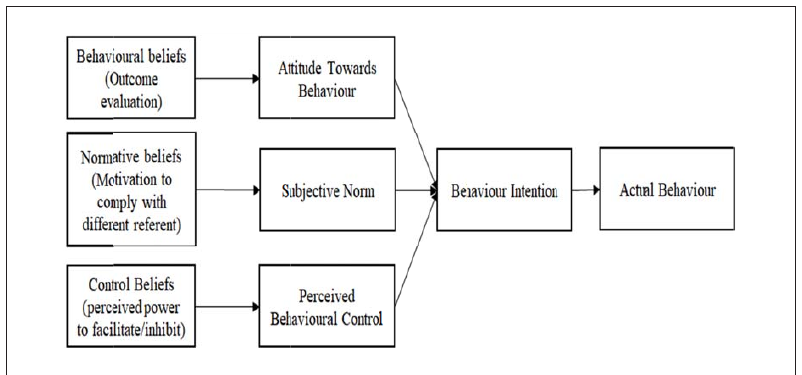
TPB was an extension to the Theory of Reasoned Action (TRA) that was adapted and adopted to explain and predict individual’s behaviour toward tax filing (Hastuti, Suryaningrum, Susilowati, & Muchtolifah, 2014; Hsu & Chiu, 2004b; Hung et al., 2006). Based on TPB, an individual’s action will be determined by their perception of control and intention, with individual’s intention being determined by attitude toward a behaviour including subjective norms as well as perceived behavioural control (Ajzen, 1991; Fishbein & Ajzen, 1975). As indicated in the diagram below (Figure 2), the constructs of attitude, subjective norm, and perceived behavioural control are seen as unidimensional measurements of beliefs as well as the evaluation of a behaviour. Numerous studies revealed the ability and applicability of TPB in various field of studies, which are useful toward understanding and predicting new technology acceptance (Ajzen, 2001). This suggests that TPB model is effective in explaining intention and behaviour of individuals toward adopting new technologies. As such, several past studies that adopted TPB model includes online tax filing (Ramayah, Mohd. Yusoff, Jamaludin, & Ibrahim, 2009), IS usage behaviour of post-merger employee
Suryaniingrum, Susilowati, & Muchtoliffah, 2014; Hsu H & Chiuu, 2004b; Hung H et al., 2006). Based oon TPB, an n individual’s action will w be deterrmined by their t percepption of conntrol and intentioon, with inndividual’s intention being b deterrmined by attitude tooward a beehaviour includinng subjectiv ve norms ass well as peerceived beehavioural control c (Ajzzen, 1991; Fishbein F DTPB as& a Better Voluntary Tax As Compliance Predictor - A Comparison 31-56 Ajzeen, 1975). A indicate d in the diagram Study: beloow (Figure 2), the connstructs of attitude, subjectiive norm, annd perceiveed behaviou ural control are seen as unidimensiional measuurements of belieefs as well as a the evaluaation of a beehaviour.
o Planned Behaviour B
undderstanding and prediccting new teechnology acceptance (Ajzen, 2001). This suggeests that TP PB model iss effective in i explainin ng intentionn and behavviour of d adopting new n technoloogies. As suuch, severall past studiees that adoptted TPB individuuals toward (Huang & Chuang, 2007), telemedicine technology acceptance by physicians (Chau model includes i on nline tax filiing (Ramayyah, Mohd. Yusoff, Jam maludin, & Ibrahim, 2009), IS & Hu,usage 2001), electronic brokerage services acceptance (Bhattacherjee, 2000),tecinternet hnology bbehaviour off post-merg er employe & Chuang, 2007), telem medicine e (Huang accepta ance by phy ysicians (C Chau &adoption Huu, 2001), e usage ofbrokerage b computerservices s resource accceptance banking acceptance (Khalil, 2005), andelectronic centre (Bhatta cherjee,1995b); 20000), intern et banking service acceptance e (Khalil, 2005), 2 (Hsuadop u usage of (Taylor & Todd, and electronic continuance &ption Chiu,and 2004b) as computter resourcee centre (Taaylor & Toddd, 1995b); and electroonic servicee continuannce (Hsu to cite&aChiu few examples. u, 2004b) as to cite a few w exampless.
Decomposed Theory of Planned Behaviour (DTPB)
D Decomposedd Theory of Planned P Beehaviour (D DTPB)
The Decomposed Theory ofofPlanned Behaviour is the extension by Taylor and Todd T P Planned Behhaviour is thhe extension by Taylorr and Todd (1995a) The Deecomposed Theory (1995a) derived by decomposing thestructu belief the TPB The . The model. consttructs thatthat waas was derived by b decompo osing the beelief ure structure of the TPB T ofmodel of constructs of attitude, subjec tive norm, as well as perceived behavioural control were decomposed into detailed belief constructs. All three main variables of TPB were decomposed to obtain clearer and easily understandable relationships of the three belief constructs. Furthermore, the decomposed constructs provide stable belief structures that are manageably relevant and can be easily applicable across variety of settings, which enables them to pinpoint the specific factors influencing adoption and usage (Lau, 2004). Several past studies examined DTPB model’s validity toward understanding behavioural intention (Hsu & Chiu, 2004a; Tao & Fan, 2017; Taylor & Todd, 1995a). Tao and Fan (2017) modified the DTPB model to study user’s intention on distance-based electronic toll collection services in Taiwan. However, there is limited tax research that utilise DTPB model in the studies. In Taiwan, Hung et al. (2006) utilised the DTPB model attitudee, subjec tivve norm, ass well as peerceived beehavioural control c werre decomposed into detailedd belief constructs. All three mainof variables o TPB were of decompossed n clearer Journal Business Management ande Accounting, Vol.to10obtain (2), July 2020: 31-56 and eassily undersstandable reelationshipss of the thhree belief constructs. Furthermore, the decompposed constrructs providde stable beelief structuures that aree manageably relevant and can be easilly applicable across variety of seettings, whiich enables them to piinpoint the specific taxpayer’s online tax filing and(LLau, payment factors influencing g adoption a usage and 2004). system (OTFPS) usage intention.
to study They found that all nine antecedents of perceived usefulness, trust, perceived risk, l past studiies examineed DTPB model’s m vaalidity towaard understaanding behhavioural perceived Several ease of use, compatibility, external influences, interpersonal influence, selfintentioon (Hsu & Chiu, C 2004aa; Tao & Fann, 2017; Taaylor & Tod dd, 1995a). Tao T and Fann (2017) efficacy and facilitating condition for personal significant modifie ed the DTP PB model toexcept study user’s inteention innovativeness on distance-bas d sed have electroonic toll in Taiwan. However, collection services there is lim mited tax research that utilise uin their DTPB B model influence towards users’ acceptance. The adoption of DTPB model study were s In Taiwan, T Huung et al. (22006) utilissed the DTP PB model to t study taxxpayer’s in the studies. able to explain 72% of and behavioural intention. It was found online ttax filing ataxpayers’ paymennt system (OTFPS) ( ussage intentiion. They also f found that allthat nine the use, anteceddents of perceived p higher total u usefulness, trust,asper rceived rissk, perceivved models ease of studied extended model provides variance compared to previous compatibility, extternal influuences, inteerpersonal influence, self-efficaccy and faccilitating by Mathieson (1991), Venkatesh, Morris, Davis, and (2003), conditio on except and for person nal innovati iveness hav ve signific ant Davis influennce towardssincluding users’ accepta ance. model The adoption a by Taylor off DTPB mToddin(1995a). theeir studyMeanwhile w were able to t inexplain 72% of the original DTPB andmodel Surabaya City, taxpayeers’ behavio oural intentiion. It was also found that the exxtended mod del provides higher Indonesia,total Hastuti et al. (2014) adapted the DTPB model with several extensions and vaariance as coompared to previous models m studiied by Mathhieson (19991), and Vennkatesh, modifications in Davis, their and study in(20 relation toding usage e-filing file anannual Morris, d Davis 003), includ the oriof iginal DTPB B system model byy to Taylor nd Todd tax ). Meanwhi ile in Surabbaya City, Indonesia, Hastuti et al.power (2014) adapted DTPB (1995a)found income. They that DTPB increases the predictive towardtheepredicting model w with severall extensionss and modiffications in their study in relation to usage off e-filing e-filing behavioural intention. system to file annnual tax inccome. They y found thaat DTPB in ncreases thee predictivee power toward predicting e-filing e behhavioural inttention.
PB) model
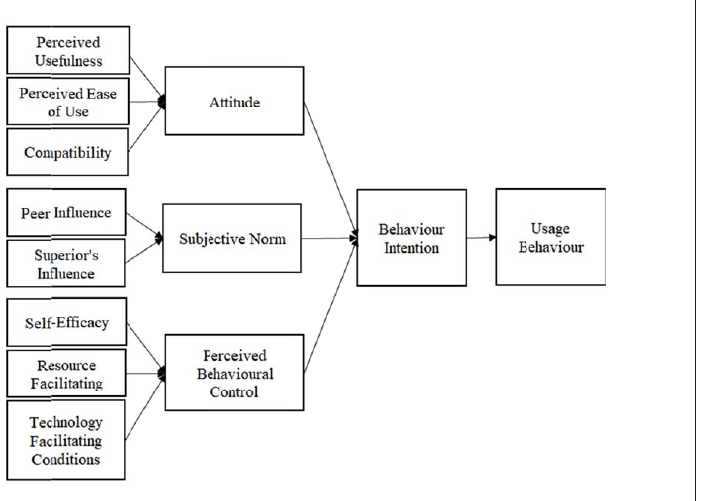
This study examined the voluntary tax compliance intention via e-filing system using a comprehensive theoretical model based on the decomposed TPB. Several rationales for using DTPB as the underpinning theory for this study are explained as follows. As the intention to comply voluntarily with tax laws using e-filing system is not entirely under the taxpayers’ control, the presence of constraints inhibits the taxpayers’ intention to perform a behaviour as well as the actual behaviour itself. Furthermore, taxpayers’ voluntary tax compliance behaviour can be affected by peer influence and mass media referent where subjective norm is an important behavioural determinant. Using mass media as referent, the taxpayers may have some basic tax knowledge toward complying tax laws voluntarily. However, there are some factors like self-efficacy, facilitating conditions, and ability to pay that may have impact on compliance behaviour. Nevertheless, DTPB is an appropriate model that provides a strong managerial implication for practitioners (Hastuti et al., 2014). Hence, this model can effectively elicit taxpayer’s compliance behaviour in the submission of income tax form via e-filing system through their salient belief structure while attaining factors that are stable, easy understandable, and managerially relevant.
Methodology
In comparing the behavioural theories, changes were made based on each theoretical framework. The DTPB model decomposed its constructs into several dimensions, while the other competing theories focuses on unidimensional constructs. As such, hypotheses were developed according to each original theoretical framework with measurements that were either grouped into each compatible construct or tested accordingly based on each decomposed dimension and construct. In this study, 12 hypotheses were developed based on the DTPB model. However, measurement items of the dimensions in DTPB model were grouped accordingly to test each variable of the TRA and TPB models. This was to obtain results based on similar measurement items for theoretical comparisons. Practically, it is tough to obtain responses from individuals that are non-compliant (Mckerchar, 2008). However, measures were taken to obtain responses from individuals working in Klang Valley. This study focused on individuals with employment income taxpayers who work in offices located in Klang Valley. In Malaysia, the total active registered taxpayers with employment income is 5,536,265 (IRBM, 2018). This study involved multi-layer clustered respondents where taxpayers were first defined as those working in large offices in Klang Valley. Then, only those individuals with Monthly Tax Deduction (MTD) in their payslip were selected. For the purpose of this study, 20 offices were identified for survey where softcopy of the survey form was provided to the representative of each office that was assigned to distribute among 100 employees with MTD in their payslip. In line with the popularity and escalation of web-based survey usage (Sax, Gilmartin, & Bryant, 2003), this study utilised the online survey. The online survey provides no significant biasness as compared to face-to-face interviews (Lindhjem & Navrud, 2011). Multi-layered cluster sampling was used to obtain a total number of 311 respondents. Before proceeding with the full-scale data collection, a pilot study was conducted in order to ascertain that the questions asked in the survey did indeed answer or address the research objectives stated. The pilot study was done as an Exploratory Factor Analysis (EFA) procedure in SPSS. After satisfying the criteria of validity and reliability for the pilot study, a new set of data was collected for further Confirmatory Factor Analysis (CFA). The data collected were then keyed into SPSS and further analysed in Smart PLS 3.2.8. The subsequent sections describe the results of the findings. The scales adapted for this study were from previous literature as well as the Inland Revenue Board of Malaysia (IRBM) website. The table below contains scale items obtained from past studies that were used in this study:
| Constructs | Total | Sources | Cronbach α |
|---|---|---|---|
| items | |||
| Intention (INT) | 3 | Taylor & Todd (1995a) | 0.91 |
| Attitude (ATT) | 4 | Taylor & Todd (1995a) | 0.85 |
| General Tax Filing Knowledge | 8 | IRBM website FAQ’s | NA |
| (GTFK) | |||
| Perceived Usefulness (PU) | 8 | Taylor & Todd (1995a) | 0.68 |
| Perceived Ease of use (PEOU) | 6 | Davis (1989) | 0.94 |
| Compatibility (COMP) | 6 | Taylor & Todd (1995a) | 0.82 |
| Peer influence (PI) | 6 | Taylor & Todd (1995a) | 0.92 |
| Subjective Norm (SN) | 4 | Taylor & Todd (1995a) | 0.88 |
| Mass media referents (MMR) | 9 | Md Husin & Ab Rahman (2016); Harrison (2009) | |
| Perceived Behavioural Control | 3 | Taylor & Todd (1995a) | 0.70 |
| (PBC) | |||
| Self-efficacy (SE) | 6 | Taylor & Todd (1995a) | 0.85 |
| Facilitating control (FC) | 9 | Taylor & Todd (1995b); Venkatesh, Chan, & Thong (2012) | 0.78 |
| Ability to pay (ATP) | 6 | Bidin & Md Idris (2009) | 0.90 |
Ability to pay (ATP)
Bidin & Md Idris (2009)
The conceptual framework of this study is as follows (Figure 4).
ual framewoork
Below ((Table 2) reepresents thee hypothesees of this stuudy.
Below (Table 2) represents the hypotheses of this study.
| Research hypotheses | ||||
|---|---|---|---|---|
| Hypoth | ||||
| hesis | summary | |||
| Hypothesissed Effect | Past Stuudies | |||
| Loo ete al. (2010)); Choong & Wong (20011); Mohd | ||||
| H1 | GTK | |||
| K -> ATT | ||||
| Tallahha et al. (20014) | ||||
| Hypothesis | ||||
| H2 | ||||
| Hypothesised | ||||
| PU -> | ||||
| - ATT | ||||
| Effect | Past Studies | |||
| Daviss (1989); Taaylor & Toddd (1995a) | ||||
| H3 | PEO | |||
| OU -> ATT | Loo etDavis | |||
| al. s(2010); | ||||
| (1989); Choong | ||||
| Taaylor &&Tod dd (1995a) | ||||
| Wong | (2011); | |||
| H1 H4 | GTK | |||
| COM-> ATT | ||||
| MP | -> ATT | Mohd Tallaha et al. (2014) athieson (19991) | ||
| Taylo or | & | Todd | ( 1995a); Ma | |
| Wartiick & Ruperrt (2010); Damayanti | ||||
| D | (2012); | |||
| H5 | PI -> | |||
| > SN | ||||
| H2 | PU -> ATT | DavisMohd | dali &Taylor | |
| (1989); | Pope (2012) | |||
| & Todd (1995a) | ||||
| Bhattacherjee (20000); Hsu and | a Chiu (20004a); Md | |||
| H3 H6 | MMR | |||
| PEOU R->->ATT | ||||
| SN | DavisHusin | |||
| (1989); | Taylor | |||
| n et al. | (2016)& Todd (1995a) | |||
| Banduura (1986); Ajzen (19991); Taylor & Todd | ||||
| H4 H7 | SE -> | |||
| COMP >-> | ||||
| PBC | ||||
| ATT | Taylor | & 5a); | ||
| (1995 Todd (1995a); Bhattac Mathieson herjee (20000) (1991) Bandu ura (1986); Ajzen (19991); Taylor Wartick & Rupert (2010); Damayanti & Todd (2012); | ||||
| H5 H8 PI FC -> PBC | ||||
| -> SN | (19955a); Bhattacherjee (20000) Mohdali & Pope (2012) | |||
| H9 ATP | ||||
| P -> PBC | Hite ((1997); Bidiin & Md Iddris (2009) | |||
| Hypothesis Hypothesised Effect | Past Studies Bhattacherjee (2000); Hsu and Chiu (2004a); | |||
| H6 MMR -> SN | ||||
| Md Husin et al. (2016) | Bandura (1986); Ajzen (1991); Taylor & Todd | |||
| H7 SE -> PBC | (1995a); Bhattacherjee (2000) Bandura (1986); Ajzen (1991); Taylor & Todd | |||
| H8 FC -> PBC | (1995a); Bhattacherjee (2000) | |||
| H9 ATP -> PBC | Hite (1997); Bidin & Md Idris (2009) Ajzen (1991); Taylor & Todd (1995a); | |||
| H10 ATT -> INT | Bhattacherjee (2000); Mathieson (1991) Ajzen (1991); Taylor & Todd (1995a); | |||
| H11 SN -> INT | Bhattacherjee (2000); Mathieson (1991) Ajzen (1991); Taylor & Todd (1995a); | |||
| H12 PBC -> INT | Bhattacherjee (2000); Mathieson (1991) |
Results and Findings
Since this study only focused on employment sourced income only, both respondents with business sourced income and those without MTD deductions were excluded from the collected data. As such, there were five respondents with employment and business income and three respondents without MTD deductions in their payslips, thus they were removed from the data pool. After removing these respondents, a total of 303 valid responses were used for further analysis. The software used for the data analysis process was SPSS and Smart PLS 3.2.8. The majority of respondents were aged between 35 and 44 (30%). There were no respondents for the 15-24 and >65 age categories as it was assumed that they are either still students or retired. From the 303 valid responses received, 73% were married and have a bachelor’s degree (60.4%). The total number of respondents in the private sector was 46.9%. From this, 71% only get their salary from employment. The respondents mostly filed their income tax via personal computer (52.8%) and laptop (35%). The respondents’ demographic details are summarised in Table 3. The scales used for this study had to be first tested for reliability and validity. As indicated in the table below, the scales recorded the reliability and validity above the threshold limit. The composite reliability for all scales were between 0.895 and 0.955, all of which are above the 0.7 threshold. The AVE values were all above the threshold of 0.5 (between 0.571 and 0.974).
| Details | Category | Frequency | Percentage |
|---|---|---|---|
| Age 15-24 | 0 | 0.0 | |
| 25-34 | 55 | 18.2 | |
| 35-44 | 91 | 30.0 | |
| 45-54 | 87 | 28.7 | |
| 55-64 | 70 | 23.1 | |
| >65 | 0 | 0.0 | |
| Total | 303 | 100 | |
| Marital Status Single | 64 | 21.1 | |
| Married | 221 | 73.0 | |
| Divorced | 18 | 5.9 | |
| Total | 303 | 100 | |
| Highest level of High School | 2 | 0.7 | |
| education Diploma/Certificate | 55 | 18.1 | |
| Bachelors | 183 | 60.4 | |
| Masters | 57 | 18.8 | |
| Ph.D./Doctorate | 6 | 2.0 | |
| Total | 303 | 100 | |
| Household income <RM5,000 | 0 | 0.0 | |
| per month RM5,001 – RM10,000 | 55 | 18.1 | |
| RM10,001 – RM15,000 | 72 | 23.8 | |
| RM15,001 – RM20,000 | 85 | 28.1 | |
| >RM20,001 | 91 | 30.0 | |
| Total | 303 | 100 | |
| Category of Private Sector | 142 | 46.9 | |
| Employment Government Linked Companies | 10 | 3.3 | |
| (GLC) | |||
| Government Servant (Under | 124 | 40.9 | |
| Public Service Pension Scheme) | |||
| Department/ Agencies Under | |||
| Government Ministries (Without | 27 | 8.9 | |
| Public Service Pension Scheme) | |||
| Total | 303 | 100 | |
| Details Category | Frequency | Percentage | |
| Sources of Income Salary from Employment only | 215 | 71.0 | |
| Combination of Salary & Other | 88 | 29.0 | |
| Non-Business Income (rental, | |||
| commission, etc.) | |||
| Combination of Salary & | 0 | 0.0 | |
| Business Income | |||
| Total | 303 | 100 | |
| Any Monthly Tax Yes | 303 | 100.0 | |
| Deduction (PCB) No | 0 | 0.0 | |
| in your salary | |||
| payslips? | |||
| Total | 303 | 100 | |
| How do you file Personal Computer | 160 | 52.8 | |
| your income tax Manual Form | 10 | 3.3 | |
| forms? PDA/ Smartphone/ Handphone | 27 | 8.9 | |
| Laptop | 106 | 35.0 | |
| Never Submit Form | 0 | 0.0 | |
| Total | 303 | 100 |
| Construct | Cronbach | Composite | Average |
|---|---|---|---|
| Alpha | Reliability | Variance | |
| Extracted (AVE) | |||
| Attitude (ATT) | 0.909 | 0.936 | 0.787 |
| General Tax Filing | 0.848 | 0.929 | 0.868 |
| Knowledge (GTFK) | |||
| Perceived Usefulness (PU) | 0.907 | 0.931 | 0.730 |
| Perceived Ease of Use | 0.923 | 0.940 | 0.721 |
| (PEOU) | |||
| Compatibility (COMP) | 0.933 | 0.947 | 0.749 |
| Subjective Norm (SN) | 0.928 | 0.949 | 0.822 |
| Peer Influence (PI) | 0.921 | 0.938 | 0.716 |
| Construct | Cronbach Alpha | Composite Reliability | Average Variance Extracted (AVE) |
| Mass Media Referent | 0.932 | 0.945 | 0.710 |
| (MMR) | |||
| Perceived Behavioural | 0.895 | 0.935 | 0.827 |
| Control (PBC) | |||
| Self-Efficacy (SE) | 0.898 | 0.936 | 0.831 |
| Ability to Pay (ATP) | 0.944 | 0.955 | 0.781 |
| Facilitating Condition (FC) | 0.843 | 0.895 | 0.682 |
| Voluntary Tax Compliance | 0.928 | 0.954 | 0.874 |
| Intention (INT) | |||
Most loadings have values of more than 0.40 and very close to 0.70. Hence, the indicators were not deleted as the values of AVE and composite reliability fell within the acceptable range. For indicators outside the acceptable range, they were deleted and this constituted the deletion of 19 items, namely GTK1, GTK3, GTK5, GTK6, GTK7, GTK8, PU1, PU2, PU5, MMR7, MMR8, SE1, SE2, SE3, FC1, FC3, FC4, FC5, and FC8. Amongst the objective of this study was to test the predictive accuracy and effect size of competing theories. The R2 was used to measure the model’s predictive accuracy. As a result, the R2 values were recorded the following indicators.
| Construct | TRA | TPB | DTPB |
|---|---|---|---|
| ATT | 0.382 | 0.325 | 0.543 |
| PBC | - | 0.650 | 0.685 |
| SN | 0.633 | 0.633 | 0.626 |
| INT | 0.467 | 0.493 | 0.492 |
DTPB
ATT
PBC
SN
INT
As indicated in Table 5 above, the R2 values improved significantly when the constructs were multidimensional, as it provided better explanatory power. The table indicated that the construct for attitude (ATT) reported a variance of 54.3% and perceived behavioural control (PBC) had a variance of 68.5% for DTPB. This indicated that these two constructs are better explained when they are measured multi-dimensionally. As for subjective norm (SN) and intention (INT) constructs, it seemed that unidimensional constructs provided a better explanatory power (63.3% variance for SN and 49.3% for
INT in TPB). For both TRA and TPB, it can be seen that INT variance improved for TPB due to the inclusion of the PBC construct (49.3% variance compared to 46.7% variance for TRA). Furthermore, the GoF for all models had good fit for the data. As seen in Table 6 below, DTPB has a better fit compared to TRA and TPB. DTPB has the fit index of 0.707106 whereas TPB and TRA have 0.676242 and 0.523682, respectively. This proves that DTPB is a better model to predict intentions as compared to TRA and TPB.
| TRA | TPB | DTPB | |
|---|---|---|---|
| R²ATT | 0.382 | 0.325 | 0.543 |
| R²INT | 0.467 | 0.493 | 0.492 |
| R²PBC | 0.650 | 0.685 | |
| R²SN | 0.633 | 0.633 | 0.626 |
| Average AVE | 0.554 | 0.827347 | 0.827376 |
| Total average | 1.047365 | 1.352483 | 1.414212 |
| GoF | 0.523682 | 0.676242 | 0.707106 |
DTPB
R²ATT
R²INT
R²PBC R²SN
Average AVE
Total average
GoF
As for hypothesis testing, it would seem that TRA does not provide a clear picture or explanation beyond the acceptance of the relationship of hypothesis, whereby p-values for all hypotheses were below 0.05. As such, TRA may not provide a clear prediction of individual voluntary tax compliance intention.
| Original | T Statistics (|O/ | ||
|---|---|---|---|
| Construct | P Values | ||
| Sample (β) | STDEV|) | ||
| ATT -> INT | 0.479 | 6.457 | 0.000 |
| PEOU + PU + GTK +COMP -> ATT | 0.618 | 15.488 | 0.000 |
| PI + MMR -> SN | 0.795 | 29.920 | 0.000 |
| SN -> INT | 0.252 | 3.437 | 0.001 |
As for hypothesis testing, the TPB model seems to provide a clearer picture or explanation due to the addition of the PBC construct into the model. In addition, all p-values for all relationships are significant except for the hypothesis of SN -> INT, which recorded the p-value > 0.05, as seen in Table 8 below.
| Original | |||
|---|---|---|---|
| T Statistics | |||
| Construct | Sample | P Values | |
| (|O/STDEV|) | |||
| (O) | |||
| ATP + SE + FC -> PBC | 0.806 | 25.465 | 0.000 |
| ATT -> INT | 0.382 | 4.129 | 0.000 |
| GTK + PEOU + PU + COMP -> ATT | 0.528 | 11.204 | 0.000 |
| PBC -> INT | 0.260 | 2.593 | 0.010 |
| PI + MMR -> SN | 0.795 | 29.605 | 0.000 |
| SN -> INT | 0.130 | 1.507 | 0.133 |
DTPB on the other hand provides a clearer explanation of the hypotheses of relationships. This clearer explanation is only possible because of the decomposition of the construct into multi-dimensional measures for the main constructs—ATT, SN and PBC. As seen in Table 9 below, the hypotheses for COMP -> ATT, PEOU -> ATT, SE -> PBC, and SN -> INT were not significant because of the p-values > 0.05. These results indicated a better explanation of the types of factors that actually play a role in influencing individual voluntary tax compliance intention.
| Original | T Statistics | ||
|---|---|---|---|
| Construct | P Values | ||
| Sample (O) | (|O/STDEV|) | ||
| ATP -> PBC | 0.202 | 2.003 | 0.046 |
| ATT -> INT | 0.380 | 4.411 | 0.000 |
| COMP -> ATT | 0.056 | 0.921 | 0.357 |
| FC -> PBC | 0.577 | 6.264 | 0.000 |
| GTK -> ATT | 0.435 | 5.879 | 0.000 |
| MMR -> SN | 0.461 | 6.252 | 0.000 |
| PBC -> INT | 0.260 Original | 2.504 T Statistics | 0.013 |
| Construct | Sample (O) | (|O/STDEV|) | P Values |
| PEOU -> ATT | -0.023 | 0.414 | 0.679 |
| PI -> SN | 0.378 | 5.169 | 0.000 |
| PU -> ATT | 0.344 | 4.383 | 0.000 |
| SE -> PBC | 0.097 | 1.550 | 0.122 |
| SN -> INT | 0.131 | 1.545 | 0.123 |
Discussion and Conclusion
The main purpose of this study was two-fold. Firstly, the main objective was to compare competing theories of intention in tax compliance settings. The purpose of comparing competing theories was to ascertain which of these theories provided better predictiveness and explanation for tax compliance intention. As indicated, the decomposition of main constructs into multi-dimension items provided better explanation and predictiveness of variables that influence individuals. The second objective was to ascertain if the items used in the data fit the constructs for the study. This was established with the use of GoF, and it was observed that DTPB was most fitting. These findings also provided some managerial implications. As indicated in the path analysis for DTPB, the hypotheses for COMP -> ATT and PEOU -> ATT relationships were not supported. This indicated that for attitudinal constructs, respondents felt that by filing income tax via e-filing platform, they are satisfied by the fast service provided as they were already aware of the implications of filing their taxes. The respondents were of the opinion that e-filing facilities should be more user friendly and compatible in order to facilitate and increase their satisfaction of the service provided. As such, it is recommended that IRB should relook at the userfriendliness of their site in order to encourage more individuals to file their taxes via e-filing. Another implication of this study is that individuals felt that the important people in their lives did not play a significant role in influencing them to file their taxes. However, interestingly the respondents acknowledged the use of mass media as reference to obtain information regarding income tax form submission. This could be an indication that, with the advancement of technologies, taxpayers may opt to use mass media. Also, filing of taxes via e-filing does not require self-confidence (self-efficacy) as a constraint to filing taxes via e-filing. Moreover, the majority of respondents only required very basic income tax form filing knowledge. Apart from very basic understanding of income tax form filing processes, most respondents just do not understand the tax laws or changes of tax laws, and their requirements. Taxpayers may opt for mass media as referents in obtaining relevant information, either as a reminder or informatively based on comments and highlights posted on mass media. However, in times of economic uncertainties or financial crisis, many would opt for deferment in tax payments. Since the e-filing system provides the advantage of filling and computing prior to declaration of tax liabilities, the amount of possible tax liabilities would detract taxpayers from filing their income tax forms immediately. Though taxpayers may acknowledge their tax liabilities, their ability to pay may cause deferment in income tax form submissions or worst still, tax evasion. Hence, taxpayers’ ability to pay taxes prior to income tax form submission plays an important role toward voluntary compliance. This study only focused on the employment income taxpayers. Future studies could utilise the DTPB model in providing better understanding and explanation toward tax compliance behaviour of other groups. In addition, cluster sampling could be used to understand each group of intended study. Future study could compare the behaviour of public and private sectors, gender-based behaviours, as well as between urban and suburban taxpayers. In conclusion, the DTPB model can be flexible, provide better explanation, and easy to understand as well as have better predictiveness which is applicable throughout various fields of studies.
Acknowledgement
The authors would like to thank the supervisors, UUM lecturers and anonymous reviewers of Journal of Management Business and Accounting (JMBA). The authors would also like to give special thanks to the Institute for Management & Business Research (IMBRe) – UUM for the opportunity towards the publication of this article. Special appreciation also extended to all related parties involved in the research study.
References
- Ajzen, I. (1991). The Theory of Planned Behavior. Organizational Behavior and Human Decision Processes, 50, 179-211.
- Ajzen, I. (2001). Nature and Operation of Attitudes. Annual Review of Psychology, 52, 27-58.
- Ajzen, I., & Fishbein, M. (1980). Understanding attitudes and predicting social behavior. Englewood Cliffs, NJ: Prentice-Hall.
- Bagozzi, R. P., Wong, N., Abe, S., & Bergami, M. (2000). Cultural and situational contingencies and the theory of reasoned action: Application to fast food restaurant consumption. Journal of Consumer Psychology, 9(2), 97-106. https://doi.org/10.1207/S15327663JCP0902
- Bandura, A. (1986). Social foundations of thought and action: A social-cognitive view. Englewood Cliffs, NJ: Prentice Hall.
- Bhattacherjee, A. (2000). Acceptance of E-commerce services: The case of electronic brokerages. IEEE Transactions on Systems, Man, and Cybernetics Part A: Systems and Humans., 30(4), 411–420. https://doi.org/10.1109/3468.852435.
- Bidin, Z., & Md Idris, K. (2009). Sikap, norma subjektif dan kawalan gelagat ditanggap terhadap niat gelagat kepatuhan zakat pendapatan gaji. International Journal of Management Studies, 16(1), 31–55. Retrieved from http://repo.uum.edu.my/3/1/ ijms1612.pdf
- Bidin, Z., & Mohd Shamsudin, F. (2013). Using theory of reasoned action to explain taxpayer intention to comply with Goods and Services Tax ( GST ) School of Accounting, College of Business, Othman Yeop Abdullah Graduate School of Business. Middle-East Journal of Scientific Research, 17(3), 387-394. https://doi.org/10.5829/idosi.mejsr.2013.17.03.12167
- Chau, P. Y. K., & Hu, P. J.-H. (2001). Information technology acceptance by individual professionals: A model comparison approach. Decision Sciences, 32(4), 699–719.
- Choong, K. F., & Wong, E. S. K. (2011). A study on self-assessment tax system awareness in Malaysia. Australian Journal of Basic and Applied Sciences, 5(7), 881–888. Retrieved from http://ajbasweb.com/old/ajbas/2011/July-2011/881-888.pdf
- Doane, A. N., Kelley, M. L., & Pearson, M. R. (2016). Reducing cyberbullying: A theory of reasoned action-based video prevention program for college students. Aggressive Behavior, 42, 136–146. https://doi.org/10.1002/ab.21610
- Doane, A. N., Pearson, M. R., & Kelley, M. L. (2014). Predictors of cyberbullying perpetration among college students: An application of the theory of reasoned action. Computers in Human Behavior, 36, 154–162.
- Fishbein, M., & Ajzen, I. (1975). Belief Attitude, Intention and Behavior. An Introduction to Theory and Research. Reading, Massachusetts: Addison-Wesley Publishing Company.
- Fisher, W. A., Fisher, J. D., & Rye, B. J. (1995). Understanding and promoting AIDS-preventive behavior: Insights from the theory of reasoned action. Health Psychology, 14(3), 255–264.
- Fitzmaurice, J. (2005). Incorporating Consumers’ Motivations into the Theory of Reasoned Action. Psychology & Marketing, 22(11), 911–929. https://doi.org/10.1002/mar.20090
- Gillmore, M. R., Archibald, M. E., Morrison, D. M., Wilsdon, A., Wells, E. A., Hoppe, M. J., Murowchick, E. (2002). Teen sexual behavior: Applicability of the theory of reasoned action. Journal of Marriage and Family, 64(4), 885-897.
- Goldenhar, L. M., & Connell, C. M. (1992). Understanding and predicting recycling behavior: an application of the theory of reasoned action. Journal of Environmental Systems, 22(1), 91-103. https://doi.org/10.2190/92KU-NXLT-XC32-RHD6
- Ha, C. L. (1998). The theory of reasoned action applied to brand loyalty. Journal of Product & Brand Management, 7(1), 51–61.
- Harrison, K. (2009). The Multidimensional Media Influence Scale: Confirmatory factor structure and relationship with body dissatisfaction among African American and Anglo American children. Body Image, 6(3), 207–215. https://doi.org/10.1016/j. bodyim.2009.04.001
- Hastuti, S., Suryaningrum, D. H., Susilowati, L., & Muchtolifah. (2014). Implementation of decomposed theory of planned behavior on the adoption of e-filling systems taxation policy in Indonesia. Expert Journal of Business and Management, 2, 1–8.
- Hite, P. A. (1997). An investigation of moral suasion and vertical equity arguments on intended taxpayer noncompliance. Law and Policy, 19(1), 1–22. https://doi.org/10.1111/1467-9930.00019
- Hsu, M.-H., & Chiu, C.-M. (2004a). Internet self-efficacy and electronic service acceptance. Decision Support Systems, 38, 369–381. https://doi.org/10.1016/j. dss.2003.08.001
- Hsu, M.-H., & Chiu, C.-M. (2004b). Predicting electronic service continuance with a decomposed theory of planned behaviour. Behaviour & Information Technology, 23(5), 359–373. https://doi.org/10.1080/01449290410001669969
- Huang, E., & Chuang, M. H. (2007). Extending the theory of planned behaviour as a model to explain post-merger employee behaviour of IS use. Computers in Human Behavior, 23, 240–257. https://doi.org/10.1016/j.chb.2004.10.010
- Hung, S.-Y., Chang, C.-M., & Yu, T.-J. (2006). Determinants of user acceptance of the e-Government services: The case of online tax filing and payment system. Government Information Quarterly, 23(1), 97–122. https://doi.org/10.1016/j. giq.2005.11.005
- IRBM, (2013). Tax Investigation Framework - Effective 1 October 2013.
- IRBM, (2018). Annual Report 2017. Kuala Lumpur.
- James, S., & Alley, C. (2004). Tax Compliance, Self-Assessment and Tax Administration. Journal of Finance and Management in Public Services, 2(2), 27–42.
- Kang, H., Hahn, M., Fortin, D. R., Hyun, Y. J., & Eom, Y. (2006). Effects of Perceived Behavioral Control on the Consumer Usage Intention of E-coupons. Psychology & Marketing, 23(10), 841–864. https://doi.org/10.1002/mar
- Kashima, Y., Gallois, C., & McCamish, M. (1993). The theory of reasoned action and cooperative behaviour: It takes two to use a condom. British Journal of Social Psychology, 32, 227–239.
- Khalil, M. N. (2005). An empirical study of internet banking acceptance in Malaysia: an extended decomposed theory of planned behaviour. Southern Illinois University, Carbondale.
- Lau, A. S. M. (2004). Strategies to encourage the adoption of G2C e-government services in Hong Kong. Electronic Government, 1(3), 273–292.
- Liker, J. K., & Sindi, A. A. (1997). User acceptance of expert systems: a test of the theory of reasoned action. Journal of Engineering and Technology Management, 14(2), 147–173.
- Lindhjem, H., & Navrud, S. (2011). Are Internet surveys an alternative to face-to-face interviews in contingent valuation? Ecological Economics, 70(9), 1628–1637. https://doi.org/10.1016/j.ecolecon.2011.04.002
- Loo, E. C., Evans, C., & Mckerchar, M. (2010). Challenges in Understanding Compliance Behaviour of Taxpayers in Malaysia. Asian Journal of Business and Accounting, 3(2), 101–118.
- Mathieson, K. (1991). Predicting User Intentions: Comparing the Technology Acceptance Model with the Theory of Planned Behavior. Information Systems Research, 2(3), 173–191.
- Mckerchar, M. (2008). Philosophical Paradigms, Inquiry Strategies and Knowledge Claims: Applying the Principles of Research Design and Conduct to Taxation. EJournal of Tax Research, 6(1), 5–22.
- Md Husin, M., & Ab Rahman, A. (2016). Predicting intention to participate in family takaful scheme using Decomposed Theory of Planned Behaviour. International Journal of Social Economics, 43(12). https://doi.org/10.1177/0020764008093373
- Md Husin, M., Ismail, N., & Ab Rahman, A. (2016). The roles of mass media, word of mouth and subjective norm in family takaful purchase intention. Journal of Islamic Marketing, 7(1). https://doi.org/10.1108/JIMA-03-2015-0020
- Mishra, D., Akman, I., & Mishra, A. (2014). Theory of Reasoned Action application for Green Information Technology acceptance. Computers in Human Behavior, 36, 29–40. https://doi.org/10.1016/j.chb.2014.03.030
- Mohd Tallaha, A., Abdul Shukor, Z., & Abu Hassan, N. S. (2014). Factors influencing e-filing usage among Malaysian taxpayers: Does tax knowledge matters? Jurnal Pengurusan, 40, 91–101. https://doi.org/10.17576/pengurusan-2014-40-08
- Mohdali, R., & Pope, J. (2012). The effects of religiosity and external environment on voluntary tax compliance. New Zealand Journal of Taxation Law and Policy, 18(June), 119–139.
- Oh, T. H., & Lim, M. S. (2011). Intention of tax non-compliance-examine the gaps. International Journal of Business and Social Science, 2(7), 79.
- Okello, A. (2014). Managing income tax compliance through self-assessment. IMF Working Paper, 41(March), 4–32.
- Ramayah, T., Mohd. Yusoff, Y., Jamaludin, N., & Ibrahim, A. (2009). Applying the theory of planned behavior (TPB) to predict internet tax filing intentions. International Journal of Management, 26(2), 272–284.
- Sax, L. J., Gilmartin, S. K., & Bryant, A. N. (2003). Assessing Response Rates and Nonresponse Bias in Web And Paper Surveys. Research in Higher Education, 44(4), 409–432.
- Shimp, T. A., & Kavas, A. (1984). The theory of reasoned action applied to coupon usage. Journal of Consumer Research, 11(3), 795–809.
- Tao, C. C., & Fan, C. C. (2017). A modified decomposed theory of planned behaviour model to analyze user intention towards distance-based electronic toll collection services. Promet-Traffic &Transportation, 29(1), 85–97. https://doi.org/10.7307/ ptt.v29i1.2076
- Taylor, S., & Todd, P. A. (1995a). Decomposition and crossover effects in the theory of planned behavior: A study of consumer adoption intentions. International Journal of Research in Marketing, 12(2), 137–155.
- Taylor, S., & Todd, P. A. (1995b). Understanding information technology usage: A test of competing models. Information Systems Research, 6(2), 144–176. https://doi.org/10.1287/isre.6.2.144
- Venkatesh, V., Chan, F. K. Y., & Thong, J. Y. L. (2012). Designing e-government services: Key service attributes and citizens’ preference structures. Journal of Operations Management, 30(1–2), 116–133. https://doi.org/10.1016/j. jom.2011.10.001
- Venkatesh, V., Morris, M. G., Davis, G. B., & Davis, F. D. (2003). User Acceptance of Information Technology: Toward a Unified View. MIS Quarterly, 27(3), 425–478.
- Wartick, M. L., & Rupert, T. J. (2010). The effects of observing a peer’s likelihood of reporting income on tax reporting decisions. Advances in Taxation, 19, 65–94. https://doi.org/10.1108/S1058-7497(2010)0000019005
- Woolley, D. J. (2015). Two issues to consider in digital piracy research: The use of Likert-like questions and the theory of reasoned action in behavioral surveys. Journal of Legal, Ethical and Regulatory Issues, 18(3), 63–68.