The Relationship between Technology, Financial and Location Strategies and Customer Relationship Management Performance among Logistics Service Providers
- Universiti Sultan Azlan Shah
Journal of Business Management and Accounting 9(1) (2019) · https://doi.org/10.32890/jbma2019.9.1.10059
Abstract
Small and medium enterprises (SMEs) are playing an increasingly important role in sustaining economic growth and logistic system in Malaysia. The objective of this study is to investigate the relationship between technology, financial and location strategy and customer relationship management performance. The population of this study consist of customers of three logistic companies in Penang, Selangor and Johor Bharu. Simple random sampling method was used from the target population. A total of 391 respondents consisting of individuals who are consumers of the logistic services offered by the companies answered the questionnaires. Findings from the study has important managerial implications as it will enable management of SMEs to understand the progressive and highly varied CRMP practices and contextual factors that contribute to CRMP as well as effective, efficient and innovative implementation. The study concludes that customer satisfaction is a significant component of CRMP.
Keywords: CRMP, technology, financial, location strategy, SMEs
Objectives of the study
The objectives of this study are as follow: 1)
To investigate the effect of critical technology strategy on Customer Relationship Management Performance of SME’s.
To investigate the effect of critical financial strategy on Customer Relationship Management Performance of SME’s.
To investigate the effect of critical location strategy on Customer Relationship Management Performance of SME’s.
2.0Customer Relationship Management Performance
Researchers believe that CRM performance should be measured in terms of customer behaviours since customers are the underlying source of value for a company and have the potential to increase the future revenue streams (Shah et al., 2017). At the same time, Shah et al. (2016) added that in business, competition is sure to arise because we are not alone in the market and are not the only one who want to earn a living. Some young entrepreneurs are accustomed to selling regular products or services. The similarity of our products with others narrows our market (Shah et al., 2018). Many young entrepreneurs, especially those who are new in their businesses, are unable to survive the competition. Therefore, entrepreneurs need to be creative and innovative to make their products and service unique and with value added. Although products could be basically the same, the added value needs to be present so that the products and services can sell and attract customers (Wahab et al., 2017). Customer loyalty is the key objective of customer relationship management and describes the loyalty which is established between a customer and companies, persons, products or brands. Individual market segments should be targeted in terms of developing customer loyalty (Singh 2015). 2.1
Technology Strategy
To stimulate economic growth, many economic policies focus on support to companies of a specific size, generally small and medium enterprises (SMEs), new start-ups, and of specific sectors, such as IT and other high-tech industries. Such policies also incentivize specific activities, such as research and development as well as technology innovation, and measure success by the number of patents filed and approved (Shah et al., 2017). The authors discuss the shortcomings of this approach to policy making and propose another approach based on the blue ocean strategy. Based on customers’ responses to questions on evaluating specific aspects of their relationship with the company, a loyalty profile of customers can be created. Loyalty segments categorize customers as loyal, neutral and vulnerable (Rizwan et al., 2014). According to Rana, Osman and Othman (2015), the basis for loyalty segmentation should be sufficiently flexible so that it recognizes and accounts for the uniqueness and special challenges of any one business or organization as well as the environment in which it competes. Business success means having desirable customers who are strongly tied to the organization. A company should monitor the number and percentage of customers in the loyal segment and do what it takes to increase their loyalty while decreasing the number of those that are vulnerable (Shah et al., 2018). 2.2
Financial Strategy
According to Shah et al. (2017), customers switching to another company would lead to the company facing economic disadvantages. In this case, loyalty is based on financial and economic grounds. Communication and engaging with customers effectively ensures that companies are seen as reliable and will help to build trust in what service providers will offer (Shah et al., 2016). The best way to build reliability with customers is not only to start strong but to finish strong as well. This is supported by Muslimin, Suryadi Hadi and Ardiansyah (2015). It is challenging to measure the level of customer loyalty within the relationship, which is why companies so often succumb to simply defining loyalty as the number of purchases made or a continuing pattern of buying behaviour. Hence, by asking the customers directly about whether they are ‘loyal’ or not, may not provide a valid measure. Customers will often say they are loyal simultaneously to multiple providers.
Consequently, the pivotal role of Customer Relationship Management Performance in increasing loyalty of profitable customers is very important for most service companies (Kavaliauskienėa et al., 2014). 2.3
Location Strategy
Location is to recommend products and services to others and to continue purchasing of products and services (Agboyi et al., 2015). Products and services that are superior to others offered in the market place influence purchasing motivation and intention to buy. This shows that intentions of consumer is influenced by motivation and purchase directly related to location. Therefore, consumer buying interest is influenced by location directly (Shah et al., 2017). This is in line with a number of previous research. Customer Relationship Management is expected to reduce the transaction costs by adapting the interaction to the kind of answer expected by the client to encouraged loyalty in location strategy. 3.0
Theoretical Background for the Models
CRM evolved from business processes such as relationship marketing and the increased emphasis on improved customer retention through the effective management of customer relationships (Bakar et al., 2014). Therefore, the model below presents and supports the idea of previous authors on the importance of technology and business process in implementing Customer Relationship Management in the organization.
1. A Customer Relationship Management implementation model
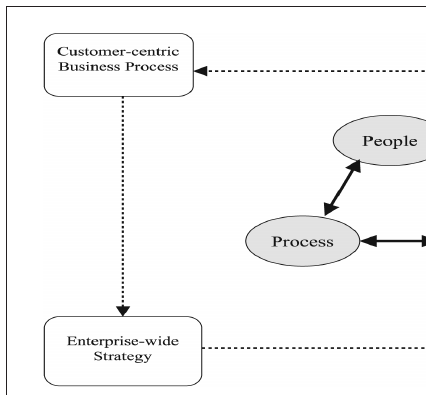
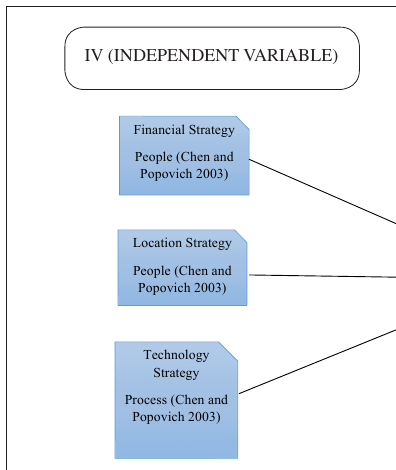
As mentioned in the previous paragraph, technology is one of the pillars of successful Customer Relationship Management. This growing concern in technology anchored in the service economy where Customer Relationship Management Performance implementation offer multiple opportunities to deal with service characteristics like intangibility, inseparability, heterogeneity and perishability (Shah et al.,2018). CRM is expected to contribute to existing or new relationships. Services are delivered through processes and their use is very often dissociated from the purchasing process. Rather than having a transaction for each purchase, the interaction with customers encompasses acts, episodes and sequences, the whole process resulting into a relationship. In such systems, what matters is the established long-term relationship and consequently the coordinated contribution of all interactions to this relationship building. Abu Bakar et al. (2014) and Zakaria et al. (2014) state that customer relationship management has the potential to facilitate the customization of the offerings by gathering and processing available information on customers with the purpose of increasing their loyalty. Technology innovations will enable the company to respond with timely and effective customized communications, deliver product and service value to individual customers (Shah et al., 2018). The current research model proposes a technology, financial and location strategy as the determinants of Customer Relationship Management Performance models for SMEs in Malaysia. The complete models proposed are as follows: Theoretical Framework Theoretical Framework
IV (INDEPENDENT VARIABLE) -%!&-*$'('*$'*+!%),-)./'0!
DV (DEPANDANT VARIABLE) $%!&$'()*$)*+!%),-)./'0!
Financial Strategy People (Chen and Popovich 2003)
Customer Relationship Management Performance
Location Strategy People (Chen and Popovich 2003)
Technology Strategy Process (Chen and Popovich 2003)
Hypotheses Development
Past research has investigated the role of supplier value in behaviour intention. There is a positive relationship between supplier value factor and behaviour intention. Beside the intention to repurchase (Shah et al., 2017), it was also found to influence customer satisfaction (Shah et al., 2017), and on online purchasing intention (Rizwan et al., 2014). Therefore, this study hypothesize that: Hypothesis: 1) There is a relationship between technology strategy factor and Customer Relationship Management Performance. 2) There is a relationship between location strategy factor and Customer Relationship Management Performance. 3) There is a relationship between financial strategy factor and Customer Relationship Management Performance. 3.2
Methodology
This research seeks to find correlation between the three independent variables and the dependent variable. Likert Scale Questionnaire survey was carried out for this research and distributed to the respondents. Furthermore the population of this study are either target groups or individuals who are customers of the organizations. The customers use logistic services provided by the companies. The target population of this study was three hundred and ninety one individual customers from Pulau Pinang, Selangor and Johor Bharu of x, y and z organization. According to Hair et al. (2006), the number of respondents in research should be more than forty.
4.0Research Finding
| Mean crmp | Pearson Correlation Sig. (2-tailed) N | 1 391 |
| MEAN_FINANCE | Pearson Correlation Sig. (2-tailed) N | .549 .000 391 |
| MEAN_LOCATION | Pearson Correlation Sig. (2-tailed) N | .590 .000 391 |
| MEAN_TECHNOLOGY | Pearson Correlation Sig. (2-tailed) N | .586 .000 391 |
| *. Correlation is significant at the 0.05 level (2-tailed). | ||
| **. Correlation is significant at the 0.01 level (2-tailed). |
*. Correlation is significant at the 0.05 level (2-tailed). **. Correlation is significant at the 0.01 level (2-tailed).
Correlation Analysis Result
In this study findings on location are significant and individual customers prefer satisfaction of location to technology and finance variables. In terms of location, customers prefer geographic and create loyalty impact for logistic services. Referring to the correlation analysis in Table 1, correlation factor of Customer Relationship Management Performance with Financial is 0.549. According to Sekaran (2013), the correlation value between predictors variable and dependent variable must below 0.75. That means financial factor is a predictor of Customer Relationship Management Performance. The correlation factor for Customer Relationship Management Performance with location is 0.590. According to Sekaran (2013) the correlation value between predictors variable and dependent variable must below 0.75. That means location factor is a good predictor of Customer Relationship Management Performance. Additionally, according to correlation analysis result, the correlation factor for Customer Relationship Management Performance with technology is 0.586. According to Sekaran (2013), the correlation value between predictors variables and dependent variable must be below 0.75. That means technology factor is a good predictor of Customer Relationship Management Performance. It means that technology strategy is correlated with logistic firm performance. The significant value is 0.000 which is less than 0.05. For that reason, there is a significant relationship between technology strategy and customer relationship management performance which supports the findings of previous studies (Shah et al., 2016; Shah et al., 2017; Shah et al., 2018; Bavarsad et al., 2013; Zakaria et al., 2014; Shafique et al., 2015; Richard et al., 2015; Muslimin et al., 2015; Martaleni, 2017).
5.0Conclusion
The findings of this research indicated that all of the variables have significant relationships with firm performance. Thus, this shows that companies need to be innovative from time to time to encourage growth (Shah et al., 2017). The current understanding of how aggregated customer relationship management performance attitudes are influenced by important business outcomes is limited. Based on the evidence to date, researchers conclude that technology in today’s business marketplace, is essential. Therefore, service providers should embrace the tools and systems available to them from a technology standpoint. With ever increasing technological capabilities and standards, great technology is available at a fraction of the price for most logistic service providers. Technology marketing systems has an array of partners and referrals for literally every element of customer relationship management related to technology (Shah et al., 2016). Research efforts directed at further exploring these issues are sorely needed, and researcher believe there is potential for longitudinal research in the area of aggregated customer relationship management and performance satisfaction. Future studies should define CRMP construct from wider and diverse perspectives by encompassing the above dimensions. Finally, in terms of theoretical contributions, this study is mainly concerned with the CRMP field. In short, the study includes a more thorough explanation of information sharing, strategic supplier partnership, customer relationship, material flow management, corporate culture in SMEs’ CRMP practices. Previous research has explored the role of customer value in technology, financial and location. There is a positive relationship between technology, financial, location and customer relationship management performance (Shah et al., 2016; Shah et al.,2017; Shah et al., 2018; Martaleni, 2017; Muslimin et al., 2015; Sanjit Singh 2015; Kavaliauskienėa et al., 2014; Zuraimi et al., 2013). The findings of this research has shown that technology and other strategic variables have significantly helped entrepreneurs in logistic firms to improve performance. Acknowledgements Researcher are grateful to Jabatan Penyelidikan dan Perundingan, Universiti Sultan Azlan, Kuala Kangsar, Perak Darul Ridzuan for awarding the grant for the research.
References
- A. A. Zuraimi, Mohd Rafi Yaacob & Mohamed Dahlan Ibrahim (2013). Logistics development in Malaysia east coast region: Infrastructure, constraints and challenges. International Journal of Trade, Economics and Finance, 4(5), 325–330.
- Belghis Bavarsad & Gholamhossein Hosseinipour (2013). Studying the factors affecting the Customer Relations Management (CRM) in Marun Petrochemical Company. Interdisciplinary Journal of Contemporary Research in Business, 4(11), 845 -857.
- Chen & Popovich (2003). Understanding Customer Relationship Management (CRM). Business Process Management Journal, 5, 672-688.
- H.Sanjit Singh (2015). The effect of satisfaction on customer loyalty in logistics outsourcing relationships. ASM’s International E-Journal on Ongoing Research in Management and IT. 228-241. E-ISSN-2320-0065.
- Hair, J. F., Black, W. C., Babin, B. J. & Anderson, R. E. (2010). Multivariate data analysis. A Global Perspective. 7th ed.New Jersey: Pearson Education Inc.
- Ieva Meidutė-Kavaliauskienėa, Artūras Aranskisa and Michail Litvinenko (2014). Consumer satisfaction with the quality of logistics services. J.Social and Behavioral Sciences, 110, 330–340. Ibrahim Zakaria, Baharom Ab. Rahman, Abdul Kadir Othman, Noor Azlina Mohamed Yunus, Mohd Redhuan Dzulkipli & Mohd Akmal Faiz Osman (2014). The relationship between loyalty program, customer satisfaction and customer loyalty in retail industry: A Case Study. Social and Behavioral Sciences, 129, 23–30.
- Martaleni (2017). Loyalty program strategy of Garuda Indonesia flight service. Journal of International Business Management, 11(3), 767-772. ISSN:1993-5250. Muhamad Fairos Mohamad Shah, Samsudin Wahab & M. Hussin Abdullah (2018). Characterising of customer relationship management and corporate entrepreneurship: A Case Study in a Malaysia logistic service. The 5th IBSM International Conference on Business, Management and Accounting. Paper Code: M13–136.145-153.
- Muhamad Fairos Mohamad Shah, Anas Tajudin & Samsudin Wahab (2018). The association of financial strategy characteristic on customer relationship management performance characteristic: An actual study among SME’s logistic operators. International Journal of Research in Management & Social Science, 6(2), 11-16, (IV): April - June, 2018. ISSN 2322–0899.
- Muhamad Fairos Mohamad Shah, Samsudin Wahab & Anas Tajudin (2018). The contributing future trends in education of financial strategy on customer relationship management performance characteristic: A pilot study among SME’s logistic operators. International Conference on the Future of Education, 183(D20)114, ISSN 1985-1731. Retrieved from http://www.iconfed 2018.my.
- Muhamad Fairos Mohamad Shah, Samsudin Wahab & Mohd Subri Tahir (2017). The contributing factor of technology strategy on customer relationship management performance: A pilot study among SME’s logistic operators. The 4th World Conference on Islamic Thought and Civilization. Journal of Thaqafah., 147-154. Retrieved from http://www.wcit.my.
- Muhamad Fairos Mohamad Shah, Samsudin Wahab & Norhayati Hussin (2017). The contributing factors of business process strategy on customer relationship management performance: A pilot study among SME’s logistic operator. 3rd International Conference on Information Science. The Journal of Services Marketing; 006;22. Retrieved from http://www.ipneducationgroup.org/.
- Muhamad Fairos Mohamad Shah & Samsudin Wahab (2017). The contributing factors of location strategy on customer relationship management performance: A pilot study among SME’s logistic operators, National Conference on Creativity in Education and Humanities. Journal of Economics, Business and Management. OP54. Retrieved from http://www.ncc2017.usm.my/.
- Muhamad Fairos Mohamad Shah & Samsudin Wahab (2017). The mediating effect of customer intention toward customer relationship management performance among Malaysia logistic service industries. International Conference Islam Borneo (X), International Journal of Entrepreneurial Behaviour & Research. (Ekp 007). Retrieved from://www.kaib.com.my/
- Muhamad Fairos Mohamad Shah, Samsudin Wahab & Mohd Subri Tahir (2016). The determinant of supplier 2 customer relationship management performance model for SMEs International Conference on Post Graduate Education (ICPE-7). Journal of Information, Knowledge and Management. T02, 47(36), 1284-1293. Retrieved from http://www.ipsis.uitm.edu.my/icpe7//.
- Muhamad Fairos Mohamad Shah, Samsudin Wahab & Mohd Subri Tahir (2016). Customer-Supplier relationship management performance model for SMEs: The integration of financial and technology strategy. Advances in Business Research International Journal. 2(2), 567. Retrived from:www.abric2016.uitm.edu.my/
- Muhamad Fairos Mohamad Shah, Samsudin Wahab & Mohd Subri Tahir (2016). Customer-supplier relationship management performance model for SMEs: Missing link between logistic and business intermediaries. ASEAN Entrepreneurship Journal AEJ, 2(2), 16-26, (ISSN 2289-2125). Retrieved from http://aej.uitm.edu.my/ Muhammad Nouman Shafique, Naveed Ahmad, Haider Abbas & Alamdar Hussain (2015). The impact of customer relationship management capabilities on organizational performance: Moderating role of competition intensity, Arabian Journal of Business and Management Review (Nigerian Chapter), 3(3), 28-47.
- Muslimin, Suryadi Hadi & Ardiansyah (2015). The relationship between logistics and financial performance of SMEs in Indonesia. Journal of Marketing, 13(7), 4805-4814. Retrieved from http://I J A B E R/
- Makafui R. Agboyi & David Ackah (2015). The impact of warehousing on customer satisfaction. World Wide Journal of Multidisciplinary Research and Development. 9-20. Mohd Azlan Abu Bakar, Harlina Suzana Jaafar, Nasruddin Faisol & Azlina Muhammad (2014). Logistics performance measurements issues and reviews, Journal of Service Providers : 15-Business and Industrial Marketing, 6(5) 329-344. Retrieved at http://mpra. ub.uni-muenchen.de/60918/
- Muhammad Rizwan, Mudasser Qayyum, Waqas Qadeer & M. Javed., (2014). The impact on branded product on consumer purchase intentions. Journal of Public Administration and Governance, 4(3), 57–74.
- Miroslava Rakovska (2013). The impact of strategy and logistics on performance: A methodological framework, research in logistic and production. Journal of Relationship Marketing, 3(3), 213-223.
- Tyokyaa K.Richard, Obunadike N.Geoergina & Lawal Harun (2015). Customer relationship management models for small and medium enterprises in Nigeria. International Journal of Research Studies in Computer Science and Engineering (IJRSCSE). 2(9), 14-23.
- Rana, Osman & Othman (2015). Factors affecting purchase intention of customers to shop at hypermarkets. Mediterranean Journal of Social Sciences, MCSER Publishing, 6(3). Retrieved from: Rome-Italy ISSN 2039-2117 (online), ISSN 2039-9340 (print). Samsudin Wahab, Sofea Adriana A Jamalulil, & Muhamad Fairos Mohamad Shah (2017). The relationship between service, process, organization and marketing innovations towards firm performance: Views of Broadcasting Industry in Malaysia (AEMS 2017). International Conference on Advanced Education and Management Science. 2335, 125-129. Retrieved from http://www.aems2017. org//.
- Sekaran, U. & Bougie, R. (2013). Research Methods for Business: A Skill-Building Approach. 6th Edition, Wiley, New York.